Asia Pacific Footwear Market Size & Outlook, 2026-2033
Global Market
Related Markets
Asia Pacific footwear market highlights
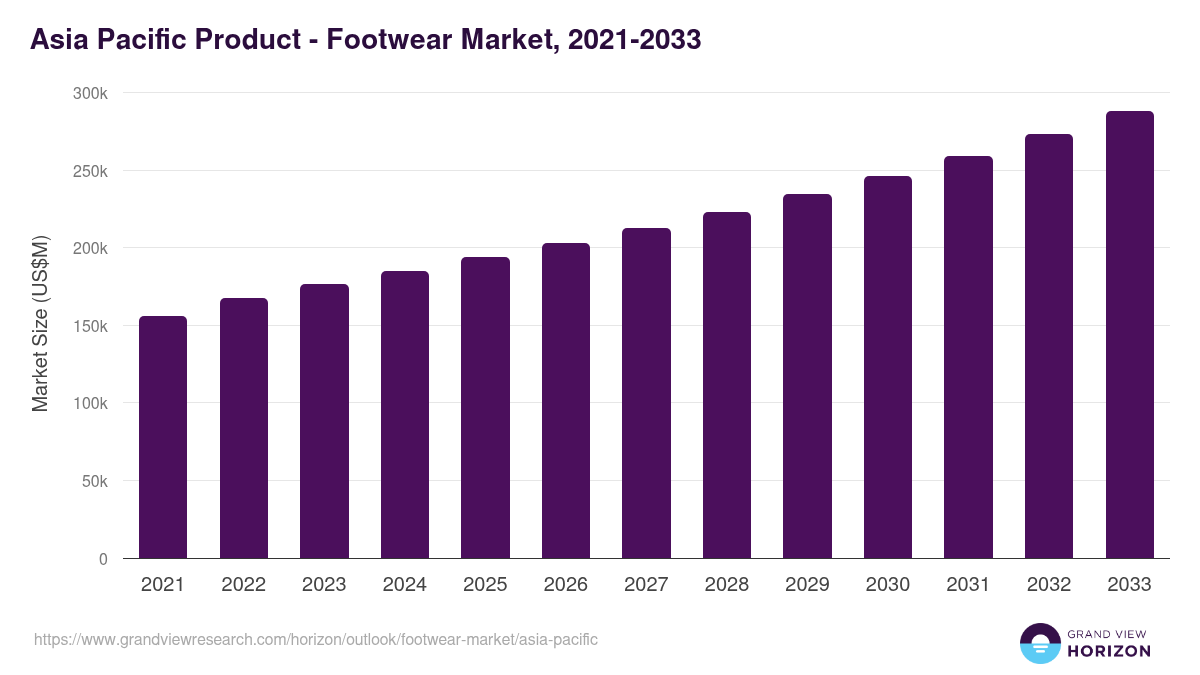
- The Asia Pacific footwear market generated a revenue of USD 194,079.5 million in 2025.
- The market is expected to grow at a CAGR of 5.1% from 2026 to 2033.
- In terms of segment, non-athletic was the largest revenue generating product in 2025.
- Athletic is the most lucrative product segment registering the fastest growth during the forecast period.
- Country-wise, India is expected to register the highest CAGR from 2026 to 2033.
Asia Pacific data book summary
| Market revenue in 2025 | USD 194,079.5 million |
| Market revenue in 2033 | USD 288,026.8 million |
| Growth rate | 5.1% (CAGR from 2026 to 2033) |
| Largest segment | Non-athletic |
| Fastest growing segment | Athletic |
| Historical data covered | 2021 - 2024 |
| Base year for estimation | 2025 |
| Forecast period covered | 2026 - 2033 |
| Quantitative units | Revenue in USD million |
| Market segmentation | Athletic, Non-Athletic |
| Key market players worldwide | Nike Inc Class B, Adidas AG, Puma SE, Geox SpA, Timberland Bancorp Inc, Skechers USA Inc Class A, Crocs Inc, Under Armour Inc Class A, Wolverine World Wide Inc |
Other key industry trends
- In terms of revenue, Asia Pacific region accounted for 40.7% of the global footwear market in 2025.
- Globally, Asia Pacific is projected to lead the regional market in terms of revenue in 2033.
- Asia Pacific is the fastest growing regional market and is projected to reach USD 288,026.8 million by 2033.
The footwear industry is labor-intensive and is affected by various factors such as land resources, labor costs, material supply, environmental protection, and sales markets. Consequently, in pursuit of profit maximization, major consumer markets, footwear manufacturers, wholesalers, and retailers worldwide are shifting their focus to lower-cost countries, leading to the constant movement of global shoemaking bases.
Japan, Taiwan, India, and China are lucrative markets for footwear in Asia Pacific. Rising disposable income and improved living standards of the consumers are key factors accelerating product demand in these countries.
The growth of this segment can be attributed to the increasing trend of casual wear in offices in countries such as Japan, Australia, and China. The growing emphasis on work-life balance by various government agencies and companies in the region is resulting in the increasing the adoption of athleisure footwear in the region.
No credit card required*
Publish Date: Mar 18, 2026
Horizon in a snapshot
- 30K+ Global Market Reports
- 120K+ Country Reports
- 1.2M+ Market Statistics
- 200K+ Company Profiles
- Industry insights and more
Three ways to get this data
Subscribe to the databook, customize it, or ask a question.Horizon Databook
Unlock every chart on this page and get dashboard access
- Statistics1.2M+ across all markets
- Databooks30K+ global, 120K+ country
- Companies200K+ profiles
- ExportPDF, Dashboard, XLS & PNG, licensed to cite
Customize it
Customize data as per your requirement
- AddCountries, segments, years
- RecutTo your product definition
- ExtendCompany-level detail
- OrA bespoke databook
- Turnaround5–10 working days
Ask Prism AI
A cited answer in seconds
- Corpus30,000 studies, 1.2M points
- ScopeAll markets, not just this
- CitationTraced to report & table
- HonestySays "not covered" if so
- SpeedSeconds, not days
Footwear Market
Footwear Market Companies
| Name | Profile | # Employees | HQ | Website |
|---|---|---|---|---|
| Under Armour Inc Class A | View profile | 14,800 | 1020 Hull Street, Baltimore, MD, United States, 21230 | www.underarmour.com |
| Nike Inc Class B | View profile | 83,700 | One Bowerman Drive, Beaverton, OR, United States, 97005-6453 | www.nike.com |
| Skechers USA Inc Class A | View profile | 17,900 | 228 Manhattan Beach Boulevard, Manhattan Beach, CA, United States, 90266 | www.skechers.com |
| Crocs Inc | View profile | 7,030 | 500 Eldorado Boulevard, Building 5, Broomfield, CO, United States, 80021 | www.crocs.com |
| Adidas AG | View profile | 59,030 | Adi-Dassler-Strasse 1, Herzogenaurach, BY, Germany, 91074 | www.adidas-group.com |
| Puma SE | View profile | 21,164 | Puma Way 1, Herzogenaurach, BY, Germany, 91074 | www.puma.com |
| Wolverine World Wide Inc | View profile | 4,100 | 9341 Courtland Drive North East, Rockford, MI, United States, 49351 | www.wolverineworldwide.com |
| Timberland Bancorp Inc | View profile | 298 | 624 Simpson Avenue, Hoquiam, WA, United States, 98550 | www.timberlandbank.com |
| Geox SpA | View profile | 2,581 | Via Feltrina Centro, 16, Biadene di Montebelluna, Treviso, Italy, 31044 | www.geox.biz |
Asia Pacific footwear market
The databook is designed to serve as a comprehensive guide to navigating this sector. The databook focuses on market statistics denoted in the form of revenue and y-o-y growth and CAGR across the globe and regions. A detailed competitive and opportunity analyses related to Footwear Market Outlook will help companies and investors design strategic landscapes.
Non-Athletic was the largest segment with a revenue share of 70.8% in 2025.
Horizon Databook has segmented the Asia Pacific footwear market based on athletic, non-athletic covering the revenue growth of each sub-segment from 2021 to 2033.
The footwear industry is labor-intensive and is affected by various factors such as land resources, labor costs, material supply, environmental protection, and sales markets. Consequently, in pursuit of profit maximization, major consumer markets, footwear manufacturers, wholesalers, and retailers worldwide are shifting their focus to lower-cost countries, leading to the constant movement of global shoemaking bases.
Japan, Taiwan, India, and China are lucrative markets for footwear in Asia Pacific. Rising disposable income and improved living standards of the consumers are key factors accelerating product demand in these countries.
The growth of this segment can be attributed to the increasing trend of casual wear in offices in countries such as Japan, Australia, and China. The growing emphasis on work-life balance by various government agencies and companies in the region is resulting in the increasing the adoption of athleisure footwear in the region.
- Asia Pacific Footwear Market Product Outlook (Revenue, USD Million , 2021-2033)
- Athletic
- Non-Athletic
- Asia Pacific Footwear Market End-user Outlook (Revenue, USD Million , 2021-2033)
- Men
- Women
- Children
Reasons to subscribe to footwear market databook
- Access to comprehensive data: Horizon Databook provides over 1 million market statistics and 20,000+ reports, offering extensive coverage across various industries and regions.
- Informed decision making: Subscribers gain insights into market trends, customer preferences, and competitor strategies, empowering informed business decisions.
- Cost-Effective solution: It's recognized as the world's most cost-effective market research database, offering high ROI through its vast repository of data and reports.
- Customizable reports: Tailored reports and analytics allow companies to drill down into specific markets, demographics, or product segments, adapting to unique business needs.
- Strategic advantage: By staying updated with the latest market intelligence, companies can stay ahead of competitors, anticipate industry shifts, and capitalize on emerging opportunities.
Target buyers of footwear market databook
- Our clientele includes a mix of footwear market companies, investment firms, advisory firms & academic institutions.
- 30% of our revenue is generated working with investment firms and helping them identify viable opportunity areas.
- Approximately 65% of our revenue is generated working with competitive intelligence & market intelligence teams of market participants (manufacturers, service providers, etc.).
- The rest of the revenue is generated working with academic and research not-for-profit institutes. We do our bit of pro-bono by working with these institutions at subsidized rates.
Horizon Databook provides a detailed overview of continent-level data and insights on the Asia Pacific footwear market, including forecasts for subscribers. This continent databook contains high-level insights into Asia Pacific footwear market from 2021 to 2033, including revenue numbers, major trends, and company profiles.
Asia Pacific Footwear Market, 2021-2033 (US$M)

Asia Pacific Product - Footwear Market Statistics, 2025 - 2033 (US$M)