- Home
- »
- Market Trend Reports
- »
-
U.S. Electronic Health Records Market Penetration, Volume, And Revenue Data
![U.S. Electronic Health Records Market Penetration, Volume, And Revenue Data, 2010 - 2030Report]()
U.S. Electronic Health Records Market Penetration, Volume, And Revenue Data, 2010 - 2030
- Published: Apr, 2025
- Report ID: GVR-MT-100304
- Format: PDF/Excel databook
- No. of Pages/Datapoints: 100
- Report Coverage: 2024 - 2030
Report Overview
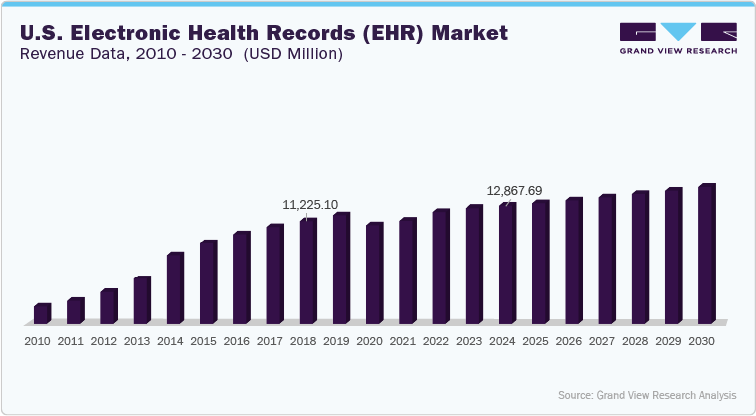
The U.S. electronic health records (EHR) market size was estimated at USD 12.86 billion in 2024 and is expected to grow at a CAGR of 2.55% from 2025 to 2030. This growth can be attributed to government initiatives to encourage healthcare IT usage, technologically advanced healthcare services, and rising demand for centralization and streamlining of healthcare data to improve overall patient outcomes and reduce healthcare costs.
U.S. Electronic Health Records Penetration Rates, by State & Overall U.S. 2023
States
Estimated Penetration Rate %
States
Estimated Penetration Rate %
Alabama
87%
Montana
91%
Alaska
96%
Nebraska
97%
Arizona
94%
Nevada
100%
Arkansas
88%
New Hampshire
90%
California
New Jersey
Colorado
New Mexico
Connecticut
New York
Delaware
North Carolina
District of Columbia
North Dakota
Florida
Ohio
Georgia
Oklahoma
Hawaii
Oregon
Idaho
Pennsylvania
Illinois
Rhode Island
Indiana
South Carolina
Iowa
South Dakota
Kansas
Tennessee
Kentucky
Texas
Louisiana
Utah
Maine
Vermont
Maryland
Virginia
Massachusetts
Washington
Michigan
West Virginia
Minnesota
Wisconsin
Mississippi
Wyoming
Missouri
U.S.
Source: Grand View Research Analysis
U.S. Electronic Health Records (EHR): Cloud-based and On-premise Segment Shares, 2010-2030 (%)

U.S. Electronic Health Records (EHR): Hospitals and Clinics Segment Share, 2010 - 2030 (%)
U.S. Electronic Health Records Cloud-based/On-premise × Hospitals Matrix 2010 to 2030 (USD Million)
Hospital
2010
2011
2012
2013
2014
2015
2016
2017
2018
2019
2020
Cloud-based
On-premise
Total
Source: Grand View Research Analysis
Hospital
2021
2022
2023
2024
2025
2026
2027
2028
2029
2030
CAGR (2025-2030)
Cloud-based
9,527.23
2.90%
On-premise
Total
Source: Grand View Research Analysis
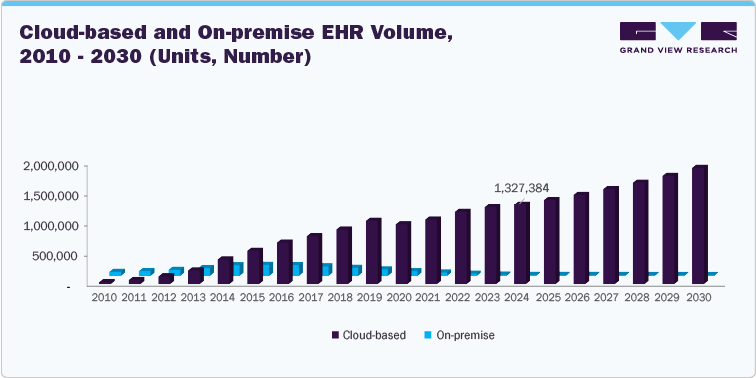
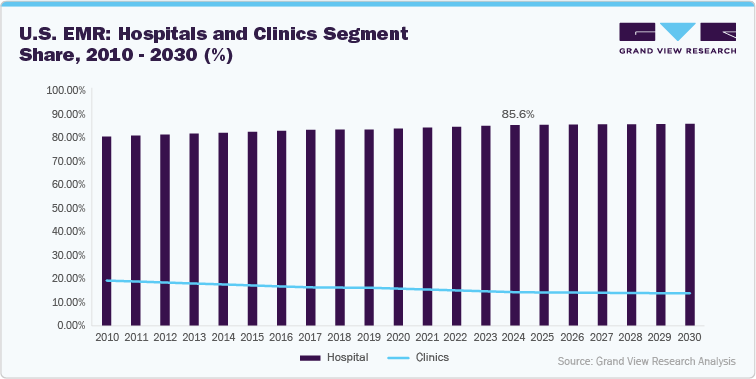
The adoption of cloud-based electronic health records (EHR) in hospitals gained momentum due to the Affordable Care Act (ACA) and the Health Information Technology for Economic and Clinical Health (HITECH) Act, which encouraged EHR implementation in the early 2010s. The adoption of electronic health records (EHR) among non-federal acute care hospitals has reached nearly universal levels, with 96% of hospitals utilizing certified EHR technology by 2015. Basic EHR functionalities, such as access to imaging views, were available in over 80% of hospitals—a significant increase from just 22% in 2008, largely due to the HITECH Act.
U.S. Electronic Health Records Cloud-based/On-premise × Clinics Matrix 2010 to 2030 (USD Million)
Clinics
2010
2011
2012
2013
2014
2015
2016
2017
2018
2019
2020
Cloud-based
On-premise
Total
Source: Grand View Research Analysis
Clinics
2021
2022
2023
2024
2025
2026
2027
2028
2029
2030
CAGR (2025-2030)
Cloud-based
1,647.26
2.20%
On-premise
Total
Source: Grand View Research Analysis
Smaller clinics are increasingly adopting cloud-based Electronic Health Records (EHRs) instead of traditional on-premises systems, driven by the need for cost efficiency and scalability. Cloud EHRs minimize the requirement for extensive IT infrastructure, enabling clinics to prioritize patient care without the financial strain of maintaining physical servers. Moreover, the demand for patient engagement tools and mobile access to records that emerged after 2020 has further accelerated the adoption of cloud EHRs in this segment. For instance, in November 2023, eClinicalWorks, the leading cloud EHR for ambulatory care, announced that Ampla Health, a 134-provider FQHC in Yuba City, CA, uses eClinicalWorks V12 to enhance operational workflows. This cloud-based EHR boosts efficiency, enriches physician experience, and empowers patient engagement with advanced, value-added features.
Pricing & Purchase Options
Service Guarantee
-
Insured Buying
This report has a service guarantee. We stand by our report quality.
-
Confidentiality
We are in compliance with GDPR & CCPA norms. All interactions are confidential.
-
Custom research service
Design an exclusive study to serve your research needs.
-
24/5 Research support
Get your queries resolved from an industry expert.


We are committed towards customer satisfaction, and quality service.
Client Testimonials

"The quality of research they have done for us has been excellent..."
ISO Certified