U.S. 3D Cell Culture Market Size & Outlook, 2026-2033
- Biotechnology
- Cell Culture & Stem Cell
- 3D Cell Culture Market Outlook
- Cell Culture & Stem Cell
Global Market
Related Markets
Ask a question about the 3d cell culture market
U.S. 3d cell culture market highlights
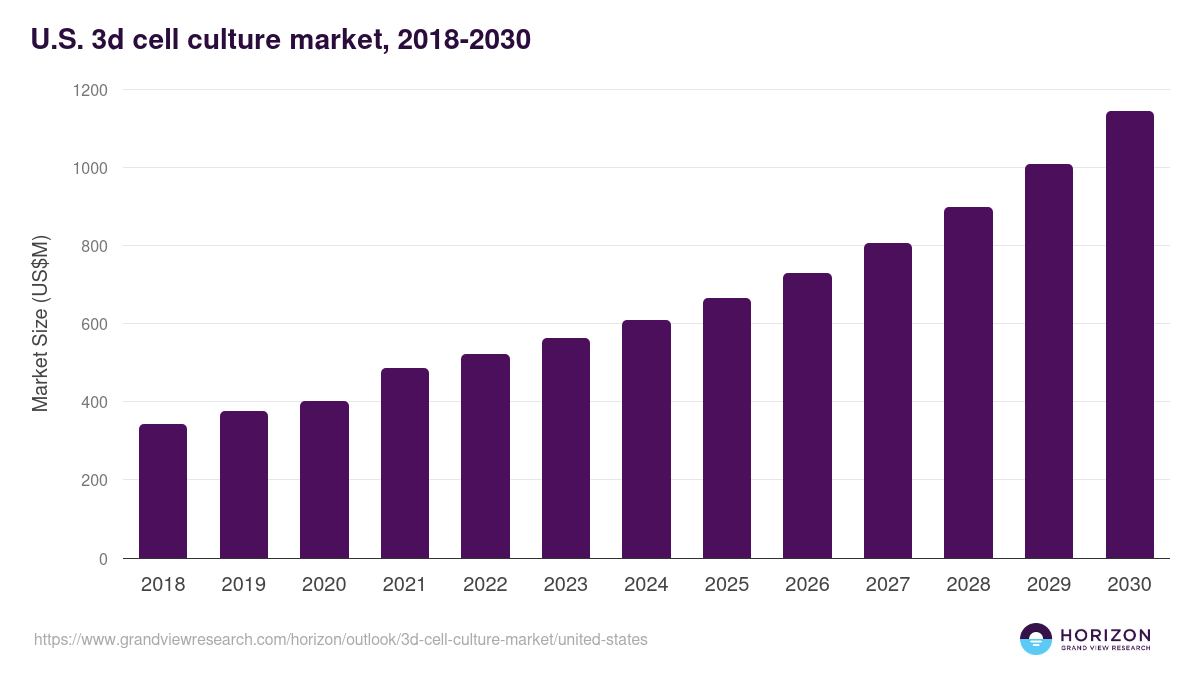
- The U.S. 3d cell culture market generated a revenue of USD 448.8 million in 2025 and is expected to reach USD 809.6 million by 2033.
- The U.S. market is expected to grow at a CAGR of 7.8% from 2026 to 2033.
- In terms of segment, scaffold based was the largest revenue generating technology in 2025.
- Scaffold Free is the most lucrative technology segment registering the fastest growth during the forecast period.
3d cell culture market data book summary
| Market revenue in 2025 | USD 448.8 million |
| Market revenue in 2033 | USD 809.6 million |
| Growth rate | 7.8% (CAGR from 2026 to 2033) |
| Largest segment | Scaffold based |
| Fastest growing segment | Scaffold Free |
| Historical data | 2021 - 2024 |
| Base year | 2025 |
| Forecast period | 2026 - 2033 |
| Quantitative units | Revenue in USD million |
| Market segmentation | Scaffold Based, Scaffold Free, Bioreactors, Microfluidics, Bioprinting |
| Key market players worldwide | Thermo Fisher Scientific Inc, Merck KGaA, PROMOCELL, Lonza Group Ltd, Corning Inc, Avantor Inc, Tecan Group AG, ReproCELL, CN Bio |
Other key industry trends
- In terms of revenue, U.S. accounted for 35.6% of the global 3d cell culture market in 2025.
- Country-wise, U.S. is expected to lead the global market in terms of revenue in 2033.
- In North America, U.S. 3d cell culture market is projected to lead the regional market in terms of revenue in 2033.
- Canada is the fastest growing regional market in North America and is projected to reach USD 53.3 million by 2033.
The U.S. held the largest share in 2015 due to high prevalence of chronic diseases in this region. Chronic diseases account for majority of the healthcare expenditure incurred in this country. As a result, the huge chronic disease burden drives the demand for 3D cell culture techniques owing to its wide applicability. Moreover, availability of government funds and investments by private organizations is further expected to drive this vertical.
The “2020: A New Vision” initiative by the U.S. Department of Health and Human Services recognizes regenerative medicine at the forefront of healthcare. The transformative impact of using regenerative medicine clinically is of utmost importance in technological innovation and progress in translation. Successful treatment of lymphoma, myeloma, or leukemia, and remarkable advances in transplantation have propelled adoption of regenerative approaches in clinical practices.
Hematopoietic stem cell transplants have been proven to be effective treatment options for metabolic storage diseases, immunodeficiency, and extracellular matrix disorders along with hematological malignancies. Thus, rapid technological advances in the country are expected to influence market growth. Moreover, companies such as Nano3D Biosciences and Thermo Fisher Scientific, Inc., which are engaged in providing 3D cell culture products are expected to witness significant growth owing to increasing adoption of 3D cellular models.
No credit card required*
Publish Date: Jan 19, 2026
Customize the Report
20% free customization
- Include
- Countries, segments, points
- Tailor
- To your product definition
- Extend
- Deeper competitor detail
- Or
- A fully bespoke study
Horizon in a snapshot
- 30K+ Global Market Reports
- 120K+ Country Reports
- 1.2M+ Market Statistics
- 200K+ Company Profiles
- Industry insights and more
3D Cell Culture Market Scope
3D Cell Culture Market Companies
| Name | Profile | # Employees | HQ | Website |
|---|---|---|---|---|
| Merck KGaA | View profile | 62,345 | Frankfurter Strasse 250, Darmstadt, HE, Germany, 64293 | www.emdgroup.com |
| Lonza Group Ltd | View profile | 18,000 | Muenchensteinerstrasse 38, Basel, Switzerland, CH-4002 | www.lonza.com |
| Thermo Fisher Scientific Inc | View profile | 122,000 | 168 Third Avenue, Waltham, MA, United States, 02451 | www.thermofisher.com |
| Avantor Inc | View profile | 14,500 | 100 Matsonford Road, Suite 200, Building One, Radnor Corporate Center, Radnor, PA, United States, 19087 | www.avantorsciences.com |
| Corning Inc | View profile | 49,800 | One Riverfront Plaza, Corning, NY, United States, 14831 | www.corning.com |
| Tecan Group AG | View profile | 3,591 | Seestrasse 103, Mannedorf, Switzerland, 8708 | www.tecan.com |
| PROMOCELL | View profile | 101-250 | Sharjah, Sharjah, United Arab Emirates, Asia | www.promo-cell.com/ |
| ReproCELL | View profile | 51-100 | Yokohama, Kanagawa, Japan, Asia | reprocell.com |
| CN Bio | View profile | 101-250 | Welwyn Garden City, Hertford, United Kingdom, Europe | www.cn-bio.com |
U.S. 3D Cell Culture Market Outlook
The databook is designed to serve as a comprehensive guide to navigating this sector. The databook focuses on market statistics denoted in the form of revenue and y-o-y growth and CAGR across the globe and regions. A detailed competitive and opportunity analyses related to 3D Cell Culture Market Outlook will help companies and investors design strategic landscapes.
Scaffold Based was the largest segment with a revenue share of 52.34% in 2025.
Horizon Databook has segmented the U.S. 3d cell culture market based on scaffold based, scaffold free, bioreactors, microfluidics, bioprinting covering the revenue growth of each sub-segment from 2021 to 2033.
The U.S. held the largest share in 2015 due to high prevalence of chronic diseases in this region. Chronic diseases account for majority of the healthcare expenditure incurred in this country. As a result, the huge chronic disease burden drives the demand for 3D cell culture techniques owing to its wide applicability. Moreover, availability of government funds and investments by private organizations is further expected to drive this vertical.
The “2020: A New Vision” initiative by the U.S. Department of Health and Human Services recognizes regenerative medicine at the forefront of healthcare. The transformative impact of using regenerative medicine clinically is of utmost importance in technological innovation and progress in translation. Successful treatment of lymphoma, myeloma, or leukemia, and remarkable advances in transplantation have propelled adoption of regenerative approaches in clinical practices.
Hematopoietic stem cell transplants have been proven to be effective treatment options for metabolic storage diseases, immunodeficiency, and extracellular matrix disorders along with hematological malignancies. Thus, rapid technological advances in the country are expected to influence market growth. Moreover, companies such as Nano3D Biosciences and Thermo Fisher Scientific, Inc., which are engaged in providing 3D cell culture products are expected to witness significant growth owing to increasing adoption of 3D cellular models.
- U.S. 3D Cell Culture Market Technology Outlook (Revenue, USD Million , 2021-2033)
- Scaffold Based
- Scaffold Free
- Bioreactors
- Microfluidics
- Bioprinting
- U.S. 3D Cell Culture Market Application Outlook (Revenue, USD Million , 2021-2033)
- Cancer Research
- Stem Cell Research & Tissue Engineering
- Drug Development & Toxicity Testing
- Others Application
- U.S. 3D Cell Culture Market End Use Outlook (Revenue, USD Million , 2021-2033)
- Biotechnology & Pharmaceutical Companies
- Academic & Research Institutes
- Hospitals
- Others End Use
Reasons to subscribe to 3D Cell Culture Market Outlook databook
- Access to comprehensive data: Horizon Databook provides over 1 million market statistics and 20,000+ reports, offering extensive coverage across various industries and regions.
- Informed decision making: Subscribers gain insights into market trends, customer preferences, and competitor strategies, empowering informed business decisions.
- Cost-Effective solution: It's recognized as the world's most cost-effective market research database, offering high ROI through its vast repository of data and reports.
- Customizable reports: Tailored reports and analytics allow companies to drill down into specific markets, demographics, or product segments, adapting to unique business needs.
- Strategic advantage: By staying updated with the latest market intelligence, companies can stay ahead of competitors, anticipate industry shifts, and capitalize on emerging opportunities.
Target buyers of 3D Cell Culture Market Outlook databook
- Our clientele includes a mix of 3D Cell Culture Market Outlook companies, investment firms, advisory firms & academic institutions.
- 30% of our revenue is generated working with investment firms and helping them identify viable opportunity areas.
- Approximately 65% of our revenue is generated working with competitive intelligence & market intelligence teams of market participants (manufacturers, service providers, etc.).
- The rest of the revenue is generated working with academic and research not-for-profit institutes. We do our bit of pro-bono by working with these institutions at subsidized rates.
Horizon Databook provides a detailed overview of country-level data and insights on the U.S. 3D Cell Culture Market Outlook, including forecasts for subscribers. This country databook contains high-level insights into U.S. 3D Cell Culture Market Outlook from 2021 to 2033, including revenue numbers, major trends, and company profiles.
U.S. 3D Cell Culture Market, 2021-2033 (US$M)

U.S. 3d cell culture market statistics, by technology, 2021-2033 (US$M)