U.S. Anti-Acne Cosmetics Market Size & Outlook, 2025-2030
- MedTech
- Aesthetic Devices
- Anti-acne Cosmetics Market Outlook
- Aesthetic Devices
Global Market
Related Markets
Ask a question about the anti-acne cosmetics market
U.S. anti-acne cosmetics market highlights
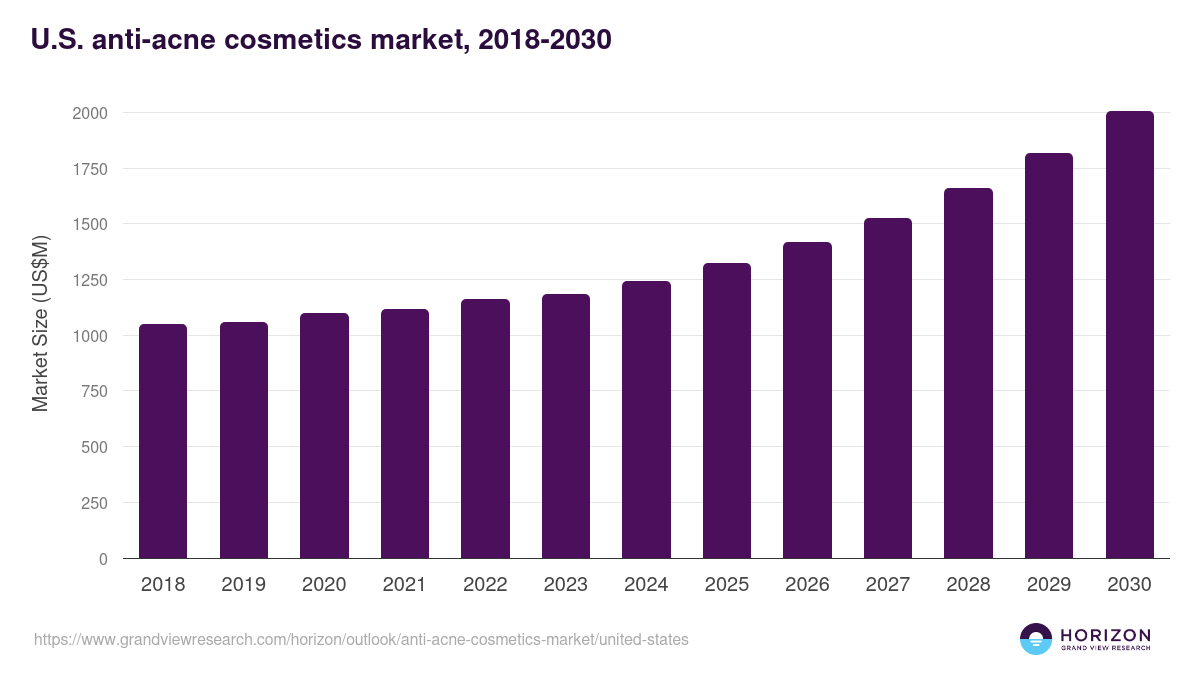
- The U.S. anti-acne cosmetics market generated a revenue of USD 1,242.2 million in 2024 and is expected to reach USD 2,005.5 million by 2030.
- The U.S. market is expected to grow at a CAGR of 8.7% from 2025 to 2030.
- In terms of segment, creams and lotions was the largest revenue generating treatment in 2024.
- Laser and Light Therapies is the most lucrative treatment segment registering the fastest growth during the forecast period.
Anti-acne cosmetics market data book summary
| Market revenue in 2024 | USD 1,242.2 million |
| Market revenue in 2030 | USD 2,005.5 million |
| Growth rate | 8.7% (CAGR from 2025 to 2030) |
| Largest segment | Creams and lotions |
| Fastest growing segment | Laser and Light Therapies |
| Historical data | 2018 - 2023 |
| Base year | 2024 |
| Forecast period | 2025 - 2030 |
| Quantitative units | Revenue in USD million |
| Market segmentation | Creams and Lotions, Cleanser & Toners, Mask, Laser and Light Therapies, Chemical Peel |
| Key market players worldwide | PCA Skin, Obagi Medical Products, Phytomer USA, AbbVie Inc, Skinbetter science, Colorescience, Sente, Revision Skincare, The Beauty Health Co Ordinary Shares - Class A, Glowbiotics, Perricone MD |
Other key industry trends
- In terms of revenue, U.S. accounted for 21.0% of the global anti-acne cosmetics market in 2024.
- Country-wise, U.S. is expected to lead the global market in terms of revenue in 2030.
- In North America, U.S. anti-acne cosmetics market is projected to lead the regional market in terms of revenue in 2030.
- U.S. is the fastest growing regional market in North America and is projected to reach USD 2,005.5 million by 2030.
According to American Academy of Dermatology, in 2013, around 5.1 million people sought medical treatment for acne, primarily children and young adults. In 2016, the U.S. FDA approved the first OTC topical retinoid in the U.S., which allows patients to buy an effective non-antimicrobial product to treat their condition.
Therapies such as oral isotretinoin, oral antibiotics, and combination therapy were most frequently prescribed by dermatologists. The aforementioned factors are expected to propel the growth of anti-acne cosmetics market in the country. However, factors such as expensive treatment and minimal insurance coverage are expected to restrict market growth.
According to GoodRx, a 2018 study found that cost or insurance restrictions were main factors preventing patients from filling their acne medication prescriptions, as medical insurers will only pay for treatment if medically necessary. Even if an individual qualifies for Medicare, they are still responsible for 20% of the cost.
No credit card required*
Publish Date: Aug 18, 2025
Customize the Report
20% free customization
- Include
- Countries, segments, points
- Tailor
- To your product definition
- Extend
- Deeper competitor detail
- Or
- A fully bespoke study
Horizon in a snapshot
- 30K+ Global Market Reports
- 120K+ Country Reports
- 1.2M+ Market Statistics
- 200K+ Company Profiles
- Industry insights and more
Anti-Acne Cosmetics Market Scope
Anti-Acne Cosmetics Market Companies
| Name | Profile | # Employees | HQ | Website |
|---|---|---|---|---|
| AbbVie Inc | View profile | 50,000 | 1 North Waukegan Road, North Chicago, IL, United States, 60064-6400 | www.abbvieinvestor.com |
| The Beauty Health Co Ordinary Shares - Class A | View profile | 881 | 2165 Spring Street, Long Beach, CA, United States, 90806 | www.beautyhealth.com |
| Glowbiotics | View profile | 11-50 | Phoenix, Arizona, United States, North America | www.glowbiotics.com |
| PCA Skin | View profile | 51-100 | Scottsdale, Arizona, United States, North America | www.pcaskin.com |
| Phytomer USA | View profile | 11-50 | Salt Lake City, Utah, United States, North America | phytomerusa.com |
| Sente | View profile | 11-50 | Encinitas, California, United States, North America | sentelabs.com |
| Revision Skincare | View profile | 51-100 | Irving, Texas, United States, North America | www.revisionskincare.com/ |
| Perricone MD | View profile | 51-100 | San Francisco, California, United States, North America | www.perriconemd.com/ |
| Obagi Medical Products | View profile | 251-500 | Long Beach, California, United States, North America | obagi.com/ |
| Skinbetter science | View profile | 101-250 | Phoenix, Arizona, United States, North America | skinbetter.com/ |
U.S. Anti-acne Cosmetics Market Outlook
The databook is designed to serve as a comprehensive guide to navigating this sector. The databook focuses on market statistics denoted in the form of revenue and y-o-y growth and CAGR across the globe and regions. A detailed competitive and opportunity analyses related to Anti-acne Cosmetics Market Outlook will help companies and investors design strategic landscapes.
Creams And Lotions was the largest segment with a revenue share of 39.8% in 2024.
Horizon Databook has segmented the U.S. anti-acne cosmetics market based on creams and lotions, cleanser & toners, mask, laser and light therapies, chemical peel covering the revenue growth of each sub-segment from 2018 to 2030.
According to American Academy of Dermatology, in 2013, around 5.1 million people sought medical treatment for acne, primarily children and young adults. In 2016, the U.S. FDA approved the first OTC topical retinoid in the U.S., which allows patients to buy an effective non-antimicrobial product to treat their condition.
Therapies such as oral isotretinoin, oral antibiotics, and combination therapy were most frequently prescribed by dermatologists. The aforementioned factors are expected to propel the growth of anti-acne cosmetics market in the country. However, factors such as expensive treatment and minimal insurance coverage are expected to restrict market growth.
According to GoodRx, a 2018 study found that cost or insurance restrictions were main factors preventing patients from filling their acne medication prescriptions, as medical insurers will only pay for treatment if medically necessary. Even if an individual qualifies for Medicare, they are still responsible for 20% of the cost.
- U.S. Anti-Acne Cosmetics Market Treatment Outlook (Revenue, USD Million , 2018-2030)
- Creams and Lotions
- Cleanser & Toners
- Mask
- Laser and Light Therapies
- Chemical Peel
- Others
- U.S. Anti-Acne Cosmetics Market Gender Outlook (Revenue, USD Million , 2018-2030)
- Female
- Male
- U.S. Anti-Acne Cosmetics Market Distribution Channel Outlook (Revenue, USD Million , 2018-2030)
- Over the Counter (OTC)
- Prescription
- Professional
Reasons to subscribe to Anti-acne Cosmetics Market Outlook databook
- Access to comprehensive data: Horizon Databook provides over 1 million market statistics and 20,000+ reports, offering extensive coverage across various industries and regions.
- Informed decision making: Subscribers gain insights into market trends, customer preferences, and competitor strategies, empowering informed business decisions.
- Cost-Effective solution: It's recognized as the world's most cost-effective market research database, offering high ROI through its vast repository of data and reports.
- Customizable reports: Tailored reports and analytics allow companies to drill down into specific markets, demographics, or product segments, adapting to unique business needs.
- Strategic advantage: By staying updated with the latest market intelligence, companies can stay ahead of competitors, anticipate industry shifts, and capitalize on emerging opportunities.
Target buyers of Anti-acne Cosmetics Market Outlook databook
- Our clientele includes a mix of Anti-acne Cosmetics Market Outlook companies, investment firms, advisory firms & academic institutions.
- 30% of our revenue is generated working with investment firms and helping them identify viable opportunity areas.
- Approximately 65% of our revenue is generated working with competitive intelligence & market intelligence teams of market participants (manufacturers, service providers, etc.).
- The rest of the revenue is generated working with academic and research not-for-profit institutes. We do our bit of pro-bono by working with these institutions at subsidized rates.
Horizon Databook provides a detailed overview of country-level data and insights on the U.S. Anti-acne Cosmetics Market Outlook, including forecasts for subscribers. This country databook contains high-level insights into U.S. Anti-acne Cosmetics Market Outlook from 2018 to 2030, including revenue numbers, major trends, and company profiles.
U.S. Anti-Acne Cosmetics Market, 2018-2030 (US$M)

U.S. anti-acne cosmetics market statistics, by treatment, 2018-2030 (US$M)