South Africa Building Thermal Insulation Market Size & Outlook
- Materials
- Construction Materials
- Building Thermal Insulation Market Outlook
- Construction Materials
Global Market
Related Markets
Ask Prism AI about the building thermal insulation market
Get cited answers from GVR research on market growth, segments, regulations and forecasts.
- Source-linked answers
- Market-specific context
- Traceable figures
South Africa building thermal insulation market highlights
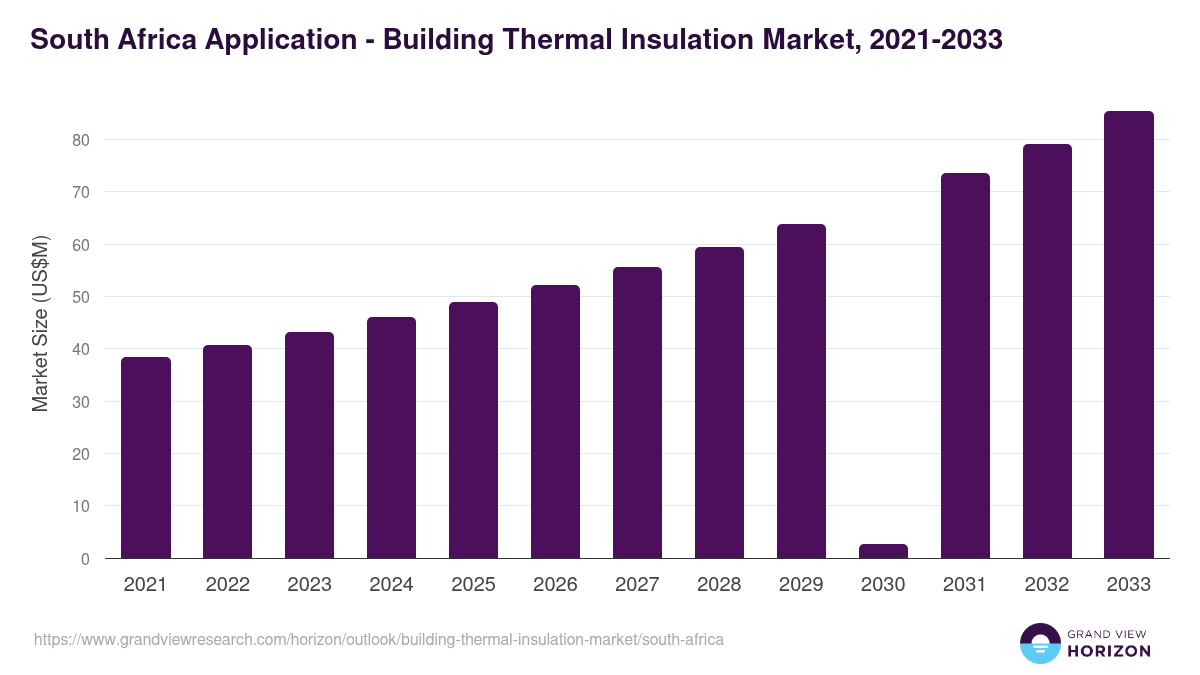
- The South Africa building thermal insulation market generated a revenue of USD 48.9 million in 2025 and is expected to reach USD 85.4 million by 2033.
- The South Africa market is expected to grow at a CAGR of 7.3% from 2026 to 2033.
- In terms of segment, glass wool was the largest revenue generating product in 2025.
- EPS is the most lucrative product segment registering the fastest growth during the forecast period.
Building thermal insulation market data book summary
| Market revenue in 2025 | USD 48.9 million |
| Market revenue in 2033 | USD 85.4 million |
| Growth rate | 7.3% (CAGR from 2026 to 2033) |
| Largest segment | Glass wool |
| Fastest growing segment | EPS |
| Historical data | 2021 - 2024 |
| Base year | 2025 |
| Forecast period | 2026 - 2033 |
| Quantitative units | Revenue in USD million |
| Market segmentation | Mineral Wool, XPS, Glass Wool, EPS, PIR, Cellulose, PUR |
| Key market players worldwide | Rockwool AS Class B, GAF, Guardian Capital Group Ltd, Huntsman Corp, Johns Manville, Atlas Roofing, CertainTeed Corporation, Dow Building Solutions, Owens-Corning Inc, Compagnie de Saint-Gobain SA, Kingspan Group PLC, Cellofoam, Rockwool, Byucksan, BASF |
Other key industry trends
- In terms of revenue, South Africa accounted for 0.2% of the global building thermal insulation market in 2025.
- Country-wise, U.S. is expected to lead the global market in terms of revenue in 2033.
- In Middle East & Africa, Saudi Arabia building thermal insulation market is projected to lead the regional market in terms of revenue in 2033.
- Saudi Arabia is the fastest growing regional market in Middle East & Africa and is projected to reach USD 470.7 million by 2033.
Although, the construction industry is South Africa experienced sluggish growth over the historic period, due to slow economic growth, policy uncertainty, and underperforming South African currency; the industry is expected to witness recovery owing to the increasing urbanization, government investment in affordable housing, renewable-energy projects, and transport and logistics infrastructure.
The growth in construction sector in South Africa is expected to have positive effect on demand for building thermal insulation over the forecast period. In February, 2018, Cyril Ramaphosa was appointed as the President of South Africa, after a disastrous tenture of previous president Jacob Zuma, in which he faced multiple corruption charges, the economy of the country suffered and inequality and employment soared.
Change in leadership in South Africa and the goodwill surrounding the current president is expected to boost the investor confidence, thereby driving the number of foreign investments in the country. Increasing investment rate is expected to stabilize the economy, which is anticipated to lead to modest recovery in construction sector in South Africa, thereby driving the demand for building thermal insulation in the country.
No credit card required*
Publish Date: May 25, 2026
Customize the Report
20% free customization
- Include
- Countries, segments, points
- Tailor
- To your product definition
- Extend
- Deeper competitor detail
- Or
- A fully bespoke study
- Turnaround
- 5–10 working days
Horizon in a snapshot
- 30K+ Global Market Reports
- 120K+ Country Reports
- 1.2M+ Market Statistics
- 200K+ Company Profiles
- Industry insights and more
Building Thermal Insulation Market Scope
Building Thermal Insulation Market Companies
| Name | Profile | # Employees | HQ | Website |
|---|---|---|---|---|
| Huntsman Corp | View profile | 6,000 | 10003 Woodloch Forest Drive, The Woodlands, TX, United States, 77380 | www.huntsman.com |
| Compagnie de Saint-Gobain SA | View profile | 168,508 | 12, Place de l'Iris, Tour Saint-Gobain, Courbevoie, France, 92400 | www.saint-gobain.com |
| Kingspan Group PLC | View profile | 22,384 | Dublin Road, Kingscourt, County Cavan, Ireland, A82 XY31 | www.kingspan.com |
| Guardian Capital Group Ltd | View profile | 359 | Commerce Court West, Suite 3100, P.O. Box 201, Toronto, ON, Canada, M5L 1E8 | www.guardiancapital.com |
| Johns Manville | View profile | 5001-10000 | Denver, Colorado, United States, North America | www.jm.com/ |
| Owens-Corning Inc | View profile | 18,000 | One Owens Corning Parkway, Toledo, OH, United States, 43659 | www.owenscorning.com |
| Rockwool AS Class B | View profile | 12,017 | Hovedgaden 584, Hedehusene, Denmark, 2640 | www.rockwool.com |
| GAF | View profile | 5001-10000 | Wayne, New Jersey, United States, North America | www.gaf.com/ |
| Atlas Roofing | View profile | 1001-5000 | Atlanta, Georgia, United States, North America | www.atlasroofing.com |
| CertainTeed Corporation | View profile | 5001-10000 | Signal Mountain, Tennessee, United States, North America | www.certainteed.com/ |
South Africa Building Thermal Insulation Market Outlook
The databook is designed to serve as a comprehensive guide to navigating this sector. The databook focuses on market statistics denoted in the form of revenue and y-o-y growth and CAGR across the globe and regions. A detailed competitive and opportunity analyses related to Building Thermal Insulation Market Outlook will help companies and investors design strategic landscapes.
Glass Wool was the largest segment with a revenue share of 36.61% in 2025.
Horizon Databook has segmented the South Africa building thermal insulation market based on mineral wool, xps, glass wool, eps, pir, cellulose, pur covering the revenue growth of each sub-segment from 2021 to 2033.
Although, the construction industry is South Africa experienced sluggish growth over the historic period, due to slow economic growth, policy uncertainty, and underperforming South African currency; the industry is expected to witness recovery owing to the increasing urbanization, government investment in affordable housing, renewable-energy projects, and transport and logistics infrastructure.
The growth in construction sector in South Africa is expected to have positive effect on demand for building thermal insulation over the forecast period. In February, 2018, Cyril Ramaphosa was appointed as the President of South Africa, after a disastrous tenture of previous president Jacob Zuma, in which he faced multiple corruption charges, the economy of the country suffered and inequality and employment soared.
Change in leadership in South Africa and the goodwill surrounding the current president is expected to boost the investor confidence, thereby driving the number of foreign investments in the country. Increasing investment rate is expected to stabilize the economy, which is anticipated to lead to modest recovery in construction sector in South Africa, thereby driving the demand for building thermal insulation in the country.
- South Africa Building Thermal Insulation Market Product Outlook (Revenue, USD Million , 2021-2033)
- Glass Wool
- Mineral Wool
- EPS
- XPS
- Cellulose
- PIR
- PUR
- Others
- South Africa Building Thermal Insulation Market Application Outlook (Revenue, USD Million , 2021-2033)
- Roof
- Walls
- Floor
- South Africa Building Thermal Insulation Market End-use Outlook (Revenue, USD Million , 2021-2033)
- Residential
- Commercial
Reasons to subscribe to Building Thermal Insulation Market Outlook databook
- Access to comprehensive data: Horizon Databook provides over 1 million market statistics and 20,000+ reports, offering extensive coverage across various industries and regions.
- Informed decision making: Subscribers gain insights into market trends, customer preferences, and competitor strategies, empowering informed business decisions.
- Cost-Effective solution: It's recognized as the world's most cost-effective market research database, offering high ROI through its vast repository of data and reports.
- Customizable reports: Tailored reports and analytics allow companies to drill down into specific markets, demographics, or product segments, adapting to unique business needs.
- Strategic advantage: By staying updated with the latest market intelligence, companies can stay ahead of competitors, anticipate industry shifts, and capitalize on emerging opportunities.
Target buyers of Building Thermal Insulation Market Outlook databook
- Our clientele includes a mix of Building Thermal Insulation Market Outlook companies, investment firms, advisory firms & academic institutions.
- 30% of our revenue is generated working with investment firms and helping them identify viable opportunity areas.
- Approximately 65% of our revenue is generated working with competitive intelligence & market intelligence teams of market participants (manufacturers, service providers, etc.).
- The rest of the revenue is generated working with academic and research not-for-profit institutes. We do our bit of pro-bono by working with these institutions at subsidized rates.
Horizon Databook provides a detailed overview of country-level data and insights on the South Africa Building Thermal Insulation Market Outlook, including forecasts for subscribers. This country databook contains high-level insights into South Africa Building Thermal Insulation Market Outlook from 2021 to 2033, including revenue numbers, major trends, and company profiles.
South Africa Building Thermal Insulation Market, 2021-2033 (US$M)

South Africa Product - Building Thermal Insulation Market Statistics, 2025 - 2033 (Kilo Tons)