U.S. Cannabidiol Market Size & Outlook, 2024-2030
- Cannabis
- Cannabidiol & Cannabinoids
- Cannabidiol Market Outlook
- Cannabidiol & Cannabinoids
Global Market
Related Markets
Ask Prism AI anything about the cannabidiol market
Get a cited answer from GVR research in seconds: segment shares, growth drivers, regulation and forecast assumptions.
U.S. cannabidiol market highlights
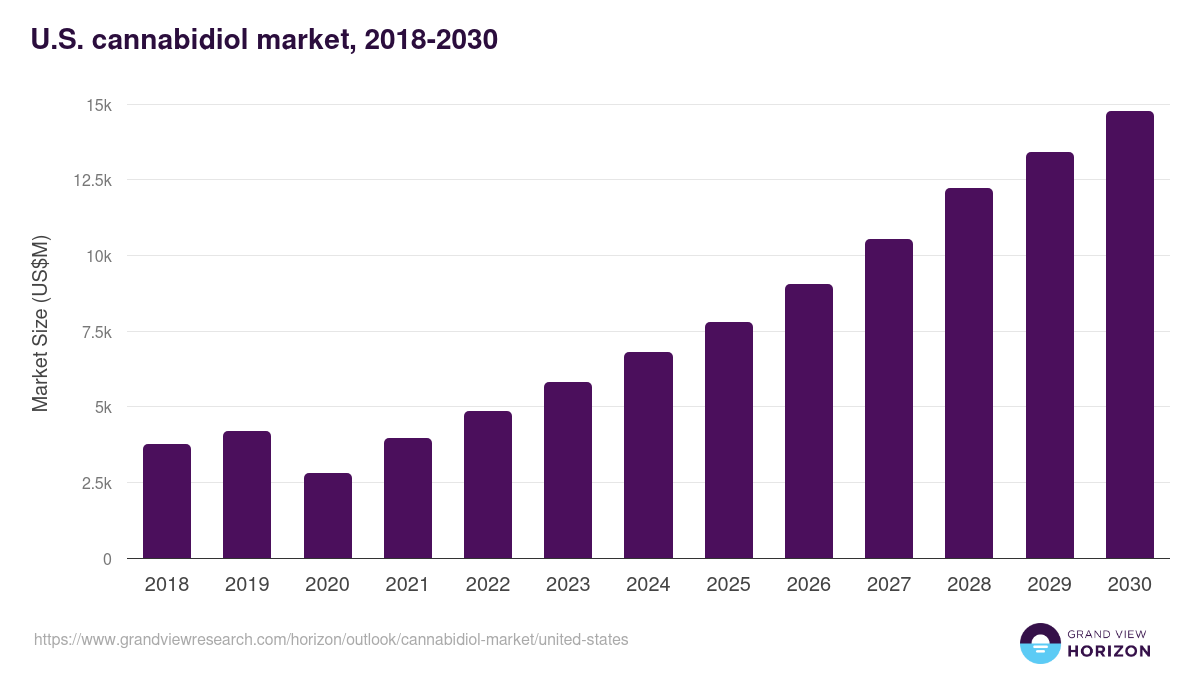
- The U.S. cannabidiol market generated a revenue of USD 6,807.9 million in 2024 and is expected to reach USD 14,762.7 million by 2030.
- The U.S. market is expected to grow at a CAGR of 13.8% from 2025 to 2030.
- In terms of segment, hemp was the largest revenue generating product in 2024.
- Hemp is the most lucrative product segment registering the fastest growth during the forecast period.
Cannabidiol market data book summary
| Market revenue in 2024 | USD 6,807.9 million |
| Market revenue in 2030 | USD 14,762.7 million |
| Growth rate | 13.8% (CAGR from 2025 to 2030) |
| Largest segment | Hemp |
| Fastest growing segment | Hemp |
| Historical data | 2018 - 2023 |
| Base year | 2024 |
| Forecast period | 2025 - 2030 |
| Quantitative units | Revenue in USD million |
| Market segmentation | Hemp, Marijuana |
| Key market players worldwide | Medical Marijuana Inc, Canopy Growth Corp, Elixinol Wellness Ltd Ordinary Shares, The Cronos Group, Isodiol International Inc, Endoca, Folium Biosciences, NuLeaf Naturals, PharmaHemp |
Other key industry trends
- In terms of revenue, U.S. accounted for 74.5% of the global cannabidiol market in 2024.
- Country-wise, U.S. is expected to lead the global market in terms of revenue in 2030.
- In North America, U.S. cannabidiol market is projected to lead the regional market in terms of revenue in 2030.
- Canada is the fastest growing regional market in North America and is projected to reach USD 2,806.4 million by 2030.
CBD derived from hemp is legalized at the federal level in the U.S. The 2018 Farm Bill legalized the production of hemp-derived CBD under certain regulations. The 2014 Farm Bill allowed pilot programs to be carried out for research purposes. Amendments to the bill defined hemp as a derivative of the cannabis plant with THC content equal to or less than 0.3%.
In addition, the bill allows the transport of hemp-derived products across the states without any restrictions for personal or commercial purposes. However, cannabinoids derived from hemp will be considered legal only when their production follows federal and state regulations. The federal government has not legalized cannabis-derived CBD in the 2018 Farm Bill. However, the farm bill is ineffective at the state level.
In total, as of 2022, 37 states have legalized cannabis for medical use, and 19 states, including California, Alaska, Maine, Massachusetts, Colorado, Vermont, Michigan, Nevada, Oregon, Washington D.C.,, have legalized cannabis for recreational purposes. Other states that continue to restrict the use of all types of cannabis, including hemp & marijuana, and cannabis-derived CBD products are South Dakota, Idaho, and Nebraska.
No credit card required*
Customize the Report
20% free customization
- Include
- Countries, segments, points
- Tailor
- To your product definition
- Extend
- Deeper competitor detail
- Or
- A fully bespoke study
- Turnaround
- 5–10 working days
Horizon in a snapshot
- 30K+ Global Market Reports
- 120K+ Country Reports
- 1.2M+ Market Statistics
- 200K+ Company Profiles
- Industry insights and more
Cannabidiol Market Scope
Cannabidiol Market Companies
| Name | Profile | # Employees | HQ | Website |
|---|---|---|---|---|
| Canopy Growth Corp | View profile | 1,621 | 1 Hershey Drive, Smiths Falls, ON, Canada, K7A 0A8 | www.canopygrowth.com |
| The Cronos Group | View profile | 1001-5000 | Kontich, Antwerpen, Belgium, Europe | cronos-groep.be/ |
| Medical Marijuana Inc | View profile | 85 | 2384 La Mirada Drive, Vista, CA, United States, 92081 | www.medicalmarijuanainc.com |
| Elixinol Wellness Ltd Ordinary Shares | View profile | - | 680 George Street, Level 12, Sydney, NSW, Australia, 2000 | www.elixinolwellness.com |
| Isodiol International Inc | View profile | 197 | 200 Granville Street, Suite 2710, Vancouver, BC, Canada, V6C 1S4 | www.isodiol.com |
| Endoca | View profile | 1-10 | Hoofddorp, Noord-Holland, The Netherlands, Europe | www.endoca.com/pl |
| Folium Biosciences | View profile | 101-250 | Colorado Springs, Colorado, United States, North America | foliumbiosciences.com/ |
| NuLeaf Naturals | View profile | 51-100 | Denver, Colorado, United States, North America | nuleafnaturals.com/ |
| PharmaHemp | View profile | 51-100 | Ljubljana, Ljubljana Urban Commune, Slovenia, Europe | b2b.pharma-hemp.com |
U.S. Cannabidiol Market Outlook
The databook is designed to serve as a comprehensive guide to navigating this sector. The databook focuses on market statistics denoted in the form of revenue and y-o-y growth and CAGR across the globe and regions. A detailed competitive and opportunity analyses related to Cannabidiol Market Outlook will help companies and investors design strategic landscapes.
Hemp was the largest segment with a revenue share of 54.64% in 2024.
Horizon Databook has segmented the U.S. cannabidiol market based on hemp, marijuana covering the revenue growth of each sub-segment from 2018 to 2030.
CBD derived from hemp is legalized at the federal level in the U.S. The 2018 Farm Bill legalized the production of hemp-derived CBD under certain regulations. The 2014 Farm Bill allowed pilot programs to be carried out for research purposes. Amendments to the bill defined hemp as a derivative of the cannabis plant with THC content equal to or less than 0.3%.
In addition, the bill allows the transport of hemp-derived products across the states without any restrictions for personal or commercial purposes. However, cannabinoids derived from hemp will be considered legal only when their production follows federal and state regulations. The federal government has not legalized cannabis-derived CBD in the 2018 Farm Bill. However, the farm bill is ineffective at the state level.
In total, as of 2022, 37 states have legalized cannabis for medical use, and 19 states, including California, Alaska, Maine, Massachusetts, Colorado, Vermont, Michigan, Nevada, Oregon, Washington D.C.,, have legalized cannabis for recreational purposes. Other states that continue to restrict the use of all types of cannabis, including hemp & marijuana, and cannabis-derived CBD products are South Dakota, Idaho, and Nebraska.
- U.S. Cannabidiol Market Product Outlook (Revenue, USD Million , 2018-2030)
- Hemp
- Marijuana
- U.S. Cannabidiol Market Sale Type Outlook (Revenue, USD Million , 2018-2030)
- B2B
- B2C
Reasons to subscribe to Cannabidiol Market Outlook databook
- Access to comprehensive data: Horizon Databook provides over 1 million market statistics and 20,000+ reports, offering extensive coverage across various industries and regions.
- Informed decision making: Subscribers gain insights into market trends, customer preferences, and competitor strategies, empowering informed business decisions.
- Cost-Effective solution: It's recognized as the world's most cost-effective market research database, offering high ROI through its vast repository of data and reports.
- Customizable reports: Tailored reports and analytics allow companies to drill down into specific markets, demographics, or product segments, adapting to unique business needs.
- Strategic advantage: By staying updated with the latest market intelligence, companies can stay ahead of competitors, anticipate industry shifts, and capitalize on emerging opportunities.
Target buyers of Cannabidiol Market Outlook databook
- Our clientele includes a mix of Cannabidiol Market Outlook companies, investment firms, advisory firms & academic institutions.
- 30% of our revenue is generated working with investment firms and helping them identify viable opportunity areas.
- Approximately 65% of our revenue is generated working with competitive intelligence & market intelligence teams of market participants (manufacturers, service providers, etc.).
- The rest of the revenue is generated working with academic and research not-for-profit institutes. We do our bit of pro-bono by working with these institutions at subsidized rates.
Horizon Databook provides a detailed overview of country-level data and insights on the U.S. Cannabidiol Market Outlook, including forecasts for subscribers. This country databook contains high-level insights into U.S. Cannabidiol Market Outlook from 2018 to 2030, including revenue numbers, major trends, and company profiles.
U.S. Cannabidiol Market, 2018-2030 (US$M)

U.S. cannabidiol market statistics, by product, 2018-2030 (US$M)