U.S. Castor Oil & Derivatives Market Size & Outlook
Global Market
Related Markets
U.S. castor oil & derivatives market highlights
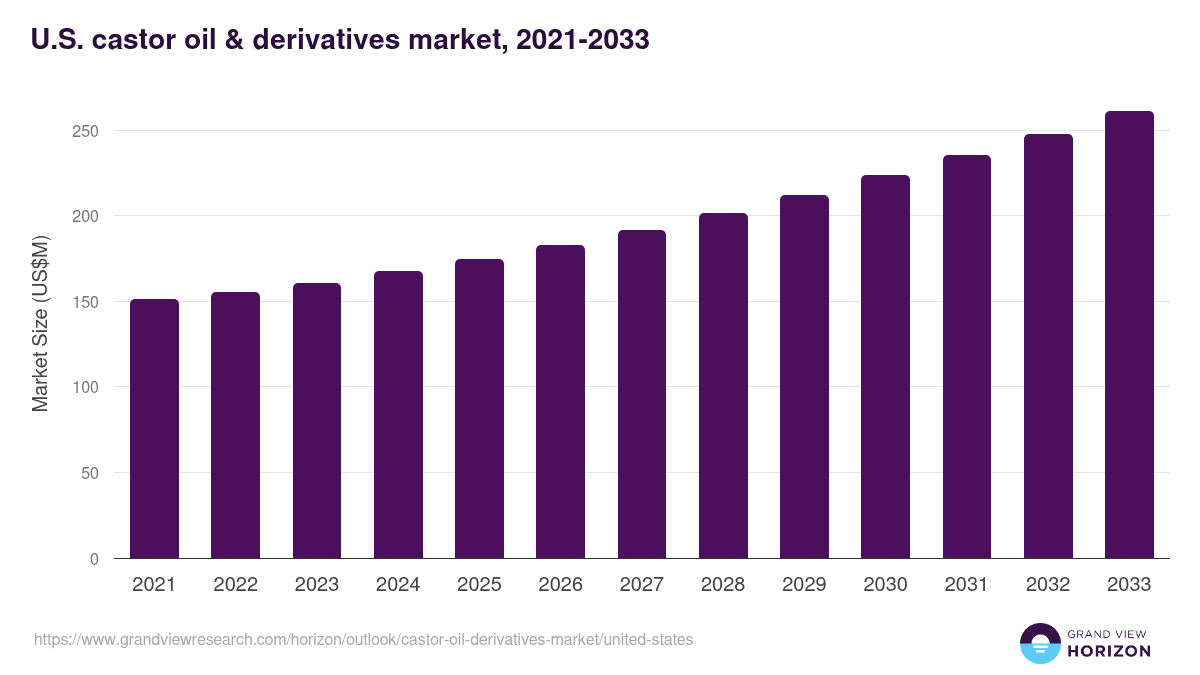
- The U.S. castor oil & derivatives market generated a revenue of USD 175.0 million in 2025 and is expected to reach USD 261.1 million by 2033.
- The U.S. market is expected to grow at a CAGR of 5.2% from 2026 to 2033.
- In terms of segment, hydrogenated castor oil was the largest revenue generating product in 2025.
- Ricinoleic Acid is the most lucrative product segment registering the fastest growth during the forecast period.
Castor oil & derivatives market data book summary
| Market revenue in 2025 | USD 175.0 million |
| Market revenue in 2033 | USD 261.1 million |
| Growth rate | 5.2% (CAGR from 2026 to 2033) |
| Largest segment | Hydrogenated castor oil |
| Fastest growing segment | Ricinoleic Acid |
| Historical data | 2021 - 2024 |
| Base year | 2025 |
| Forecast period | 2026 - 2033 |
| Quantitative units | Revenue in USD million |
| Market segmentation | Ricinoleic Acid, Hydrogenated Castor Oil, Undecylenic Acid, Sebacic acid, 12HSA, Dehydrated Castor Oil |
| Key market players worldwide | Thai Oil PCL ADR, Adani Wilmar, Hokuriku Electric Power Co Inc, ITOCHU Corp, Jayant Agro-Organics, RPK Group, Taj Agro, N K Proteins, Castor, Liaoning Shengde Huaxing Chemical Co., Gokul Agro Resources, Vertellus, Yuki Gosei Kogyo |
Other key industry trends
- In terms of revenue, U.S. accounted for 12.0% of the global castor oil & derivatives market in 2025.
- Country-wise, China is expected to lead the global market in terms of revenue in 2033.
- In North America, U.S. castor oil & derivatives market is projected to lead the regional market in terms of revenue in 2033.
- Mexico is the fastest growing regional market in North America and is projected to reach USD 18.4 million by 2033.
The U.S., on an average, imports 76 kilo metric tons of castor oil mainly from India, which is used for the production of fatty acids, paints, sulfonated oils, varnishes, soaps, lubricants, and cosmetics products. The country imports castor oil from India, Mexico, and Brazil for its domestic needs.
Castor seeds are grown on a small-scale in the U.S., majorly in the regions having loamy soil of medium texture. It is best adapted to the Missouri, southern Indiana, southeastern Kansas, southern Illinois, Kentucky, Tennessee, and parts of Texas and Oklahoma with irrigation.
In the U.S., castor oil has been used by the military in the manufacturing of explosives, hydraulic fluids, and aircraft lubricants. Textile industries use sulfonated castor oil for dyeing leather and fabrics. It has been also used for the production of nylon, enamels, paints, printer ink, and electrical insulators.
No credit card required*
Horizon in a snapshot
- 30K+ Global Market Reports
- 120K+ Country Reports
- 1.2M+ Market Statistics
- 200K+ Company Profiles
- Industry insights and more
Three ways to get this data
Subscribe to the databook, customize it, or ask a question.Horizon Databook
Unlock every chart on this page and get dashboard access
- Statistics1.2M+ across all markets
- Databooks30K+ global, 120K+ country
- Companies200K+ profiles
- ExportPDF, Dashboard, XLS & PNG, licensed to cite
Customize it
Customize data as per your requirement
- AddCountries, segments, years
- RecutTo your product definition
- ExtendCompany-level detail
- OrA bespoke databook
- Turnaround5–10 working days
Ask Prism AI
A cited answer in seconds
- Corpus30,000 studies, 1.2M points
- ScopeAll markets, not just this
- CitationTraced to report & table
- HonestySays "not covered" if so
- SpeedSeconds, not days
Castor Oil & Derivatives Market Scope
Castor Oil Derivatives Market Companies
| Name | Profile | # Employees | HQ | Website |
|---|---|---|---|---|
| ITOCHU Corp | View profile | 155,403 | 5-1, Kita Aoyama 2-chome, Minato-ku, Tokyo, Japan, 107-8077 | www.itochu.co.jp |
| Adani Wilmar | View profile | 1001-5000 | Ahmedabad, Gujarat, India, Asia | www.adaniwilmar.com/ |
| Thai Oil PCL ADR | View profile | - | 11th Floor, Vibhavadi Rangsit Road, 555/1 Energy Complex Building A, Kwang Chatuchak, Khet Chatuchak, Bangkok, Thailand, 10900 | www.thaioilgroup.com |
| Hokuriku Electric Power Co Inc | View profile | 9,623 | 15-1 Ushijima-cho, Toyama, Japan, 930-8686 | www.rikuden.co.jp |
| Jayant Agro-Organics | View profile | 251-500 | Mumbai, Maharashtra, India, Asia | www.jayantagro.com/ |
| RPK Group | View profile | 11-50 | Annapolis, Maryland, United States, North America | rpkgroup.com/ |
| Taj Agro | View profile | 501-1000 | Mumbai, Maharashtra, India, Asia | tajagro.com |
| N K Proteins | View profile | 501-1000 | Ahmedabad, Gujarat, India, Asia | www.nkproteins.com |
| Castor | View profile | 101-250 | Amsterdam, Noord-Holland, The Netherlands, Europe | www.castoredc.com |
| Liaoning Shengde Huaxing Chemical Co. | View profile | 11-50 | Dengta, Liaoning, China, Asia | www.huaxingchemical.com |
U.S. Castor Oil & Derivatives Market Outlook
The databook is designed to serve as a comprehensive guide to navigating this sector. The databook focuses on market statistics denoted in the form of revenue and y-o-y growth and CAGR across the globe and regions. A detailed competitive and opportunity analyses related to Castor Oil & Derivatives Market Outlook will help companies and investors design strategic landscapes.
Hydrogenated Castor Oil was the largest segment with a revenue share of 30.97% in 2025.
Horizon Databook has segmented the U.S. castor oil & derivatives market based on ricinoleic acid, hydrogenated castor oil, undecylenic acid, sebacic acid, 12hsa, dehydrated castor oil covering the revenue growth of each sub-segment from 2021 to 2033.
The U.S., on an average, imports 76 kilo metric tons of castor oil mainly from India, which is used for the production of fatty acids, paints, sulfonated oils, varnishes, soaps, lubricants, and cosmetics products. The country imports castor oil from India, Mexico, and Brazil for its domestic needs.
Castor seeds are grown on a small-scale in the U.S., majorly in the regions having loamy soil of medium texture. It is best adapted to the Missouri, southern Indiana, southeastern Kansas, southern Illinois, Kentucky, Tennessee, and parts of Texas and Oklahoma with irrigation.
In the U.S., castor oil has been used by the military in the manufacturing of explosives, hydraulic fluids, and aircraft lubricants. Textile industries use sulfonated castor oil for dyeing leather and fabrics. It has been also used for the production of nylon, enamels, paints, printer ink, and electrical insulators.
- U.S. Castor Oil & Derivatives Market Product Type Outlook (Revenue, USD Million , 2021-2033)
- Sebacic acid
- 12HSA
- Ricinoleic Acid
- Hydrogenated Castor Oil
- Undecylenic Acid
- Dehydrated Castor Oil
- Others
- U.S. Castor Oil & Derivatives Market Application Outlook (Revenue, USD Million , 2021-2033)
- Lubricants
- Surface Coatings
- Biodiesel
- Cosmetics and Pharmaceuticals
- Plastics and Resins
- Others
Reasons to subscribe to Castor Oil & Derivatives Market Outlook databook
- Access to comprehensive data: Horizon Databook provides over 1 million market statistics and 20,000+ reports, offering extensive coverage across various industries and regions.
- Informed decision making: Subscribers gain insights into market trends, customer preferences, and competitor strategies, empowering informed business decisions.
- Cost-Effective solution: It's recognized as the world's most cost-effective market research database, offering high ROI through its vast repository of data and reports.
- Customizable reports: Tailored reports and analytics allow companies to drill down into specific markets, demographics, or product segments, adapting to unique business needs.
- Strategic advantage: By staying updated with the latest market intelligence, companies can stay ahead of competitors, anticipate industry shifts, and capitalize on emerging opportunities.
Target buyers of Castor Oil & Derivatives Market Outlook databook
- Our clientele includes a mix of Castor Oil & Derivatives Market Outlook companies, investment firms, advisory firms & academic institutions.
- 30% of our revenue is generated working with investment firms and helping them identify viable opportunity areas.
- Approximately 65% of our revenue is generated working with competitive intelligence & market intelligence teams of market participants (manufacturers, service providers, etc.).
- The rest of the revenue is generated working with academic and research not-for-profit institutes. We do our bit of pro-bono by working with these institutions at subsidized rates.
Horizon Databook provides a detailed overview of country-level data and insights on the U.S. Castor Oil & Derivatives Market Outlook, including forecasts for subscribers. This country databook contains high-level insights into U.S. Castor Oil & Derivatives Market Outlook from 2021 to 2033, including revenue numbers, major trends, and company profiles.
U.S. Castor Oil Derivatives Market, 2021-2033 (US$M)

U.S. castor oil & derivatives market statistics, by product, 2021-2033 (US$M)