Brazil Textile Recycling Market Size & Outlook, 2026-2033
Global Report
Related Markets
Brazil textile recycling market highlights
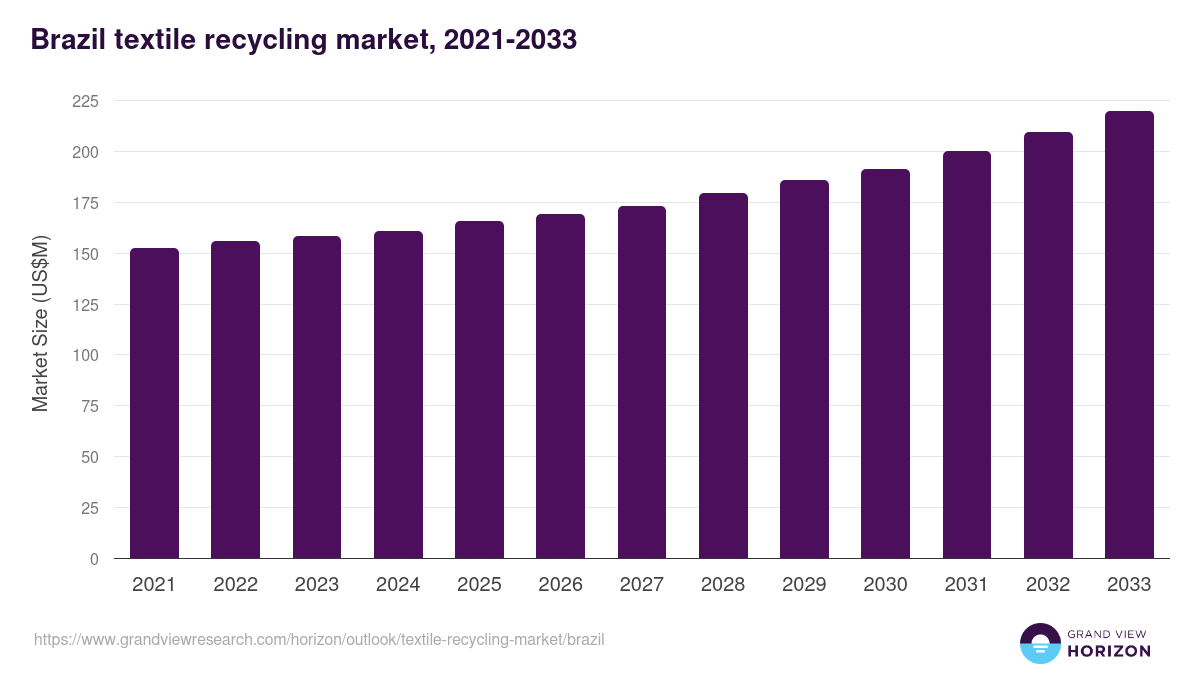
- The Brazil textile recycling market generated a revenue of USD 165.7 million in 2025 and is expected to reach USD 219.9 million by 2033.
- The Brazil market is expected to grow at a CAGR of 3.8% from 2026 to 2033.
- In terms of segment, cotton was the largest revenue generating material in 2025.
- Polyester is the most lucrative material segment registering the fastest growth during the forecast period.
Textile recycling market data book summary
| Market revenue in 2025 | USD 165.7 million |
| Market revenue in 2033 | USD 219.9 million |
| Growth rate | 3.8% (CAGR from 2026 to 2033) |
| Largest segment | Cotton |
| Fastest growing segment | Polyester |
| Historical data | 2021 - 2024 |
| Base year | 2025 |
| Forecast period | 2026 - 2033 |
| Quantitative units | Revenue in USD million |
| Market segmentation | Cotton, Polyester, Wool, Polyamide, Other |
| Key market players worldwide | Worn Again Technologies, Lenzing AG, Birla Cellulose, The Woolmark Company, EcoTex, Boer Group, Unifi Inc, Textile Recycling International Limited, Hyosung Corporation, Martex Fiber, re:newcell, BLS EduTech |
Other key industry trends
- In terms of revenue, Brazil accounted for 3.3% of the textile recycling market in 2025.
- Country-wise, U.S. is expected to lead the global market in terms of revenue in 2033.
- In Latin America, Brazil textile recycling market is projected to lead the regional market in terms of revenue in 2033.
- Argentina is the fastest growing regional market in Latin America and is projected to reach USD 150.4 million by 2033.
According to the Brazilian Textile and Apparel Industry Association, the country is the only one to have a complete textile supply chain in the Americas, having all stages of the industry operations ranging from fiber production units to textile mills carrying out all activities from apparel manufacturing to retail selling. According to a Brazilian autonomous social institution, Sebrae or Serviço Brasileiro de Apoio às Micro e Pequenas Empresas, approximately 170 thousand tons of textile waste is generated every year in the country with Sao Paul being the major contributor to this waste in Brazil.
As most of the waste in the country is managed through landfills, the textile recycling rate is low in Brazil. However, awareness related to the benefits of textile recycling is increasing among consumers, manufacturers, and retailers in the country. This is anticipated to drive the demand for textile recycling facilities in Brazil in the coming years. For instance, in June 2022, Malwee Group carried out a social awareness campaign in Sao Paulo and distributed approximately 1,500 sweatshirts made from recycled clothes.
No credit card required*
Publish Date: Jun 23, 2025
Horizon in a snapshot
- 30K+ Global Market Reports
- 120K+ Country Reports
- 1.2M+ Market Statistics
- 200K+ Company Profiles
- Industry insights and more
Three ways to get this data
Subscribe to the databook, customize it, or ask a question.Horizon Databook
Unlock every chart on this page and get dashboard access
- Statistics1.2M+ across all markets
- Databooks30K+ global, 120K+ country
- Companies200K+ profiles
- ExportPDF, Dashboard, XLS & PNG, licensed to cite
Customize it
Customize data as per your requirement
- AddCountries, segments, years
- RecutTo your product definition
- ExtendCompany-level detail
- OrA bespoke databook
- Turnaround5–10 working days
Ask Prism AI
A cited answer in seconds
- Corpus30,000 studies, 1.2M points
- ScopeAll markets, not just this
- CitationTraced to report & table
- HonestySays "not covered" if so
- SpeedSeconds, not days
Textile Recycling Market Scope
Textile Recycling Market Companies
| Name | Profile | # Employees | HQ | Website |
|---|---|---|---|---|
| Lenzing AG | View profile | 7,798 | Werkstrasse 2, Lenzing, Austria, 4860 | www.lenzing.com |
| Unifi Inc | View profile | 2,800 | 7201 West Friendly Avenue, Greensboro, NC, United States, 27410 | www.unifi.com |
| Hyosung Corporation | View profile | 10001+ | Seoul, Seoul-t'ukpyolsi, South Korea, Asia | www.hyosung.com |
| Worn Again Technologies | View profile | 11-50 | Nottingham, Nottingham, United Kingdom, Europe | www.wornagain.co.uk/ |
| Birla Cellulose | View profile | 10001+ | Mumbai, Maharashtra, India, Asia | birlacellulose.com/ |
| The Woolmark Company | View profile | 101-250 | Sydney, New South Wales, Australia, Oceania | www.woolmark.com/ |
| EcoTex | View profile | 51-100 | Constantí, Catalonia, Spain, Europe | www.ecotex.biz |
| Boer Group | View profile | 101-250 | Dordrecht, Zuid-Holland, The Netherlands, Europe | www.boergroup.eu/?lang=en |
| Textile Recycling International Limited | View profile | 501-1000 | Bilston, Wolverhampton, United Kingdom, Europe | textilerecyclinginternational.co.uk/ |
| Martex Fiber | View profile | 501-1000 | Charlotte, North Carolina, United States, North America | www.martexfiber.com/ |
Brazil Textile Recycling Market Outlook
The databook is designed to serve as a comprehensive guide to navigating this sector. The databook focuses on market statistics denoted in the form of revenue and y-o-y growth and CAGR across the globe and regions. A detailed competitive and opportunity analyses related to Textile Recycling Market Outlook will help companies and investors design strategic landscapes.
Cotton was the largest segment with a revenue share of 69.64% in 2025.
Horizon Databook has segmented the Brazil textile recycling market based on cotton, polyester, wool, polyamide, other covering the revenue growth of each sub-segment from 2021 to 2033.
According to the Brazilian Textile and Apparel Industry Association, the country is the only one to have a complete textile supply chain in the Americas, having all stages of the industry operations ranging from fiber production units to textile mills carrying out all activities from apparel manufacturing to retail selling. According to a Brazilian autonomous social institution, Sebrae or Serviço Brasileiro de Apoio às Micro e Pequenas Empresas, approximately 170 thousand tons of textile waste is generated every year in the country with Sao Paul being the major contributor to this waste in Brazil.
As most of the waste in the country is managed through landfills, the textile recycling rate is low in Brazil. However, awareness related to the benefits of textile recycling is increasing among consumers, manufacturers, and retailers in the country. This is anticipated to drive the demand for textile recycling facilities in Brazil in the coming years. For instance, in June 2022, Malwee Group carried out a social awareness campaign in Sao Paulo and distributed approximately 1,500 sweatshirts made from recycled clothes.
- Brazil Textile Recycling Market Material Outlook (Revenue, USD Million , 2021-2033)
- Cotton
- Polyester
- Wool
- Polyamide
- Other
- Brazil Textile Recycling Market Source Outlook (Revenue, USD Million , 2021-2033)
- Apparel Waste
- Home Furnishing Waste
- Automotive Waste
- Other
- Brazil Textile Recycling Market Process Outlook (Revenue, USD Million , 2021-2033)
- Mechanical
- Chemical
Reasons to subscribe to Textile Recycling Market Outlook databook
- Access to comprehensive data: Horizon Databook provides over 1 million market statistics and 20,000+ reports, offering extensive coverage across various industries and regions.
- Informed decision making: Subscribers gain insights into market trends, customer preferences, and competitor strategies, empowering informed business decisions.
- Cost-Effective solution: It's recognized as the world's most cost-effective market research database, offering high ROI through its vast repository of data and reports.
- Customizable reports: Tailored reports and analytics allow companies to drill down into specific markets, demographics, or product segments, adapting to unique business needs.
- Strategic advantage: By staying updated with the latest market intelligence, companies can stay ahead of competitors, anticipate industry shifts, and capitalize on emerging opportunities.
Target buyers of Textile Recycling Market Outlook databook
- Our clientele includes a mix of Textile Recycling Market Outlook companies, investment firms, advisory firms & academic institutions.
- 30% of our revenue is generated working with investment firms and helping them identify viable opportunity areas.
- Approximately 65% of our revenue is generated working with competitive intelligence & market intelligence teams of market participants (manufacturers, service providers, etc.).
- The rest of the revenue is generated working with academic and research not-for-profit institutes. We do our bit of pro-bono by working with these institutions at subsidized rates.
Horizon Databook provides a detailed overview of country-level data and insights on the Brazil Textile Recycling Market Outlook, including forecasts for subscribers. This country databook contains high-level insights into Brazil Textile Recycling Market Outlook from 2021 to 2033, including revenue numbers, major trends, and company profiles.
Brazil Textile Recycling Market, 2021-2033 (US$M)

Brazil textile recycling market statistics, by material, 2021-2033 (US$M)