Middle East & Africa Biofertilizers Market Size & Outlook
- Bulk Chemicals
- Petrochemicals
- Biofertilizers Market Outlook
- Petrochemicals
Global Report
Related Markets
Ask Prism AI anything about the biofertilizers market
Get a cited answer from GVR research in seconds: segment shares, growth drivers, regulation and forecast assumptions.
MEA biofertilizers market highlights
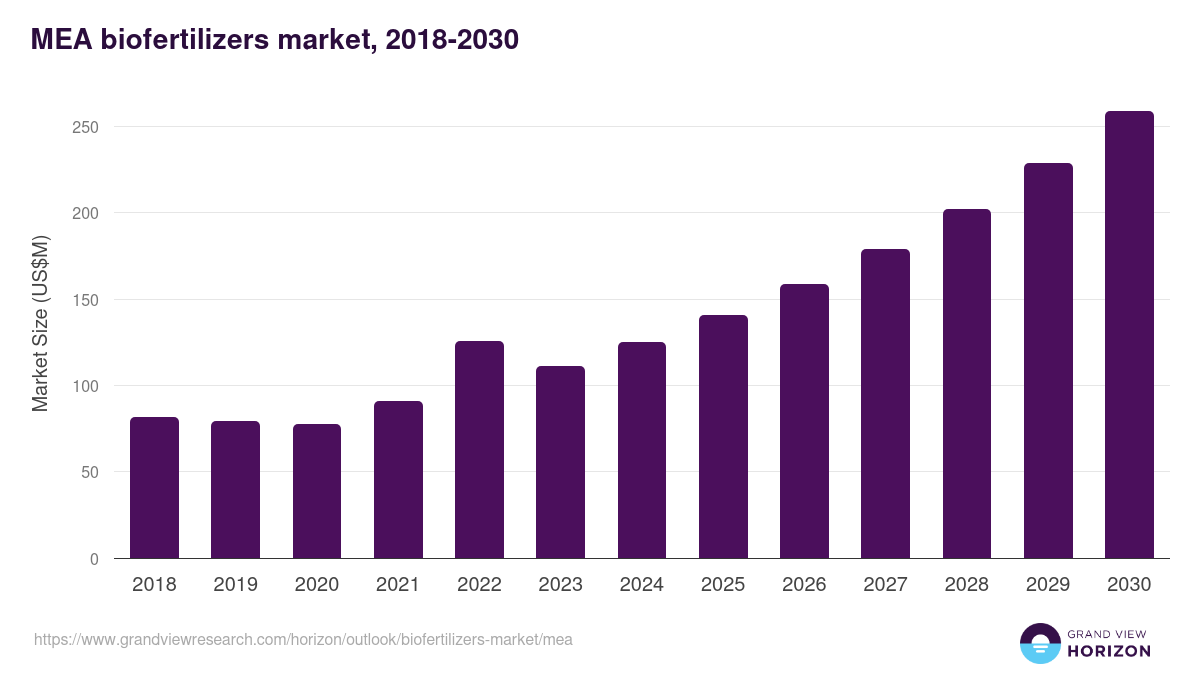
- The MEA biofertilizers market generated a revenue of USD 125.2 million in 2024.
- The market is expected to grow at a CAGR of 12.9% from 2025 to 2030.
- In terms of segment, nitrogen fixation was the largest revenue generating product in 2024.
- Phosphate Solubilizing is the most lucrative product segment registering the fastest growth during the forecast period.
MEA data book summary
| Market revenue in 2024 | USD 125.2 million |
| Market revenue in 2030 | USD 258.9 million |
| Growth rate | 12.9% (CAGR from 2025 to 2030) |
| Largest segment | Nitrogen fixation |
| Fastest growing segment | Phosphate Solubilizing |
| Historical data covered | 2018 - 2023 |
| Base year for estimation | 2024 |
| Forecast period covered | 2025 - 2030 |
| Quantitative units | Revenue in USD million |
| Market segmentation | Nitrogen Fixation, Phosphate Solubilizing |
| Key market players worldwide | Novo Holdings, Bioceres Crop Solutions Corp, Lallemand, National Industrial, AgriLife, BIOMAX, Symborg, Antibiotice, Labofarm, Sigma AgriScience, Agrinos Inc., Kiwa Bio-Tech Products Group |
Other key industry trends
- In terms of revenue, MEA region accounted for 9.1% of the biofertilizers market in 2024.
- Globally, North America is projected to lead the regional market in terms of revenue in 2030.
- Asia Pacific is the fastest growing regional market and is projected to reach USD 630.1 million by 2030.
The Middle East & Africa is a gradually evolving market, in terms of biofertilizers consumption, which is likely to project a volumetric growth rate of 11.9% from 2020 to 2027. As of 2017, the region comprised over 2.4 million hectares of agricultural farmland with more than 0.3% of the total land dedicated to organic cultivation.
The organic agricultural farmland availability across the region is increasing by around 14% annually with an increasing number of farmers switching from traditional chemical-based agricultural practices and moving toward more sustainable farming practices.
The majority of the region’s organic farmlands are utilized for producing oilseeds, which comprise over 0.9% of the overall landmass used in organic practices, followed by textile crops and cereal. In the Middle East & Africa region, countries such as the United Arab Emirates recorded overall organic food sales of over USD 38.1 million in 2017, growing at an annual rate of 11.6%, due to high demand for multiple cereals & grains, followed by fruits & vegetables among the local communities.
No credit card required*
Publish Date: Dec 19, 2024
Customize the Report
20% free customization
- Include
- Countries, segments, points
- Tailor
- To your product definition
- Extend
- Deeper competitor detail
- Or
- A fully bespoke study
- Turnaround
- 5–10 working days
Horizon in a snapshot
- 30K+ Global Market Reports
- 120K+ Country Reports
- 1.2M+ Market Statistics
- 200K+ Company Profiles
- Industry insights and more
Biofertilizers Market Scope
Biofertilizers Market Companies
| Name | Profile | # Employees | HQ | Website |
|---|---|---|---|---|
| Bioceres Crop Solutions Corp | View profile | 790 | Ocampo 210 Bis, Predio CCT, Province of Santa Fe, Rosario, Argentina, 2000 | www.biocerescrops.com |
| Lallemand | View profile | 5001-10000 | Rexdale, Ontario, Canada, North America | www.lallemand.com |
| Novo Holdings | View profile | 101-250 | Hellerup, Hovedstaden, Denmark, Europe | www.novoholdings.dk |
| National Industrial | View profile | 101-250 | Abu Dhabi, Abu Dhabi, United Arab Emirates, Asia | www.nicuae.com |
| AgriLife | View profile | - | Nairobi, Nairobi Area, Kenya, Africa | agrilife.co.ke/ |
| BIOMAX | View profile | 11-50 | Cairo, Al Qahirah, Egypt, Africa | - |
| Symborg | View profile | 11-50 | Espinardo, Murcia, Spain, Europe | www.symborg.com/ |
| Antibiotice | View profile | 1001-5000 | Valea Lupului, Iasi, Romania, Europe | www.antibiotice.ro |
| Labofarm | View profile | 11-50 | Barcelona, Catalonia, Spain, Europe | www.labofarm.es |
| Sigma AgriScience | View profile | - | Boling, Texas, United States, North America | sigmaagriscience.com/ |
Middle East & Africa Biofertilizers Market Outlook
The databook is designed to serve as a comprehensive guide to navigating this sector. The databook focuses on market statistics denoted in the form of revenue and y-o-y growth and CAGR across the globe and regions. A detailed competitive and opportunity analyses related to Biofertilizers Market Outlook will help companies and investors design strategic landscapes.
Nitrogen Fixation was the largest segment with a revenue share of 90.5% in 2024.
Horizon Databook has segmented the Middle East & Africa biofertilizers market based on nitrogen fixation, phosphate solubilizing covering the revenue growth of each sub-segment from 2018 to 2030.
The Middle East & Africa is a gradually evolving market, in terms of biofertilizers consumption, which is likely to project a volumetric growth rate of 11.9% from 2020 to 2027. As of 2017, the region comprised over 2.4 million hectares of agricultural farmland with more than 0.3% of the total land dedicated to organic cultivation.
The organic agricultural farmland availability across the region is increasing by around 14% annually with an increasing number of farmers switching from traditional chemical-based agricultural practices and moving toward more sustainable farming practices.
The majority of the region’s organic farmlands are utilized for producing oilseeds, which comprise over 0.9% of the overall landmass used in organic practices, followed by textile crops and cereal. In the Middle East & Africa region, countries such as the United Arab Emirates recorded overall organic food sales of over USD 38.1 million in 2017, growing at an annual rate of 11.6%, due to high demand for multiple cereals & grains, followed by fruits & vegetables among the local communities.
- Middle East & Africa Biofertilizers Market Product Outlook (Revenue, USD Million , 2018-2030)
- Nitrogen Fixation
- Phosphate Solubilizing
- Others
- Middle East & Africa Biofertilizers Market End Use Outlook (Revenue, USD Million , 2018-2030)
- Seed Treatment
- Soil Treatment
- Middle East & Africa Biofertilizers Market Application Outlook (Revenue, USD Million , 2018-2030)
- Cereals & Grains
- Oilseeds & Pulses
- Fruits & Vegetables
- Others Core Type
Reasons to subscribe to Biofertilizers Market Outlook databook
- Access to comprehensive data: Horizon Databook provides over 1 million market statistics and 20,000+ reports, offering extensive coverage across various industries and regions.
- Informed decision making: Subscribers gain insights into market trends, customer preferences, and competitor strategies, empowering informed business decisions.
- Cost-Effective solution: It's recognized as the world's most cost-effective market research database, offering high ROI through its vast repository of data and reports.
- Customizable reports: Tailored reports and analytics allow companies to drill down into specific markets, demographics, or product segments, adapting to unique business needs.
- Strategic advantage: By staying updated with the latest market intelligence, companies can stay ahead of competitors, anticipate industry shifts, and capitalize on emerging opportunities.
Target buyers of Biofertilizers Market Outlook databook
- Our clientele includes a mix of Biofertilizers Market Outlook companies, investment firms, advisory firms & academic institutions.
- 30% of our revenue is generated working with investment firms and helping them identify viable opportunity areas.
- Approximately 65% of our revenue is generated working with competitive intelligence & market intelligence teams of market participants (manufacturers, service providers, etc.).
- The rest of the revenue is generated working with academic and research not-for-profit institutes. We do our bit of pro-bono by working with these institutions at subsidized rates.
Horizon Databook provides a detailed overview of continent-level data and insights on the Middle East & Africa Biofertilizers Market Outlook, including forecasts for subscribers. This continent databook contains high-level insights into Middle East & Africa Biofertilizers Market Outlook from 2018 to 2030, including revenue numbers, major trends, and company profiles.
MEA biofertilizers market statistics, by product, 2018-2030 (US$M)