
- Home
- »
- Backup Power Solutions
- »
-
Power Rental Systems Market Size & Share Report, 2033GVR Report cover

Power Rental Systems Market (2026 - 2033)
Size, Share & Trends Analysis Report By Application (Peak Shaving, Continuous Power, Standby Power), By End-use (Government and Utilities), By Region, And Segment Forecasts
Market Size, 2025
$28.0BMarket Estimate, 2026
$30.2BMarket Forecast, 2033
$58.3BCAGR, 2026–2033
9.8%Power Rental Systems Market Summary
The global power rental systems market size was valued at USD 28.0 billion in 2025 and is projected to grow from USD 30.2 billion in 2026 to USD 58.3 billion by 2033, at a CAGR of 9.8% from 2026 to 2033. Asia Pacific dominated the power rental systems market with the largest revenue share of 39.2% in 2025. This growth is attributed to increasing industrialization and urbanization, creating a higher demand for reliable electricity, particularly in regions with inadequate grid infrastructure.
 Source: Grand View Research, IR Documents, Primary Interviews, Paid DatabasesTo learn more about this report,
 Download Free Sample Report
Key Market Trends & Insights
- By end use: Government and utilities segment held the largest market share of 26.1% in 2025.
- By application: Continuous power segment held the largest market share of 45.7% in 2025.
Regional Highlights
- Largest regional market: Asia Pacific (39.2% revenue share, 2025)
- By country: China held the largest market share in 2025
Market Size & Forecast
- Market size in 2025: USD 28.0 Billion
- Estimated market size in 2026: USD 30.2 Billion
- Projected market size by 2033: USD 58.3 Billion
- CAGR (2026-2033): 9.8%
Three ways to get this report
Buy it, customize it, or ask a question.Ask an Analyst
Analyst response in 1 business day
- AccessReport author, directly
- Reply timeWithin 1 working day
- No sales callDirect answer only
- FormatEmail reply
- CostFree, no cost
Get the Full Report
What the study covers
- FormatsPDF · Excel · Dashboard
- Timeline2026–2033 annual, 2025 base
- Coverage20+ countries, 5 regions
- Companies10+ key players profiled
Customize the Report
20% free customization
- IncludeCountries, segments, points
- TailorTo your product definition
- ExtendDeeper competitor detail
- OrA fully bespoke study
- Turnaround5–10 working days
In addition, frequent power outages and the need for backup power during emergencies further boost the adoption of rental solutions. Furthermore, the expansion of construction and infrastructure projects necessitates temporary power sources. The integration of renewable energy technologies also enhances the appeal of power rental systems, making them a flexible and sustainable option for various industries.
 To learn more about this report, Download Free Sample Report
Power rental offers significant benefits compared to purchasing power equipment. Rental generators provide essential flexibility in power ratings, incur minimal maintenance and installation costs, and are available on short notice, making them cost-effective. Industries typically opt for rental solutions when maintaining existing power systems, facing limited grid infrastructure, or requiring temporary power. This model is particularly popular for events worldwide.
The mining sector is a major user of rental power because its operations are often situated far from urban centers where grid access is lacking. Since mining projects are temporary, companies in this field favor rental generators to meet their energy needs without long-term commitments. Furthermore, manufacturing industries utilize rental generators to maintain existing systems or manage peak load demands during outages.
In addition, technological advancements are driving growth in the power rental market. Manufacturers focus on creating generators that boast improved fuel efficiency and reduced emissions while enhancing power output. These innovations lower operational costs and minimize environmental impacts, making rental solutions more appealing. Integrating renewable energy sources into rental offerings has led to the development of hybrid systems that deliver greater efficiency and lower fuel consumption than traditional diesel generators.
Moreover, the mining sector's demand for continuous power supply further propels market growth. Rental generator sets are essential for operations in areas with poor grid connectivity, especially in mining, where high-capacity generators are necessary for heavy-duty tasks. This trend indicates a robust market potential for larger generator sets in the mining industry, reflecting the increasing reliance on rental power solutions across various sectors.
Market Dynamics
The power rental systems market is driven by the growing need for reliable and flexible electricity across industries where uninterrupted power is critical. Rising infrastructure development, frequent grid outages, industrial maintenance activities, and large-scale events are increasing the demand for temporary power solutions. Companies are also adopting rental power systems to avoid high upfront capital investments and to quickly meet short-term or emergency power requirements. The increasing deployment of cleaner and hybrid generator technologies is supporting market growth by helping end users meet sustainability and emission regulations.
The primary driver of the power rental systems market is the rapid growth of infrastructure development and industrial projects that require dependable temporary electricity before permanent grid connections are available. Construction sites, oil & gas fields, mining operations, utilities, and large industrial facilities increasingly rely on rental power systems to avoid project delays, ensure operational continuity, and reduce the capital investment associated with purchasing power equipment. Frequent grid outages and planned maintenance activities are encouraging businesses and utilities to adopt flexible rental power solutions.
According to the International Energy Agency (IEA), global electricity demand is projected to increase by 3.3% in 2025 and 3.7% in 2026, driven by expanding industrial activity, electrification, air conditioning, and rapid growth in data centers. The resulting pressure on power infrastructure is increasing the need for temporary and flexible electricity solutions during grid constraints, maintenance activities, and new project development, thereby supporting the demand for power rental systems.
The growth of the market is restrained by increasingly stringent emission regulations and the rising operating costs associated with diesel-powered rental generators. Many countries are implementing stricter standards on nitrogen oxide (NOx), particulate matter (PM), and greenhouse gas emissions, requiring rental companies to invest in cleaner, low-emission equipment or hybrid alternatives. In addition, fluctuations in diesel fuel prices increase operating expenses, making conventional rental power solutions less cost-effective for end users and encouraging a shift toward cleaner technologies.
The rapid expansion of data centers and investments in grid modernization present a significant growth opportunity for the power rental systems market. Data centers require uninterrupted power during construction, commissioning, maintenance, and emergency outages, while utilities increasingly deploy temporary power solutions during grid upgrades and renewable energy integration projects. As digital infrastructure expands and electricity networks are modernized, demand for flexible and reliable rental power systems is expected to grow across both developed and emerging economies.
Analyst Perspective
The power rental systems market is moving beyond equipment rentals to provide complete temporary power solutions with installation, maintenance, and remote monitoring services. Demand is growing due to rising construction activity, aging power infrastructure, industrial expansion, and frequent power outages. Customers are increasingly looking for reliable, flexible, and fast-to-deploy power solutions instead of owning equipment. A major trend in the market is the growing use of hybrid rental systems that combine diesel generators with battery energy storage systems (BESS) to improve fuel efficiency and reduce emissions. Companies are also expanding their rental fleets and service networks to support growing demand from utilities, data centers, oil & gas, and infrastructure projects.
Application Insights
Based on application, the continuous power segment led the market with the largest revenue share of 45.7% in 2025. This growth is attributed to the increasing need for reliable electricity in the oil and gas, construction, and mining industries. In addition, these sectors often operate in remote locations with limited grid access, necessitating a dependable power source for prolonged periods. Furthermore, continuous power rental solutions ensure uninterrupted operations, support critical infrastructure, and enable businesses to maintain productivity without the risk of outages, thereby enhancing operational efficiency and reliability.
The peak shaving applications are expected to grow at a CAGR of 9.3% over the forecast period, owing to the need to manage energy consumption during high-demand periods. In addition, businesses often face increased electricity costs during peak hours, prompting them to seek temporary power solutions to reduce their reliance on the grid. By utilizing rental generators, companies can effectively lower their energy expenses while ensuring adequate power supply during peak load times. This approach optimizes operational costs and enhances overall energy management strategies within various industries.
End-use Insights
Based on end use, the government and utilities segment led the market with the largest revenue share of 26.1% in 2025 attributed to the increasing demand for reliable, uninterrupted power supply. In addition, many regions, particularly developing areas, face challenges with inadequate grid infrastructure, leading to frequent outages. Power rental solutions provide a flexible and immediate response to these issues, ensuring that essential services remain operational. Furthermore, government initiatives aimed at infrastructure development and urbanization further propel the need for temporary power solutions to support various public projects.
 To learn more about this report, Download Free Sample Report
The event management segment is expected to grow at a CAGR of 9.1% from 2025 to 2030, owing to the need for reliable electricity during large-scale events and festivals. Organizers often require temporary power solutions to ensure seamless operations without interruptions. In addition, rental power's flexibility allows event planners to tailor their energy needs according to specific requirements, accommodating everything from lighting to sound systems. Moreover, as the popularity of outdoor events increases, so does the reliance on power rentals, making it a vital component for successful event execution.
Regional Insights
The North America power rental systems market is expected to grow substantially over the forecast period, driven by power infrastructure and frequent outages. Industries such as construction, oil and gas, and event management increasingly rely on rental generators as a reliable backup during emergencies or planned maintenance. In addition, the growing awareness of the need for uninterrupted operations further propels this market segment. Moreover, natural disasters prompt businesses to seek temporary power solutions quickly, reinforcing the importance of rental services in maintaining operational continuity.
U.S. Power Rental Systems Market Trends
The growth of the power rental market in the U.S. is fueled by a rising demand for innovative solutions that enhance operational efficiency and reduce environmental impact. Furthermore, technological advancements in generator design lead to improved fuel efficiency and lower emissions, making rental options more appealing to businesses aiming for sustainability. Moreover, the increasing frequency of natural disasters necessitates a robust rental infrastructure capable of providing immediate support during crises, solidifying the role of power rentals as a critical component of energy management strategies across various sectors.
Asia Pacific Power Rental Systems Market Trends
Asia Pacific dominated the power rental systems market with the largest revenue share of 39.2% in 2025 attributed to rapid industrialization and urbanization across the region. Countries like India and China are witnessing significant infrastructure development, which requires reliable temporary power solutions. In addition, frequent power outages and limited grid access in many areas further drive the demand for rental generators. Furthermore, the increasing adoption of renewable energy sources encourages businesses to utilize power rental systems as a flexible solution to meet their energy needs during peak times and emergencies.
 To learn more about this report, Download Free Sample Report
The power rental systems market in China held the largest share in the Asia Pacific region in 2025, driven by significant technological advancements in generator efficiency and emissions reduction. In addition, the government’s focus on sustainable energy solutions has led to increased investments in hybrid systems combining traditional fuels and renewable sources. These innovations enhance the appeal of rental services, providing reliable and environmentally friendly options for industries facing high energy demands. Furthermore, China's rapid economic growth necessitates flexible power solutions to support its expanding manufacturing and construction sectors.
Latin America Power Rental Systems Market Trends
The power rental systems market in Latin America is expected to grow at a CAGR of 9.9% over the forecast period, owing to the ongoing infrastructure development projects. Many countries in the region are investing heavily in construction activities that require temporary power solutions, particularly in remote areas where grid connectivity is insufficient. In addition, the need for reliable on-site electricity to support these projects drives the demand for rental services. Furthermore, economic fluctuations often lead businesses to prefer renting over purchasing equipment, further boosting market growth.
Europe Power Rental Systems Market Trends
Europe power rental systems market is expected to grow significantly over the forecast period, driven by the rising demand for reliable and uninterrupted power supply across various industries such as construction, events, and utilities. In addition, the issue of power outages and the need for backup solutions during emergencies have amplified the reliance on rental services. Moreover, the increasing focus on sustainability has shifted towards greener rental options, with companies investing in hybrid systems that integrate renewable energy sources. Regulatory pressures to reduce carbon emissions further enhance the market's evolution, presenting opportunities for innovative power rental solutions.
The power rental systems market in Germany dominated the European market and accounted for the largest revenue share in 2024. This growth is attributed to a strong emphasis on renewable energy integration and energy efficiency. In addition, the country's commitment to transitioning towards sustainable energy sources encourages industries to adopt rental solutions that align with environmental goals. Furthermore, as companies seek to minimize operational costs while ensuring compliance with stringent regulations, the flexibility offered by power rentals becomes increasingly attractive.
Key Power Rental Systems Company Insights
Some of the key players in the market include Aggreko, Herc Rentals Inc., APR Energy, and others. These companies are adopting various strategies to enhance their competitive edge. These include launching innovative products that cater to evolving customer needs, forming strategic partnerships to expand service offerings, and entering agreements that enhance market reach. Furthermore, companies focus on sustainability by integrating renewable energy solutions into their rental services. These strategies aim to improve operational efficiency, meet regulatory requirements, and address the growing demand for reliable and environmentally friendly power solutions across diverse industries.
-
Herc Rentals Inc. specializes in renting heavy equipment, tools, generators, and pumps, enabling clients to manage their power needs efficiently without the burden of ownership. The company delivers reliable temporary power solutions, including emergency and standby power systems, to support critical operations across numerous sectors while ensuring safety and compliance with industry standards.
-
APR Energy designs and deploys modular power plants that provide flexible and scalable electricity generation to meet specific customer requirements. The company emphasizes rapid deployment capabilities, effectively allowing clients to address urgent power needs. APR Energy aims to deliver sustainable and efficient power rental solutions supporting global economic growth and infrastructure development by integrating advanced technologies and renewable energy sources into its offerings.
Key Power Rental Systems Companies:
The following key companies have been profiled for this study on the power rental systems market.
-
Aggreko
-
Herc Rentals Inc.
-
APR Energy
-
Caterpillar
-
United Rentals, Inc.
-
Cummins Inc.
-
Ashtead Group plc
-
Atlas Copco AB
-
Al Faris
-
Shenton Group
-
Hertz System, Inc.
-
Kohler Co.
-
Bredenoord
-
HIMOINSA
Competitive Benchmarking
Category
Operating Strategies
Competitive Edge
Weakness
Established Players (Aggreko, Herc Rentals Inc., Caterpillar, United Rentals, Inc., Cummins Inc., Ashtead Group plc, Atlas Copco Group)
- Focus on expanding global rental fleets, integrated service networks, and turnkey power solutions to strengthen market leadership.
- Invest in hybrid power systems, low-emission generators, digital fleet management, and remote monitoring technologies to enhance operational efficiency.
- Strengthen global presence through acquisitions, long-term customer contracts, and strategic partnerships across key end-use industries.
- Extensive global footprint, diversified rental fleets, and strong brand recognition enable rapid deployment across multiple regions.
- Broad product portfolios, comprehensive service capabilities, and strong financial resources support large-scale and complex projects.
- Long-standing customer relationships, technical expertise, and reliable after-sales support enhance customer retention.
- High capital investment requirements for fleet expansion, maintenance, and technology upgrades increase operating costs.
- Large organizational structures can reduce operational agility and slow strategic decision-making.
- Greater exposure to fluctuations in industrial activity, infrastructure spending, and utilization rates.
Emerging Players (New APR Energy, LLC, Al Faris, Shenton Group, HIMOINSA)
- Focus on regional market expansion, customized rental solutions, and flexible contract models to strengthen customer relationships.
- Invest selectively in fleet expansion, fuel-efficient equipment, and localized service capabilities to improve competitiveness.
- Build market presence through regional partnerships, distributor networks, and targeted expansion into high-growth industries.
- Strong regional market knowledge, operational flexibility, and faster response times enable highly customized customer service.
- Competitive pricing strategies and localized support help secure contracts in niche and underserved markets.
- Lean organizational structures allow quicker adaptation to changing customer requirements and market conditions.
- Limited fleet capacity, geographic reach, and financial resources restrict participation in large-scale international projects.
- Lower brand recognition and narrower service portfolios reduce competitiveness against global market leaders.
- Higher dependence on regional demand and customer concentration increases exposure to local economic fluctuations.
Recent Developments
-
In January 2024, Aggreko completed the acquisition of RenEnergy Group's UK and South African operations, enhancing its presence in the power rental systems market. RenEnergy specializes in solar energy and energy storage solutions for commercial and industrial clients, offering services such as installing solar panels and charging systems. Following the acquisition, RenEnergy will maintain its brand, aiming to leverage Aggreko's resources for growth in the renewable energy sector, as both companies seek to expand their capabilities and client solutions.
-
In October 2023, Shenton Group announced the expansion of its rental fleet to include 500kVA generators, enhancing its offerings in the power rental systems market. These high-capacity generators are designed to provide reliable power supply for critical applications across various sectors, including manufacturing and healthcare. The generators are versatile, allowing for diverse configurations and seamless synchronization. Shenton Group emphasizes customer satisfaction with 24/7 support and efficient fuel management, ensuring uninterrupted power for essential operations.
Power Rental Systems Market Report Scope
Report Attribute
Details
Market Definition
The power rental systems market revenue comprises sales of temporary power generation systems and related equipment supplied for standby, continuous power, and peak shaving applications across end-use sectors.
Market size in 2025
USD 28.0 billion
Estimated market size in 2026
USD 30.2 billion
Projected market size by 2033
USD 58.3 billion
Growth rate
CAGR of 9.8% from 2026 to 2033
Base year for estimation
2025
Historical data
2021 - 2024
Forecast period
2026 - 2033
Quantitative units
Revenue in USD Million and CAGR from 2026 to 2033
Report coverage
Revenue forecast, company ranking, competitive landscape, growth factors, and trends
Segments covered
Technology, Grid Type, Application, Region
Regional scope
North America, Europe, Asia Pacific, Latin America, Middle East & Africa
Country scope
U.S.; Canada; Mexico; Germany; UK; France; Italy; Spain; China; India; Japan; Australia; Brazil; Argentina; UAE; Qatar
Key companies profiled
Aggreko, Herc Rentals Inc., New APR Energy, LLC, Caterpillar, United Rentals, Inc., Cummins Inc., Ashtead Group plc, Atlas Copco Group, Al Faris, Shenton Group, HIMOINSA
Customization scope
Free report customization (equivalent up to 8 analysts' working days) with purchase. Addition or alteration to country, regional & segment scope.
Pricing and purchase options
Avail customized purchase options to meet your exact research needs. Explore purchase options
Global Power Rental Systems Market Report Segmentation
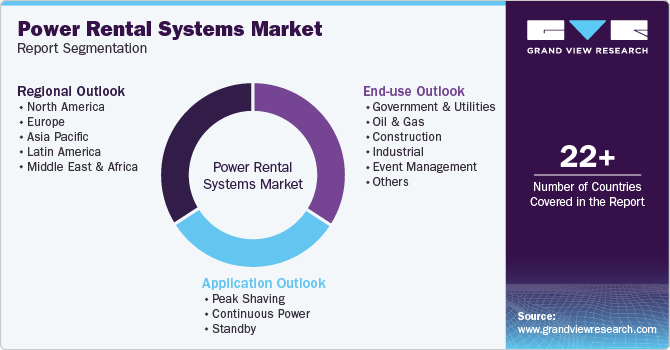
This report forecasts revenue growth at global, regional, and country levels and analyzes the latest industry trends in each sub-segment from 2021 to 2033. For this study, Grand View Research has segmented the global power rental systems market report based on end-use, application, and region:
 To learn more about this report, Download Free Sample Report
-
End-use Outlook (Revenue, USD Million, 2021 - 2033)
-
Government and Utilities
-
Oil & Gas
-
Construction
-
Industrial
-
Event Management
-
Others
-
-
Application Outlook (Revenue, USD Million, 2021 - 2033)
-
Peak Shaving
-
Continuous Power
-
Standby
-
-
Regional Outlook (Revenue, USD Million, 2021 - 2033)
-
North America
-
U.S.
-
Canada
-
Mexico
-
-
Europe
-
Germany
-
UK
-
France
-
Russia
-
-
Asia Pacific
-
China
-
India
-
Japan
-
Australia
-
-
Latin America
-
Brazil
-
Argentina
-
-
Middle East & Africa
-
UAE
-
Qatar
-
-
Research Methodology
The power rental systems market figures in this report are based on a proven research process that combines executive interviews with secondary research from proprietary databases, company filings, and recognized regulatory and institutional sources. Market size is built through value-chain sizing - reconciling supply-side and demand-side estimates - and triangulated with bottom-up and top-down approaches. Every estimate passes multiple levels of expert validation before publication, with each power rental systems segment quantified using the revenue-capture definitions in the table below.
Segment Definition
Segment - End Use
Revenue capture definition
Government and Utilities
Revenue represents the rental of temporary power systems to government agencies and utility companies for public infrastructure, grid support, emergency services, and utility operations.
Oil & Gas
Captures revenue from the rental of temporary power systems supplied to the oil & gas industry for exploration, production, refining, processing, storage, and pipeline operations.
Construction
Covers revenue from the rental of temporary power systems supplied to the construction industry for infrastructure projects, commercial buildings, residential developments, and industrial construction activities.
Industrial
Comprises revenue from the rental of temporary power systems supplied to manufacturing, mining, metals, chemicals, cement, food & beverage, pulp & paper, and other industrial facilities.
Event Management
Accounts for revenue generated from the rental of temporary power systems supplied to the events and entertainment industry, including exhibitions, convention centers, sports venues, hospitality, and outdoor event organizers.
Others
Revenue represents the rental of temporary power systems supplied to industries such as telecommunications, healthcare, data centers, agriculture, commercial facilities, and disaster recovery services.
Segment - Application
Revenue capture definition
Peak Shaving
Revenue represents the rental of power systems used to supplement grid electricity during periods of high electricity demand, reducing peak power consumption.
Continuous Power
Captures revenue from the rental of power systems used as the primary source of electricity where continuous power supply is required due to limited or unavailable grid access.
Standby
Covers revenue generated from the rental of backup power systems used to provide electricity during planned maintenance, grid outages, equipment failures, or other interruptions to the primary power supply.
Estimation Model
Layer Name
Key Question
Description
Power Rental Systems Demand Layer
What drives the demand for power rental systems?
Identify the key demand drivers for power rental systems, including increasing power outages, aging grid infrastructure, rising construction and industrial activities, expansion of oil & gas operations, growing demand for temporary power, and the need for reliable backup electricity. Assess the impact of infrastructure development, disaster recovery, and seasonal peak power requirements on market growth.
Power Rental Systems Equipment & Application Layer
What types of power rental solutions are deployed?
Analyze the adoption of power rental systems based on application, including peak shaving, continuous power, and standby power. Assess deployment trends based on power reliability requirements, project duration, operational continuity, fuel efficiency, and temporary electricity needs across end-use industries.
Power Rental Systems End-Use Layer
Which industries drive demand for power rental systems?
Evaluate the use of power rental systems across government & utilities, oil & gas, construction, industrial, event management, and other end-use industries. Assess demand based on temporary power requirements, planned maintenance, emergency backup, remote operations, infrastructure projects, and business continuity needs.
Revenue Layer
How is market revenue generated?
Market revenue is quantified through the rental of temporary power systems across different applications and end-use industries. The overall market value is determined by revenue generated from equipment rental contracts and associated rental services supplied for temporary, continuous, peak shaving, and standby power requirements.
Delivered Customizations
This report has been delivered with the following In-depth customizations
Client Request
Customization Delivered
Value Adds
End-use Industry Opportunity Assessment
Conducted a detailed analysis of rental demand across government & utilities, oil & gas, construction, industrial, event management, and other end-use industries by evaluating project activity, temporary power requirements, and investment trends.
Identified high-growth end-use sectors and prioritized revenue opportunities.
Competitive Benchmarking
Benchmarked leading power rental system providers based on rental fleet size, power capacity portfolio, geographic presence, end-use industry focus, application coverage (peak shaving, continuous power, and standby), service capabilities, and strategic initiatives.
Identified competitive positioning, market gaps, and differentiation strategies to support business planning and investment decisions.
Regional Demand Assessment
Conducted a regional demand assessment by analyzing power rental requirements across key end-use industries and applications. The study evaluated infrastructure development, industrial growth, grid reliability, power outage frequency, and project investments to identify regional demand patterns.
Identified high-growth regional markets, priority end-use industries, and key application opportunities to support expansion and market entry strategies.
Frequently Asked Questions About This Report
The Asia Pacific region dominated the power rental systems market with a revenue share of 39.2% in 2025.
China dominated the Asia Pacific region market with a revenue share of 30.6% in 2025.
Latin America is anticipated to register the second fastest CAGR of 9.8% over the forecast period.
Based on application, the continuous power segment accounted for the largest revenue share of 45.7% in 2025.
The key factors driving the power rental systems market include rising infrastructure and construction activities, increasing demand for reliable temporary power, aging grid infrastructure, frequent power outages, and growing industrial and utility investments.
The power rental systems market size was estimated at USD 28.0 billion in 2025 and is expected to reach USD 30.2 billion in 2026.
The key players operating in the power rental systems market are Aggreko, Herc Rentals Inc., Caterpillar, United Rentals, Inc., Cummins Inc., Ashtead Group plc, Atlas Copco Group, New APR Energy, LLC, Al Faris, Shenton Group, HIMOINSA, and others.
The power rental systems market is expected to grow at a CAGR of 9.8% from 2026 to 2033 to reach USD 58.3 billion by 2033.
Based on end use, the government and utilities segment accounted for the largest revenue share of 26.1% in 2025.
About the Author(s)
Backup Power Solutions Research Team
Energy & Power · Backup Power SolutionsThis report was authored by the backup power solutions research team at Grand View Research - comprising two research analysts, one senior research analyst, and one industry expert - with specialized expertise in the backup power solutions segment of the energy & power industry. All findings are based on proprietary energy & power databases, executive interviews, and regulatory analysis, subject to internal peer review prior to publication.
Last Updated:
Speak to Analyst

Customize this report to your needs - add regions, segments, or data points, with 20% free customization.
Or view our licence options:


ISO 9001:2015 & 27001:2022 Certified
We are GDPR and CCPA compliant! Your transaction & personal information is safe and secure. For more details, please read our privacy policy.


