
- Home
- »
- Advanced Interior Materials
- »
-
Automotive Composite Market Size And Share Report, 2033GVR Report cover

Automotive Composite Market (2026 - 2033)
Size, Share & Trends Analysis Report By Product (Polymer Matrix Composites, Metal Matrix Composites, Ceramic Matrix Composites), By Application, By Region, And Segment Forecasts
Market Size, 2025
$15.6BMarket Estimate, 2026
$16.6BMarket Forecast, 2033
$26.1BCAGR, 2026–2033
6.7%Automotive Composite Market Summary
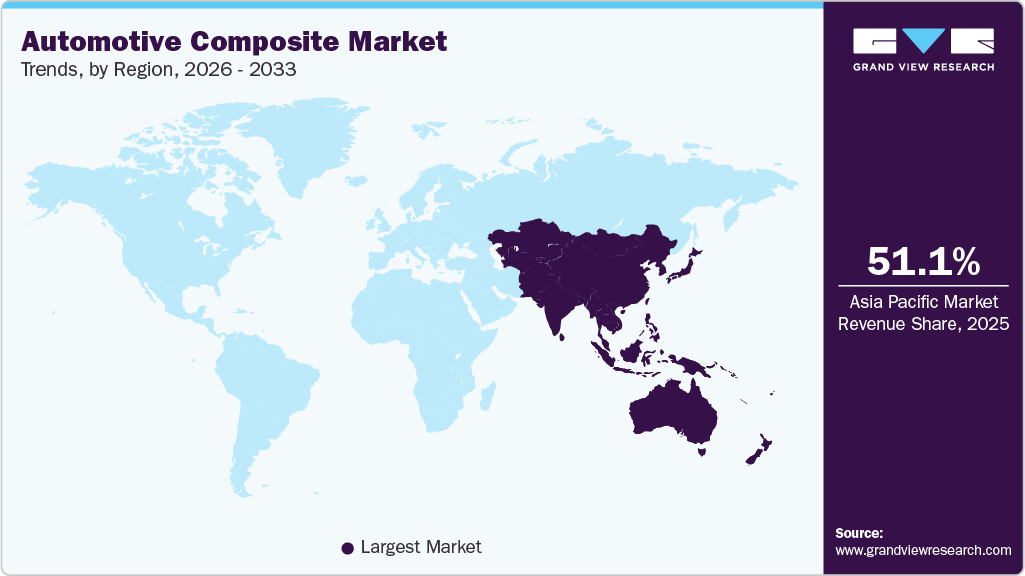
The global automotive composite market size was valued at USD 15.6 billion in 2025 and is projected to grow from USD 16.6 billion in 2026 to USD 26.1 billion by 2033, growing at a CAGR of 6.7% from 2026 to 2033. Asia Pacific dominated the market with the largest revenue share of 51.1% in 2025. Tightening global emission standards are pushing manufacturers to adopt materials and technologies that contribute to overall vehicular sustainability.
 Source: Grand View Research, IR Documents, Primary Interviews, Paid DatabasesTo learn more about this report,
 Download Free Sample Report
 Key Market Trends & Insights
- By product: Metal matrix composites segment is expected to grow at the fastest CAGR of 6.8% from 2026 to 2033
- By application: Structural & powertrain components segment is expected to grow at the fastest CAGR of 6.7% from 2026 to 2033
Regional Highlights
- Largest regional market: Asia Pacific (51.1% revenue share, 2025)
- The China automotive composite market is expected to grow over the forecast period.
Market Size & Forecast
- Market size in 2025: USD 15.6 Billion
- Estimated market size in 2026: USD 16.6 Billion
- Projected market size by 2033: USD 26.1 Billion
- CAGR (2026-2033): 6.7%
Three ways to get this report
Buy it, customize it, or ask a question.Ask an Analyst
Analyst response in 1 business day
- AccessReport author, directly
- Reply timeWithin 1 working day
- No sales callDirect answer only
- FormatEmail reply
- CostFree, no cost
Get the Full Report
What the study covers
- FormatsPDF · Excel · Dashboard
- Timeline2026–2033 annual, 2025 base
- Coverage20+ countries, 5 regions
- Companies10+ key players profiled
Customize the Report
20% free customization
- IncludeCountries, segments, points
- TailorTo your product definition
- ExtendDeeper competitor detail
- OrA fully bespoke study
- Turnaround5–10 working days
Composites help lower the overall emissions during both the production and operational phases of a vehicle's lifecycle. Governments and regulatory bodies are implementing policies that encourage the adoption of advanced materials in vehicles to meet environmental goals. This has led to an increased incorporation of composites in exterior body parts, under-the-hood components, and structural applications, thereby driving market growth across segments.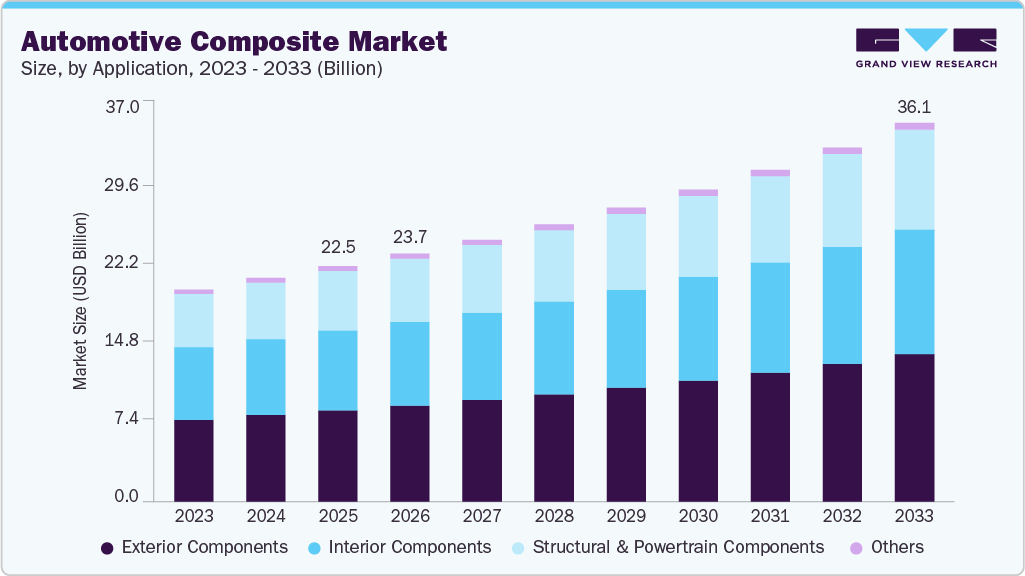 To learn more about this report, Download Free Sample Report
 As the global shift toward electric mobility accelerates, composites are playing a critical role in the design and engineering of electric and hybrid vehicles. Automakers are utilizing composite materials to offset the weight of heavy battery systems and improve driving range. Lightweight, durable composites not only enhance performance but also improve thermal management and design flexibility in EVs. This trend is expected to intensify as EV adoption grows worldwide, offering significant opportunities for composite manufacturers.
Technological advances in composite manufacturing processes, such as automated fiber placement, resin transfer molding, and 3D printing, are reducing production costs and cycle times. These advancements are making composites more commercially viable for high-volume automotive production. Additionally, innovations in hybrid and recyclable thermoplastic composites are improving material properties, including strength, impact resistance, and sustainability. These developments are expanding the application scope of composites from luxury and performance cars to mainstream passenger and commercial vehicles.
Market Concentration & Characteristics
The global automotive composite market is moderately concentrated, with several key players dominating the supply of advanced materials and components across regions. Companies such as Toray Industries, Hexcel Corporation, SGL Carbon, and Teijin Limited play leading roles through extensive R&D, vertically integrated operations, and strategic partnerships with automotive OEMs. The market is characterized by high innovation, as manufacturers continuously develop new resin systems, fiber reinforcements, and manufacturing techniques to meet evolving performance and sustainability demands. Technological advancements such as fast-curing thermoset resins and high-volume production methods are making composites increasingly suitable for large-scale automotive manufacturing, reducing the cost barrier traditionally associated with these materials.
 To learn more about this report, Download Free Sample Report
 Mergers and acquisitions are a recurring feature of the automotive composites industry, driven by the need to expand capabilities, integrate value chains, and enter new geographic territories. Regulatory frameworks, particularly those targeting vehicle emissions and recyclability, significantly influence material choices and design strategies. Composite materials benefit from these regulations due to their lightweight and energy-efficient properties. However, the availability of substitutes, such as high-strength steel and aluminum alloys, puts downward pressure on prices, especially in cost-sensitive segments. End-use concentration is notable in electric vehicles, performance vehicles, and high-end passenger cars. However, usage is gradually expanding into commercial vehicles and mid-range segments as cost-effectiveness improves and production scalability increases.
Product Insights
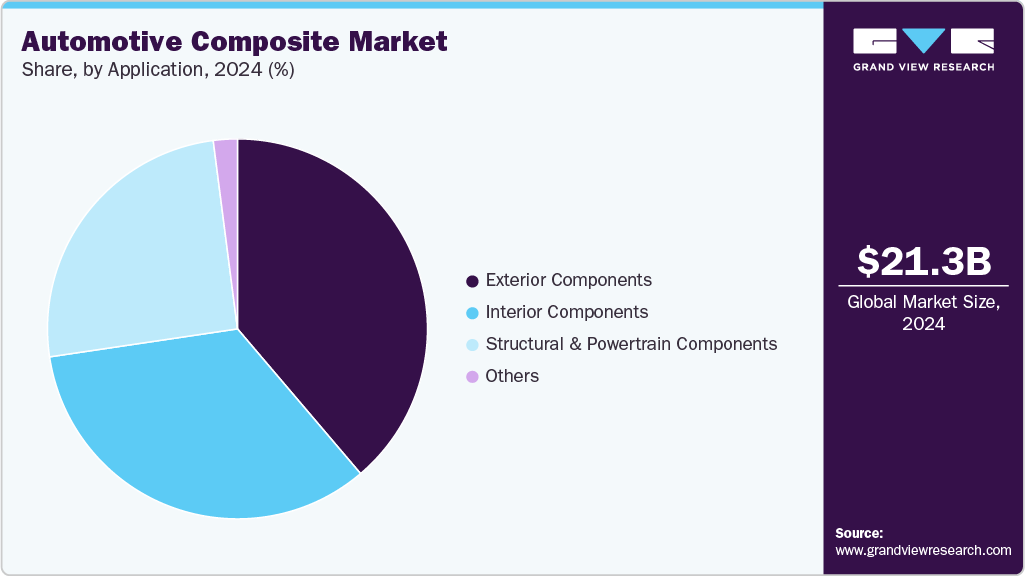
The polymer matrix composites segment dominated the market, accounting for a revenue share of 74.9% in 2025, driven by the growing demand for lightweight and durable materials in vehicle manufacturing. PMCs, which typically include thermoset and thermoplastic matrices reinforced with glass or carbon fibers, offer excellent mechanical strength, corrosion resistance, and design flexibility. These properties make them particularly valuable for applications such as body panels, bumpers, dashboards, and structural reinforcements. The ability of PMCs to reduce overall vehicle weight directly supports automakers in achieving improved fuel efficiency and lower emissions, aligning with global environmental regulations.
 To learn more about this report, Download Free Sample Report
 The metal matrix composites segment is expected to grow at the fastest CAGR of 6.8% over the forecast period, driven by superior mechanical properties and thermal performance. MMCs, which typically combine metals such as aluminum or magnesium with ceramic or metallic reinforcements, offer high strength-to-weight ratios, excellent wear resistance, and improved dimensional stability under thermal stress. These characteristics make them ideal for automotive components that operate under high mechanical loads or extreme temperatures, such as engine parts, brake systems, and drivetrain elements. As automakers pursue lighter, more durable materials to meet stringent efficiency and durability standards, MMCs offer a compelling alternative to conventional metals.
Application Insights
Exterior components led the automotive composite market, accounting for 38.8% in 2025, driven by the growing need for lightweight, aerodynamically efficient vehicle designs. Composite materials such as carbon fiber-reinforced polymers (CFRP) and glass fiber-reinforced plastics (GFRP) are widely used in body panels, bumpers, hoods, fenders, and roof systems due to their excellent strength-to-weight ratio. These materials help reduce overall vehicle weight, improving fuel efficiency and reducing emissions.
The structural & powertrain components segment is expected to grow at the fastest CAGR of 6.7% over the forecast period. Advancements in composite manufacturing technologies such as high-pressure resin transfer molding (HP-RTM), compression molding, and thermoplastic composite processing are enabling the cost-effective mass production of structural and powertrain parts. These innovations are reducing cycle times and production costs, making composites a viable choice for a broader range of vehicle models. Additionally, regulatory mandates on vehicle emissions and crash safety performance are encouraging manufacturers to incorporate composite materials into structural zones that must effectively absorb and distribute impact energy.
Regional Insights
Asia Pacific dominated the automotive composite market, accounting for 51.1% in 2025, driven by the rapid expansion of the automotive manufacturing sector, particularly in India, Japan, South Korea, and Southeast Asian nations. The region’s cost-competitive production environment and rising demand for fuel-efficient vehicles support the adoption of lightweight composite materials. Moreover, increasing investments in electric vehicle (EV) infrastructure and the presence of global and regional automakers accelerating EV production are further contributing to the growth of composite usage across both structural and interior applications.
 To learn more about this report, Download Free Sample Report
 The China automotive composite market is expected to grow over the forecast period. In China, government policies promoting electric mobility and stringent regulations on fuel consumption and emissions are key market growth drivers. The country is the world’s largest EV market, and automakers are increasingly using composite materials to reduce vehicle weight and extend battery range. Additionally, China’s "Made in China" initiative encourages the development of advanced manufacturing technologies, including lightweight materials such as carbon fiber composites, thereby supporting both domestic innovation and international competitiveness in the automotive sector.
North America Automotive Composite Market Trends
In North America, the growth of the automotive composites industry is driven by strong demand for performance vehicles, increased adoption of electric vehicles, and a well-established automotive research and development ecosystem. Automakers are leveraging composites for structural applications to meet Corporate Average Fuel Economy (CAFE) standards and reduce vehicle emissions. The presence of major composite manufacturers, coupled with ongoing innovation in high-volume composite processing, supports the integration of advanced materials into mass-market vehicle platforms across the region.
U.S. Automotive Composite Market Trends
A combination of federal regulatory mandates for emissions reduction and the increasing production of high-performance and electric vehicles fuels the U.S. automotive composites industry. Automakers are prioritizing lightweight construction techniques to enhance vehicle efficiency and range. The U.S. also benefits from strong technological capabilities and a well-developed supply chain for advanced composite materials, which supports the domestic production of structurally complex automotive components.
Europe Automotive Composite Market Trends
The rapid advancement of composite manufacturing technologies in Europe is a critical driver propelling market growth. Techniques such as automated fiber placement, resin transfer molding, and high-pressure resin infusion have become more efficient and cost-effective. These advancements have reduced production times and enabled high-volume manufacturing, making composites increasingly viable not only for luxury and sports vehicles but also for mass-market passenger cars. This shift is allowing European automakers to integrate composite components into a broader range of vehicle models.
Germany’s automotive composite market is driven by the country’s leadership in automotive engineering and innovation. The presence of premium, performance-focused automakers such as BMW, Audi, and Mercedes-Benz has encouraged early and widespread adoption of carbon fiber and hybrid composites. These materials are used in both structural parts and body panels to enhance vehicle performance, safety, and aesthetics. Additionally, Germany’s commitment to sustainability and e-mobility supports further integration of lightweight composite solutions.
Central & South America Automotive Composite Market Trends
In Central and South America, the automotive composites industry is driven by the growing demand for cost-effective, fuel-efficient vehicles. Countries like Brazil and Argentina are witnessing increased vehicle production and exports, which is fostering interest in lightweight materials to improve overall vehicle efficiency. Though the market is still developing, local automakers are gradually exploring composite applications for non-structural parts and interiors to reduce manufacturing costs and meet regulatory standards.
Middle East & Africa Automotive Composite Market Trends
The automotive composites industry in the Middle East and Africa is gradually gaining momentum, driven by the region’s growing focus on local automotive manufacturing and diversification away from oil-based economies. Countries like the UAE and South Africa are investing in advanced automotive technologies and sustainable transportation. Although the market is nascent, the need for durable, heat-resistant, and lightweight materials for vehicles operating in harsh climatic conditions is driving interest in composite solutions, particularly for commercial and utility vehicles.
Key Automotive Composite Company Insights
Some of the key players operating in the market include Solvay and Toray Industries, Inc.
-
Solvay is a Belgium-based global leader in advanced materials and specialty chemicals, with a strong presence in the automotive composites market. The company offers a broad portfolio of high-performance thermoplastic and thermoset composites, including carbon fiber-reinforced polymers and specialty resins. Solvay’s automotive composite materials are widely used in structural, powertrain, and interior components to reduce vehicle weight and improve energy efficiency. Their solutions support both internal combustion and electric vehicles, enabling compliance with stringent emission standards and sustainability goals.
-
Toray Industries, headquartered in Japan, is a leading manufacturer of carbon fiber and composite materials with a significant focus on automotive applications. The company’s product offerings include carbon fiber-reinforced plastics (CFRP), thermoplastic composites, and prepregs used in structural body parts, chassis components, and battery enclosures. Global automakers widely adopt Toray’s innovations to reduce weight, enhance performance, and improve fuel economy.
SGL Carbon and Teijin Limited are some of the emerging participants in the automotive composite market.
-
SGL Carbon is a Germany-based company known for its expertise in carbon-based materials and solutions for the mobility and energy sectors. In the automotive composite market, SGL Carbon provides carbon fiber fabrics, non-crimp fabrics, and composite components for integration into structural vehicle parts, such as crossbeams, roof segments, and battery housings. The company collaborates closely with OEMs to develop lightweight, durable components that meet modern vehicle design and safety requirements, particularly in electric and premium vehicle segments.
-
Teijin Limited, headquartered in Japan, is a diversified materials company with a strong foothold in the automotive composites space. The company specializes in carbon fiber, aramid fiber, and thermoplastic composite materials for structural, exterior, and interior vehicle components. Teijin’s advanced solutions support weight reduction, energy absorption, and thermal management, making them ideal for next-generation automotive platforms. The company also emphasizes sustainable manufacturing and recyclability in its composite product lines, aligning with the industry's shift toward eco-friendly materials.
Key Automotive Composite Companies:
The following key companies have been profiled for this study on the automotive composite market.
- Solvay
- Toray Industries, Inc.
- SGL Carbon
- Teijin Limited
- Hexcel Corporation
- Mitsubishi Chemical Carbon Fiber and Composites, Inc.
- Johns Manville
- Gurit
- Plasan Carbon Composites
- TPI Composites
- GMS Composites
- IDI Composites International
- Revchem Composites
- Formaplex
- Owens Corning
Recent Developments
-
In October 2023, Toray Industries, Inc. introduced TORAYCA carbon fiber, an advanced lightweight material designed to enhance the performance of carbon-fiber-reinforced plastics. This innovation not only reduces weight across a range of applications but also supports environmental sustainability by improving overall efficiency. With its exceptional properties, TORAYCA is poised to make a significant impact across industries such as aerospace and automotive, thereby improving fuel economy and reducing carbon emissions.
Automotive Composite Market Report Scope
Report Attribute
Details
Market size in 2025
USD 15.6 billion
Estimated market size in 2026
USD 16.6 billion
Projected market size by 2033
USD 26.1 billion
Growth rate
CAGR of 6.7% from 2026 to 2033
Base year for estimation
2025
Historical data
2021 - 2025
Forecast period
2026 - 2033
Quantitative units
Revenue in USD million/billion, volume in Kilotons, and CAGR from 2026 to 2033
Report coverage
Revenue forecast, volume forecast, company ranking, competitive landscape, growth factors, and trends
Segments covered
Product, application, and region
Regional scope
North America; Europe; Asia Pacific; Central & South America; Middle East & Africa
Country scope
U.S.; Canada; Mexico; UK; Germany; France; Spain; China; India; Japan; South Korea; Brazil; Argentina; Morocco; South Africa
Key companies profiled
Solvay; Toray Industries, Inc.; SGL Carbon; Teijin Limited; Hexcel Corporation; Mitsubishi Chemical Carbon Fiber and Composites, Inc.; Johns Manville; Gurit; Plasan Carbon Composites; TPI Composites; GMS Composites; IDI Composites International; Revchem Composites; Formaplex; Owens Corning
Customization scope
Free report customization (equivalent up to 8 analysts working days) with purchase. Addition or alteration to country, regional & segment scope.
Pricing and purchase options
Avail customized purchase options to meet your exact research needs. Explore purchase options
Global Automotive Composite Market Report Segmentation
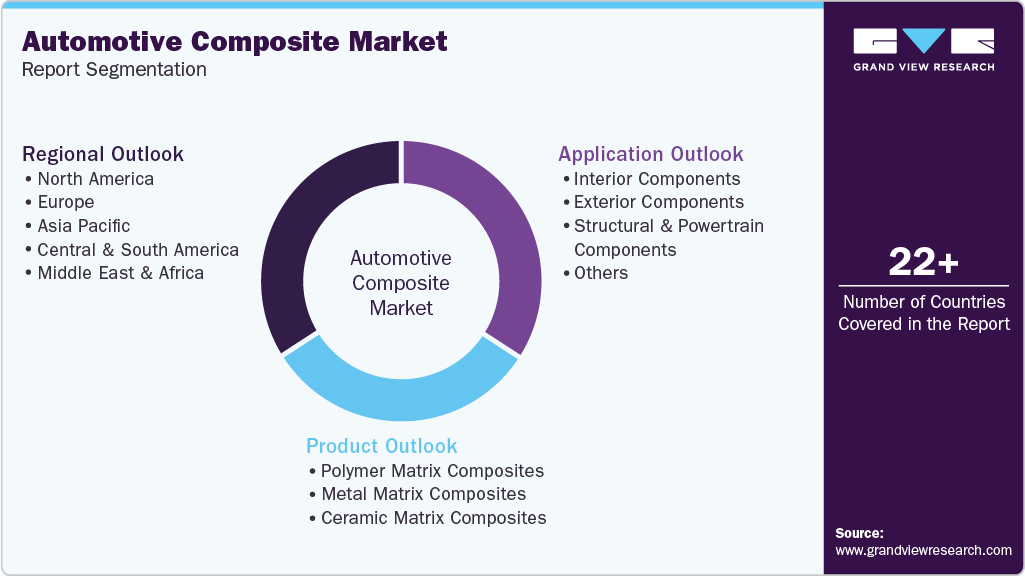
This report forecasts revenue & volume growth at the global, regional, and country levels and provides an analysis of the latest industry trends in each of the sub-segments from 2021 to 2033. For this study, Grand View Research has segmented the global automotive composite market report based on product, application, and region:
 To learn more about this report, Download Free Sample Report
 -
Product Outlook (Volume, Kilotons; Revenue, USD Million, 2021 - 2033)
-
Polymer Matrix Composites
-
Metal Matrix Composites
-
Ceramic Matrix Composites
-
-
Application Outlook (Volume, Kilotons; Revenue, USD Million, 2021 - 2033)
-
Interior Components
-
Exterior Components
-
Structural & Powertrain Components
-
Others
-
-
Regional Outlook (Volume, Kilotons; Revenue, USD Million, 2021 - 2033)
-
North America
-
U.S.
-
Canada
-
Mexico
-
-
Europe
-
Germany
-
UK
-
France
-
Spain
-
-
Asia Pacific
-
China
-
Japan
-
India
-
South Korea
-
-
Central & South America
-
Brazil
-
Argentina
-
-
Middle East & Africa
-
Morocco
-
South Africa
-
-
Frequently Asked Questions About This Report
Key factors driving the automotive composite market include increasing demand for lightweight vehicles, stringent emission regulations, and advancements in high-performance composite materials.
Asia Pacific dominated with a 51.1% revenue share in 2025.
The polymer matrix composites segment dominated the market, accounting for a revenue share of 74.9% in 2025, driven by the growing demand for lightweight and durable materials in vehicle manufacturing.
Exterior components led the automotive composite market, accounting for 38.8% in 2025
The global automotive composite market size was estimated at USD 22.4 billion in 2025 and is expected to reach USD 23.6 billion in 2026.
The global automotive composite market is expected to grow at a compound annual growth rate of 6.2% from 2026 to 2033 to reach USD 36.1 billion by 2033.
Exterior components led the market and accounted for a 38.8% share in 2025, driven by the increasing need for lightweight and aerodynamically efficient vehicle designs.
Key players in the automotive composite market included Solvay, Toray Industries, Inc.; SGL Carbon; Teijin Limited, Hexcel Corporation, Mitsubishi Chemical Carbon Fiber and Composites, Inc.; Johns Manville, Gurit, Plasan Carbon Composites, TPI Composites, GMS Composites, IDI Composites International, Revchem Composites, Formaplex, Owens Corning
About the Author(s)
Advanced Interior Materials Research Team
Advanced Materials · Advanced Interior MaterialsThis report was authored by the advanced interior materials research team at Grand View Research - comprising two research analysts, one senior research analyst, and one industry expert - with specialized expertise in the advanced interior materials segment of the advanced materials industry. All findings are based on proprietary advanced materials databases, executive interviews, and regulatory analysis, subject to internal peer review prior to publication.
Last Updated:
Speak to Analyst

Customize this report to your needs - add regions, segments, or data points, with 20% free customization.
Or view our licence options:


ISO 9001:2015 & 27001:2022 Certified
We are GDPR and CCPA compliant! Your transaction & personal information is safe and secure. For more details, please read our privacy policy.


