Report Overview
The global medical holography market size was valued at USD 356.4 Million in 2016. It is expected to post a CAGR of 31.0% during the forecast period. Increasing adoption of medical holographic techniques and products in biomedical research activities is one of the key trends stimulating market growth.
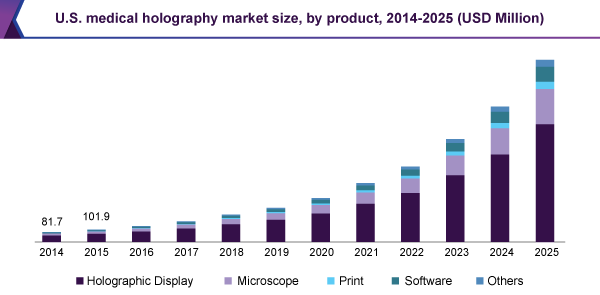
The rising number of R&D activities conducted by prominent pharmaceutical and biotechnological companies are projected to widen the base of biomedical research initiatives. This subsequent increase in R&D efforts is anticipated to provide the market with lucrative growth opportunities in the coming years.
Moreover, the growing clinical application of holography in orthopedics, cardiac electrophysiology, radiological & surgical procedures, and dentistry is working in favor of the market. Emerging technological innovations, such as the inclusion of advanced pico-like projectors and miniaturized light-emitting diodes to deliver high clarity holographic images, are estimated to trigger the demand for medical holography.
The introduction of holographic visualization and interaction technologies enables less-invasive procedures, thus lending an improved safety profile. The technology is consequently yielding better patient outcomes, which is likely to augment patient and physician preference for it in the future.
Product Insights
The microscope segment is poised to register a noteworthy CAGR over the coming years owing to technological advancements in the field of microscopy. A combination of digital and traditional microscopy techniques has found application in clinical imaging and microbiology, which allows high-resolution visualization of transparent cells without labeling and staining. Consequently, owing to these advancements, the adoption of digital holographic microscopy for examining apoptosis events, drug response, cellular diagnosis, and cytotoxic treatment doses has increased significantly, thereby presenting tremendous growth opportunities for the market.
The holographic displays segment held the largest share of the market in 2016, owing to the high penetration of these products in medical holography techniques. Growing advancements and modifications in these displays such as the incorporation of laser, electro-holographic, and piston-based displays are expected to boost the adoption of these products by researchers and physicians in biomedical research and educational purposes.
The aforementioned technological advancements provide several benefits in performing diagnostic procedures, thus offering significant growth opportunities to the overall market. These benefits include improved training, generation of real-time organ images, planning of surgical interventions without breaking the skin, and precise coordination in diagnostic and interventional applications.
Application Insights
Biomedical research held the largest share in the market in 2016. The dominant share can be attributed to a wide array of applications of medical holography in biomedical research. It is used to develop three-dimensional holograms of various cells, tissues, and organs in order to study them from various angles. Moreover, this application allows studying the effect of various drugs on different organs of a patient’s body. This segment is projected to exhibit steady growth owing to rising technological integration in the healthcare space.
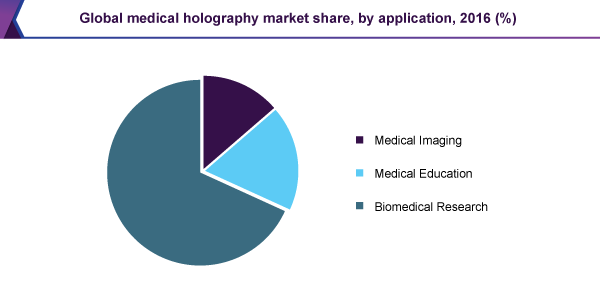
The medical education segment is anticipated to expand at a remarkable CAGR over the forecast period. Because of their sharpness, details, and high impact, medical holograms are better teaching tools as compared to conventional images. In addition, it allows teachers and students to better understand the human anatomy in virtual reality, thereby reducing the need for cadavers.
Furthermore, Case Western Reserve University and the Cleveland Clinic have partnered with Microsoft to use its HoloLens technology for constructing a 485,000 square-foot Health Education Campus designed to support collaborative learning among various health disciplines. Such collaborations are further estimated to boost the demand for these systems.
End-use Insights
In the end-use segment, research laboratories were the leading revenue contributor in the medical holography market in 2016. The surging adoption of holography products in research activities, which primarily involves phase-contrast imaging and dynamic live cell imaging, is contributing to the dominance of the segment. In addition, the holographic detection method is minimally invasive in nature, thus obviating cell deformation during examination procedures and consequently, rendering it one of the most preferred choices among researchers.
The academic centers segment is likely to register healthy growth in the coming years, owing to the burgeoning adoption of medical holography for educational purposes. According to a study, it has been observed that medical holograms improve the understanding of anatomy compared to traditional methods. Other benefits offered are improved medical instructions, intuitive visualization, collaborative viewing, and effective communication of complex anatomical information. These benefits are poised to bolster the growth of the segment.
Regional Insights
North America held a prominent position in the market, with over 37.0% share in 2016. The share acquired by this region can be attributed to extensive research activities undertaken by a majority of prominent players headquartered in the region. Increasing funding and interest of healthcare organizations and key companies owing to the benefits of the technology over traditional imaging methods are also intensifying the influx of holographic products in the medical industry.
Growing disease burden and clinical urgency for efficient screening technologies such as medical holography, which is becoming increasingly accessible in the region, serve as a major growth catalyst in the region. Also, the rise in acceptance of holographic teaching tools in the region is expected to influence the overall market positively.
The Asia Pacific is projected to witness phenomenal growth during the forecast period. Increasing disposable income, rising healthcare spending, and high physician awareness levels regarding the benefits of these products in diagnostic and interventional procedures are providing a significant push to the regional market.
Moreover, a growing inclination towards holographic techniques in the education sector is anticipated to drive the market. For instance, the National University of Singapore has developed virtual reality simulation projects for nursing and undergraduate medical education. The holographic platform allows enhanced learning of the human anatomy and dissection and provides a virtual platform for real-life like scenarios such as hospital emergency room, operation theatre, and mass casualty incidents.
Medical Holography Market Share Insights
Key participants include Zebra Imaging; Nanolive SA; RealView Imaging Ltd.; Phase Holographic Imaging AB; zSpace, Inc.; and Lyncee Tec. These companies are increasingly undertaking strategic activities such as extensive distribution, new product development, and mergers & acquisitions.
This is consequently contributing to the growth of the market. For instance, in November 2015, Zebra Imaging acquired Rattan, a software consulting firm. This acquisition was carried out to accelerate the integration of advanced 3D light-field technology in their array of holographic display products. New product approval is also playing a pivotal role in the development of the market.
For instance, True3D Viewer by EchoPixel received U.S. FDA approval in 2015 and has applications in surgical planning and diagnostics. The software has the potential of converting 2D imaging data obtained from CT and MRI scans into interactive holograms, which can be dissected and manipulated in midair. This industry is highly competitive in nature owing to several recent technological advancements in this field.
Medical Holography Market Report Scope
|
Report Attribute
|
Details
|
|
Market size value in 2020
|
USD 978.3 million
|
|
Revenue forecast in 2025
|
USD 4.04 billion
|
|
Growth Rate
|
CAGR of 31.0% from 2017 to 2025
|
|
Base year for estimation
|
2016
|
|
Historical data
|
2014 – 2016
|
|
Forecast period
|
2017 – 2025
|
|
Quantitative units
|
Revenue in USD million and CAGR from 2017 to 2025
|
|
Report coverage
|
Revenue forecast, company ranking, competitive landscape, growth factors, and trends
|
|
Segments covered
|
Product, application, end-use, region
|
|
Regional scope
|
North America; Europe; APAC; Latin America; MEA
|
|
Country scope
|
U.S.; Canada; U.K.; Germany; Japan; China; India; Brazil; Mexico; South Africa
|
|
Key companies profiled
|
Zebra Imaging; Nanolive SA; RealView Imaging Ltd.; Phase Holographic Imaging AB; zSpace, Inc.; Lyncee Tec
|
|
Customization scope
|
Free report customization (equivalent up to 8 analysts working days) with purchase. Addition or alteration to country, regional & segment scope.
|
|
Pricing and purchase options
|
Avail customized purchase options to meet your exact research needs. Explore purchase options
|
Segments Covered in the Report
This report forecasts revenue growth at global, regional, & country levels and provides an analysis of the industry trends in each of the sub segments from 2014 to 2025. For the purpose of this study, Grand View Research has segmented the global medical holography market report on the basis of product, application, end use, and region:
-
Product Outlook (Revenue, USD Million, 2014 - 2025)
-
Holographic Display
-
Laser
-
Touchable
-
Piston
-
Semi-Transparent
-
Microscope
-
Print
-
Software
-
Others
-
Application Outlook (Revenue, USD Million, 2014 - 2025)
-
Medical Imaging
-
Ophthalmology
-
Dentistry
-
Urology
-
Otology
-
Orthopedics
-
Others
-
Medical Education
-
Biomedical Research
-
End-use Outlook (Revenue, USD Million, 2014 - 2025)
-
Regional Outlook (Revenue, USD Million, 2014 - 2025)
Frequently Asked Questions About This Report
b. The global medical holography market size was estimated at USD 752.5 million in 2019 and is expected to reach USD 978.3 million in 2020.
b. The global medical holography market is expected to grow at a compound annual growth rate of 31.0% from 2015 to 2025 to reach USD 4.0 billion by 2025.
b. North America dominated the medical holography market with a share of 37.2% in 2019. This is attributable to extensive research activities undertaken by a majority of prominent players, increasing funding and interest of healthcare organizations and technological advancement.
b. Some key players operating in the medical holography market include Zebra Imaging; Nanolive SA; RealView Imaging Ltd.; Phase Holographic Imaging AB; zSpace, Inc.; and Lyncee Tec.
b. Key factors that are driving the market growth include increasing adoption of medical holographic techniques and products in biomedical research activities.

 Download Sample Report
















