
- Home
- »
- Clinical Diagnostics
- »
-
Molecular Diagnostics Market Share Analysis, Industry Report, 2026-2033GVR Report cover

Molecular Diagnostics Market (2026 - 2033)
Size, Share & Trends Analysis Report By Product (Instruments, Reagents, Others), By Test Location (Point Of Care, Self-Test), By Technology (PCR, ISH, INAAT), By Application (Oncology, Infectious Diseases), By Region, And Segment Forecasts
Market Size, 2025
$18.8BMarket Estimate, 2026
$19.4BMarket Forecast, 2033
$25.6BCAGR, 2026–2033
4.1%Molecular Diagnostics Market Summary
The global molecular diagnostics market size was valued at USD 18.8 billion in 2025 and is projected to grow from USD 19.4 billion in 2026 to USD 25.6 billion by 2033, at a CAGR of 4.1% from 2026 to 2033. The North America dominated the global market with a revenue share of 44.1% in 2025, supported by advanced healthcare infrastructure, strong adoption of molecular testing technologies, and the presence of major diagnostic companies. The increasing demand for early disease detection and personalized medicine is expected to further support market growth.
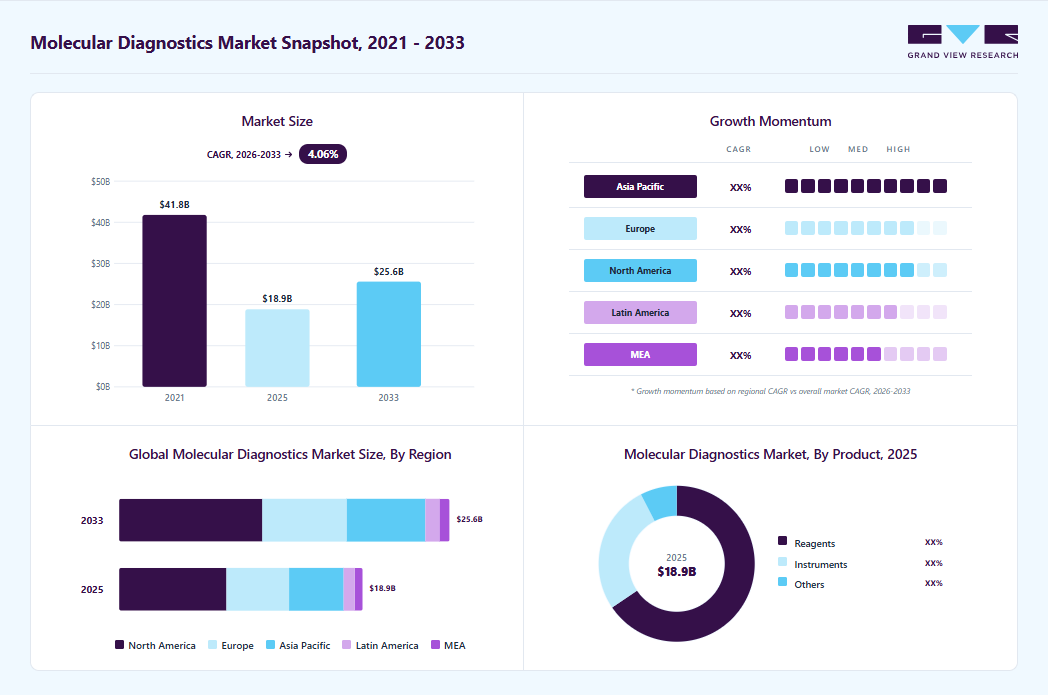 Source: Grand View Research, IR Documents, Primary Interviews, Paid DatabasesTo learn more about this report,
 Download Free Sample Report
 Key Market Trends & Insights
- By product: Reagents segment held the largest market share of 65.5% in 2025.
- By technology: PCR segment held the largest market share of 62.2% in 2025.
- By application: Infectious disease segment held the largest market share in 2025.
- By test location: Central laboratories segment held the largest market share in 2025.
Regional Highlights
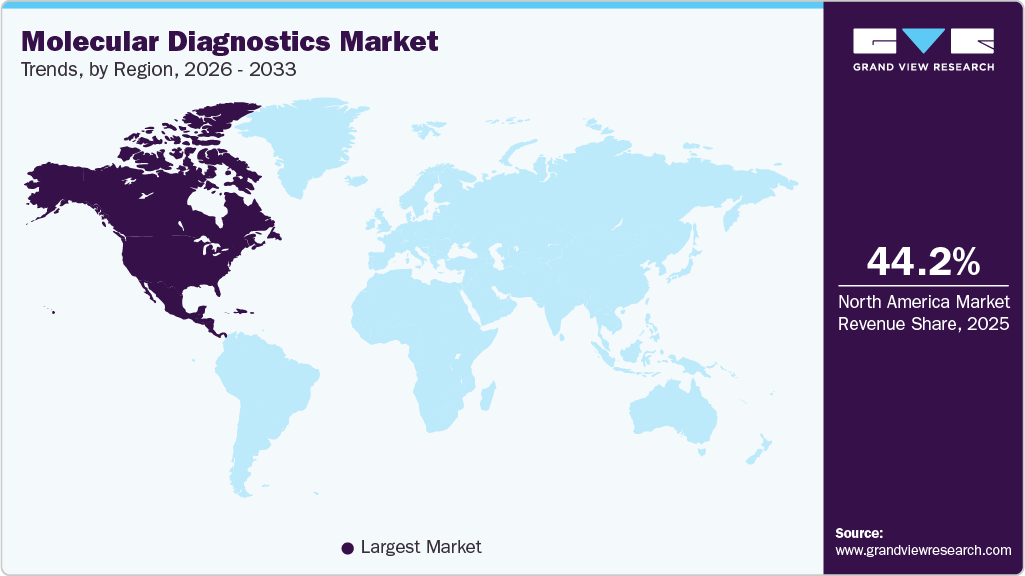
- Largest regional market: North America (44.1% revenue share, 2025)
- Fastest-growing regional market: Asia Pacific (highest CAGR, 2026-2033)
- The molecular diagnostics industry in the U.S. held the largest revenue share of 84.3% in 2025.
Market Size & Forecast
- Market size in 2025: USD 18.8 Billion
- Estimated market size in 2026: USD 19.4 Billion
- Projected market size by 2033: USD 25.6 Billion
- CAGR (2026-2033): 4.1%
Three ways to get this report
Buy it, customize it, or ask a question.Ask an Analyst
Analyst response in 1 business day
- AccessReport author, directly
- Reply timeWithin 1 working day
- No sales callDirect answer only
- FormatEmail reply
- CostFree, no cost
Get the Full Report
What the study covers
- FormatsPDF · Excel · Dashboard
- Timeline2026–2033 annual, 2025 base
- Coverage20+ countries, 5 regions
- Companies10+ key players profiled
Customize the Report
20% free customization
- IncludeCountries, segments, points
- TailorTo your product definition
- ExtendDeeper competitor detail
- OrA fully bespoke study
- Turnaround5–10 working days
Key Takeaways from the Report
-
The growing burden of chronic and genetic diseases is expanding the addressable application base, increasing demand for molecular biomarkers and genetic testing for early detection, disease characterization, and personalized treatment.
-
The market is transitioning toward broader clinical applications such as infectious diseases, oncology, genetic disorders, and precision medicine. These emerging decentralized testing applications are expected to support sustained long-term market growth.
-
Strategic partnerships, funding, and R&D investments are supporting product innovation, with companies and research organizations focusing on oncology diagnostics, antimicrobial resistance, NGS, digital PCR, and decentralized testing platforms.
-
North America dominates the global market, driven by advanced healthcare infrastructure, high adoption of molecular testing, and demand for precision diagnostics. Asia Pacific is expected to be the fastest-growing regional market, driven by increasing penetration of advanced diagnostic technologies, unmet diagnostic needs, and initiatives to expand access to molecular testing.
-
Reagents represented the largest product segment, reflecting their recurring use across PCR, NGS, digital PCR, and other molecular assays. Whereas, PCR remained the dominant technology, owing to its established role in infectious disease testing, oncology, genetic testing, and other clinical applications.
-
Next-generation sequencing (NGS) represents an important opportunity as genomic testing expands across oncology, wherein oncology is emerging as a significant growth area, with molecular testing increasingly used for biomarker identification, cancer classification, treatment selection, and monitoring of disease progression.
-
Technological innovation is reshaping molecular diagnostics, with developments in digital PCR, multiplex PCR, LAMP, TMA, microfluidics, biochips, and sequencing improving the speed, sensitivity, specificity, and portability of testing.
-
Strategic partnerships, funding, and R&D investments are supporting product innovation, with companies and research organizations focusing on oncology diagnostics, antimicrobial resistance, NGS, digital PCR, and decentralized testing platforms.
The growing adoption of Point-of-Care (POC) testing is driven by increasing demand for convenient self-diagnostic solutions and greater patient awareness of the advantages of rapid test results. This trend is encouraging manufacturers to develop and launch innovative testing products. As point-of-care testing (POCT) gains wider acceptance, several developments are influencing its evolution and strengthening its contribution to the molecular diagnostics market.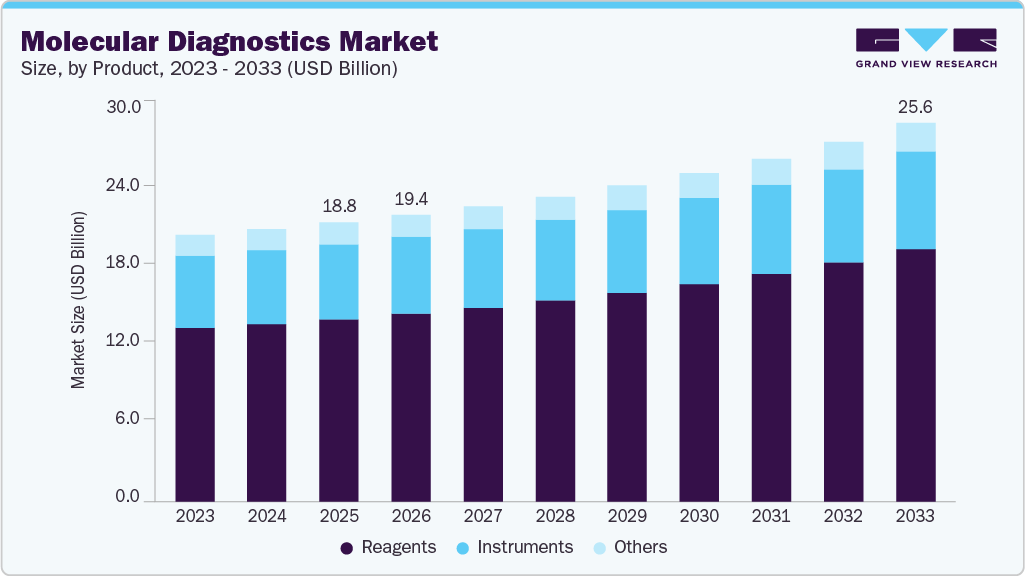 To learn more about this report, Download Free Sample Report
 One notable development is the increasing specialization of clinical departments, which is encouraging the development of POCT solutions tailored to specific medical applications. This trend is consistent with the broader decentralization of healthcare, as sophisticated diagnostic technologies become increasingly available in smaller healthcare facilities. As a result, POCT systems are evolving to offer faster results, improved accuracy, greater portability, and enhanced cost efficiency.
Market participants are increasingly investing in innovative POCT products to address emerging opportunities. For instance, in November 2024, Texas introduced a pilot program for self-collected HPV screening to improve access to cervical cancer testing in underserved communities. The program, implemented at Su Clinica Federally Qualified Health Center (FQHC) in collaboration with The University of Texas MD Anderson Cancer Center, is evaluating the effectiveness of self-collection screening in real-world settings. The initiative uses the FDA-approved BD Onclarity HPV Assay to address geographic and socioeconomic barriers to cervical cancer screening and to evaluate approaches to improve healthcare access. The program also demonstrates how decentralized testing models can support broader access to molecular diagnostic services in underserved settings.
Companies such as Merck KGaA and QIAGEN are applying advanced technologies, including Transcription-Mediated Amplification (TMA) and Loop-Mediated Isothermal Amplification (LAMP), to tumor diagnostics. Next-generation sequencing (NGS) is also emerging as a rapidly expanding technology, supported by its increasing application in genomic research. New systems, including Thermo Fisher’s 5500x1 genetic analyzer and Illumina’s NextSeq CN500, together with greater adoption of multiplex and real-time PCR platforms such as QIAGEN’s EpiTect Methyl II PCR, are contributing to continued market development.
Leading manufacturers are also expanding their quantitative PCR (qPCR) and disease-specific diagnostic portfolios through targeted R&D and strategic collaborations. Developments in oncology and infectious disease testing include Roche’s Cobas HPV assay and Cepheid’s GeneXpert Xpert assay for tuberculosis. At the same time, technologies such as Fluorescence In Situ Hybridization (FISH) and Enzyme-Linked Immunosorbent Assay (ELISA) are gaining adoption, broadening the range of diagnostic approaches and clinical applications within molecular testing.
The continuing prevalence of infectious diseases is sustaining demand for rapid molecular diagnostic solutions. During the COVID-19 pandemic, reverse transcription polymerase chain reaction (RT-PCR) and sequencing became important tools for virus detection, supported by products such as Biosciences’ Lyo-Ready RT-qPCR mix and Novacyt’s genesig Coronavirus (COVID-19) Real-Time PCR Assay. Liquid biopsy is also attracting increasing interest, driven by advances such as the 2024 blood test developed by researchers at the University of Chicago and Northwestern University, which identifies cancer through circulating DNA fragments.
Molecular diagnostic technologies play an important role in detecting biomarkers associated with chronic diseases at earlier stages, supporting timely treatment and disease management. According to the Centers for Disease Control and Prevention (CDC), approximately 129 million Americans were living with at least one major chronic condition in 2024, including heart disease, cancer, diabetes, obesity, or hypertension. Furthermore, 42% of the population manages two or more chronic conditions, while 12% has five or more. These diseases account for approximately 90% of the country’s annual healthcare expenditure of USD 4.1 trillion. As the prevalence of chronic disease continues to increase, demand for advanced diagnostic and disease-management solutions is expected to rise. The increasing burden of cancer, cardiovascular diseases, neurological disorders, and genetic conditions is likely to support molecular diagnostics adoption further.
External funding for molecular diagnostics research is another important factor supporting technological innovation and product development. In September 2025, South Korea-based Seegene Inc., in partnership with Springer Nature, launched the 2025-2026 “Nature Awards MDx Impact Grants,” providing financial support and access to syndromic PCR assays for research focused on diagnostics for antibiotic-resistant urinary tract infections. Similarly, in April 2023, Promega Corporation provided a USD 15,000 grant to support academic research using qPCR. Ongoing expansion of molecular diagnostic test menus remains important as infectious disease patterns evolve and antimicrobial resistance increases. The COVID-19 outbreak, declared a global health emergency by the World Health Organization (WHO) in January 2020, further highlighted the need for continued innovation and rapid development of diagnostic technologies.
Key Funding and Partnerships
Year
Month
Description
2025
September
Seegene and Springer Nature opened applications worldwide for the 2025-2026 Nature Awards MDx Impact Grants, offering up to USD 600,000 and access to PCR technologies for UTI antibiotic-resistance research.
2025
June
QIAGEN expanded its oncology diagnostics portfolio in the Netherlands through partnerships with Tracer Biotechnologies and Foresight Diagnostics, advancing minimal residual disease testing using QIAcuity digital PCR and NGS-based assays.
2025
May
Siemens Healthineers invested USD 150 million in the U.S., expanding manufacturing and supply depots and opening a 60,000 sq. ft. Experience Center, creating jobs and enhancing healthcare innovation nationwide.
2025
April
Roche announced a USD 50 billion investment in the U.S., expanding R&D and manufacturing facilities across multiple states, creating over 12,000 jobs, and strengthening its footprint in pharmaceuticals and diagnostics nationwide.
2025
January
Geneoscopy raised USD 105 million in a Series C round led by Bio-Rad in the U.S. to launch its FDA-approved ColoSense stool-based colorectal cancer screening test and advance gastrointestinal diagnostic innovations.
2024
August
Cambrian Bioworks, a Bengaluru-based biotechnology startup, successfully raised USD 1.45 million in seed funding. The company focuses on developing innovative solutions tailored for the fast-growing next-generation sequencing (NGS) and molecular diagnostics sectors. These advancements could facilitate broader adoption of NGS technologies, making molecular diagnostics more accessible and efficient.
2024
June
BillionToOne secured USD 130 million in an oversubscribed Series D funding round. Premji Invest led the financing, with notable participation from new investor Neuberger Berman and existing backers such as Adam Street Partners, Baillie Gifford, Hummingbird Ventures, Civilization Ventures, Libertus Capital, and Fifty Years. The company plans to use the funds to scale its prenatal and oncology divisions.
2024
April
PathGen Diagnostik Teknologi announced it has secured funding from East Ventures and Royal Group Indonesia. This investment will be directed toward several strategic initiatives, including research and development, technological innovation, market expansion, and other critical areas of growth.
2024
May
En Carta Diagnostics secured USD 1.59 million in pre-seed funding. This investment will support the company in advancing preclinical research for a prototype diagnostic kit targeting Lyme disease, a debilitating condition. Additionally, the funding will help ensure the scalability of its technology for industrial production.
2024
June
Fuse Diagnostics announced the successful completion of an oversubscribed seed funding round, raising USD 1.27 million. The investment, backed by a syndicate of angel investors and Innovate UK, will accelerate the development of a groundbreaking new generation of diagnostic products. These innovations aim to combine the accuracy of laboratory-based instruments with the convenience and affordability of rapid, point-of-need testing solutions.
2024
May
Nanopath Inc. secured USD 4 million in federal funding, comprising a USD 3 million grant from the National Institutes of Health (NIH) and a USD 1 million grant from the National Science Foundation (NSF). The funding will support the ongoing research and development of the company's point-of-care diagnostic platform for pelvic and gynecologic infections and diseases.
2024
April
The venture capital firms East Ventures and Royal Group Indonesia grant funding to PathGen Diagnostik Teknologi. While the exact amount was not disclosed, the investment will support research and development, technology implementation, market expansion, and other key initiatives.
Market Dynamics
The molecular diagnostics market is driven by the growing adoption of rapid and precise diagnostic testing as healthcare systems increasingly shift toward early disease detection and personalized treatment. Molecular diagnostic solutions that leverage PCR, next-generation sequencing (NGS), digital PCR, and other advanced amplification technologies enable accurate pathogen identification, biomarker detection, and genetic analysis. However, high testing costs, complex workflows, regulatory requirements, limited access to specialized infrastructure, and shortages of skilled professionals can constrain adoption, particularly in resource-limited healthcare settings. At the same time, the increasing integration of point-of-care testing, liquid biopsy, multiplex diagnostics, and NGS technologies presents significant growth opportunities by enabling faster diagnosis, decentralized testing, disease monitoring, and data-driven clinical decision-making. As healthcare systems expand precision medicine, strengthen infectious disease surveillance, and invest in advanced diagnostic infrastructure, demand for innovative molecular diagnostic solutions is expected to increase.
The molecular diagnostics market is undergoing considerable transformation as technological advancements continue to improve diagnostic accuracy while making testing more accessible, portable, and cost-effective in certain applications. Companies such as Merck KGaA and QIAGEN are adopting advanced techniques, including Transcription-Mediated Amplification (TMA) and Loop-Mediated Isothermal Amplification (LAMP), for tumor diagnostics. Meanwhile, Next-Generation Sequencing (NGS) remains one of the fastest-growing technologies, primarily driven by its extensive use in genomic research. Product introductions, including Thermo Fisher’s 5500x1 genetic analyzer and Illumina’s NextSeq CN500, combined with the growing application of multiplex and real-time PCR technologies such as QIAGEN’s EpiTect Methyl II PCR, are further contributing to market development.
Major industry participants are also expanding their qPCR and disease-specific testing portfolios through continued R&D investments and strategic collaborations. Developments across oncology and infectious disease diagnostics include Roche’s Cobas HPV assay and Cepheid’s GeneXpert Xpert assay for tuberculosis, highlighting ongoing innovation in rapid molecular testing. In addition, FISH and ELISA-based technologies are witnessing greater adoption across diagnostic applications. The broader availability of these technologies is expanding the range of molecular tests offered and supporting their integration into clinical settings, thereby contributing to wider market penetration.
The persistent emergence and recurrence of infectious diseases continue to create demand for rapid and reliable molecular diagnostic testing. During the COVID-19 pandemic, RT-PCR and sequencing technologies became critical for identifying and monitoring the virus, with solutions such as Biosciences’ Lyo-Ready RT-qPCR mix and Novacyt’s genesig Coronavirus (COVID-19) Real-Time PCR Assay supporting testing requirements. At the same time, growing attention to liquid biopsy is creating new opportunities in the market. This trend is supported by developments such as the 2024 blood test developed by researchers at the University of Chicago and Northwestern University, which detects cancer by identifying circulating DNA fragments.
Molecular diagnostics provide accurate and reliable results and have become an essential component of disease detection and diagnosis. However, the relatively high cost of molecular testing remains a significant barrier to market expansion. The limited availability of comparable products also contributes to elevated prices, while substantial differences in test costs across applications further increase the overall expense of molecular diagnostic solutions.
In addition, the considerable investment required for molecular diagnostic instruments continues to pose a challenge to wider market adoption. For instance, Bio-Rad Laboratories’ CFX Connect PCR Detection System is priced at approximately USD 17,995, while Thermo Fisher Scientific’s 7900 HT qPCR system typically costs between USD 20,000 and USD 30,000. Digital PCR (dPCR) platforms, which provide enhanced sensitivity and accuracy, generally require even greater investment than conventional real-time PCR systems. Manual dPCR instruments can cost approximately USD 65,000-70,000, while automated systems may exceed USD 100,000. For example, Thermo Fisher Scientific’s OpenArray Real-Time PCR System, together with TaqMan OpenArray Digital PCR Plates, is priced at around USD 140,000, whereas Bio-Rad Laboratories’ QX100 ddPCR system costs approximately USD 89,000. Such substantial upfront equipment costs can restrict adoption, particularly among organizations with limited diagnostic infrastructure and budgets, thereby exerting some pressure on overall market growth.
The growing incorporation of artificial intelligence (AI) into molecular diagnostics is improving the processing and interpretation of complex diagnostic data while creating new avenues for innovation. In October 2024, Ataraxis AI secured USD 4 million in seed financing co-led by Obvious Ventures and Giant Ventures. The funding is being used to advance AI-enabled diagnostic tests to improve predictions of patient outcomes and support more personalized treatment decisions. The company also introduced Ataraxis Breast, its flagship AI-based prognostic and predictive test for breast cancer. The development represents an important advancement in cancer diagnostics, with the technology designed to deliver highly accurate assessments. Greater awareness of advanced diagnostic solutions and regulatory approvals is supporting their commercialization. Nevertheless, factors such as high development and testing costs, complex regulatory requirements, and the need for specialized expertise may limit adoption. Despite these challenges, strategic collaborations, government support, and continued R&D investment are expected to create favorable conditions for market expansion.
AI-based analysis of genomic and molecular information represents another significant opportunity for molecular diagnostics. NGS-based workflows generate large volumes of genomic data, posing challenges for conventional bioinformatics approaches in processing speed and interpretation. AI and machine learning technologies can analyze these datasets more efficiently to identify clinically relevant mutations, biomarkers, and genetic signatures associated with cancer, infectious diseases, and rare genetic disorders. By automating complex analytical processes, these technologies can shorten interpretation timelines while improving the consistency and reliability of diagnostic findings. In oncology, AI-assisted genomic profiling is increasingly being explored to detect actionable mutations and guide the selection of targeted therapies, thereby supporting the broader adoption of precision medicine.
Market Concentration & Characteristics
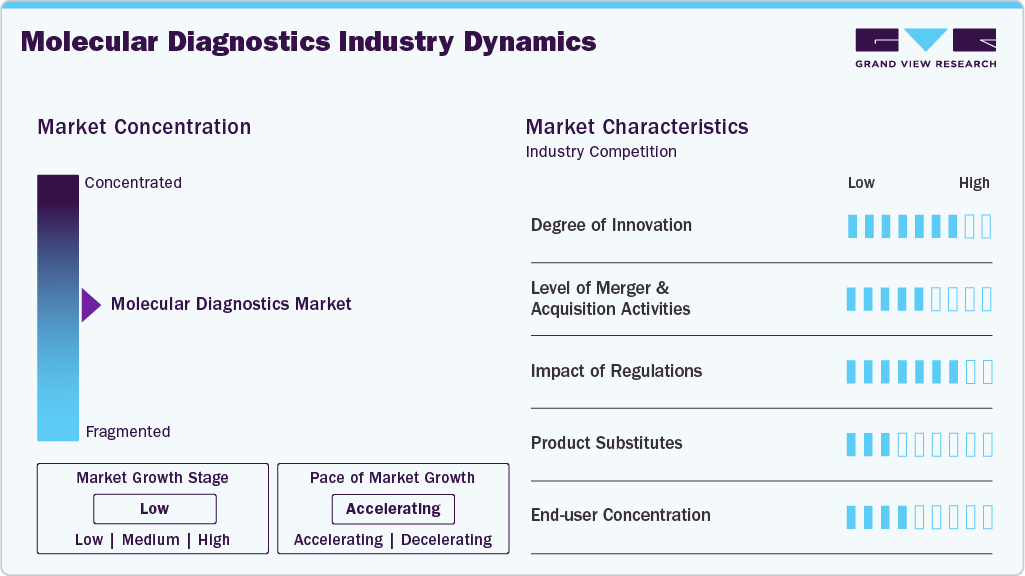
The molecular diagnostics market is currently at a low growth stage, with expansion supported by the growing geriatric population, increasing demand for point-of-care testing, rising R&D investments, and the introduction of technologically advanced diagnostic products.
Innovation remains a key characteristic of the molecular diagnostics industry, as companies continue to develop advanced solutions to strengthen their competitive position and broaden their product portfolios.
 To learn more about this report, Download Free Sample Report
 Regulatory requirements have a significant impact on market development, creating both opportunities and challenges for industry participants. Efficient regulatory frameworks can accelerate product approvals, encourage innovation, and support the availability of high-quality diagnostic tests. Conversely, stringent requirements can extend development timelines and increase costs, potentially restricting access to advanced diagnostic technologies. For instance, a February 2024 article published by Yale School of Medicine highlighted concerns among Yale experts regarding the FDA’s proposed regulation of laboratory-developed tests (LDTs). According to the experts, the proposed framework could restrict access to critical diagnostics, particularly for rare diseases, while potentially increasing costs and limiting rapid responses during public health emergencies.
Mergers and acquisitions (M&A) represent another important strategic activity in the molecular diagnostics market. Companies are pursuing acquisitions to strengthen their diagnostic portfolios, access complementary technologies, and expand their presence across high-value testing segments. For instance, in January 2023, Thermo Fisher Scientific completed the acquisition of The Binding Site Group, strengthening its specialty diagnostics business, particularly in oncology testing for multiple myeloma. The transaction expanded Thermo Fisher’s diagnostic capabilities and supported the development and availability of advanced testing solutions.
The threat of substitutes in molecular diagnostics is significant because alternative approaches, including immunoassays and conventional microbiology testing, are widely available. However, the overall threat remains moderate, as molecular diagnostics offer high accuracy and specificity, which are particularly valuable for early disease detection and personalized treatment. Continued technological development and growing demand for rapid point-of-care testing are further strengthening the position of molecular diagnostics relative to alternative testing methods.
The molecular diagnostics market also exhibits significant end-user concentration, with hospitals, diagnostic laboratories, research institutions, and other healthcare facilities representing the primary users. Hospitals remain particularly important due to increasing patient volumes, growing demand for advanced diagnostic testing, and government support for modern healthcare technologies. The concentration of demand among these facilities highlights their central role in the adoption, implementation, and utilization of molecular diagnostic technologies.
Analyst Perspective
The molecular diagnostics market is expanding as healthcare providers increasingly adopt advanced diagnostic technologies for the early and accurate detection of diseases. The rising prevalence of infectious diseases, cancer, and genetic disorders is driving demand for molecular testing across hospitals, diagnostic laboratories, and research institutions. Technological advancements in polymerase chain reaction (PCR), next-generation sequencing (NGS), and other molecular testing platforms are improving diagnostic accuracy, turnaround times, and the ability to identify disease-specific biomarkers. The growing use of companion diagnostics and personalized medicine is further expanding the role of molecular diagnostics in treatment selection and patient management. Companies with strong testing capabilities, broad product portfolios, and established laboratory partnerships are well-positioned to benefit from continued adoption. In the coming years, market growth will be supported by increasing demand for early diagnosis, expansion of precision medicine, and continued innovation in molecular testing technologies.
Product Insights
The reagents segment accounted for the largest market share of 65.5% in 2025, and is projected to grow at the fastest CAGR of 4.3% over the forecast period. The rising need for accurate and efficient diagnostic solutions across oncology, infectious diseases, genetic disorders, and other healthcare applications is driving growth. Reagents, including enzymes, probes, primers, and buffers, are essential for molecular diagnostic techniques such as polymerase chain reaction (PCR), next-generation sequencing (NGS), and digital PCR. Ongoing product innovation and the introduction of new testing solutions by leading market participants are further supporting segment expansion. For instance, in April 2023, Cepheid, a subsidiary of Danaher, announced plans to introduce new infectious disease tests covering respiratory illnesses and tuberculosis. Such developments are expected to enhance testing efficiency, improve standardization of results, and lower diagnostic costs, thereby supporting market growth.
The instruments segment is also expected to experience significant growth over the forecast period, supported by increasing demand for early and accurate disease detection, particularly in oncology, infectious diseases, and genetic disorders. Molecular technologies such as PCR, NGS, and microarrays play an important role in the diagnosis of diseases, including cancer, HIV, and genetic conditions. The anticipated increase in the global cancer burden is expected to further strengthen demand for advanced diagnostic instruments. With global cancer cases projected to reach 30 million new cases by 2040 and cancer diagnoses in the Americas expected to reach 6.23 million, representing a 57% increase, healthcare providers are likely to require increasingly sophisticated molecular diagnostic technologies for timely and accurate disease detection.
Test Location Insights
The central laboratories segment accounted for the largest share of the molecular diagnostics industry in 2025, supported by ongoing advancements in laboratory technologies, particularly automation and system integration, which are improving testing efficiency, capacity, and throughput. Their ability to process high volumes of samples while delivering timely and accurate results makes them critical to disease diagnosis, monitoring, and personalized medicine. Continued development of laboratory-based molecular diagnostic solutions by leading companies is also supporting segment growth. For instance, in September 2024, QIAGEN introduced the QIAcuityDx Digital PCR System, an advanced molecular diagnostic platform designed for clinical testing in oncology. The system enables precise DNA and RNA quantification and supports applications such as cancer monitoring through liquid biopsies. Its integrated partitioning, thermocycling, and imaging capabilities help reduce laboratory space requirements and costs while improving throughput, precision, and processing speed.
The self-test or over-the-counter (OTC) segment is expected to grow at the fastest CAGR over the forecast period, driven by increasing consumer interest in convenient, at-home health monitoring and diagnostic solutions. These tests allow individuals to conduct certain diagnostic procedures independently, reducing the need for clinical visits or professional intervention. Growing emphasis on convenience, privacy, accessibility, and affordable healthcare is encouraging the use of self-test kits for applications such as infectious disease detection, genetic testing, and wellness monitoring. Improvements in test accuracy, simplicity, and ease of use are further increasing consumer acceptance, supporting the segment’s growing role in decentralized and personalized healthcare.
Technology Insights
The PCR segment accounted for the largest market share of 62.2% in 2025, supported by its broad range of applications and continued technological advancement. PCR encompasses techniques such as quantitative PCR, reverse transcription PCR, inverse PCR, and multiplex PCR, with multiplex PCR gaining preference for its ability to simultaneously detect multiple targets. Real-time PCR is also increasingly used for cancer marker analysis, supporting the adoption of high-throughput PCR platforms for cancer diagnostics. Further, the emergence of digital PCR systems is contributing to segment expansion. For instance, in 2023, Thermo Fisher Scientific introduced the QuantStudio Absolute Q AutoRun dPCR Suite, which automates laboratory workflows to improve operational efficiency and reduce costs. Similarly, Roche launched the Digital LightCycler System in 2022, offering advanced capabilities for cancer detection.
The ISH segment is projected to grow at the fastest CAGR over the forecast period, driven by the introduction of advanced probes for applications such as B-cell lymphoma and human papillomavirus (HPV) detection. These solutions improve diagnostic precision and expand the use of ISH technology across clinical and cancer diagnostics. For instance, in May 2023, Bio-Techne introduced Kappa and Lambda RNAscope ISH Probes as analyte-specific reagents (ASRs) to detect immunoglobulin kappa and lambda light-chain mRNA in B cells. The probes support the assessment of B-cell clonality, an important factor in diagnosing B-cell lymphomas, and provide high sensitivity in formalin-fixed, paraffin-embedded (FFPE) tissue samples. Their compatibility with laboratory-developed tests (LDTs) and compliance with GMP standards further support their use in clinical diagnostics and research.
Application Insights
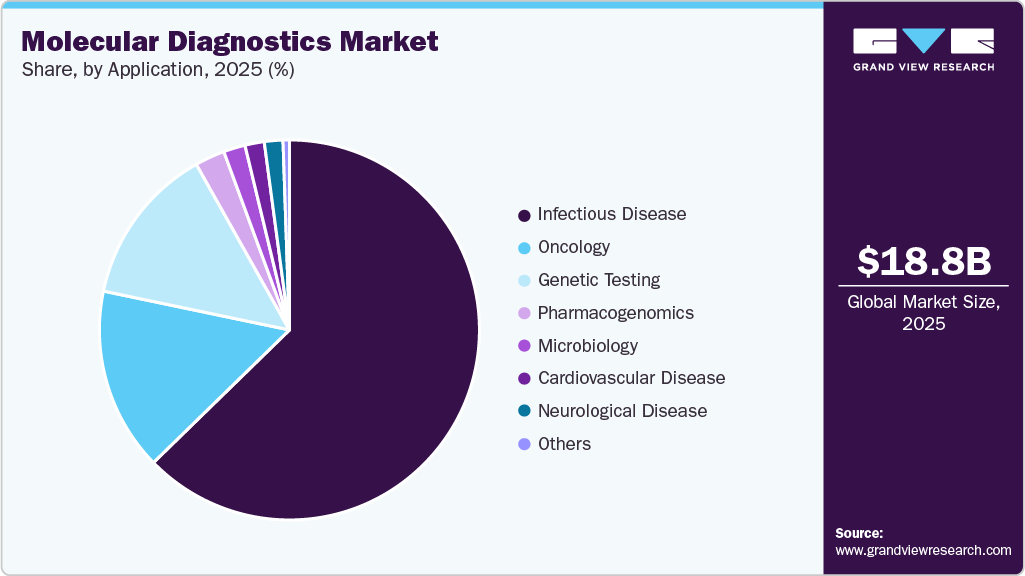
The infectious disease segment accounted for the largest share of the molecular diagnostics industry in 2025, driven by the growing need for rapid and reliable pathogen detection. Molecular diagnostic technologies, including polymerase chain reaction (PCR) and next-generation sequencing (NGS), have improved the identification of infectious agents and enabled more efficient diagnosis of tuberculosis, HIV, and various viral infections compared with conventional culture-based methods. Continued innovation by market participants is also supporting segment growth through the development of faster and more accurate testing solutions. Multiplex PCR is widely used to detect pathogens associated with HIV-1, HIV-2 (HIV-AIDS), HSV-1 and HSV-2 (meningitis and encephalitis), H. influenzae and S. pneumoniae (respiratory infections), N. gonorrhoeae and C. trachomatis (genital infections), C. parvum (diarrheal diseases), and Leishmania spp. Products such as Roche Diagnostics' Cobas CT/NG, Abbott's RealTime CT/NG Assay, and Hologic's Aptima STIs support the diagnosis of these infections. In addition, advanced multiplex solutions such as the Randox STI assay enable the simultaneous detection of multiple sexually transmitted infections, supporting demand for more efficient infectious disease diagnostics.
 To learn more about this report, Download Free Sample Report
 The oncology segment is expected to grow at the fastest CAGR over the forecast period, supported by increasing demand for early cancer detection, personalized treatment, and monitoring of therapeutic responses. Advances in oncology research and cancer drug discovery are increasing the use of molecular diagnostics based on biomarkers associated with cancer-causing genes and their manifestations. The identification of predictive biomarkers can facilitate earlier cancer diagnosis and help healthcare providers select more targeted treatment approaches. As precision medicine continues to gain importance in cancer care, molecular diagnostic technologies are becoming increasingly relevant for patient stratification, treatment selection, and disease monitoring. These factors are expected to create substantial growth opportunities for the application of molecular diagnostics in oncology and support the segment's rapid expansion.
Regional Insights
North America dominated the global molecular diagnostics market, representing a revenue share of 44.1% in 2025. The region’s leadership is supported by the increasing adoption of molecular diagnostic technologies due to their high accuracy, sensitivity, and specificity. Growing demand for genetic testing is also contributing to regional expansion, particularly as personalized healthcare gains importance in the management of conditions such as diabetes and cancer. In addition, supportive regulatory policies for advanced diagnostic technologies and increasing collaborations between pharmaceutical companies and molecular diagnostic providers are creating new growth opportunities. Companion diagnostic development is a key area of collaboration in the region. For instance, in November 2024, Fluxergy announced its use of the National Institute of Allergy and Infectious Diseases' (NIAID) in-kind Diagnostics Development Services to advance molecular testing and sample preparation on the Fluxergy platform. Through NIAID's preclinical services, contractors will evaluate advanced nucleic acid extraction and purification methods optimized for Fluxergy's Test Card.
 To learn more about this report, Download Free Sample Report
 The U.S. molecular diagnostics market is supported by the presence of major industry participants, favorable reimbursement conditions, an established R&D infrastructure, and the rising prevalence of diseases. The country’s substantial cancer burden is also expected to sustain demand for advanced molecular testing. According to the American Cancer Society, more than 2 million new cancer cases were projected to be diagnosed in the U.S. in 2024. This estimate excludes basal and squamous cell skin cancers, which are not required to be reported to cancer registries, as well as noninvasive carcinoma in situ, except for urinary bladder cases. The continued burden of cancer and other health conditions is expected to support the adoption of molecular diagnostic technologies across the country.
The molecular diagnostics market in Canada is expected to witness significant growth over the forecast period. Increasing cancer incidence is creating greater demand for advanced diagnostic technologies that can support earlier disease detection and personalized treatment decisions. According to the Canadian Cancer Society, approximately 247,100 Canadians were expected to be diagnosed with cancer in 2024, compared with 239,100 new cases in 2023. The increase is largely associated with the country’s growing and aging population. Cancer-related deaths were also projected to increase from 86,700 in 2023 to 88,100 in 2024. The rising disease burden is therefore expected to encourage greater use of molecular diagnostics for cancer detection, characterization, and treatment planning in Canada.
Europe Molecular Diagnostics Market Trends
The Europe molecular diagnostics industry is expanding amid the increasing burden of genetic and cardiovascular disorders and greater investment in proteomics and genomic research. Cardiovascular diseases (CVDs) remain a major health burden across the region. According to WHO data from 2024, CVDs are the leading cause of disability and premature death in the European Region, accounting for more than 42.5% of deaths annually, equivalent to approximately 10,000 deaths each day. The substantial and growing CVD burden is therefore expected to increase the need for molecular diagnostic testing for disease detection, risk assessment, and monitoring over the forecast period.
The UK molecular diagnostics market is supported by a well-developed healthcare infrastructure, relatively high disposable income, and increasing awareness of the benefits associated with early disease detection. Efforts to improve diagnostic capacity and reduce pressure on healthcare services are also contributing to market development. In April 2024, the rollout of community diagnostic centers (CDCs) across England aimed to reduce long waiting lists, improve value for taxpayers, and support the decarbonization of the NHS. Such initiatives to expand and improve diagnostic services are expected to strengthen the adoption of advanced testing technologies and support market growth in the country.
The molecular diagnostics market in Germany is driven by the increasing demand for rapid, highly accurate diagnostic solutions across key therapeutic areas, including infectious diseases, oncology, and genetic disorders. Demographic changes, particularly the expansion of the elderly population, are further increasing the need for advanced diagnostic technologies. According to UN population data, approximately one in every 20 people in Germany is aged over 80, and this proportion is projected to increase to one in every six individuals by 2050. The higher susceptibility of older populations to chronic conditions, including diabetes, cardiovascular diseases, and neurovascular disorders, due to aging and declining immune function, is expected to sustain demand for molecular diagnostics.
Asia Pacific Molecular Diagnostics Market Trends
The Asia Pacific molecular diagnostics industry is supported by the region’s high burden of infectious diseases, particularly tuberculosis (TB), drug-resistant TB, multidrug-resistant TB (MDR-TB), and rifampicin-resistant TB (RR-TB). According to the WHO Global TB Report 2023, the WHO South-East Asia (SEA) Region accounts for more than 45% of global annual TB incidence despite representing approximately one-fourth of the world’s population. In 2022, more than 4.8 million people in the region developed TB, while over 600,000 deaths were attributed to the disease, excluding HIV-related TB mortality. This accounted for more than half of global TB-related deaths. The continued disease burden, combined with improvements in healthcare infrastructure and a growing geriatric population, is expected to increase the adoption of molecular diagnostic technologies across the region.
The China molecular diagnostics market is benefiting from rising healthcare expenditure and the country’s large and growing population, which is contributing to an increasing burden of chronic diseases. Continued advances in genomics and proteomics research are also creating opportunities for molecular diagnostics by improving the understanding of disease risk and biological mechanisms. Following the completion of the Human Genome Project (HGP), global research efforts have increasingly focused on developing comprehensive catalogs of human proteins, supporting further advances in disease identification and personalized healthcare. These developments, along with the country’s expanding elderly population and improvements in the State Food & Drug Administration (FDA) regulatory policies, are expected to strengthen healthcare capabilities and create new opportunities for molecular diagnostics manufacturers in China.
Latin America Molecular Diagnostics Market Trends
The Latin America molecular diagnostics industry, comprising Brazil, Chile, Peru, Argentina, and Colombia, is expected to benefit from continued improvements in healthcare technology and diagnostic capabilities. Rising government spending on research and development (R&D), increasing interest from multinational medical device companies in the molecular diagnostics sector, and greater patient awareness of infectious diseases are creating favorable conditions for market expansion. In June 2025, Roche Diagnostics Mexico introduced a rapid molecular test for tuberculosis and a genomic sequencing system for oncology and personalized medicine at its TomorrowLab 2025 event. The developments enhance access to advanced molecular and genomic diagnostics in Mexico while supporting faster detection of infectious diseases and the expansion of precision medicine applications. These factors are expected to support the adoption of advanced molecular testing technologies across the region during the forecast period.
The Brazil molecular diagnostics market is experiencing strong growth as technological advancements coincide with increasing healthcare needs and supportive government policies. The country continues to face a substantial burden of infectious diseases, including dengue, Zika, HIV, and tuberculosis, while cancer also represents a major healthcare concern. The need for timely and reliable disease identification is therefore increasing. Molecular diagnostic methods, which offer higher sensitivity and specificity than conventional approaches, are gaining importance for the rapid detection and management of these conditions. Continued technological development and growing demand for accurate testing are expected to further strengthen the adoption of molecular diagnostics in Brazil.
Middle East and Africa Molecular Diagnostics Market Trends
The molecular diagnostics industry in the Middle East and Africa (MEA) is expanding as the prevalence of chronic and noncommunicable diseases, particularly cancer and cardiovascular diseases, continues to increase. According to WHO estimates, cancer incidence in the Middle East was expected to double by 2030 from 2020 levels. In addition, approximately 9 of the 22 countries in the MEA region lacked optimal operational facilities for cancer management, highlighting significant unmet diagnostic needs. Improving economic conditions and persistent gaps in healthcare access, particularly in emerging markets such as South Africa, are also creating opportunities for molecular diagnostic technologies. The need to strengthen disease detection and improve access to advanced diagnostic services is expected to support market development across the region.
The Saudi Arabia molecular diagnostics market is supported by the increasing prevalence of noncommunicable diseases, including cardiovascular diseases (CVDs) and diabetes, as well as the growing burden of cancer. According to ScienceDirect, the number of people affected by CVDs in the country is estimated to reach 479,500 by 2035. In addition, data from the International Diabetes Atlas indicated that more than 4.27 million people in Saudi Arabia had diabetes in 2021. The country was also anticipated to record more than 31,000 new cancer cases in 2023. The increasing burden of chronic diseases is creating a greater need for continuous diagnostic assessment to support disease detection, treatment planning, and monitoring. Consequently, rising disease prevalence is expected to generate additional opportunities for molecular diagnostics and related testing technologies in Saudi Arabia.
Competitive Landscape
Key market players are adopting strategic initiatives, including product launches, partnerships, collaborations, mergers & acquisitions, approvals, expansions, and other measures, to expand their presence in the global molecular diagnostics industry. These advancements in the molecular diagnostics industry are anticipated to boost market growth over the forecast period.
Key Molecular Diagnostics Companies:
The following key companies have been profiled for this study on the molecular diagnostics market.
Competitive Benchmarking
Operating Strategies
Competitive Edge
Weaknesses
Mature Players: BD
- Mature players focus on expanding automated PCR, NGS, and multiplex platforms. They emphasize different types of assay expansion, regulatory compliance, and collaborations to enhance clinical utility.
- Investments targeted high-throughput systems, decentralized testing, and scalable manufacturing to capture rising infectious disease, oncology, and genetic testing demand.
- These companies benefit from strong brand credibility, large installed instrument bases, and comprehensive assay portfolios across infectious disease, oncology, and genetic testing.
- Robust regulatory track records, global supply chains, and customer support programs further reinforced market dominance.
- Mature players may face challenges such as complex regulatory burdens, high pricing that limits adoption in emerging markets, and dependence on centralized laboratory infrastructure.
Emerging Players: Seegene, Inc.
- Emerging players focus on rapid assay development, flexible manufacturing, and partnerships with instrument providers to accelerate commercialization.
- They prioritize niche infectious disease panels, decentralized testing solutions, and open-platform compatibility. In addition, many utilize cloud-based analytics, sample-to-answer platforms, and regional regulatory pathways to shorten launch timelines and strengthen adoption in underserved markets.
- Their smaller scale benefits from technological agility, cost-efficient workflows, and specialization in novel or underserved diagnostic areas. Emerging firms outperformed larger competitors by offering open-system assays, faster turnaround times, and customizable multiplex panels.
- Strong R&D-to-market speed, ability to pivot during outbreaks, and integration of AI-driven analytics further enhanced their value proposition for laboratories.
- Emerging players face constraints such as limited global distribution, constrained manufacturing capacity, and dependence on strategic partnerships for scale.
Recent Developments
-
In August 2026, QIAGEN launched QIAsymphony Connect for automated clinical nucleic-acid extraction. The system is designed to standardize DNA and RNA extraction across workflows, including liquid biopsy, oncology, and infectious disease diagnostics, supporting greater automation and workflow consistency in clinical molecular laboratories.
-
In June 2026, Roche reported developing a research-use-only molecular PCR test for the Bundibugyo species of Ebola virus within six days. The test was developed for use on Roche's LightCycler and cobas z 480 systems and demonstrates the ability of molecular diagnostic platforms to respond rapidly to emerging infectious-disease threats.
-
In March 2026, Abbott completed the acquisition of Exact Sciences for approximately USD 21 billion, strengthening its position in cancer screening and diagnostics segments. The transaction is expected to expand Abbott’s cancer diagnostics portfolio and accelerate the integration of advanced testing solutions across the cancer care continuum.
-
In February 2026, QIAGEN unveiled QIAsprint Connect, an automated high-throughput system designed to expand laboratory automation and complement its existing nucleic-acid extraction platforms. The company also indicated plans to introduce additional automated extraction systems during 2026, supporting the broader automation of molecular testing workflows.
-
In November 2025, Roche collaborated with Sapphiros to expand access to rapid diagnostic technologies, including lateral flow testing and next-generation molecular point-of-care platforms. The collaboration supports Roche’s strategy of expanding decentralized and rapid diagnostics while strengthening access to testing technologies across global healthcare markets.
-
In October 2025, the World Health Organization (WHO) prequalified BD Onclarity HPV Assay for the BD COR and BD Viper LT systems, expanding access to high-quality molecular HPV testing in low- and middle-income countries. The assay provides extended genotyping of high-risk HPV types and supports self-collection options, strengthening the availability of molecular cervical cancer screening solutions in resource-limited settings.
-
In January 2025, bioMérieux received U.S. FDA clearance for its BIOFIRE FILMARRAY Gastrointestinal (GI) Panel Mid, a multiplex PCR molecular diagnostic panel capable of simultaneously testing for 11 common bacterial, viral, and parasitic causes of gastroenteritis from a single sample, with results available in approximately one hour. The development strengthens the role of syndromic molecular testing in rapid infectious-disease diagnosis and supports the expansion of multiplex PCR applications.
Value Chain Analysis
The molecular diagnostics market value chain comprises raw material and reagent suppliers, molecular diagnostics manufacturers, technology providers, distributors, clinical laboratories, healthcare providers, and end users. Raw material and reagent suppliers provide enzymes, nucleotides, primers, probes, antibodies, buffers, sample preparation materials, and other consumables required for molecular testing. Technology providers supply PCR and NGS platforms, digital PCR systems, automation, microfluidics, and diagnostic software that support sample preparation, amplification, sequencing, data analysis, and result interpretation. These technologies enable the development of increasingly accurate, automated, and integrated diagnostic workflows.
Molecular diagnostics manufacturers design, develop, manufacture, and commercialize diagnostic instruments, test kits, reagents, assays, and related consumables. Companies invest in PCR, NGS, digital PCR, multiplex testing, and isothermal amplification technologies to improve sensitivity, accuracy, testing speed, and workflow efficiency. Products are distributed directly to hospitals and laboratories or through distributors and specialized laboratory suppliers. Technical support, training, instrument maintenance, and assay development services further support customer relationships and product adoption.
Clinical laboratories and diagnostic service providers perform molecular tests across infectious diseases, oncology, genetic disorders, and other applications. Growing adoption of automated and point-of-care testing enables healthcare facilities to integrate molecular diagnostics with digital systems and rapid testing platforms. Hospitals, diagnostic centers, physician practices, and specialized laboratories select products based on clinical requirements, test performance, turnaround time, workflow compatibility, regulatory considerations, and cost. Healthcare professionals use diagnostic results to support disease detection, treatment selection, monitoring, and patient management. Patients represent the final end users, benefiting from earlier diagnosis, improved disease monitoring, and increasingly personalized treatment. Greater integration across manufacturers, technology providers, laboratories, and healthcare professionals is supporting more efficient testing workflows and expanding access to advanced molecular diagnostics.
Molecular Diagnostics Market Report Scope
Report Attribute
Details
Market size in 2025
USD 18.8 billion
Estimated market size in 2026
USD 19.4 billion
Projected market size by 2033
USD 25.6 billion
Growth rate
CAGR of 4.1% from 2026 to 2033
Base year for estimation
2025
Historical data
2021 - 2024
Forecast period
2026 - 2033
Quantitative units
Revenue in USD million/billion, and CAGR from 2026 to 2033
Report coverage
Revenue forecast, company ranking, competitive landscape, growth factors, and trends
Segments covered
Product, test location, technology, application, and region
Regional Scope
North America; Europe; Asia Pacific; Latin America; Middle East & Africa
Country Scope
U.S.; Canada; Mexico; UK; Germany; France; Spain; Italy; Belgium; Switzerland; Netherlands; Portugal; Denmark; Sweden; Turkey; Norway; Japan; China; India; Australia; Indonesia; South Korea; Malaysia; Thailand; Vietnam; Brazil; Colombia; Chile; Peru; Argentina; Ecuador; South Africa; Saudi Arabia; UAE; Kuwait
Key companies profiled
BD; BIOMÉRIEUX; Bio-Rad Laboratories, Inc.; Abbott; Agilent Technologies, Inc.; Danaher; Hologic Inc. Illumina, Inc.; Grifols; QIAGEN; F. Hoffmann-La Roche, Ltd.; Siemens Healthineers AG; Sysmex Corporation; Seegene Inc; EliTechGroup; CERTEST BIOTEC
Customization scope
Free report customization (equivalent to up to 8 analysts working days) with purchase. Addition or alteration to country, regional & segment scope.
Pricing and purchase options
Avail of customized purchase options to meet your exact research needs. Explore purchase options
Global Molecular Diagnostics Market Report Segmentation
This report forecasts revenue growth at the global, regional, and country levels and provides an analysis of the latest industry trends across sub-segments from 2021 to 2033. For this study, Grand View Research has segmented the global molecular diagnostics market report based on product, test location, technology, application, and region.
Global Molecular Diagnostics Market Report - Table of Contents
Table of Contents
Chapter 1. Methodology and Scope
1.1. Methodology segmentation & scope
1.2. Market Definitions
1.3. Research Methodology
1.3.1. Information Procurement
1.3.2. Information or Data Analysis
1.3.3. Market Formulation & Data Visualization
1.3.4. Data Validation & Publishing
1.4. Research Scope and Assumptions
1.4.1. List of Data Sources
Chapter 2. Executive Summary
2.1. Market Outlook
2.2. Segment Outlook
2.3. Competitive Insights
Chapter 3. Molecular Diagnostics Variables, Trends & Scope
3.1. Market Lineage Outlook
3.1.1. Parent Market Outlook
3.1.2. Related/ancillary market outlook
3.2. Market Dynamics
3.2.1. Market Driver Analysis
3.2.1.1. Introduction of technologically advanced products
3.2.1.2. Increase in demand for point-of-care Testing
3.2.1.3. Growing prevalence of target diseases
3.2.1.4. Increasing external funding for R&D
3.2.1.5. Outbreak of COVID-19
3.2.1.6. Increase in geriatric population
3.2.2. Market Restraint Analysis
3.2.2.1. Presence of an ambiguous regulatory framework
3.2.2.2. High prices of molecular diagnostics tests
3.3. Molecular Diagnostics Analysis Tools
3.3.1. Industry Analysis - Porter’s
3.3.1.1. Bargaining power of suppliers
3.3.1.2. Bargaining power of buyers
3.3.1.3. Threat of substitutes
3.3.1.4. Threat of new entrants
3.3.1.5. Competitive rivalry
3.3.2. PESTEL Analysis
3.3.2.1. Political landscape
3.3.2.2. Economic landscape
3.3.2.3. Social landscape
3.3.2.4. Technological landscape
3.3.2.5. Environmental landscape
3.3.2.6. Legal landscape
Chapter 4. Molecular Diagnostics Market: Segment Analysis, By Product, 2021 - 2033 (USD Million/Billion)
4.1. Definition and Scope
4.2. Product Market Share Analysis, 2025 & 2033
4.3. Molecular Diagnostics Market, by Product, 2021 to 2033
4.4. Market Size & Forecasts and Trend Analyses, 2021 to 2033
4.4.1. Instruments
4.4.1.1. Instruments market estimates and forecasts, 2021 - 2033 (USD Million/Billion)
4.4.2. Reagents
4.4.2.1. Reagents market estimates and forecasts, 2021 - 2033 (USD Million/Billion)
4.4.3. Others
4.4.3.1. Others market estimates and forecasts, 2021 - 2033 (USD Million/Billion)
Chapter 5. Molecular Diagnostics Market: Segment Analysis, By Test Location, 2021 - 2033 (USD Million/Billion)
5.1. Definition and Scope
5.2. Test Location Market Share Analysis, 2025 & 2033
5.3. Global Molecular Diagnostics Market, by Test Location, 2021 to 2033
5.4. Market Size & Forecasts and Trend Analyses, 2021 to 2033
5.4.1. Point of care
5.4.1.1. Point of care market estimates and forecasts, 2021 - 2033 (USD Million/Billion)
5.4.2. Self test or OTC
5.4.2.1. Self test or OTC market estimates and forecasts, 2021 - 2033 (USD Million/Billion)
5.4.3. Central laboratories
5.4.3.1. Central laboratories market estimates and forecasts, 2021 - 2033 (USD Million/Billion)
Chapter 6. Molecular Diagnostics Market: Segment Analysis, By Technology, 2021 - 2033 (USD Million/Billion)
6.1. Definition and Scope
6.2. Technology Market Share Analysis, 2025 & 2033
6.3. Global Molecular Diagnostics Market, by Technology, 2021 to 2033
6.4. Market Size & Forecasts and Trend Analyses, 2021 to 2033
6.4.1. PCR
6.4.1.1. PCR market estimates and forecasts, 2021 - 2033 (USD Million/Billion)
6.4.1.2. By procedure
6.4.1.2.1. Nucleic acid extraction
6.4.1.2.1.1. Nucleic acid extraction market estimates and forecasts, 2021 - 2033 (USD Million/Billion)
6.4.1.2.2. Others
6.4.1.2.2.1. Others market estimates and forecasts, 2021 - 2033 (USD Million/Billion)
6.4.1.3. By type
6.4.1.3.1. Multiplex
6.4.1.3.1.1. Multiplex market estimates and forecasts, 2021 - 2033 (USD Million/Billion)
6.4.1.3.2. Others
6.4.1.3.2.1. Others market estimates and forecasts, 2021 - 2033 (USD Million/Billion)
6.4.1.4. By product
6.4.1.4.1. Instruments
6.4.1.4.1.1. Instruments market estimates and forecasts, 2021 - 2033 (USD Million/Billion)
6.4.1.4.2. Reagents
6.4.1.4.2.1. Reagents market estimates and forecasts, 2021 - 2033 (USD Million/Billion)
6.4.1.4.3. Others
6.4.1.4.3.1. Others market estimates and forecasts, 2021 - 2033 (USD Million/Billion)
6.4.2. ISH
6.4.2.1. ISH market estimates and forecasts, 2021 - 2033 (USD Million/Billion)
6.4.2.2. Instruments
6.4.2.2.1. Instruments market estimates and forecasts, 2021 - 2033 (USD Million/Billion)
6.4.2.3. Reagents
6.4.2.3.1. Reagents market estimates and forecasts, 2021 - 2033 (USD Million/Billion)
6.4.2.4. Others
6.4.2.4.1. Others market estimates and forecasts, 2021 - 2033 (USD Million/Billion)
6.4.3. INAAT
6.4.3.1. INAAT market estimates and forecasts, 2021 - 2033 (USD Million/Billion)
6.4.3.2. Instruments
6.4.3.2.1. Instruments market estimates and forecasts, 2021 - 2033 (USD Million/Billion)
6.4.3.3. Reagents
6.4.3.3.1. Reagents market estimates and forecasts, 2021 - 2033 (USD Million/Billion)
6.4.3.4. Others
6.4.3.4.1. Others market estimates and forecasts, 2021 - 2033 (USD Million/Billion)
6.4.4. Chips and microarrays
6.4.4.1. Chips and microarrays market estimates and forecasts, 2021 - 2033 (USD Million/Billion)
6.4.4.2. Instruments
6.4.4.2.1. Instruments market estimates and forecasts, 2021 - 2033 (USD Million/Billion)
6.4.4.3. Reagents
6.4.4.3.1. Reagents market estimates and forecasts, 2021 - 2033 (USD Million/Billion)
6.4.4.4. Others
6.4.4.4.1. Others market estimates and forecasts, 2021 - 2033 (USD Million/Billion)
6.4.5. Mass spectrometry
6.4.5.1. Mass spectrometry market estimates and forecasts, 2021 - 2033 (USD Million/Billion)
6.4.5.2. Instruments
6.4.5.2.1. Instruments market estimates and forecasts, 2021 - 2033 (USD Million/Billion)
6.4.5.3. Reagents
6.4.5.3.1. Reagents market estimates and forecasts, 2021 - 2033 (USD Million/Billion)
6.4.5.4. Others
6.4.5.4.1. Others market estimates and forecasts, 2021 - 2033 (USD Million/Billion)
6.4.6. Sequencing
6.4.6.1. Sequencing market estimates and forecasts, 2021 - 2033 (USD Million/Billion)
6.4.6.2. Instruments
6.4.6.2.1. Instruments market estimates and forecasts, 2021 - 2033 (USD Million/Billion)
6.4.6.3. Reagents
6.4.6.3.1. Reagents market estimates and forecasts, 2021 - 2033 (USD Million/Billion)
6.4.6.4. Others
6.4.6.4.1. Others market estimates and forecasts, 2021 - 2033 (USD Million/Billion)
6.4.7. TMA
6.4.7.1. TMA market estimates and forecasts, 2021 - 2033 (USD Million/Billion)
6.4.7.2. Instruments
6.4.7.2.1. Instruments market estimates and forecasts, 2021 - 2033 (USD Million/Billion)
6.4.7.3. Reagents
6.4.7.3.1. Reagents market estimates and forecasts, 2021 - 2033 (USD Million/Billion)
6.4.7.4. Others
6.4.7.4.1. Others market estimates and forecasts, 2021 - 2033 (USD Million/Billion)
6.4.8. Others
6.4.8.1. Others market estimates and forecasts, 2021 - 2033 (USD Million/Billion)
6.4.8.2. Instruments
6.4.8.2.1. Instruments market estimates and forecasts, 2021 - 2033 (USD Million/Billion)
6.4.8.3. Reagents
6.4.8.3.1. Reagents market estimates and forecasts, 2021 - 2033 (USD Million/Billion)
6.4.8.4. Others
6.4.8.4.1. Others market estimates and forecasts, 2021 - 2033 (USD Million/Billion)
Chapter 7. Molecular Diagnostics Market: Segment Analysis, By Application, 2021 - 2033 (USD Million/Billion)
7.1. Definition and Scope
7.2. Application Market Share Analysis, 2025 & 2033
7.3. Global Molecular Diagnostics Market, by Application,2021 to 2033
7.4. Market Size & Forecasts and Trend Analyses, 2021 to 2033
7.4.1. Oncology
7.4.1.1. Oncology market estimates and forecasts, 2021 - 2033 (USD Million/Billion)
7.4.1.2. Breast cancer
7.4.1.2.1. Breast cancer market estimates and forecasts, 2021 - 2033 (USD Million/Billion)
7.4.1.3. Prostate cancer
7.4.1.3.1. Prostate cancer market estimates and forecasts, 2021 - 2033 (USD Million/Billion)
7.4.1.4. Colorectal cancer
7.4.1.4.1. Colorectal cancer market estimates and forecasts, 2021 - 2033 (USD Million/Billion)
7.4.1.5. Cervical
7.4.1.5.1. Cervical market estimates and forecasts, 2021 - 2033 (USD Million/Billion)
7.4.1.6. Kidney
7.4.1.6.1. Kidney market estimates and forecasts, 2021 - 2033 (USD Million/Billion)
7.4.1.7. Liver
7.4.1.7.1. Liver market estimates and forecasts, 2021 - 2033 (USD Million/Billion)
7.4.1.8. Blood
7.4.1.8.1. Blood market estimates and forecasts, 2021 - 2033 (USD Million/Billion)
7.4.1.9. Lung
7.4.1.9.1. Lung market estimates and forecasts, 2021 - 2033 (USD Million/Billion)
7.4.1.10. Other
7.4.1.10.1. Other market estimates and forecasts, 2021 - 2033 (USD Million/Billion)
7.4.2. Pharmacogenomics
7.4.2.1. Pharmacogenomics market estimates and forecasts, 2021 - 2033 (USD Million/Billion)
7.4.3. Infectious disease
7.4.3.1. Infectious disease market estimates and forecasts, 2021 - 2033 (USD Million/Billion)
7.4.3.2. MRSA
7.4.3.2.1. MRSA market estimates and forecasts, 2021 - 2033 (USD Million/Billion)
7.4.3.3. Clostridium difficile
7.4.3.3.1. Clostridium difficile market estimates and forecasts, 2021 - 2033 (USD Million/Billion)
7.4.3.4. Vancomycin-resistant enterococci
7.4.3.4.1. Vancomycin-resistant enterococci market estimates and forecasts, 2021 - 2033 (USD Million/Billion)
7.4.3.5. Carbapenem-resistant bacteria testing
7.4.3.5.1. Carbapenem-resistant bacteria testing market estimates and forecasts, 2021 - 2033 (USD Million/Billion)
7.4.3.6. Flu
7.4.3.6.1. Flu market estimates and forecasts, 2021 - 2033 (USD Million/Billion)
7.4.3.7. Respiratory syncytial virus (RSV)
7.4.3.7.1. Respiratory syncytial virus (RSV) market estimates and forecasts, 2021 - 2033 (USD Million/Billion)
7.4.3.8. Candida
7.4.3.8.1. Candida market estimates and forecasts, 2021 - 2033 (USD Million/Billion)
7.4.3.9. Tuberculosis and drug-resistant TB
7.4.3.9.1. Tuberculosis and drug-resistant TB market estimates and forecasts, 2021 - 2033 (USD Million/Billion)
7.4.3.10. Meningitis
7.4.3.10.1. Meningitis market estimates and forecasts, 2021 - 2033 (USD Million/Billion)
7.4.3.11. Gastrointestinal panel testing
7.4.3.11.1. Gastro-intestinal panel testing market estimates and forecasts, 2021 - 2033 (USD Million/Billion)
7.4.3.12. Chlamydia
7.4.3.12.1. Chlamydia market estimates and forecasts, 2021 - 2033 (USD Million/Billion)
7.4.3.13. Gonorrhea
7.4.3.13.1. Gonorrhea market estimates and forecasts, 2021 - 2033 (USD Million/Billion)
7.4.3.14. HIV
7.4.3.14.1. HIV market estimates and forecasts, 2021 - 2033 (USD Million/Billion)
7.4.3.15. Hepatitis C
7.4.3.15.1. Hepatitis C market estimates and forecasts, 2021 - 2033 (USD Million/Billion)
7.4.3.16. Hepatitis B
7.4.3.16.1. Hepatitis B market estimates and forecasts, 2021 - 2033 (USD Million/Billion)
7.4.3.17. Other infectious diseases
7.4.3.17.1. Other infectious diseases market estimates and forecasts, 2021 - 2033 (USD Million/Billion)
7.4.4. Genetic testing
7.4.4.1. Genetic testing market estimates and forecasts, 2021 - 2033 (USD Million/Billion)
7.4.4.2. Newborn screening
7.4.4.2.1. Newborn screening market estimates and forecasts, 2021 - 2033 (USD Million/Billion)
7.4.4.3. Predictive and presymptomatic testing
7.4.4.3.1. Predictive and presymptomatic testing market estimates and forecasts, 2021 - 2033 (USD Million/Billion)
7.4.4.4. Others
7.4.4.4.1. Others market estimates and forecasts, 2021 - 2033 (USD Million/Billion)
7.4.5. Neurological disease
7.4.5.1. Neurological disease market estimates and forecasts, 2021 - 2033 (USD Million/Billion)
7.4.6. Cardiovascular disease
7.4.6.1. Cardiovascular disease market estimates and forecasts, 2021 - 2033 (USD Million/Billion)
7.4.7. Microbiology
7.4.7.1. Microbiology market estimates and forecasts, 2021 - 2033 (USD Million/Billion)
7.4.8. Others
7.4.8.1. Others market estimates and forecasts, 2021 - 2033 (USD Million/Billion)
Chapter 8. Molecular Diagnostics Market: Regional Estimates & Trend Analysis
8.1. Regional Dashboard
8.2. Market Size, & Forecasts Trend Analysis, 2021 to 2033
8.3. North America
8.3.1. U.S.
8.3.1.1. Key country dynamics
8.3.1.2. Regulatory framework/ reimbursement structure
8.3.1.3. Competitive scenario
8.3.1.4. U.S. market estimates and forecasts 2021 to 2033 (USD Million/Billion)
8.3.2. Canada
8.3.2.1. Key country dynamics
8.3.2.2. Regulatory framework/ reimbursement structure
8.3.2.3. Competitive scenario
8.3.2.4. Canada market estimates and forecasts 2021 to 2033 (USD Million/Billion)
8.3.3. Mexico
8.3.3.1. Key country dynamics
8.3.3.2. Regulatory framework/ reimbursement structure
8.3.3.3. Competitive scenario
8.3.3.4. Mexico market estimates and forecasts 2021 to 2033 (USD Million/Billion)
8.4. Europe
8.4.1. UK
8.4.1.1. Key country dynamics
8.4.1.2. Regulatory framework/ reimbursement structure
8.4.1.3. Competitive scenario
8.4.1.4. UK market estimates and forecasts 2021 to 2033 (USD Million/Billion)
8.4.2. Germany
8.4.2.1. Key country dynamics
8.4.2.2. Regulatory framework/ reimbursement structure
8.4.2.3. Competitive scenario
8.4.2.4. Germany market estimates and forecasts 2021 to 2033 (USD Million/Billion)
8.4.3. France
8.4.3.1. Key country dynamics
8.4.3.2. Regulatory framework/ reimbursement structure
8.4.3.3. Competitive scenario
8.4.3.4. France market estimates and forecasts 2021 to 2033 (USD Million/Billion)
8.4.4. Spain
8.4.4.1. Key country dynamics
8.4.4.2. Regulatory framework/ reimbursement structure
8.4.4.3. Competitive scenario
8.4.4.4. Spain market estimates and forecasts 2021 to 2033 (USD Million/Billion)
8.4.5. Italy
8.4.5.1. Key country dynamics
8.4.5.2. Regulatory framework/ reimbursement structure
8.4.5.3. Competitive scenario
8.4.5.4. Italy market estimates and forecasts 2021 to 2033 (USD Million/Billion)
8.4.6. Belgium
8.4.6.1. Key country dynamics
8.4.6.2. Regulatory framework/ reimbursement structure
8.4.6.3. Competitive scenario
8.4.6.4. Belgium market estimates and forecasts 2021 to 2033 (USD Million/Billion)
8.4.7. Switzerland
8.4.7.1. Key country dynamics
8.4.7.2. Regulatory framework/ reimbursement structure
8.4.7.3. Competitive scenario
8.4.7.4. Switzerland market estimates and forecasts 2021 to 2033 (USD Million/Billion)
8.4.8. Netherlands
8.4.8.1. Key country dynamics
8.4.8.2. Regulatory framework/ reimbursement structure
8.4.8.3. Competitive scenario
8.4.8.4. Netherlands market estimates and forecasts 2021 to 2033 (USD Million/Billion)
8.4.9. Portugal
8.4.9.1. Key country dynamics
8.4.9.2. Regulatory framework/ reimbursement structure
8.4.9.3. Competitive scenario
8.4.9.4. Portugal market estimates and forecasts 2021 to 2033 (USD Million/Billion)
8.4.10. Denmark
8.4.10.1. Key country dynamics
8.4.10.2. Regulatory framework/ reimbursement structure
8.4.10.3. Competitive scenario
8.4.10.4. Denmark market estimates and forecasts 2021 to 2033 (USD Million/Billion)
8.4.11. Sweden
8.4.11.1. Key country dynamics
8.4.11.2. Regulatory framework/ reimbursement structure
8.4.11.3. Competitive scenario
8.4.11.4. Sweden market estimates and forecasts 2021 to 2033 (USD Million/Billion)
8.4.12. Turkey
8.4.12.1. Key country dynamics
8.4.12.2. Regulatory framework/ reimbursement structure
8.4.12.3. Competitive scenario
8.4.12.4. Turkey market estimates and forecasts 2021 to 2033 (USD Million/Billion)
8.4.13. Norway
8.4.13.1. Key country dynamics
8.4.13.2. Regulatory framework/ reimbursement structure
8.4.13.3. Competitive scenario
8.4.13.4. Norway market estimates and forecasts 2021 to 2033 (USD Million/Billion)
8.5. Asia Pacific
8.5.1. China
8.5.1.1. Key country dynamics
8.5.1.2. Regulatory framework/ reimbursement structure
8.5.1.3. Competitive scenario
8.5.1.4. China market estimates and forecasts 2021 to 2033 (USD Million/Billion)
8.5.2. Japan
8.5.2.1. Key country dynamics
8.5.2.2. Regulatory framework/ reimbursement structure
8.5.2.3. Competitive scenario
8.5.2.4. Japan market estimates and forecasts 2021 to 2033 (USD Million/Billion)
8.5.3. India
8.5.3.1. Key country dynamics
8.5.3.2. Regulatory framework/ reimbursement structure
8.5.3.3. Competitive scenario
8.5.3.4. India market estimates and forecasts 2021 to 2033 (USD Million/Billion)
8.5.4. Australia
8.5.4.1. Key country dynamics
8.5.4.2. Regulatory framework/ reimbursement structure
8.5.4.3. Competitive scenario
8.5.4.4. Australia market estimates and forecasts 2021 to 2033 (USD Million/Billion)
8.5.5. Thailand
8.5.5.1. Key country dynamics
8.5.5.2. Regulatory framework/ reimbursement structure
8.5.5.3. Competitive scenario
8.5.5.4. Thailand market estimates and forecasts 2021 to 2033 (USD Million/Billion)
8.5.6. Malaysia
8.5.6.1. Key country dynamics
8.5.6.2. Regulatory framework/ reimbursement structure
8.5.6.3. Competitive scenario
8.5.6.4. Malaysia market estimates and forecasts 2021 to 2033 (USD Million/Billion)
8.5.7. Vietnam
8.5.7.1. Key country dynamics
8.5.7.2. Regulatory framework/ reimbursement structure
8.5.7.3. Competitive scenario
8.5.7.4. Vietnam market estimates and forecasts 2021 to 2033 (USD Million/Billion)
8.5.8. Indonesia
8.5.8.1. Key country dynamics
8.5.8.2. Regulatory framework/ reimbursement structure
8.5.8.3. Competitive scenario
8.5.8.4. Indonesia market estimates and forecasts 2021 to 2033 (USD Million/Billion)
8.5.9. South Korea
8.5.9.1. Key country dynamics
8.5.9.2. Regulatory framework/ reimbursement structure
8.5.9.3. Competitive scenario
8.5.9.4. South Korea market estimates and forecasts 2021 to 2033 (USD Million/Billion)
8.6. Latin America
8.6.1. Brazil
8.6.1.1. Key country dynamics
8.6.1.2. Regulatory framework/ reimbursement structure
8.6.1.3. Competitive scenario
8.6.1.4. Brazil market estimates and forecasts 2021 to 2033 (USD Million/Billion)
8.6.2. Colombia
8.6.2.1. Key country dynamics
8.6.2.2. Regulatory framework/ reimbursement structure
8.6.2.3. Competitive scenario
8.6.2.4. Colombia market estimates and forecasts 2021 to 2033 (USD Million/Billion)
8.6.3. Chile
8.6.3.1. Key country dynamics
8.6.3.2. Regulatory framework/ reimbursement structure
8.6.3.3. Competitive scenario
8.6.3.4. Chile market estimates and forecasts 2021 to 2033 (USD Million/Billion)
8.6.4. Peru
8.6.4.1. Key country dynamics
8.6.4.2. Regulatory framework/ reimbursement structure
8.6.4.3. Competitive scenario
8.6.4.4. Peru market estimates and forecasts 2021 to 2033 (USD Million/Billion)
8.6.5. Argentina
8.6.5.1. Key country dynamics
8.6.5.2. Regulatory framework/ reimbursement structure
8.6.5.3. Competitive scenario
8.6.5.4. Argentina market estimates and forecasts 2021 to 2033 (USD Million/Billion)
8.6.6. Ecuador
8.6.6.1. Key country dynamics
8.6.6.2. Regulatory framework/ reimbursement structure
8.6.6.3. Competitive scenario
8.6.6.4. Ecuador market estimates and forecasts 2021 to 2033 (USD Million/Billion)
8.7. MEA
8.7.1. South Africa
8.7.1.1. Key country dynamics
8.7.1.2. Regulatory framework/ reimbursement structure
8.7.1.3. Competitive scenario
8.7.1.4. South Africa market estimates and forecasts 2021 to 2033 (USD Million/Billion)
8.7.2. Saudi Arabia
8.7.2.1. Key country dynamics
8.7.2.2. Regulatory framework/ reimbursement structure
8.7.2.3. Competitive scenario
8.7.2.4. Saudi Arabia market estimates and forecasts 2021 to 2033 (USD Million/Billion)
8.7.3. UAE
8.7.3.1. Key country dynamics
8.7.3.2. Regulatory framework/ reimbursement structure
8.7.3.3. Competitive scenario
8.7.3.4. UAE market estimates and forecasts 2021 to 2033 (USD Million/Billion)
8.7.4. Kuwait
8.7.4.1. Key country dynamics
8.7.4.2. Regulatory framework/ reimbursement structure
8.7.4.3. Competitive scenario
8.7.4.4. Kuwait market estimates and forecasts 2021 to 2033 (USD Million/Billion)
Chapter 9. Competitive Landscape
9.1. Market Participant Categorization
9.2. Recent Developments & Impact Analysis by Key Market Participants
9.3. Company Market Share Analysis, 2025
9.4. Key Company Profiles
9.4.1. BD
9.4.1.1. Company overview
9.4.1.2. Financial performance
9.4.1.3. Product benchmarking
9.4.1.4. Strategic initiatives
9.4.2. BIOMÉRIEUX
9.4.2.1. Company overview
9.4.2.2. Financial performance
9.4.2.3. Product benchmarking
9.4.2.4. Strategic initiatives
9.4.3. Bio-Rad Laboratories, Inc.
9.4.3.1. Company overview
9.4.3.2. Financial performance
9.4.3.3. Product benchmarking
9.4.3.4. Strategic initiatives
9.4.4. Abbott
9.4.4.1. Company overview
9.4.4.2. Financial performance
9.4.4.3. Product benchmarking
9.4.4.4. Strategic initiatives
9.4.5. Agilent Technologies, Inc.
9.4.5.1. Company overview
9.4.5.2. Financial performance
9.4.5.3. Product benchmarking
9.4.5.4. Strategic initiatives
9.4.6. Danaher
9.4.6.1. Company overview
9.4.6.2. Financial performance
9.4.6.3. Product benchmarking
9.4.6.4. Strategic initiatives
9.4.7. Hologic Inc.
9.4.7.1. Company overview
9.4.7.2. Financial performance
9.4.7.3. Product benchmarking
9.4.7.4. Strategic initiatives
9.4.8. Illumina, Inc.
9.4.8.1. Company overview
9.4.8.2. Financial performance
9.4.8.3. Product benchmarking
9.4.8.4. Strategic initiatives
9.4.9. Grifols
9.4.9.1. Company overview
9.4.9.2. Financial performance
9.4.9.3. Product benchmarking
9.4.9.4. Strategic initiatives
9.4.10. QIAGEN
9.4.10.1. Company overview
9.4.10.2. Financial performance
9.4.10.3. Product benchmarking
9.4.10.4. Strategic initiatives
9.4.11. F. Hoffmann-La Roche, Ltd.
9.4.11.1. Company overview
9.4.11.2. Financial performance
9.4.11.3. Product benchmarking
9.4.11.4. Strategic initiatives
9.4.12. Siemens Healthineers AG
9.4.12.1. Company overview
9.4.12.2. Financial performance
9.4.12.3. Product benchmarking
9.4.12.4. Strategic initiatives
9.4.13. Sysmex Corporation
9.4.13.1. Company overview
9.4.13.2. Financial performance
9.4.13.3. Product benchmarking
9.4.13.4. Strategic initiatives
9.4.14. Seegene Inc.
9.4.14.1. Company overview
9.4.14.2. Financial performance
9.4.14.3. Product benchmarking
9.4.14.4. Strategic initiatives
9.4.15. EliTechGroup
9.4.15.1. Company overview
9.4.15.2. Financial performance
9.4.15.3. Product benchmarking
9.4.15.4. Strategic initiatives
9.4.16. CERTEST BIOTEC
9.4.16.1. Company overview
9.4.16.2. Financial performance
9.4.15.3. Product benchmarking
9.4.15.4. Strategic initiativesList of Tables
Table 1 List of secondary sources
Table 2 List of abbreviations
Table 3 North America molecular diagnostics market, by country, 2021 - 2033 (USD Million/Billion)
Table 4 North America molecular diagnostics market, by product, 2021 - 2033 (USD Million/Billion)
Table 5 North America molecular diagnostics market, by test location, 2021 - 2033 (USD Million/Billion)
Table 6 North America molecular diagnostics market, by technology, 2021 - 2033 (USD Million/Billion)
Table 7 North America molecular diagnostics market, by application, 2021 - 2033 (USD Million/Billion)
Table 8 U.S. molecular diagnostics, by product, 2021 - 2033 (USD Million/Billion)
Table 9 U.S. molecular diagnostics, by test location, 2021 - 2033 (USD Million/Billion)
Table 10 U.S. molecular diagnostics, by technology, 2021 - 2033 (USD Million/Billion)
Table 11 U.S. molecular diagnostics, by application, 2021 - 2033 (USD Million/Billion)
Table 12 Canada molecular diagnostics market, by product, 2021 - 2033 (USD Million/Billion)
Table 13 Canada molecular diagnostics market, by test location, 2021 - 2033 (USD Million/Billion)
Table 14 Canada molecular diagnostics market, by technology, 2021 - 2033 (USD Million/Billion)
Table 15 Canada molecular diagnostics market, by application, 2021 - 2033 (USD Million/Billion)
Table 16 Mexico molecular diagnostics market, by product, 2021 - 2033 (USD Million/Billion)
Table 17 Mexico molecular diagnostics market, by test location, 2021 - 2033 (USD Million/Billion)
Table 18 Mexico molecular diagnostics market, by technology, 2021 - 2033 (USD Million/Billion)
Table 19 Mexico molecular diagnostics market, by application, 2021 - 2033 (USD Million/Billion)
Table 20 Europe molecular diagnostics market, by country, 2021 - 2033 (USD Million/Billion)
Table 21 Europe molecular diagnostics market, by product, 2021 - 2033 (USD Million/Billion)
Table 22 Europe molecular diagnostics market, by test location, 2021 - 2033 (USD Million/Billion)
Table 23 Europe molecular diagnostics market, by technology, 2021 - 2033 (USD Million/Billion)
Table 24 Europe molecular diagnostics market, by application, 2021 - 2033 (USD Million/Billion)
Table 25 UK molecular diagnostics market, by product, 2021 - 2033 (USD Million/Billion)
Table 26 UK molecular diagnostics market, by test location, 2021 - 2033 (USD Million/Billion)
Table 27 UK molecular diagnostics market, by technology, 2021 - 2033 (USD Million/Billion)
Table 28 UK molecular diagnostics market, by application, 2021 - 2033 (USD Million/Billion)
Table 29 Germany molecular diagnostics market, by product, 2021 - 2033 (USD Million/Billion)
Table 30 Germany molecular diagnostics market, by test location, 2021 - 2033 (USD Million/Billion)
Table 31 Germany molecular diagnostics market, by technology, 2021 - 2033 (USD Million/Billion)
Table 32 Germany molecular diagnostics market, by application, 2021 - 2033 (USD Million/Billion)
Table 33 France molecular diagnostics market, by product, 2021 - 2033 (USD Million/Billion)
Table 34 France molecular diagnostics market, by test location, 2021 - 2033 (USD Million/Billion)
Table 35 France molecular diagnostics market, by technology, 2021 - 2033 (USD Million/Billion)
Table 36 France molecular diagnostics market, by application, 2021 - 2033 (USD Million/Billion)
Table 37 Spain molecular diagnostics market, by product, 2021 - 2033 (USD Million/Billion)
Table 38 Spain molecular diagnostics market, by test location, 2021 - 2033 (USD Million/Billion)
Table 39 Spain molecular diagnostics market, by technology, 2021 - 2033 (USD Million/Billion)
Table 40 Spain molecular diagnostics market, by application, 2021 - 2033 (USD Million/Billion)
Table 41 Italy molecular diagnostics market, by product, 2021 - 2033 (USD Million/Billion)
Table 42 Italy molecular diagnostics market, by test location, 2021 - 2033 (USD Million/Billion)
Table 43 Italy molecular diagnostics market, by technology, 2021 - 2033 (USD Million/Billion)
Table 44 Italy molecular diagnostics market, by application, 2021 - 2033 (USD Million/Billion)
Table 45 Belgium molecular diagnostics market, by product, 2021 - 2033 (USD Million/Billion)
Table 46 Belgium molecular diagnostics market, by test location, 2021 - 2033 (USD Million/Billion)
Table 47 Belgium molecular diagnostics market, by technology, 2021 - 2033 (USD Million/Billion)
Table 48 Belgium molecular diagnostics market, by application, 2021 - 2033 (USD Million/Billion)
Table 49 Switzerland molecular diagnostics market, by product, 2021 - 2033 (USD Million/Billion)
Table 50 Switzerland molecular diagnostics market, by test location, 2021 - 2033 (USD Million/Billion)
Table 51 Switzerland molecular diagnostics market, by technology, 2021 - 2033 (USD Million/Billion)
Table 52 Switzerland molecular diagnostics market, by application, 2021 - 2033 (USD Million/Billion)
Table 53 Netherlands molecular diagnostics market, by product, 2021 - 2033 (USD Million/Billion)
Table 54 Netherlands molecular diagnostics market, by test location, 2021 - 2033 (USD Million/Billion)
Table 55 Netherlands molecular diagnostics market, by technology, 2021 - 2033 (USD Million/Billion)
Table 56 Netherlands molecular diagnostics market, by application, 2021 - 2033 (USD Million/Billion)
Table 57 Portugal molecular diagnostics market, by product, 2021 - 2033 (USD Million/Billion)
Table 58 Portugal molecular diagnostics market, by test location, 2021 - 2033 (USD Million/Billion)
Table 59 Portugal molecular diagnostics market, by technology, 2021 - 2033 (USD Million/Billion)
Table 60 Portugal molecular diagnostics market, by application, 2021 - 2033 (USD Million/Billion)
Table 61 Denmark molecular diagnostics market, by product, 2021 - 2033 (USD Million/Billion)
Table 62 Denmark molecular diagnostics market, by test location, 2021 - 2033 (USD Million/Billion)
Table 63 Denmark molecular diagnostics market, by technology, 2021 - 2033 (USD Million/Billion)
Table 64 Denmark molecular diagnostics market, by application, 2021 - 2033 (USD Million/Billion)
Table 65 Sweden molecular diagnostics market, by product, 2021 - 2033 (USD Million/Billion)
Table 66 Sweden molecular diagnostics market, by test location, 2021 - 2033 (USD Million/Billion)
Table 67 Sweden molecular diagnostics market, by technology, 2021 - 2033 (USD Million/Billion)
Table 68 Sweden molecular diagnostics market, by application, 2021 - 2033 (USD Million/Billion)
Table 69 Turkey molecular diagnostics market, by product, 2021 - 2033 (USD Million/Billion)
Table 70 Turkey molecular diagnostics market, by test location, 2021 - 2033 (USD Million/Billion)
Table 71 Turkey molecular diagnostics market, by technology, 2021 - 2033 (USD Million/Billion)
Table 72 Turkey molecular diagnostics market, by application, 2021 - 2033 (USD Million/Billion)
Table 73 Norway molecular diagnostics market, by product, 2021 - 2033 (USD Million/Billion)
Table 74 Norway molecular diagnostics market, by test location, 2021 - 2033 (USD Million/Billion)
Table 75 Norway molecular diagnostics market, by technology, 2021 - 2033 (USD Million/Billion)
Table 76 Norway molecular diagnostics market, by application, 2021 - 2033 (USD Million/Billion)
Table 77 Asia Pacific molecular diagnostics market, by country, 2021 - 2033 (USD Million/Billion)
Table 78 Asia Pacific molecular diagnostics market, by product, 2021 - 2033 (USD Million/Billion)
Table 79 Asia Pacific molecular diagnostics market, by test location, 2021 - 2033 (USD Million/Billion)
Table 80 Asia Pacific molecular diagnostics market, by technology, 2021 - 2033 (USD Million/Billion)
Table 81 Asia Pacific molecular diagnostics market, by application, 2021 - 2033 (USD Million/Billion)
Table 82 Japan molecular diagnostics market, by product, 2021 - 2033 (USD Million/Billion)
Table 83 Japan molecular diagnostics market, by test location, 2021 - 2033 (USD Million/Billion)
Table 84 Japan molecular diagnostics market, by technology, 2021 - 2033 (USD Million/Billion)
Table 85 Japan molecular diagnostics market, by application, 2021 - 2033 (USD Million/Billion)
Table 86 China molecular diagnostics market, by product, 2021 - 2033 (USD Million/Billion)
Table 87 China molecular diagnostics market, by test location, 2021 - 2033 (USD Million/Billion)
Table 88 China molecular diagnostics market, by technology, 2021 - 2033 (USD Million/Billion)
Table 89 China molecular diagnostics market, by application, 2021 - 2033 (USD Million/Billion)
Table 90 India molecular diagnostics market, by product, 2021 - 2033 (USD Million/Billion)
Table 91 India molecular diagnostics market, by test location, 2021 - 2033 (USD Million/Billion)
Table 92 India molecular diagnostics market, by technology, 2021 - 2033 (USD Million/Billion)
Table 93 India molecular diagnostics market, by application, 2021 - 2033 (USD Million/Billion)
Table 94 Australia molecular diagnostics market, by product, 2021 - 2033 (USD Million/Billion)
Table 95 Australia molecular diagnostics market, by test location, 2021 - 2033 (USD Million/Billion)
Table 96 Australia molecular diagnostics market, by technology, 2021 - 2033 (USD Million/Billion)
Table 97 Australia molecular diagnostics market, by application, 2021 - 2033 (USD Million/Billion)
Table 98 South Korea molecular diagnostics market, by product, 2021 - 2033 (USD Million/Billion)
Table 99 South Korea molecular diagnostics market, by test location, 2021 - 2033 (USD Million/Billion)
Table 100 South Korea molecular diagnostics market, by technology, 2021 - 2033 (USD Million/Billion)
Table 101 South Korea molecular diagnostics market, by application, 2021 - 2033 (USD Million/Billion)
Table 102 Malaysia molecular diagnostics market, by product, 2021 - 2033 (USD Million/Billion)
Table 103 Malaysia molecular diagnostics market, by test location, 2021 - 2033 (USD Million/Billion)
Table 104 Malaysia molecular diagnostics market, by technology, 2021 - 2033 (USD Million/Billion)
Table 105 Malaysia molecular diagnostics market, by application, 2021 - 2033 (USD Million/Billion)
Table 106 Thailand molecular diagnostics market, by product, 2021 - 2033 (USD Million/Billion)
Table 107 Thailand molecular diagnostics market, by test location, 2021 - 2033 (USD Million/Billion)
Table 108 Thailand molecular diagnostics market, by technology, 2021 - 2033 (USD Million/Billion)
Table 109 Thailand molecular diagnostics market, by application, 2021 - 2033 (USD Million/Billion)
Table 110 Vietnam molecular diagnostics market, by product, 2021 - 2033 (USD Million/Billion)
Table 111 Vietnam molecular diagnostics market, by test location, 2021 - 2033 (USD Million/Billion)
Table 112 Vietnam molecular diagnostics market, by technology, 2021 - 2033 (USD Million/Billion)
Table 113 Vietnam molecular diagnostics market, by application, 2021 - 2033 (USD Million/Billion)
Table 114 Indonesia molecular diagnostics market, by product, 2021 - 2033 (USD Million/Billion)
Table 115 Indonesia molecular diagnostics market, by test location, 2021 - 2033 (USD Million/Billion)
Table 116 Indonesia molecular diagnostics market, by technology, 2021 - 2033 (USD Million/Billion)
Table 117 Indonesia molecular diagnostics market, by application, 2021 - 2033 (USD Million/Billion)
Table 118 Latin America molecular diagnostics market, by country, 2021 - 2033 (USD Million/Billion)
Table 119 Latin America molecular diagnostics market, by product, 2021 - 2033 (USD Million/Billion)
Table 120 Latin America molecular diagnostics market, by test location, 2021 - 2033 (USD Million/Billion)
Table 121 Latin America molecular diagnostics market, by technology, 2021 - 2033 (USD Million/Billion)
Table 122 Latin America molecular diagnostics market, by application, 2021 - 2033 (USD Million/Billion)
Table 123 Brazil molecular diagnostics market, by product, 2021 - 2033 (USD Million/Billion)
Table 124 Brazil molecular diagnostics market, by test location, 2021 – 2033 (USD Million/Billion)
Table 125 Brazil molecular diagnostics market, by technology, 2021 - 2033 (USD Million/Billion)
Table 126 Brazil molecular diagnostics market, by application, 2021 - 2033 (USD Million/Billion)
Table 127 Colombia molecular diagnostics market, by product, 2021 - 2033 (USD Million/Billion)
Table 128 Colombia molecular diagnostics market, by test location, 2021 - 2033 (USD Million/Billion)
Table 129 Colombia molecular diagnostics market, by technology, 2021 - 2033 (USD Million/Billion)
Table 130 Colombia molecular diagnostics market, by application, 2021 - 2033 (USD Million/Billion)
Table 131 Chile molecular diagnostics market, by product, 2021 - 2033 (USD Million/Billion)
Table 132 Chile molecular diagnostics market, by test location, 2021 - 2033 (USD Million/Billion)
Table 133 Chile molecular diagnostics market, by technology, 2021 - 2033 (USD Million/Billion)
Table 134 Chile molecular diagnostics market, by application, 2021 - 2033 (USD Million/Billion)
Table 135 Peru molecular diagnostics market, by product, 2021 - 2033 (USD Million/Billion)
Table 136 Peru molecular diagnostics market, by test location, 2021 - 2033 (USD Million/Billion)
Table 137 Peru molecular diagnostics market, by technology, 2021 - 2033 (USD Million/Billion)
Table 138 Peru molecular diagnostics market, by application, 2021 - 2033 (USD Million/Billion)
Table 139 Argentina molecular diagnostics market, by product, 2021 - 2033 (USD Million/Billion)
Table 140 Argentina molecular diagnostics market, by test location, 2021 - 2033 (USD Million/Billion)
Table 141 Argentina molecular diagnostics market, by technology, 2021 - 2033 (USD Million/Billion)
Table 142 Argentina molecular diagnostics market, by application, 2021 - 2033 (USD Million/Billion)
Table 143 Ecuador molecular diagnostics market, by product, 2021 - 2033 (USD Million/Billion)
Table 144 Ecuador molecular diagnostics market, by test location, 2021 - 2033 (USD Million/Billion)
Table 145 Ecuador molecular diagnostics market, by technology, 2021 - 2033 (USD Million/Billion)
Table 146 Ecuador molecular diagnostics market, by application, 2021 - 2033 (USD Million/Billion)
Table 147 MEA molecular diagnostics market, by product, 2021 - 2033 (USD Million/Billion)
Table 148 MEA molecular diagnostics market, by test location, 2021 - 2033 (USD Million/Billion)
Table 149 MEA molecular diagnostics market, by technology, 2021 - 2033 (USD Million/Billion)
Table 150 MEA molecular diagnostics market, by application, 2021 - 2033 (USD Million/Billion)
Table 151 South Africa molecular diagnostics market, by product, 2021 - 2033 (USD Million/Billion)
Table 152 South Africa molecular diagnostics market, by test location, 2021 - 2033 (USD Million/Billion)
Table 153 South Africa molecular diagnostics market, by technology, 2021 - 2033 (USD Million/Billion)
Table 154 South Africa molecular diagnostics market, by application, 2021 - 2033 (USD Million/Billion)
Table 155 Saudi Arabia molecular diagnostics market, by product, 2021 - 2033 (USD Million/Billion)
Table 156 Saudi Arabia molecular diagnostics market, by test location, 2021 - 2033 (USD Million/Billion)
Table 157 Saudi Arabia molecular diagnostics market, by technology, 2021 - 2033 (USD Million/Billion)
Table 158 Saudi Arabia molecular diagnostics market, by application, 2021 - 2033 (USD Million/Billion)
Table 159 UAE molecular diagnostics market, by product, 2021 - 2033 (USD Million/Billion)
Table 160 UAE molecular diagnostics market, by test location, 2021 - 2033 (USD Million/Billion)
Table 161 UAE molecular diagnostics market, by technology, 2021 - 2033 (USD Million/Billion)
Table 162 UAE molecular diagnostics market, by application, 2021 - 2033 (USD Million/Billion)
Table 163 Kuwait molecular diagnostics market, by product, 2021 - 2033 (USD Million/Billion)
Table 164 Kuwait molecular diagnostics market, by test location, 2021 - 2033 (USD Million/Billion)
Table 165 Kuwait molecular diagnostics market, by technology, 2021 - 2033 (USD Million/Billion)
Table 166 Kuwait molecular diagnostics market, by application, 2021 - 2033 (USD Million/Billion)List of Figures
Fig. 1 Molecular diagnostics market segmentation
Fig. 2 Market research process
Fig. 3 Information procurement
Fig. 4 Primary research pattern
Fig. 5 Market research approaches.
Fig. 6 Value-chain-based sizing & forecasting
Fig. 7 QFD modeling for market share assessment
Fig. 8 Market formulation & validation
Fig. 9 Market snapshot
Fig. 10 Product and test location segment snapshot
Fig. 11 Technology segment snapshot
Fig. 12 Application segment snapshot
Fig. 13 Competitive landscape snapshot
Fig. 14 Molecular diagnostics market value, 2025 (USD Billion)
Fig. 15 Market dynamics
Fig. 16 Global number of people aged over 60 years or over (thousands) in 2025
Fig. 17 Global estimated cancer incidence in different elderly age groups, 2022 (Million)
Fig. 18 General trend shifts from laboratory to point-of-care
Fig. 19 Incidence of cancer in North America, 2022 - 2050
Fig. 20 Incidence of cancer in Europe, 2022 - 2050
Fig. 21 Incidence of cancer in Asia Pacific, 2022 - 2050
Fig. 22 Incidence of cancer in Latin America, 2022 - 2050
Fig. 23 Incidence of cancer in Africa, 2022 - 2050
Fig. 24 Incidence of cancer in Oceania, 2022 - 2050
Fig. 25 Sources of healthcare financing according to country income, 2020 (%)
Fig. 26 Porter’s five forces analysis
Fig. 27 PESTLE analysis
Fig. 28 Molecular diagnostics market: Product outlook and key takeaways
Fig. 29 Molecular diagnostics market: Product movement analysis
Fig. 30 Instruments market estimates and forecast, 2021 - 2033 (USD Million/Billion)
Fig. 31 Reagents market estimates and forecast, 2021 - 2033 (USD Million/Billion)
Fig. 32 Others market estimates and forecast, 2021 - 2033 (USD Million/Billion)
Fig. 33 Molecular diagnostics market: Technology outlook and key takeaways
Fig. 34 Molecular diagnostics market: Technology movement analysis
Fig. 35 PCR market estimates and forecast, 2021 - 2033 (USD Million/Billion)
Fig. 36 Multiplex PCR market estimates and forecast, 2021 - 2033 (USD Million/Billion)
Fig. 37 Other PCR market estimates and forecast, 2021 - 2033 (USD Million/Billion)
Fig. 38 Nucleic acid extraction market estimates and forecast, 2021 - 2033 (USD Million/Billion)
Fig. 39 Others market estimates and forecast, 2021 - 2033 (USD Million/Billion)
Fig. 40 Instruments market estimates and forecast, 2021 - 2033 (USD Million/Billion)
Fig. 41 Reagents market estimates and forecast, 2021 - 2033 (USD Million/Billion)
Fig. 42 Others market estimates and forecast, 2021 - 2033 (USD Million/Billion)
Fig. 43 In situ hybridization market estimates and forecast, 2021 - 2033 (USD Million/Billion)
Fig. 44 Instruments market estimates and forecast, 2021 - 2033 (USD Million/Billion)
Fig. 45 Reagents market estimates and forecast, 2021 - 2033 (USD Million/Billion)
Fig. 46 Others market estimates and forecast, 2021 - 2033 (USD Million/Billion)
Fig. 47 INAAT market estimates and forecast, 2021 - 2033 (USD Million/Billion)
Fig. 48 Instruments market estimates and forecast, 2021 - 2033 (USD Million/Billion)
Fig. 49 Reagents market estimates and forecast, 2021 - 2033 (USD Million/Billion)
Fig. 50 Others market estimates and forecast, 2021 - 2033 (USD Million/Billion)
Fig. 51 Chips and microarrays market estimates and forecast, 2021 - 2033 (USD Million/Billion)
Fig. 52 Instruments market estimates and forecast, 2021 - 2033 (USD Million/Billion)
Fig. 53 Reagents market estimates and forecast, 2021 - 2033 (USD Million/Billion)
Fig. 54 Others market estimates and forecast, 2021 - 2033 (USD Million/Billion)
Fig. 55 Mass spectrometry market estimates and forecast, 2021 - 2033 (USD Million/Billion)
Fig. 56 Instruments market estimates and forecast, 2021 - 2033 (USD Million/Billion)
Fig. 57 Reagents market estimates and forecast, 2021 - 2033 (USD Million/Billion)
Fig. 58 Others market estimates and forecast, 2021 - 2033 (USD Million/Billion)
Fig. 59 Sequencing market estimates and forecast, 2021 - 2033 (USD Million/Billion)
Fig. 60 Instruments market estimates and forecast, 2021 - 2033 (USD Million/Billion)
Fig. 61 Reagents market estimates and forecast, 2021 - 2033 (USD Million/Billion)
Fig. 62 Others market estimates and forecast, 2021 - 2033 (USD Million/Billion)
Fig. 63 Transcription mediated amplification (TMA) market estimates and forecast, 2021 - 2033 (USD Million/Billion)
Fig. 64 Instruments market estimates and forecast, 2021 - 2033 (USD Million/Billion)
Fig. 65 Reagents market estimates and forecast, 2021 - 2033 (USD Million/Billion)
Fig. 66 Others market estimates and forecast, 2021 - 2033 (USD Million/Billion)
Fig. 67 Others market estimates and forecast, 2021 - 2033 (USD Million/Billion)
Fig. 68 Instruments market estimates and forecast, 2021 - 2033 (USD Million/Billion)
Fig. 69 Reagents market estimates and forecast, 2021 - 2033 (USD Million/Billion)
Fig. 70 Others market estimates and forecast, 2021 - 2033 (USD Million/Billion)
Fig. 71 Molecular diagnostics market: Application outlook and key takeaways
Fig. 72 Molecular diagnostics market: Application movement analysis
Fig. 73 Oncology market estimates and forecast, 2021 - 2033 (USD Million/Billion)
Fig. 74 Breast cancer market estimates and forecast, 2021 - 2033 (USD Million/Billion)
Fig. 75 Prostate cancer market estimates and forecast, 2021 - 2033 (USD Million/Billion)
Fig. 76 Colorectal cancer market estimates and forecast, 2021 - 2033 (USD Million/Billion)
Fig. 77 Cervical cancer market estimates and forecast, 2021 - 2033 (USD Million/Billion)
Fig. 78 Kidney cancer market estimates and forecast, 2021 - 2033 (USD Million/Billion)
Fig. 79 Liver cancer market estimates and forecast, 2021 - 2033 (USD Million/Billion)
Fig. 80 Lung cancer market estimates and forecast, 2021 - 2033 (USD Million/Billion)
Fig. 81 Blood cancer market estimates and forecast, 2021 - 2033 (USD Million/Billion)
Fig. 82 Other cancer market estimates and forecast, 2021 - 2033 (USD Million/Billion)
Fig. 83 Pharmacogenomics market estimates and forecast, 2021 - 2033 (USD Million/Billion)
Fig. 84 Infectious diseases market estimates and forecast, 2021 - 2033 (USD Million/Billion)
Fig. 85 Methicillin-resistant Staphylococcus aureus (MRSA) market estimates and forecast, 2021 - 2033 (USD Million/Billion)
Fig. 86 Clostridium difficile market estimates and forecast, 2021 - 2033 (USD Million/Billion)
Fig. 87 Vancomycin-resistant enterococci (VRE) market estimates and forecast, 2021 - 2033 (USD Million/Billion)
Fig. 88 Carbapenem-resistant bacteria market estimates and forecast, 2021 - 2033 (USD Million/Billion)
Fig. 89 Flu market estimates and forecast, 2021 - 2033 (USD Million/Billion)
Fig. 90 Respiratory syncytial virus (RSV) market estimates and forecast, 2021 - 2033 (USD Million/Billion)
Fig. 91 Candida market estimates and forecast, 2021 - 2033 (USD Million/Billion)
Fig. 92 Tuberculosis and drug-resistant TB market estimates and forecast, 2021 - 2033 (USD Million/Billion)
Fig. 93 Meningitis market estimates and forecast, 2021 - 2033 (USD Million/Billion)
Fig. 94 Gastrointestinal panel testing market estimates and forecast, 2021 - 2033 (USD Million/Billion)
Fig. 95 Chlamydia market estimates and forecast, 2021 - 2033 (USD Million/Billion)
Fig. 96 Gonorrhea market estimates and forecast, 2021 - 2033 (USD Million/Billion)
Fig. 97 HIV market estimates and forecast, 2021 - 2033 (USD Million/Billion)
Fig. 98 Hepatitis C market estimates and forecast, 2021 - 2033 (USD Million/Billion)
Fig. 99 Hepatitis B market estimates and forecast, 2021 - 2033 (USD Million/Billion)
Fig. 100 Other infectious diseases market estimates and forecast, 2021 - 2033 (USD Million/Billion)
Fig. 101 Genetic testing market estimates and forecast, 2021 - 2033 (USD Million/Billion)
Fig. 102 Newborn screening market estimates and forecast, 2021 - 2033 (USD Million/Billion)
Fig. 103 Predictive and presymptomatic testing market estimates and forecast, 2021 - 2033 (USD Million/Billion)
Fig. 104 Other genetic testing market estimates and forecast, 2021 - 2033 (USD Million/Billion)
Fig. 105 Neurological disease market estimates and forecast, 2021 - 2033 (USD Million/Billion)
Fig. 106 Cardiovascular disease market estimates and forecast, 2021 - 2033 (USD Million/Billion)
Fig. 107 Microbiology market estimates and forecast, 2021 - 2033 (USD Million/Billion)
Fig. 108 Others market estimates and forecast, 2021 - 2033 (USD Million/Billion)
Fig. 109 Molecular diagnostics market: Test location outlook and key takeaways
Fig. 110 Molecular diagnostics market: Test location movement analysis
Fig. 111 Point of care market estimates and forecast, 2021 - 2033 (USD Million/Billion)
Fig. 112 Self-test or over-the-counter market estimates and forecast, 2021 - 2033 (USD Million/Billion)
Fig. 113 Central laboratories market estimates and forecast, 2021 - 2033 (USD Million/Billion)
Fig. 114 Molecular diagnostics market revenue, by region, 2025 & 2033 (USD Million/Billion)
Fig. 115 Regional marketplace: Key takeaways
Fig. 116 Regional marketplace: Key takeaways
Fig. 117 North America molecular diagnostics market estimates and forecasts, 2021 - 2033 (USD Million/Billion)
Fig. 118 Key country dynamics
Fig. 119 Estimated cancer incidence in the U.S., 2025 - 2033
Fig. 120 U.S. molecular diagnostics market estimates and forecasts, 2021 - 2033 (USD Million/Billion)
Fig. 121 Key country dynamics
Fig. 122 Estimated cancer incidence in Canada, 2025 - 2033
Fig. 123 Canada molecular diagnostics market estimates and forecasts, 2021 - 2033 (USD Million/Billion)
Fig. 124 Key country dynamics
Fig. 125 Estimated cancer incidence in Mexico, 2025 - 2033
Fig. 126 Mexico molecular diagnostics market estimates and forecasts, 2021 - 2033 (USD Million/Billion)
Fig. 127 Europe molecular diagnostics market estimates and forecasts, 2021 - 2033 (USD Million/Billion)
Fig. 128 Key country dynamics
Fig. 129 Estimated cancer incidence in the UK, 2025 - 2033
Fig. 130 UK molecular diagnostics market estimates and forecasts, 2021 - 2033 (USD Million/Billion)
Fig. 131 Key country dynamics
Fig. 132 Estimated cancer incidence in Germany, 2025 - 2033
Fig. 133 Germany molecular diagnostics market estimates and forecasts, 2021 - 2033 (USD Million/Billion)
Fig. 134 Key country dynamics
Fig. 135 Estimated cancer incidence in France, 2025 - 2033
Fig. 136 France molecular diagnostics market estimates and forecasts, 2021 - 2033 (USD Million/Billion)
Fig. 137 Key country dynamics
Fig. 138 Estimated cancer incidence in Spain, 2025 - 2033
Fig. 139 Spain molecular diagnostics market estimates and forecasts, 2021 - 2033 (USD Million/Billion)
Fig. 140 Key country dynamics
Fig. 141 Estimated cancer incidence in Italy, 2025 - 2033
Fig. 142 Italy molecular diagnostics market estimates and forecasts, 2021 - 2033 (USD Million/Billion)
Fig. 143 Key country dynamics
Fig. 144 Estimated cancer incidence in Denmark, 2025 - 2033
Fig. 145 Denmark molecular diagnostics market estimates and forecasts, 2021 - 2033 (USD Million/Billion)
Fig. 146 Key country dynamics
Fig. 148 Sweden molecular diagnostics market estimates and forecasts, 2021 - 2033 (USD Million/Billion)
Fig. 149 Key country dynamics
Fig. 150 Norway molecular diagnostics market estimates and forecasts, 2021 - 2033 (USD Million/Billion)
Fig. 151 Key country dynamics
Fig. 152 Belgium molecular diagnostics market estimates and forecasts, 2021 - 2033 (USD Million/Billion)
Fig. 153 Key country dynamics
Fig. 154 Switzerland molecular diagnostics market estimates and forecasts, 2021 - 2033 (USD Million/Billion)
Fig. 155 Key country dynamics
Fig. 156 Netherlands molecular diagnostics market estimates and forecasts, 2021 - 2033 (USD Million/Billion)
Fig. 157 Key country dynamics
Fig. 158 Portugal molecular diagnostics market estimates and forecasts, 2021 - 2033 (USD Million/Billion)
Fig. 159 Key country dynamics
Fig. 160 Turkey molecular diagnostics market estimates and forecasts, 2021 - 2033 (USD Million/Billion)
Fig. 161 Rest of Europe molecular diagnostics market estimates and forecasts, 2021 - 2033 (USD Million/Billion)
Fig. 162 Asia Pacific molecular diagnostics market estimates and forecast, 2021 - 2033 (USD Million/Billion)
Fig. 163 Key country dynamics
Fig. 164 Japan molecular diagnostics market estimates and forecast, 2021 - 2033 (USD Million/Billion)
Fig. 165 Key country dynamics
Fig. 167 China molecular diagnostics market estimates and forecast, 2021 - 2033 (USD Million/Billion)
Fig. 168 Key country dynamics
Fig. 169 India molecular diagnostics market estimates and forecast, 2021 - 2033 (USD Million/Billion)
Fig. 170 Key country dynamics
Fig. 171 Australia molecular diagnostics market estimates and forecast, 2021 - 2033 (USD Million/Billion)
Fig. 172 Key country dynamics
Fig. 173 Thailand molecular diagnostics market estimates and forecast, 2021 - 2033 (USD Million/Billion)
Fig. 174 Key country dynamics
Fig. 175 South Korea molecular diagnostics market estimates and forecast, 2021 - 2033 (USD Million/Billion)
Fig. 176 Key country dynamics
Fig. 177 South Korea molecular diagnostics market estimates and forecast, 2021 - 2033 (USD Million/Billion)
Fig. 178 Key country dynamics
Fig. 179 Malaysia molecular diagnostics market estimates and forecast, 2021 - 2033 (USD Million/Billion)
Fig. 180 Key country dynamics
Fig. 181 Vietnam molecular diagnostics market estimates and forecast, 2021 - 2033 (USD Million/Billion)
Fig. 182 Key country dynamics
Fig. 183 Indonesia molecular diagnostics market estimates and forecast, 2021 - 2033 (USD Million/Billion)
Fig. 184 Rest of Asia Pacific molecular diagnostics market estimates and forecast, 2021 - 2033 (USD Million/Billion)
Fig. 185 Latin America molecular diagnostics market estimates and forecasts, 2021 - 2033 (USD Million/Billion)
Fig. 186 Key country dynamics
Fig. 187 Brazil molecular diagnostics market estimates and forecasts, 2021 - 2033 (USD Million/Billion)
Fig. 188 Key country dynamics
Fig. 189 Argentina molecular diagnostics market estimates and forecasts, 2021 - 2033 (USD Million/Billion)
Fig. 190 Key country dynamics
Fig. 191 Colombia molecular diagnostics market estimates and forecasts, 2021 - 2033 (USD Million/Billion)
Fig. 192 Key country dynamics
Fig. 193 Chile molecular diagnostics market estimates and forecasts, 2021 - 2033 (USD Million/Billion)
Fig. 194 Key country dynamics
Fig. 195 Peru molecular diagnostics market estimates and forecasts, 2021 - 2033 (USD Million/Billion)
Fig. 196 Key country dynamics
Fig. 197 Ecuador molecular diagnostics market estimates and forecasts, 2021 - 2033 (USD Million/Billion)
Fig. 198 Rest of Latin America molecular diagnostics market estimates and forecasts, 2021 - 2033 (USD Million/Billion)
Fig. 199 MEA molecular diagnostics market estimates and forecasts, 2021 - 2033 (USD Million/Billion)
Fig. 200 Key country dynamics
Fig. 201 Estimated cancer incidence in South Africa, 2025 - 2033
Fig. 202 South Africa molecular diagnostics market estimates and forecasts, 2021 - 2033 (USD Million/Billion)
Fig. 203 Key country dynamics
Fig. 204 Estimated cancer incidence in Saudi Arabia, 2025 - 2033
Fig. 205 Saudi Arabia molecular diagnostics market estimates and forecasts, 2021 - 2033 (USD Million/Billion)
Fig. 206 Key country dynamics
Fig. 207 Estimated new cancer cases in UAE, 2025 - 2033
Fig. 208 UAE molecular diagnostics market estimates and forecasts, 2021 - 2033 (USD Million/Billion)
Fig. 209 Key country dynamics
Fig. 210 Kuwait molecular diagnostics market estimates and forecasts, 2021 - 2033 (USD Million/Billion)
Fig. 211 Rest of MEA molecular diagnostics market estimates and forecasts, 2021 - 2033 (USD Million/Billion)
Fig. 212 Key company categorization
Fig. 213 Global company market share analysis for molecular diagnostics, 2025
Fig. 214 North America company market share analysis for molecular diagnostics, 2025
Fig. 215 Europe company market share analysis for molecular diagnostics, 2025
Fig. 216 Asia Pacific company market share analysis for molecular diagnostics, 2025
Fig. 217 Latin America company market share analysis for molecular diagnostics, 2025
Fig. 218 MEA company market share analysis for molecular diagnostics, 2025
Fig. 219 Strategy mappingScope & Research Methodology
The market study on the molecular diagnostics market has been developed using a structured, multi-stage research framework designed to ensure accuracy, consistency, and reliability of the market size estimates and forecasts. The methodology combines quantitative modeling techniques with qualitative validation to arrive at a defensible view of market size, segmentation, and growth trends.
The molecular diagnostics market includes products, technologies, and services designed to detect, identify, and analyze genetic material, biomarkers, and disease-causing pathogens for purposes such as disease diagnosis, screening, and monitoring. Molecular diagnostics employs techniques such as polymerase chain reaction (PCR), next-generation sequencing (NGS), digital PCR, and isothermal amplification to provide accurate and sensitive insights into genetic and molecular characteristics. The primary goals of this field are to support early and precise disease detection, guide treatment selection, monitor disease progression, and enable personalized healthcare across applications such as infectious diseases, oncology, genetic disorders, and other clinical conditions.
The global molecular diagnostics market has been segmented into product, test location, technology, application, and region.
Based on product, the market has been further segmented into:
- Instrument: This segment includes PCR, ISH, sequencing analyzers, microarray, and other molecular diagnostic instruments used in different end-use applications.
- Reagent: This segment includes testing kits, reagents, and other solutions used during molecular diagnostic tests performed at clinical facilities.
- Others: This segment includes software support and allied services for the proper functioning of molecular diagnostic instruments.
Based on test location, the market has been further segmented into:
- Pointof care: This segment includes molecular diagnostic tests performed at point-of-care settings, such as clinics, retail pharmacies, and hospital emergency departments.
- Self-test or OTC: This segment includes over-the-counter tests directly available to consumers.
- Centrallaboratory: This segment includes molecular diagnostic tests performed at core and reference laboratories.
Based on technology, the market has been further segmented into:
- PCR: The segment includes PCR technologies, such as real-time PCR, digital PCR, and conventional PCR, used in clinical diagnostics.
- ISH: In Situ Hybridization (ISH) is used for the precise localization of a specific segment of nucleic acid in the sample.
- INAAT: Isothermal Nucleic Acid Amplification Technology (INAAT) is a simple process that rapidly and efficiently accumulates nucleic acid sequences.
- Chips& microarrays: This segment includes revenue from chips and microarray technologies used in clinical laboratory tests.
- Massspectrometry: The mass spectrometry technique measures one or more molecules in the sample to diagnose different diseases.
- Sequencing: The segment includes sequencing and NGS techniques used in diagnostic applications
- TMA: It is a molecular nucleic acid amplification test used to detect genetic materials in the sample.
Based on application, the market has been further segmented into:
- Oncology: This segment includes molecular diagnostic tests to detect cancer and cancer biomarkers in different sample types.
- Pharmacogenomics: This segment includes tests to monitor patient response to drugs during the treatment.
- Infectiousdisease: This segment includes revenue from diagnostic tests to detect infections.
- Genetictesting: This segment includes genetic tests such as noninvasive prenatal testing, neonatal genetic testing, and tests for genetic diseases.
- Neurologicaldisease: This segment includes revenue from molecular diagnostic tests for neurological diseases.
- Cardiovasculardisease: This segment includes revenue from molecular diagnostic tests to diagnose cardiovascular diseases.
- Microbiology: This segment includes testing of nucleic acid of microorganisms to confirm pathogens in different healthcare facilities.
Based on region, the market has been further segmented into North America, Europe, Asia Pacific, Latin America, and the Middle East & Africa.
- North America: The North America regional market includes the markets of the U.S., Canada, and Mexico.
- Europe: The Europe regional market includes the markets of the UK, Germany, France, Spain, Italy, Belgium, Switzerland, the Netherlands, Portugal, Denmark, Sweden, Turkey, and Norway.
- Asia Pacific: The Asia Pacific regional market includes the markets of China, India, Australia, Indonesia, South Korea, Malaysia, Thailand, and Vietnam.
- LatinAmerica: The Latin America regional market includes the markets of Brazil, Colombia, Chile, Peru, Argentina, and Ecuador.
- MiddleEast & Africa: The Middle East & Africa regional Molecular Diagnostics market includes the markets of Saudi Arabia, the UAE, Kuwait, and South Africa.
The study began with secondary research to understand the market landscape, key trends, competitive dynamics, and historical data. Sources included company annual reports, investor presentations, regulatory filings, industry publications, government and trade databases, paid research platforms, press releases, and reputable trade publications. This phase also supported historical data mapping (2021 onward), the identification of key market participants, and the development of preliminary hypotheses regarding segment shares and regional trends, which were subsequently validated through primary research.
Market sizing was conducted using a combination of top-down and bottom-up approaches, with results triangulated to arrive at a converged, validated estimate.
Under the top-down approach, the overall parent markets, encompassing molecular diagnostics, in vitro diagnostics (IVD), clinical laboratory testing, and molecular testing technologies, were first sized using available industry, government, and association data. The molecular diagnostics market was then derived using penetration rates, adoption ratios, testing volumes, and segment-specific weightings, supported by secondary research and expert input.
Under the bottom-up approach, market size was built by aggregating revenues of key molecular diagnostics manufacturers, reagent suppliers, technology providers, and diagnostic service companies across applications such as infectious diseases, oncology, genetic testing, pharmacogenomics, and other clinical areas. This involved mapping company-level revenues, test volumes, average product prices, and product adoption across technologies, test locations, and end-use settings.
The two approaches were cross-checked, and any significant differences led to a review of the assumptions, data, and segment definitions until the estimates aligned.
To validate and refine assumptions derived from secondary research and modeling, structured primary interviews were conducted with a cross-section of industry stakeholders and independent industry consultants. These interviews served to validate market size estimates and growth assumptions, confirm segment- and region-level share distributions, identify emerging trends and adoption barriers, and verify qualitative findings.
All primary inputs were systematically triangulated against secondary data and the top-down/bottom-up model outputs. Where material inconsistencies arose, additional interviews or data points were sourced until a consistent, well-supported view was established, ensuring the final estimates reflect both quantitative rigor and real-world market intelligence.
Delivered Customizations
This report has been delivered with the following In-depth customizations
Client Request
Customization Delivered
Value Adds
Infectious Disease & Genetic Testing Demand Analysis
Assessment of molecular testing demand across infectious diseases, oncology, genetic disorders, reproductive health, and other key applications.
Identifies high-growth testing areas and future market opportunities.
Laboratory Adoption & Testing Workflow Analysis
Evaluation of molecular diagnostic utilization across hospitals, reference laboratories, academic institutes, and decentralized testing settings.
Supports customer targeting and market expansion strategies.
PCR, NGS & Advanced Platform Assessment
Analysis of PCR, RT-PCR, NGS, multiplex assays, syndromic testing, and automated molecular diagnostic platform adoption trends.
Tracks technology evolution and supports product positioning decisions.
Innovation & Future Technology Landscape
Assessment of AI-enabled diagnostics, liquid biopsy integration, point-of-care molecular testing, digital PCR, and next-generation molecular technologies.
Highlights emerging innovation areas and long-term growth opportunities.
Frequently Asked Questions About This Report
The global molecular diagnostics market size was valued at USD 18.8 billion in 2025 and is estimated at USD 19.4 billion for 2026.
The global molecular diagnostics market is expected to grow at a CAGR of 4.1% from 2026 to 2033, reaching USD 25.6 billion by 2033.
North America dominated with a 44.1% revenue share in 2025.
Asia Pacific is the fastest-growing region over the forecast period.
Key players include BD; BIOMÉRIEUX; Bio-Rad Laboratories, Inc.; Abbott; Agilent Technologies, Inc.; Danaher; Hologic Inc. Illumina, Inc.; Grifols; QIAGEN; F. Hoffmann-La Roche, Ltd.; Siemens Healthineers AG; Sysmex Corporation; Seegene Inc; EliTechGroup; CERTEST BIOTEC.
Key factors include ongoing technological advancements, a steadily aging population, and rising demand for precise, efficient genetic testing solutions.
The reagents segment led with a 65.5% revenue share in 2025, and is the fastest-growing product.
The central laboratories segment held the largest market share in 2025, while the self-test or OTC segment is the fastest-growing.
The PCR segment led with a 62.2% revenue share in 2025.
The infectious disease segment held the largest revenue share in 2025, while the oncology segment is expected to witness significant growth.
About the Author(s)
Clinical Diagnostics Research Team
Healthcare · Clinical DiagnosticsThis report was authored by the clinical diagnostics research team at Grand View Research - comprising two research analysts, one senior research analyst, and one industry expert - with specialized expertise in the clinical diagnostics segment of the healthcare industry. All findings are based on proprietary healthcare databases, executive interviews, and regulatory analysis, subject to internal peer review prior to publication.
Last Updated:
Speak to Analyst

Customize this report to your needs - add regions, segments, or data points, with 20% free customization.
Or view our licence options:


ISO 9001:2015 & 27001:2022 Certified
We are GDPR and CCPA compliant! Your transaction & personal information is safe and secure. For more details, please read our privacy policy.


