Phosphate Fertilizer Market Summary
The global phosphate fertilizer market size was estimated at USD 61.63 billion in 2021 and is projected to reach USD 176.06 billion by 2040, growing at a CAGR of 5.7% from 2022 to 2040. This is attributed to the increased demand from agricultural producers for a fertilizer that provides necessary nutrients such as nitrogen and potassium.
Key Market Trends & Insights
- Asia Pacific led the phosphate fertilizer market with the largest revenue share of more than 61.0% in 2021.
- By product, the monoammonium phosphate segment led, with the largest revenue share of around 31.0% in 2021.
- By application, the cereals & grains application segment held the largest revenue share of over 46.0% in 2021.
Market Size & Forecast
- 2021 Market Size: USD 61.63 Billion
- 2040 Projected Market Size: USD 176.06 Billion
- CAGR (2022-2040): 5.7%
- Asia Pacific: Largest market in 2021
Agricultural products, such as fruits, vegetables, cereals, and pulses, are major application areas. The use of phosphorous fertilizers in various grains promotes root growth, improves crop quality, and enhances stalk strength. Phosphorus rocks are the most significant global sources of phosphorus. Globally, the U.S. is the leading producer and consumer of phosphate rocks, which are primarily used for the manufacturing of the product. The rising global demand for food is a significant factor driving the growth of the market.
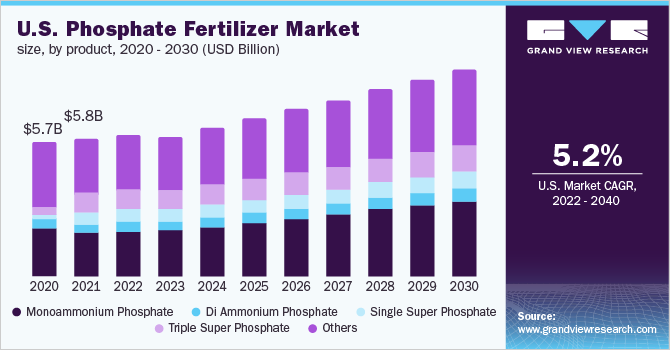
The global demand for phosphate is surging owing to the increasing world population resulting in rising food demand. The spike in costs of raw materials resulting from increased investments in new mine capacity expansions is expected to continue in the coming years as well.
Hence, rising prices of mining activities impact the costs of raw materials worldwide. Emerging economies around the world are now realizing the importance of using the product in agricultural production. Governments of major agrarian economies such as Brazil and India support the use of phosphate fertilizers to improve crop yields. This has encouraged farmers and local entrepreneurs in these countries to increase the consumption of fertilizer-grade phosphate.
The COVID-19 pandemic has significantly impacted various global businesses related to the agricultural sector, agricultural inputs, fertilizers, etc. As a majority of countries in Asia Pacific are agrarian economies, any slowdown in their agricultural activities or momentary pauses in their cross-border trade has a significant impact on the overall operations of agricultural companies and farmers operating in Asia Pacific.
This eventually leads to disruptions in the overall agricultural sector across all major countries of the region. In 2020, amid the COVID-19 pandemic, the prices of primary raw materials such as ammonia and sulfur increased sharply owing to supply restrictions and refinery curtailments.
Product Insights
The monoammonium phosphate segment accounted for the largest revenue share of around 31% in 2021. This is attributed to the low costs of MAP and the high level of phosphorous present in it. MAP is the most important phosphate fertilizer as it as it is a vital source of nitrogen and phosphorus. In agricultural applications, it has been used as an important granular fertilizer. It is used either directly or as a raw material for manufacturing numerous complex fertilizers such as nitrogen phosphate and nitrogen-phosphate-potassium owing to its water solubility.
Triple superphosphate was the second-largest product segment in 2021 accounting for around 17% of the revenue share. It is a highly concentrated phosphorus fertilizer containing approximately 46% of diphosphorus pentoxide. The increasing demand for TSP from the global agriculture industry is a major factor contributing to the growth of the TSP segment of the market during the forecast period.
Other products include DAP, SSP, and others. DAP is also used in several industrial processes such as metal finishing. It is commonly added to milk to produce cheese cultures, as well as to wine for sustaining yeast fermentation. DAP also acts as a fire retardant. With the increasing demand for agriculture in emerging economies such as Brazil and India, the demand for DAP for use in agricultural applications is anticipated to increase over the forecast period.
Application Insights
The cereals & grains application accounted for the largest revenue share of around 46% in 2021. The growth is attributed to the increasing demand for major cereals & grains worldwide on account of the growing population has led to high demand for phosphorous fertilizers across all developing as well as emerging agrarian economies of the world.
The oilseeds & pulses segment accounted for the second-largest market share and is anticipated to expand at a 5.6% CAGR over the forecast period in terms of revenue. This is attributed due to the increasing demand for various agricultural products, including soybean, groundnut, sesame, and sunflower, among other products, in these regions. The product promotes the growth of plants and is proven to be most effective for the cultivation of a wide range of oilseeds & pulses.
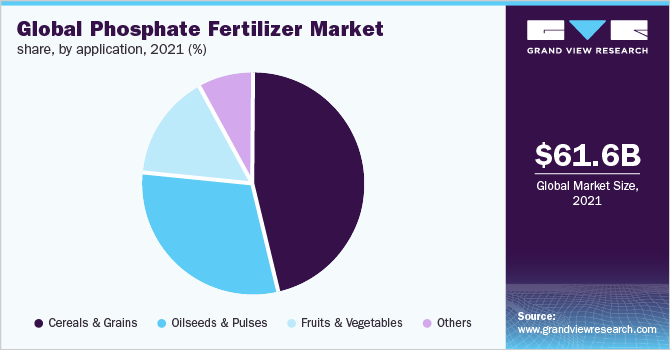
The use of the product in seed treatment is considered highly effective for the growth of fruits and vegetables, including onions, tomatoes, chilies, and other crops. Their application in cultivation ensures increased food production, improved seed development, plant maturation, and root development
Regional Insights
Asia Pacific region accounted for the largest revenue share of more than 61% in 2021. This is attributed to the growing food production and increasing demand for food products like rice and vegetables from import-dependent countries of Asia Pacific. Additionally, the agricultural sector is the backbone of the Indian economy as it provides employment to 50% of the workforce and contributes about 18% to the country’s GDP. The major crops grown in India are wheat, rice, pulses, spices, and spice products. India is one of the fastest-growing markets for agro-based industries. Due to this, the demand for the market is expected to increase over the forecast period.
Europe was the second-largest regional segment in terms of revenue in 2020 and is anticipated to expand at a CAGR of 6.1% in the coming years. This is attributed to the agriculture production of the countries in the region, Germany is among the fourth largest agricultural producers in the region and France is the sixth-largest producer, accounting for almost 1/3rd of the total agricultural land within the European Union.
Key Companies & Market Share Insights
The market is highly fragmented owing to the presence of numerous manufacturers of fertilizers, especially in agriculture-dependent countries. Players in the market are focusing on expanding their manufacturing capacity, as agrochemical demand is increasing in various regions. For instance, in August 2021, EuroChem Group signed an agreement to acquire a phosphate project of Serra do Salitren based in Brazil. This acquisition is expected to strengthen the crop nutrient production and distribution capabilities of the company.
PhosAgro Group of Companies continues to expand the production of its feed phosphates and fertilizers by approximately 25%, accounting for 11.7 million tonnes of the product by 2025. The company also targets to expand the range of its fertilizer grades from 18 to 50 by 2025. Some prominent players in the global phosphate fertilizer market include:
-
Eurochem Group AG
-
Agrium Inc.
-
Potash Corp. of Saskatchewan Inc.
-
Yara International ASA
-
CF Industries Holdings Inc.
-
Israel Chemicals Ltd.
-
Coromandel International Ltd.
-
The Mosaic Co.
-
S.A OCP
-
PJSC PhosAgro.
Phosphate Fertilizer Market Report Scope
|
Report Attribute
|
Details
|
|
Market size value in 2022
|
USD 63.81 billion
|
|
Revenue forecast in 2040
|
USD 176.06 billion
|
|
Growth rate
|
CAGR of 5.7% from 2021 to 2040
|
|
Base year for estimation
|
2021
|
|
Historical data
|
2010 - 2021
|
|
Forecast period
|
2022 - 2040
|
|
Quantitative units
|
Volume in Thousand Tons, Revenue in USD million and CAGR from 2021 to 2040
|
|
Report coverage
|
Revenue forecast, company ranking, competitive landscape, growth factors, and trends
|
|
Segments covered
|
Product, application, region
|
|
Regional scope
|
North America; Europe; Asia Pacific; CSA; MEA
|
|
Country scope
|
U.S.; Canada; Mexico; Germany; U.K.; Italy; France; Russia; Finland; China; India; Japan; Australia; Southeast Asia; Brazil; Argentina; Chile; Saudi Arabia; Tunisia; Morocco; Senegal; Egypt
|
|
Key companies profiled
|
Eurochem Group AG; Agrium Inc.; Potash Corp. of Saskatchewan Inc.; Yara International ASA; CF Industries Holdings Inc.; Israel Chemicals Ltd.; Coromandel International Ltd.; The Mosaic Co.; S.A OCP; PJSC PhosAgro.
|
|
Customization scope
|
Free report customization (equivalent up to 8 analysts working days) with purchase. Addition or alteration to country, regional & segment scope.
|
|
Pricing and purchase options
|
Avail customized purchase options to meet your exact research needs. Explore purchase options
|
Segments Covered in the Report
This report forecasts revenue growth at global, regional, and country levels and provides an analysis of the latest industry trends in each of the sub-segments from 2022 to 2040. For this study, Grand View Research has segmented the global phosphate fertilizer market report on the basis of product, application, and region:
-
Product Outlook (Volume, Thousand Tons; Revenue, USD Million, 2010 - 2040)
-
Monoammonium Phosphate (MAP)
-
Diammonium Phosphate (DAP)
-
Single Superphosphate (SSP)
-
Triple Superphosphate (TSP)
-
Others
-
Application Outlook (Volume, Thousand Tons; Revenue, USD Million, 2010 - 2040)
-
Cereals & Grains
-
Oilseeds & Pulses
-
Fruits & Vegetables
-
Others
-
Regional Outlook (Volume, Thousand Tons; Revenue, USD Million, 2010 - 2040)
-
North America
-
Europe
-
Germany
-
U.K.
-
Italy
-
France
-
Russia
-
Finland
-
Asia Pacific
-
China
-
India
-
Japan
-
Southeast Asia
-
Australia
-
Central & South America
-
Middle East & Africa
-
Saudi Arabia
-
Morocco
-
Senegal
-
Tunisia
-
Egypt
Frequently Asked Questions About This Report
b. The global phosphate fertilizers market size was estimated at USD 61.63 billion in 2021 and is expected to reach USD 63.81 billion in 2022.
b. The global phosphate fertilizers market is expected to grow at a compound annual growth rate of 5.7% from 2022 to 2040 to reach USD 176.06 billion by 2040.
b. Asia Pacific dominated the phosphate fertilizers market with a share of over 60% in 2021. This is attributable to presence of large population in countries such as China and India and rising demand for diversified food.
b. Some key players operating in the phosphate fertilizers market include T Eurochem Group AG; Agrium Inc.; Potash Corp. of Saskatchewan Inc.; Yara International ASA; CF Industries Holdings Inc.; Israel Chemicals Ltd.; Coromandel International Ltd.; The Mosaic Co.; S.A OCP; and PJSC PhosAgro.
b. Key factors that are driving the phosphate fertilizers market growth include the limited availability of arable land for cultivation and the focus on enhancing the crop yield.

 Download Sample Report