
- Home
- »
- Medical Devices
- »
-
Phototherapy Equipment Market Size & Share Report, 2030GVR Report cover
![Phototherapy Equipment Market Size, Share & Trends Report]()
Phototherapy Equipment Market (2023 - 2030) Size, Share & Trends Analysis Report By Product (Conventional Phototherapy Equipment), By Application (Skin Diseases Treatment), By End-use, By Region, And Segment Forecasts
- Report ID: GVR-1-68038-701-8
- Number of Report Pages: 90
- Format: PDF
- Historical Range: 2018 - 2021
- Forecast Period: 2023 - 2030
- Industry: Healthcare
- Report Summary
- Table of Contents
- Interactive Charts
- Methodology
- Download FREE Sample
-
 Download Sample Report
Report Overview
The global phototherapy equipment market size was valued at USD 382.3 million in 2022 and is anticipated to grow at a compound annual growth rate (CAGR) of 4.0% from 2023 to 2030. The rising prevalence of skin diseases is the key factor driving the market growth. For instance, according to the American Academy of Dermatology Association, 84.5 million Americans, i.e., around one in every four individuals are impacted by some kind of skin disease. The rise in neonatal jaundice cases in established and developing markets, increasing skin disease cases, influx of technologically sophisticated products, and increasing use of LED-based phototherapy equipment are the primary factors driving the market for phototherapy equipment.
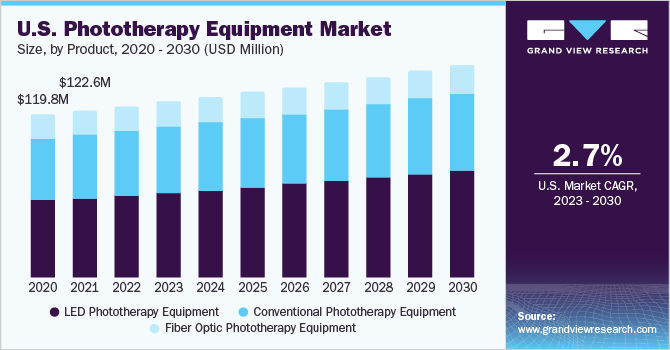
The COVID-19 pandemic had a slightly negative impact on the phototherapy equipment market. However, with various strategic initiatives taken up by market players, the phototherapy equipment market is estimated to progress in the post-COVID-19 pandemic period. Market players are involved in initiatives such as product launches, geographic expansions, and mergers & acquisitions. For instance, in December 2020, GlobalMed Technologies launched a home use product ‘Omnilux Contour’. Additionally, the company launched a new online store for all its products, which was expected to help the company gain significant market share during and after the COVID-19 pandemic.
According to the National Psoriasis Foundation, around 125 million people globally suffer from psoriasis, which is around 2-3% of the total population. Similarly, according to the National Eczema Association, around 31.6 million people in the U.S. suffer from eczema and one in every ten individuals is anticipated to suffer from eczema once in their lifetime.
Phototherapy treatment is widely recognized as a highly beneficial approach for addressing neonatal jaundice. This therapeutic method involves subjecting newborns to fluorescent light, which accelerates their recovery process. Although jaundice is a common occurrence among infants, persistent cases often require the use of phototherapy devices for treatment. According to the Pediatric Medicine Journal, the incidence of jaundice in newborns ranges from 60% to over 90%. Moreover, the National Health Service estimates that approximately six out of ten babies experience jaundice, while the risk of jaundice rises to eight out of ten for premature infants.
The implementation of phototherapy in neonatal care offers several advantages, including reduced healthcare costs and the ability to keep infants and their families together during the treatment process. In November 2021, Little Sparrows Technologies announced that it had received FDA approval for its home-based phototherapy treatment for newborn infants with jaundice. This device has proved to be more energy-efficient, which lasts 10 times longer than the conventional devices, and is also comparatively cheaper. The device used for this purpose delivers high-intensity phototherapy, comparable to the treatments administered in neonatal intensive care units (NICU). Furthermore, the gadget is designed to be mobile, portable, and lightweight, allowing it to operate on batteries. It can be easily cleaned using standard hospital sanitizing chemicals, making it suitable for use in various settings, including hospitals, homes, and even resource-limited or rural areas.
The increasing number of newborns is projected to drive substantial growth in the demand for phototherapy equipment devices. For instance, according to the Centers for Disease Control and Prevention, an increase in the number of births in the U.S. was reported. The report shows that there was a slight rise of less than 1% in births, with a total of 3,661,220 births recorded in 2021. This upward trend in birth rates is anticipated to positively impact the market's growth trajectory throughout the forecast period.
Product Insights
The LED-based phototherapy segment dominated the market with the largest revenue share of 48.5% and is expected to grow at the fastest CAGR of 4.6% during the forecast period from 2023 to 2030. LED based phototherapy is used to treat skin diseases and concerns such as fine lines, psoriasis, and acne. The rise in the number of people suffering from such skin conditions is expected to boost the demand for LED-based phototherapy devices. For instance, according to MDALGORITHMS INC., 85% of people experience acne at some point in their life.
Moreover, 50 million people in the U.S. are anticipated to suffer from acne, out of which 15% suffer from acne which can result in scarring. Additionally, according to an article published by the National Library of Medicine, infrared light therapy can improve and reduce fine lines & wrinkles. The increasing number of people suffering from fine lines & wrinkles is expected to help the segment growth. For instance, according to Pushups, LLC, as a result of wrinkles and other skin-related issues, around 60% of Americans do not feel comfortable regarding their own skin. This may increase the use of LED-based phototherapy equipment, thereby impelling the segment growth in the forecast period.
The conventional phototherapy equipment segment is expected to grow at a lucrative CAGR during the forecast period from 2023 to 2030. Conventional phototherapy equipment is used for the treatment of jaundice, as it helps in reducing bilirubin levels in neonates. The rising incidence of newborns suffering from jaundice is anticipated to help the segment propel during the forecast period. For instance, according to the March of Dimes Organization, around 3 in every 5 babies (around 60%) suffer from jaundice. Similarly, according to Medscape, it is estimated that 80% of pre-term babies are expected to develop jaundice within 2-4 days. Therefore, the increasing number of pre-term babies is further expected to help the segment's growth.
Application Insights
The skin disease segment dominated the market with the largest revenue share of 67.4% in 2022. This can be accredited to a rise in the number of various skin diseases such as acne, vitiligo, and others. For instance, according to the British Journal of Dermatology, it is estimated that there were 117.4 million incident cases and 231.2 million prevalent cases of acne in 2019, which is around a 48% increase when compared with the statistics from 1990. Vitiligo, a condition in which the skin loses its pigment cells, is becoming dormant in various regions globally. For instance, according to the National Library of Medicine, India is predicted to have an incidence rate of 8.8%, whereas, the same for Mexico was estimated to be 2.6 - 4%. As phototherapy has been shown to stop/slow down the progression of vitiligo, its use is expected to increase. Hence, due to the above-mentioned factors, the phototherapy equipment market is estimated to expand during the projected period.
The neonatal jaundice management segment is expected to grow at the fastest CAGR of 4.5% during the forecast period. This can be attributed to the increasing infant population and rising incidences of neonatal jaundice globally. For instance, according to an article by BMJ Publishing Group & Royal College of Paediatrics and Child Health, neonatal jaundice is extremely common in the UK, where phototherapy is used to treat around 5-10% of babies born at term. Moreover, there has been an increase in the number of births across the globe. For instance, according to Statistics Norway's quarterly population figure, in the first three months of 2021, 13,700 children were born, which was 700 more than what was observed in the first quarter of 2020. Therefore, as a result of the aforementioned factors, the segment is expected to witness a significant growth rate.
End-use Insights
The hospital segment dominated the market with the largest revenue share of 82.8% in 2022. This can be attributed to the increasing number of hospitals worldwide. For instance, according to The King’s Fund Organization, the total number of hospitals in the UK tallied up to 141,000 in 2019/20. Similarly, according to the American Health Association, the number of hospitals in the U.S. is over 6,000. Moreover, according to a study conducted by NCBI, the prevalence of neonatal jaundice at a National District Hospital, Bloemfontein, was calculated to be 55.2%. Hence, owing to the aforementioned factors, the segment is anticipated to propel during the forecast period.
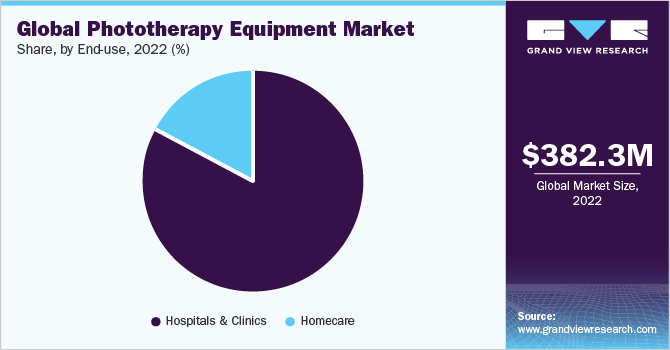
The homecare segment is expected to grow at the fastest CAGR of 5.1% during the forecast period. This can be credited to the availability of phototherapy equipment for homecare settings, and rising awareness about phototherapy equipment among the common population. Moreover, according to the National Psoriasis Foundation, treatment of psoriasis with a home UVB phototherapy can be convenient and economical. Similarly, according to The Royal Women’s Hospital, phototherapy is a safe & convenient option to treat neonatal jaundice in a homecare setting. Hence, the segment is projected to experience lucrative growth in the forecast duration.
Regional Insights
North America dominated the market and accounted for the largest revenue share of 39.0% in 2022. The rising number of various skin conditions such as vitiligo, psoriasis, eczema, and acne is expected to help the region dominate the phototherapy equipment market. For instance, according to the Canadian Dermatology Association, acne affects around 5.6 million people, 20% of the population in Canada. Similarly, according to the Asthma and Allergy Foundation of America, around 7.3% of U.S. adults suffer from eczema, while around 40% of the people suffer from moderate to severe symptoms.
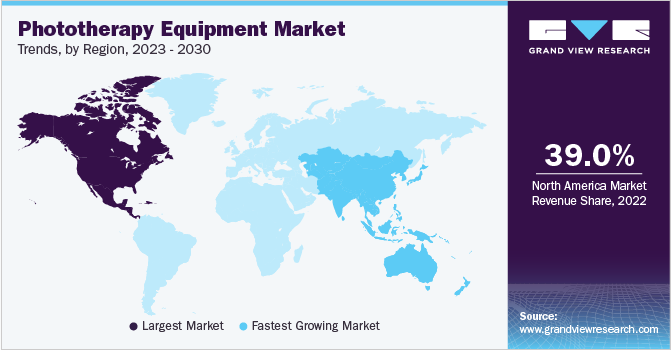
The Asia-Pacific region is projected to witness the fastest CAGR of 5.6% during the forecast period. The increase in the number of births of pre-term babies and the number of people suffering from skin disorders can be accredited to the high growth rate. For instance, according to The Lancet, around 85% of preterm births occur in the late preterm period, out of which 80% occur in Asia & South-Asian regions. Moreover, according to the Narayan Health Organization, out of the 15 million pre-term births globally, 20% of these births take place in India alone. Additionally, people in the Asia Pacific are prone to acne, which is further expected to propel the use of phototherapy equipment. For instance, according to the Derma Health Institute, acne is a common condition for people of Asian ethnicity, thereby impelling the phototherapy equipment market in this region.
Key Companies & Market Share Insights
The phototherapy equipment market comprises several small and large manufacturers. The degree of competition and competitive rivalry in the market is anticipated to intensify in the forecast period. Major companies are focusing on clinical trials, mergers and acquisitions, product launches, and geographic expansions to have a competitive edge over others. For instance, in September 2022, Bristol-Myers Squibb Company announced that the U.S. Food and Drug Administration (FDA) granted approval for Sotyktu (deucravacitinib), an oral medication indicated for the treatment of moderate to severe plaque psoriasis in adults. Sotyktu represents a significant advancement in oral therapeutic options for patients with moderate to severe plaque psoriasis. Thus, with various strategies acquired by market players, the market is expected to impel during the forecast period. Some prominent players in the global phototherapy equipment market include:
-
Signify Holding
-
GE Healthcare
-
Natus Medical Incorporated
-
Hebert Waldmann GmbH & Co. KG
-
Nice Neotech Medical Systems Pvt. Ltd.
-
Atom Medical Corporation
-
Phoenix Medical Systems Pvt. Ltd.
-
National Biological Corp.
-
Solarc Systems Inc.
-
The Daavlin Company
Phototherapy Equipment Market Report Scope
Report Attribute
Details
Market size value in 2023
USD 396.5 million
Revenue forecast in 2030
USD 521.1 million
Growth Rate
CAGR of 4.0% from 2023 to 2030
Base year for estimation
2022
Historical data
2018 - 2021
Forecast period
2023 - 2030
Quantitative units
Revenue in USD million and CAGR from 2023 to 2030
Report coverage
Revenue forecast, company ranking, competitive landscape, growth factors, and trends
Segments covered
Product, application, end-use, region
Regional scope
North America; Europe; Asia Pacific; Latin America; MEA
Country scope
U.S.; Canada; UK; Germany; France; Italy; Spain; Denmark; Sweden; Norway; China; Japan; India; Australia; South Korea; Thailand; Brazil; Mexico ; Argentina; Saudi Arabia; South Africa; UAE; Kuwait
Key companies profiled
Signify Holding; GE Healthcare; Natus Medical Incorporated; Hebert Waldmann GmbH & Co. KG; Nice Neotech Medical Systems Pvt. Ltd.; Atom Medical Corporation; Phoenix Medical Systems Pvt. Ltd.; National Biological Corp.; Solarc Systems Inc.; The Daavlin Company
Customization scope
Free report customization (equivalent up to 8 analyst’s working days) with purchase. Addition or alteration to country, regional & segment scope
Pricing and purchase options
Avail customized purchase options to meet your exact research needs. Explore purchase options
Global Phototherapy Equipment Market Report Segmentation
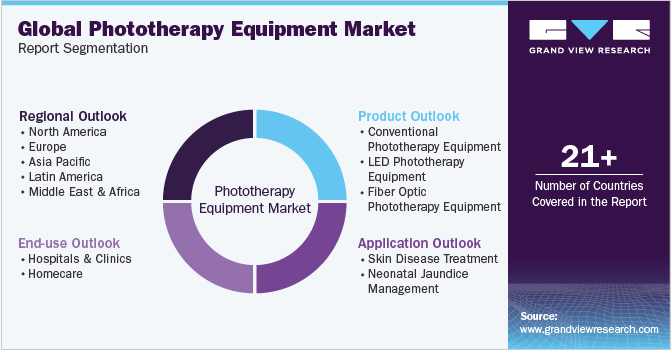
This report forecasts revenue growth at global, regional, and country levels and provides an analysis of the latest industry trends in each of the sub-segments from 2018 to 2030. For this study, Grand View Research has segmented the global phototherapy equipment market based on product, application, end use, and region:
-
Product Outlook (Revenue, USD Million, 2018 - 2030)
-
Conventional Phototherapy Equipment
-
Conventional Phototherapy Equipment with Fluorescent Lamp
-
Conventional Phototherapy Equipment with Compact Fluorescent Lamp
-
-
LED Phototherapy Equipment
-
Fiber Optic Phototherapy Equipment
-
-
Application Outlook (Revenue, USD Million, 2018 - 2030)
-
Skin Disease Treatment
-
Psoriasis
-
Vitiligo
-
Eczema
-
Others
-
-
Neonatal Jaundice Management
-
-
End-use Outlook (Revenue, USD Million, 2018 - 2030)
-
Hospitals & Clinics
-
Homecare
-
-
Regional Outlook (Revenue, USD Million, 2018 - 2030)
-
North America
-
U.S.
-
Canada
-
-
Europe
-
UK
-
Germany
-
France
-
Italy
-
Spain
-
Denmark
-
Sweden
-
Norway
-
-
Asia Pacific
-
Japan
-
China
-
India
-
Australia
-
Thailand
-
South Korea
-
-
Latin America
-
Brazil
-
Mexico
-
Argentina
-
-
Middle East & Africa
-
South Africa
-
Saudi Arabia
-
UAE
-
Kuwait
-
-
Frequently Asked Questions About This Report
b. The global phototherapy equipment market size was estimated at USD 382.3 million in 2022 and is expected to reach USD 396.5 million in 2023.
b. The global phototherapy equipment market is expected to grow at a compound annual growth rate of 4.0% from 2023 to 2030 to reach USD 521.1 million by 2030.
b. North America dominated the phototherapy equipment market with a share of 38.9% in 2022. This is attributable to the rising prevalence of acne-related problems and the huge adoption rate for technologically advanced skin care treatment devices.
b. Some of the key players operating in the phototherapy equipment market include Philips Lighting Holding B.V.; GE Healthcare; Natus Medical, Inc.; Herbert Waldmann GmbH & Co. KG; Nice Neotech Medical Systems Pvt. Ltd.; Phoenix Medical Systems Pvt. Ltd.; Atom Medical Corp.; National Biological Corp.; and Solarc Systems, Inc.
b. Key factors that are driving the phototherapy equipment market growth include the increasing prevalence of severe skin diseases, the introduction of technologically advanced products, and the rising prevalence of neonatal jaundice.

Share this report with your colleague or friend.
Need a Tailored Report?
Customize this report to your needs — add regions, segments, or data points, with 20% free customization.


ISO 9001:2015 & 27001:2022 Certified
We are GDPR and CCPA compliant! Your transaction & personal information is safe and secure. For more details, please read our privacy policy.
Trusted market insights - try a free sample
See how our reports are structured and why industry leaders rely on Grand View Research. Get a free sample or ask us to tailor this report to your needs.













