
- Home
- »
- Renewable Chemicals
- »
-
1,3 Propanediol Market Size, Share & Trends Report, 2033GVR Report cover
![1,3 Propanediol Market (2026 - 2033)Report]()
1,3 Propanediol Market (2026 - 2033)
Size, Share & Trends Analysis Report By Product (Conventional, Bio-based), By Application (Polytrimethylene Terapthalate, Polyurethane, Personal Care), By Region (North America, Europe, Asia Pacific, CSA, MEA), And Segment Forecasts
Market Size, 2025
$492.4MMarket Estimate, 2026
$535.9MMarket Forecast, 2033
$1,535.4MCAGR, 2026–2033
16.2%1,3 Propanediol Market Summary
The global 1,3 propanediol market size was valued at USD 492.4 million in 2025 and is projected to grow from USD 535.9 million in 2026 to USD 1,535.4 million by 2033, at a CAGR of 16.2% from 2026 to 2033. North America dominated the market, accounting for a revenue share of 35.8% in 2025. The demand for the product can be attributed to the rising adoption of polytrimethylene terephthalate from various end-use industries, such as personal care, cosmetics, and cleaning products.

Key Market Trends & Insights
- By product: Bio-based segment accounted for the largest revenue of 56.1% in 2025.
- By application: Polytrimethylene terapthalate segment accounted for the largest revenue share of 67.7% in 2025.
Regional Highlights
- Largest regional market: North America (35.8% revenue share, 2025)
- By country: The U.S. held the largest market share in 2025.
Market Size & Forecast
- Market size in 2025: USD 492.4 Million
- Estimated market size in 2026: USD 535.9 Million
- Projected market size by 2033: USD 1,535.4 Million
- CAGR (2026-2033): 16.2%
Three ways to get this report
Buy it, customize it, or ask a question.Get the Full Report
What the study covers
- FormatsPDF · Excel · Dashboard
- Timeline2026–2033 annual, 2025 base
- Coverage20+ countries, 5 regions
- Companies10+ key players profiled
Customize the Report
20% free customization
- IncludeCountries, segments, points
- TailorTo your product definition
- ExtendDeeper competitor detail
- OrA fully bespoke study
- Turnaround5–10 working days
Ask an Analyst
A direct answer, usually in 1 working day
- AccessReport author, directly
- Reply timeWithin 1 working day
- No sales callDirect answer only
- FormatEmail reply
- CostFree, no cost
The market is expected to be driven by shifting consumer preference toward bio-based products. It is anticipated that the increasing consumer acceptability for bio-based products across a range of end-use sectors would further bolster market expansion. Changing customer preferences toward bio-based products are expected to drive the global 1,3-propanediol market. The growing acceptance of bio-based products across diverse end-use industries is presumed to complement the market growth further. Companies are focusing on increasing the renewable content in their products for various reasons. The need to reduce carbon emissions and create more sustainable products has increased the demand for bio-based products.The primary raw materials used in the production of 1,3 propanediol are glycerol, glucose, and crude glycerin from vegetable oils or recycled oil. It is also produced from petrochemicals-based glycols such as glycerin, propylene glycol, and butylene glycol. Fermentation, chemical conversion, bioconversion, catalytic processes, a two-step process, and the Degussa-DuPont route are some of the processes utilized in the production of 1,3 propanediol.

Life Cycle Assessment (LCA) is applied to biobased 1,3-propanediol (PDO) production. The cradle-to-factory gate system includes growing corn, corn milling, converting cornstarch to glucose, and fermentative production of PDO using a genetically modified biocatalyst. The LCA is a preliminary biobased process design and is used to identify system improvement targets and benchmark life-cycle environmental performance. The analysis indicates that approximately 70% of nonrenewable energy produces PDO from glucose. The most significant part of this is used in purifying PDO. Biobased PDO is predicted to have significantly lower cradle-to-factory gate nonrenewable energy and climate change potential than PDO derived from ethylene oxide. PDO converted to polytrimethylene terephthalate (PTT) is expected to outperform Nylon 6 in these categories and have lower NO x emissions.
The increasing demand for eco-friendly and sustainable materials, technological advancements in biobased PDO production, and expanding applications beyond textiles and cosmetics into industries such as automotive and packaging are significant opportunities for the market.
Market Dynamics
The 1,3-propanediol market is witnessing steady growth, supported by rising demand for sustainable and bio-based chemicals across industries such as textiles, personal care, automotive, and packaging. Increasing adoption of bio-based 1,3-propanediol in the production of high-performance polymers, particularly polytrimethylene terephthalate (PTT), along with growing regulatory emphasis on reducing carbon emissions, continues to strengthen market expansion.
The increasing shift toward bio-based and sustainable chemicals is a key factor driving the growth of the 1,3-propanediol market. Manufacturers across textiles, personal care, packaging, and automotive industries are replacing petroleum-based ingredients with renewable alternatives to meet sustainability goals, reduce carbon emissions, and comply with evolving environmental regulations. Bio-based 1,3-propanediol offers favorable performance characteristics, lower environmental impact, and compatibility with green manufacturing practices, making it an attractive choice for industrial applications.
Growing consumer preference for environmentally responsible products and rising corporate investments in renewable chemical production are accelerating the commercialization of bio-based 1,3-propanediol. The increasing use of the material in high-performance polymers, cosmetic formulations, and specialty chemical applications is further strengthening market demand, encouraging capacity expansions, product innovation, and long-term supply agreements among leading manufacturers.
The growth of the 1,3-propanediol market is restrained by the relatively high production costs associated with bio-based manufacturing processes and fluctuations in feedstock availability. The production of bio-based 1,3-propanediol relies on renewable raw materials such as corn sugar and glycerol, whose prices and supply can vary due to agricultural conditions, climate factors, and competing demand from other bio-based industries. These cost fluctuations can affect manufacturers' profit margins and pricing competitiveness.
Conventional petroleum-based chemical alternatives often remain more cost-effective in price-sensitive markets, limiting the broader adoption of bio-based 1,3-propanediol. High capital investments required for fermentation facilities, process optimization, and production scale-up also present challenges for new market entrants and smaller manufacturers, slowing capacity expansion and limiting market penetration in developing regions.
The expanding use of 1,3-propanediol in high-performance polymers and sustainable materials presents a significant growth opportunity for the market. Increasing demand for durable, lightweight, and environmentally friendly materials in the textile, automotive, packaging, and consumer goods industries is driving the adoption of polytrimethylene terephthalate (PTT) and other bio-based polymer formulations. As manufacturers prioritize circular economy initiatives and low-carbon product portfolios, the demand for renewable chemical intermediates is expected to accelerate.
Continuous advancements in biotechnology and fermentation processes are improving production efficiency and making bio-based 1,3-propanediol more commercially viable. Rising investments in bio-refineries, strategic collaborations between chemical producers and biotechnology companies, and the development of innovative specialty applications are expected to expand the market's addressable opportunities and support long-term revenue growth.
Market Concentration & Characteristics
The 1,3 propanediol market is fragmented with the presence of many manufacturers. 1,3 propanediol comes in various products, such as conventional, and Bio-based.
Manufacturers must adopt the right sales channel to ensure their products are distributed effectively to end consumers. To ensure a smooth supply of goods, manufacturers must establish a good working relationship with their distributing partners. Selection of an ideal sales channel is essential for secure distribution of the product to end-user.
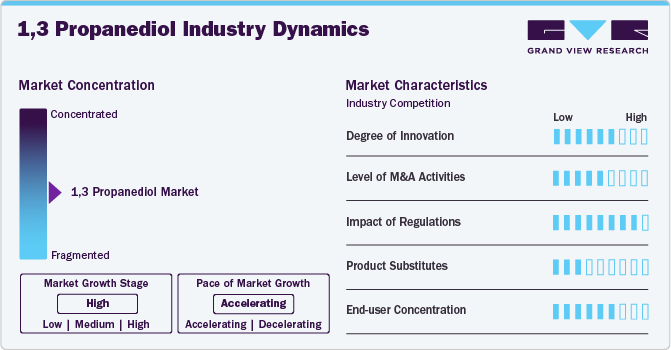
Leading market players, such as DuPont, Shell Chemicals LP, and Tokyo Chemical Industry Co., Ltd., have a vast distribution network owing to their global presence and are integrated throughout the value chain. Some of the key distributors of 1,3 PDO include Wego Chemical Group, Connect Chemicals, ATAMAN KiMYA, Parchem- fine & specialty chemicals, Gantrade Corporation, Otto Chemie Pvt. Ltd etc.
A few small and domestic players rely on third-party distributors to provide their products to customers. Online distribution channels are preferred by both large and small players in this market. The online supply of 1,3-propanediol is facilitated through online platforms, such as TCI America, Amazon, Brenntag India, IndiaMart, and Merck KGaA.
Analyst Perspective
The 1,3-propanediol market is positioned for steady expansion, driven by the structural shift toward bio-based and low-carbon chemical alternatives across polymers, personal care, and specialty applications. While established players continue to strengthen their dominance through integrated production capabilities and global supply chains, emerging manufacturers are intensifying competition through cost-efficient bio-fermentation technologies and region-specific offerings.
Product Insights
Bio-based segment accounted for the largest revenue of 56.1% in 2025. The production from biomass imparts distinct characteristics, making it an attractive option for eco-conscious industries. It reduces reliance on finite fossil resources and mitigates environmental impact by lowering greenhouse gas emissions and reducing dependency on petrochemical feedstocks.
Conventional 1,3 propanediol (PDO) represents a fundamental segment of chemical compounds. Its structure is defined by a linear propane backbone comprising three carbon atoms sequentially bonded together. Two hydroxyl groups (-OH) are strategically positioned along this backbone, specifically at the first and third carbon positions. Hydroxyl groups confer a diol characteristic to the molecule, playing a pivotal role in its functionality and versatility across numerous industrial applications.
Application Insights
By application, the polytrimethylene terapthalate held a dominant position, contributing 67.7% of total revenue in 2025. This is attributable to the product’s exceptional characteristics, such as resilience, stain resistance, and environmental sustainability. PTT is used as a crucial polymer in the formulation of various composites, adhesives, laminates, and moldings.

Polyurethane benefits significantly from incorporating 1,3-propanediol in its synthesis, as this versatile polymer is used in many applications. This bio-based compound, derived from renewable resources, enhances the sustainability and performance of polyurethanes, making it suitable for various application segments. One of the polyurethanes' most significant application segments (incorporating 1,3 PDO) is foams, which include flexible and rigid types. In flexible foams, 1,3 PDO improves comfort and resilience, making it ideal for mattresses, furniture, and automotive seating. Rigid foams enhance insulation properties, crucial for energy-efficient buildings and refrigeration applications.
Regional Insights
North America dominated the 1,3 propanediol market with the highest revenue share of 35.8% in 2025. North America market is expected to grow on account of the presence of various personal care and cosmetic companies such as Maybelline New York, Procter & Gamble, Colgate-Palmolive Company, Avon, Unilever, and Johnson & Johnson Private Limited.

U.S. 1,3 Propanediol Market Trends
U.S. dominated the North America 1,3 propanediol market in 2025. The U.S. market has experienced significant demand from the personal care industry as it effectively replaces glycol and butylene as a more environmentally and skin-friendly alternative. The personal care industry is constantly booming in the domestic market.
Asia Pacific 1,3 Propanediol Market Trends
The demand for bioplastics is evident in every major region, especially in the Asia Pacific owing to favorable government policies and regulations aimed at encouraging the use of bio-based products.
The 1,3 propanediol market in China has been witnessing steady growth over the past few years owing to the country's expanding personal care products industry. The increase in raw materials prices used for developing biobased and conventional 1,3 propanediol resulted in the moderate-to-slow market growth in China during 2023.
Europe 1,3 Propanediol Market Trends
The market is anticipated to be driven by the growth in the personal care industry. Several developments in Europe reflect the promising growth for the 1,3 propanediol market. In addition, the region also has well-established construction and furniture industries owing to the need for aesthetic products and the presence of regional manufacturers. According to the European Commission, the region's economy highly depends on its construction industry.
The Germany 1,3 propanediol market is witnessing significant growth due to the overall market of 1,3 propanediol receiving a significant boost. Several investments in the personal care industry reflected the strong growth and performance of the market.
Central & South America 1,3 Propanediol Market Trends
The Central & South America market accounted for a low revenue and volume share relative to the global market. This situation will likely remain the same over the forecast period, owing to the consolidated nature of the global market and the availability of traditional substitutes of 1,3 propanediol.
The Brazil 1,3 propanediol market is anticipated to receive a boost from the domestic personal care industry. It is the largest market in the region and the fourth-largest cosmetics market globally. The personal care market witnessed strong growth, with most of its revenue derived from exports to neighboring countries in the region.
Middle East & Africa 1,3 Propanediol Market Trends
Middle East and Africa are promising regions for the demand for 1,3-propanol. According to the Organic, Natural & Clean Beauty MENA Market Report 2023, published by the Middle East Organic and Natural Products Expo, which took place in Dubai, UAE, from 12th to 14th December 2023, the region presents significant opportunities for companies to cater to the growing demand for organic and specialty products in personal care.
The 1,3 propanediol market in South Africa is anticipated to grow due to the presence of domestic manufacturers of cosmetics and personal care products. Companies such as Lelive and Suki Naturals have consciously focused their marketing efforts on catering to differing skin types and tones in the country and differentiating themselves from global brands.
Key 1,3 Propanediol Company Insights
Some of the key players operating in the market include DuPont, Shell Chemicals LP among others.
-
Dupont is a chemical company that produces polymers, high-performance fibers and foams, aramid papers, non-woven structures, water purification technologies, and protective garments. The company has subsidiaries in about 50 countries worldwide and manufacturing operations in about 24 countries. It has 150 research and development facilities in China, Brazil, India, Germany, and Switzerland.
-
Shell Chemicals is the petrochemicals arm of Shell plc. It consists of nearly 70 companies engaged in the production of chemicals, supplying the parent company, and selling to the external market. The company is a pioneer in 1,3 PDO production and was responsible for developing 1,3 PDO two decades ago. It also produces alpha olefins, detergent alcohols, alcohol ethoxylates, plasticizer alcohols, ethylene oxide, and ethylene glycols. It operates in over 70 countries and caters to the energy and petrochemical industries. Its business is divided into the following segments: Integrated Gas, Upstream, Chemicals & Products, Renewables & Energy Solutions, and Marketing.
Shenghong Group Holdings, Zhangjiagang Glory Biomaterial Co., Ltd. and Zouping Mingxing Chemical Co., Ltd., among others, are some of the emerging market participants in the 1,3 propanediol market.
-
Zhangjiagang Glory Biomaterial Co., Ltd. (earlier called Zhangjiagang Huamei Biomaterial Co., Ltd.) is a manufacturer of 1,3 PDO that was initially established for a biobased PDO program between Glory Chemical and Softbank China Venture Capital. The former had partnered with DuPont until 2012, after which the contract expired. The company produces PDO from glycerol used in cosmetics, humectants, solvents, and APIs. Its annual production capacity for 1,3 PDO and 2,3 BDO is 65,000 tons, and its products are ISO 9001:2000 certified.
-
Shenghong Group Holdings is a manufacturer of chemical fibers and polymers. The company produces microfibers, differentiated functional fibers, and other fiber products. It has three industrial bases: Suzhou, Lianyungang, and Suqian. The company acquired the Global Recycled Standard (GRS) certification license and promoted its green competitiveness and sustainability mission in the international market. The "green design platform for bio-based PTT fiber" developed by the company was then exported for use in various end-user markets. It mainly caters to the domestic market, with exports to other APAC countries and MEA.
Key 1,3 Propanediol Companies
The following key companies have been profiled for this study on the 1,3 propanediol market.
-
DuPont
-
Metabolic Biopolymer
-
Zhangjiagang Glory Biomaterial Co., Ltd.
-
Zouping Mingxing Chemical Co., Ltd.
-
Shell Chemicals LP
-
Tokyo Chemical Industry Co., Ltd.
-
Shenghong Group Holdings
-
Primient
-
Haihang Industry
Competitive Benchmarking
Category
Operating Strategies
Competitive Edge
Weakness
Established Players (DuPont, Shell Chemicals LP, Tokyo Chemical Industry Co., Ltd., Shenghong Group Holdings, Primient)
- Focus on large-scale production and global supply networks.
- Invest in bio-based technologies, process optimization, and strategic partnerships.
- Expand application portfolio across polymers, personal care, and specialty chemicals.
- Strong manufacturing capabilities and established distribution channels.
- Broad product portfolios with advanced R&D and technical expertise.
- Long-term customer relationships and strong brand recognition.
- Higher operating and manufacturing costs due to stringent quality and regulatory requirements.
- Longer commercialization timelines for novel enzyme products.
- Complex organizational structures may slow decision-making.
- Greater exposure to regulatory changes across multiple geographies.
Emerging Players (Metabolic Biopolymer, Zhangjiagang Glory Biomaterial Co., Ltd., Zouping Mingxing Chemical Co., Ltd., Haihang Industry)
- Focus on niche applications and cost-effective manufacturing.
- Expand regional presence through distributor partnerships and customized product offerings.
- Invest in fermentation technologies and sustainable product development.
- Greater flexibility in product customization and faster commercialization.
- Competitive pricing and ability to address regional demand efficiently.
- Increasing focus on renewable chemicals and innovation.
- Limited global presence and smaller production capacities.
- Lower brand recognition compared to multinational competitors.
- Dependence on regional markets and comparatively lower R&D investments.
Recent Developments
-
In April 2023, Ningbo Juhua Chemical & Science Co., Ltd. awarded a contract to Technip Energies for a 1,3 PDO plant with an annual capacity of 72 kilo tons in Ningbo, Zhejiang, China. This is part of the company’s initiative to expand its petrochemical new material business.
-
In January 2024, Germany-based chemical manufacturer Nordmann acquired Italy-based SD Chemicals S.r.l., a distributor of raw materials catering to the cosmetics industry catering to skin care, hair care, and makeup applications. This acquisition will enable Nordmann to expand its presence and enhance customer reach.
1,3 Propanediol Market Report Scope
Report Attribute
Details
Market size in 2025
USD 492.4 million
Estimated market size in 2026
USD 535.9 million
Projected market size by 2033
USD 1,535.4 million
Growth rate
CAGR of 16.2% from 2026 to 2033
Base year for estimation
2025
Historical data
2021 - 2024
Forecast period
2026 - 2033
Quantitative units
Revenue in USD billion/million, volume in kilotons and CAGR from 2026 to 2033
Report coverage
Revenue forecast, company ranking, competitive landscape, growth factors, and trends
Segments covered
Application, product, region
Regional scope
North America; Europe; Asia Pacific; Latin America; MEA
Country scope
U.S.; Canada; Mexico; Germany; UK; France; Italy; Spain; China; India; Japan; South Korea; Brazil; Argentina; South Africa; Saudi Arabia
Key companies profiled
DuPont; Metabolic Biopolymer; Zhangjiagang Glory Biomaterial Co., Ltd.; Zouping Mingxing Chemical Co., Ltd.; Shell Chemicals LP; Tokyo Chemical Industry Co., Ltd.; Shenghong Group Holdings; Primient; Haihang Industry
Customization scope
Free report customization (equivalent up to 8 analysts' working days) with purchase. Addition or alteration to country, regional & segment scope.
Pricing and purchase options
Avail customized purchase options to meet your exact research needs. Explore purchase options
Global 1,3 Propanediol Market Report Segmentation
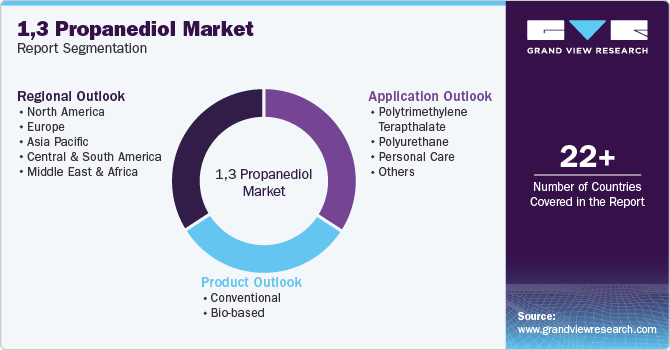
This report forecasts revenue growth at global, regional, and country levels and provides an analysis of the latest industry trends in each of the sub-segments from 2021 to 2033. For this study, Grand View Research has segmented the global 1,3 propanediol market report based on product, application, and region.
-
Product Outlook (Revenue, USD Million; Volume, Kilotons, 2021 - 2033)
-
Conventional
-
Bio-based
-
-
Application Outlook (Revenue, USD Million; Volume, Kilotons, 2021 - 2033)
-
Polytrimethylene Terapthalate
-
Polyurethane
-
Personal Care
-
Others
-
-
Regional Outlook (Revenue, USD Million; Volume, Kilotons, 2021 - 2033)
-
North America
-
U.S.
-
Canada
-
Mexico
-
-
Europe
-
Germany
-
UK
-
France
-
Italy
-
Spain
-
-
Asia Pacific
-
China
-
India
-
Japan
-
South Korea
-
-
Central & South America
-
Brazil
-
Argentina
-
-
Middle East and Africa
-
Saudi Arabia
-
South Africa
-
-
Research Methodology
The 1,3 propanediol market figures in this report are based on a proven research process that combines executive interviews with secondary research from proprietary databases, company filings, and recognized regulatory and institutional sources. Market size is built through value-chain sizing-reconciling supply-side and demand-side estimates-and triangulated with bottom-up and top-down approaches. Every estimate passes multiple levels of expert validation before publication, with each 1,3 propanediol segment quantified using the revenue-capture definitions in the table below.
Segment Definition
Segment - Product
Revenue capture definition
Convention
Revenue is generated from petroleum-based 1,3-propanediol supplied to industrial applications where cost competitiveness and established manufacturing processes remain key purchasing factors.
Bio-based
Revenue is captured through renewable 1,3-propanediol used in sustainable polymers, personal care ingredients, and specialty chemicals, driven by increasing demand for low-carbon and bio-based materials.
Segment - Application
Revenue capture definition
Polytrimethylene Terephthalate (PTT)
Revenue is generated from the consumption of 1,3-propanediol as a key monomer in PTT production for textiles, carpets, engineering plastics, and other high-performance polymer applications.
Polyurethane
Revenue is captured from the use of 1,3-propanediol in polyurethane formulations to improve flexibility, durability, and performance across coatings, adhesives, sealants, and elastomers.
Personal Care
Revenue is derived from the incorporation of 1,3-propanediol as a natural humectant, solvent, and preservative booster in skincare, haircare, cosmetics, and hygiene products.
Others
Revenue is generated from applications including industrial solvents, lubricants, cleaning formulations, pharmaceutical intermediates, and specialty chemical products where 1,3-propanediol provides functional and performance benefits.
Estimation Model
Layer Name
Key Question
Description
Feedstock Supply Assessment
What is the availability of raw materials used for 1,3-propanediol production?
Estimates the supply of key feedstocks such as corn sugar, glycerol, and petrochemical intermediates, considering production capacity, pricing trends, and regional availability.
Production Capacity Analysis
How much 1,3-propanediol can manufacturers produce?
Evaluates installed production capacities, capacity expansions, plant utilization rates, and output volumes of both conventional and bio-based 1,3-propanediol manufacturers.
Product Segmentation Analysis
How is market demand distributed between conventional and bio-based products?
Assesses revenue and volume contribution of each product type based on adoption trends, sustainability initiatives, pricing, and end-user preferences.
Application Demand Assessment
Which applications generate the highest demand for 1,3-propanediol?
Estimates consumption across polytrimethylene terephthalate (PTT), polyurethane, personal care, and other industrial applications based on production and usage patterns.
Delivered Customizations
This report has been delivered with the following In-depth customizations
Client Request
Customization Delivered
Value Adds
Regional Segmentation
A detailed regional assessment of the 1,3-propanediol market was conducted across North America, Europe, Asia Pacific, Latin America, and Middle East & Africa. The study evaluated country-level demand for conventional and bio-based 1,3-propanediol while assessing consumption across polytrimethylene terephthalate (PTT), polyurethane, personal care, and other industrial applications. Production concentration, renewable feedstock availability, and downstream polymer manufacturing trends were also examined.
Provides clearer visibility into regional production-consumption dynamics and bio-based adoption trends. Supports strategic expansion planning, feedstock sourcing decisions, and identification of high-growth downstream polymer markets.
Cross-Segmentation Analysis
The relationship between product type and application demand was assessed to understand substitution trends between conventional and bio-based 1,3-propanediol. The analysis examined consumption patterns across PTT fiber production, polyurethane formulations, and personal care ingredient applications, highlighting shifts toward renewable chemical integration in performance materials.
Enables identification of high-growth bio-based applications and substitution opportunities. Supports portfolio positioning, product differentiation, and commercialization strategies aligned with sustainability-driven demand shifts.
Opportunity Assessment
Emerging opportunities were assessed across bio-based polymers, sustainable textiles (PTT fibers), eco-friendly polyurethane systems, and personal care formulations driven by green chemistry adoption. The analysis also evaluated increasing substitution of petroleum-based glycols with renewable alternatives in industrial applications.
Enables identification of sustainability-led growth opportunities and high-value bio-based applications. Supports innovation strategy development, portfolio diversification, and long-term green chemistry adoption planning.
Frequently Asked Questions About This Report
Key factors that are driving the market growth include growing demand for polyesters such as polytrimethylene terephthalate (PTT) and increasing polyurethane penetration across various end-use industries.
The global 1,3 propanediol market is expected to grow at a CAGR of 16.2% from 2026 to 2033, reaching USD 1,535.4 million by 2033.
Key players include DuPont; Metabolic Biopolymer; Zhangjiagang Glory Biomaterial Co., Ltd.; Zouping Mingxing Chemical Co., Ltd.; Shell Chemicals LP; Tokyo Chemical Industry Co., Ltd.; Shenghong Group Holdings; Primient; Haihang Industry.
Polytrimethylene terapthalate segment accounted for the largest revenue share of 67.7% in 2025.
The global 1,3 propanediol market size was valued at USD 492.4 million in 2025 and is estimated at USD 535.9 million for 2026.
North America dominated the market, accounting for a revenue share of 35.8% in 2025.
Bio-based segment accounted for the largest revenue of 56.1% in 2025.
About the Author(s)
Renewable Chemicals Research Team
Specialty & Chemicals · Renewable ChemicalsThis report was authored by the renewable chemicals research team at Grand View Research - comprising two research analysts, one senior research analyst, and one industry expert - with specialized expertise in the renewable chemicals segment of the specialty & chemicals industry. All findings are based on proprietary specialty & chemicals databases, executive interviews, and regulatory analysis, subject to internal peer review prior to publication.
Last Updated:
Speak to Analyst


Customize this report to your needs - add regions, segments, or data points, with 20% free customization.
Or view our licence options:


ISO 9001:2015 & 27001:2022 Certified
We are GDPR and CCPA compliant! Your transaction & personal information is safe and secure. For more details, please read our privacy policy.


