
- Home
- »
- Agrochemicals & Fertilizers
- »
-
Bioherbicides Market Size And Share Report, 2026-2033GVR Report cover

Bioherbicides Market (2026 - 2033)
Size, Share & Trends Analysis Report By Application (Grains & Cereals, Oil Seeds, Fruits & Vegetables, Turf & Ornamental Grass), By Region (North America, Europe, Asia Pacific, Latin America, Middle East & Africa), And Segment Forecasts
Market Size, 2025
$3.9BMarket Estimate, 2026
$4.5BMarket Forecast, 2033
$12.1BCAGR, 2026–2033
15.3%Bioherbicides Market Summary
The global bioherbicides market size was valued at USD 3.9 billion in 2025 and is projected to grow from USD 4.5 billion in 2026 to USD 12.1 billion by 2033, at a CAGR of 15.3% from 2026 to 2033. North America dominated the market, accounting for the largest revenue share of 28.6% in 2025. As awareness of the harmful effects of synthetic herbicides increases, farmers are seeking alternative solutions that are safer for the environment, human health, and beneficial insects.
 Source: Grand View Research, IR Documents, Primary Interviews, Paid DatabasesTo learn more about this report,
 Download Free Sample Report
 Key Market Trends & Insights
- By application: Turf & ornamental grass segment led the market with the largest revenue share of 27.8% in 2025
- By application: Turf & ornamental grass segment is anticipated to register at the fastest CAGR of 15.6% over the forecast period.
Regional Highlights
- Largest regional market: North America (28.6% revenue share, 2025)
- By country: The U.S. held the largest share in 2025.
Market Size & Forecast
- Market Size in 2025: USD 3.9 Billion
- Estimated Market Size in 2026: USD 4.5 Billion
- Projected Market Size by 2033: USD 12.1 Billion
- CAGR (2026-2033): 15.3%
Three ways to get this report
Buy it, customize it, or ask a question.Ask an Analyst
Analyst response in 1 business day
- AccessReport author, directly
- Reply timeWithin 1 working day
- No sales callDirect answer only
- FormatEmail reply
- CostFree, no cost
Get the Full Report
What the study covers
- FormatsPDF · Excel · Dashboard
- Timeline2026–2033 annual, 2025 base
- Coverage20+ countries, 5 regions
- Companies10+ key players profiled
Customize the Report
20% free customization
- IncludeCountries, segments, points
- TailorTo your product definition
- ExtendDeeper competitor detail
- OrA fully bespoke study
- Turnaround5–10 working days
Bioherbicides, derived from natural organisms or substances, provide a viable weed control solution without the negative environmental impact of traditional chemical herbicides. The growing adoption of integrated pest management (IPM) systems proliferates the market. IPM strategies aim to combine biological, cultural, mechanical, and chemical control methods to manage pests and weeds while minimizing the use of chemicals. Bioherbicides fit perfectly into IPM as they are a natural and non-toxic alternative to conventional herbicides, offering a targeted approach to weed control. This growing trend towards sustainable agriculture, where bioherbicides are seen as an essential tool for weed management, is driving their adoption among farmers globally. To learn more about this report, Download Free Sample Report
 The increasing regulatory pressure on chemical herbicides is also fueling market growth. Governments worldwide are tightening regulations on the use of synthetic herbicides due to concerns about their long-term effects on soil health, water quality, and biodiversity. Many countries encourage the development and use of bio-based products through financial incentives, subsidies, and research grants. This regulatory shift pushes agricultural companies to invest in research and development to create new and effective bioherbicides, further stimulating market growth.
Technological advancements in biotechnology and microbiology are another major factor contributing to the growth of the bioherbicide industry. Innovations such as developing microbial-based bioherbicides, including bacteria, fungi, and viruses, have expanded the range of bioherbicides available to farmers. These advancements have created more effective, target-specific products that offer improved weed control with minimal impact on non-target species. The growing investment in research and innovation is making bioherbicides more accessible and efficient, which is increasing their popularity among farmers.
Market Dynamics
Bioherbicides are biologically derived weed control products formulated using microorganisms, plant extracts, naturally occurring compounds, and other biological agents. These products are designed to suppress weed growth while minimizing environmental impact compared to conventional synthetic herbicides. Growing interest in sustainable agriculture, organic farming, and integrated weed management practices continues to support market expansion globally.
The increasing shift toward sustainable agriculture is a major factor driving the bioherbicides market. Farmers are increasingly seeking environmentally friendly weed management solutions that reduce chemical residues, improve soil health, and support long-term agricultural sustainability. Bioherbicides provide an attractive alternative by offering targeted weed control while aligning with evolving environmental and consumer expectations.
In addition, rising demand for organic food products is encouraging growers to adopt biological crop protection solutions. Regulatory restrictions on certain synthetic herbicides and growing awareness regarding ecological conservation are further accelerating the adoption of bioherbicides across agricultural and non-agricultural applications.
One of the primary challenges facing the bioherbicides market is the variability in product performance under changing environmental conditions. Factors such as temperature, humidity, soil characteristics, and weed growth stages can influence the effectiveness of biological weed control agents.
Compared to conventional herbicides, some bioherbicides may require more precise application timing and management practices to achieve optimal results. These limitations can affect adoption rates among growers seeking consistent and predictable weed control outcomes.
The growing adoption of integrated weed management strategies is creating significant opportunities for bioherbicide manufacturers. Agricultural producers are increasingly combining biological products with cultural, mechanical, and chemical weed control methods to improve long-term weed management and reduce herbicide resistance risks.
Furthermore, ongoing advancements in microbial technologies, biological formulations, and precision agriculture tools are expected to improve product efficacy and expand commercial applications. These developments are likely to support substantial market growth over the forecast period.
Analyst Perspective
The bioherbicides market is transitioning from a niche biological crop protection segment into a strategically important component of sustainable agriculture. While organic farming continues to be a key demand driver, the broader opportunity lies in conventional agriculture, where growers are increasingly integrating biological products into resistance management and regenerative farming programs. Rising regulatory scrutiny of synthetic herbicides and growing investments in biological crop inputs are expected to accelerate commercialization of advanced bioherbicide technologies. Companies focused on improving efficacy, shelf life, and compatibility with existing agricultural practices are likely to benefit from the industry's long-term shift toward environmentally sustainable weed management solutions.
Application Insights
Based on application, the turf & ornamental grass segment led the market with the largest revenue share of 27.8% in 2025. Traditional chemical herbicides often leave harmful residues on fruits and vegetables, posing health risks to consumers and polluting the ecosystem. Bioherbicides, on the other hand, offer a safer option for weed management, reducing chemical residue levels and improving soil health over time. The growing regulatory pressure on chemical pesticides in agriculture further accelerates the demand for bioherbicides in cultivating fruits and vegetables.
The turf & ornamental grass segment is anticipated to register at the fastest CAGR of 15.6% over the forecast period. The shift toward organic lawn care and landscaping fosters the demand for bioherbicides that align with organic certification standards. Bioherbicides are critical for maintaining healthy turf and ornamental grass without relying on harmful synthetic chemicals. As the demand for organic and pesticide-free gardens, lawns, and green spaces rises, bioherbicides are gaining traction as a natural alternative that ensures effective weed control while preserving the health of the plants, soil, and surrounding ecosystem.
Regional Insights
North America dominated the bioherbicides market with the largest revenue share of 28.6% in 2025. Regulatory bodies such as the Environmental Protection Agency (EPA) are increasingly enforcing stricter regulations on the use of chemical herbicides due to concerns over their toxicity and long-term environmental effects. This has increased emphasis on developing and approving biopesticides, including bioherbicides.
 To learn more about this report, Download Free Sample Report
 U.S. Bioherbicides Market Trends
The U.S. accounted for dominant revenue share of the North American bioherbicides market in 2025. Organic farming regulations prohibit synthetic chemicals, creating a growing demand for natural herbicide solutions. Bioherbicides are a vital component in the toolkit for organic farmers, enabling them to control weeds effectively without compromising their organic certification. As the organic food market expands, driven by consumer preferences for pesticide-free produce, the demand for bioherbicides will continue rising.
Moreover, the Organic Transition Initiative (OTI), a USD 300 million initiative by the USDA, aims to facilitate farmers' transition to organic practices while enhancing organic market infrastructure. This program is crucial for farmers who face a challenging three-year transition period during which they must manage their land without synthetic pesticides before achieving organic certification. As more farmers transition to organic farming methods under initiatives like the OTI, there is an increasing demand for sustainable pest management solutions, including bioherbicides.
Asia Pacific Bioherbicides Market Trends
The bioherbicides market in Asia Pacific is anticipated to experience at a significant CAGR during the forecast period, as farmers in key countries such as India, China, and Japan are becoming more conscious of the adverse effects of chemical herbicides on health, the environment, and biodiversity. As a result, there is a growing shift toward natural and eco-friendly alternatives, such as bioherbicides, which are non-toxic, biodegradable, and environmentally sustainable.
Europe Bioherbicides Market Trends
The bioherbicides market in Europe is anticipated to experience at a significant CAGR during the forecast period. The European Union has implemented stringent laws to reduce the use of harmful chemical pesticides to safeguard the environment and public health. The European Green Deal and the Farm to Fork Strategy are integral to this shift, encouraging the use of safer, more sustainable alternatives to chemical herbicides. These regulations are pushing farmers to seek bioherbicide solutions as an efficient way to comply with these rules while still maintaining crop yields and productivity.
Latin America Bioherbicides Market Trends
The bioherbicides market in Latin America is anticipated to grow at a substantial CAGR during the forecast period. Latin American countries, such as Argentina and Brazil, have witnessed an increase in demand for organic products, both domestically and for export, due to consumer preference for clean, pesticide-free produce. This growing trend toward organic farming is expected to fuel the demand for bioherbicides, as they provide an effective solution that aligns with organic certification standards.
Middle East & Africa Bioherbicides Market Trends
The bioherbicides market in the Middle East & Africa is anticipated to grow at a significant CAGR during the forecast period. The key countries in the Middle East, such as Saudi Arabia and the United Arab Emirates, face severe water shortages, which significantly impact agricultural practices. Using chemical herbicides, which can harm soil and water resources, has led to a growing concern over their long-term sustainability. Bioherbicides, with their reduced environmental impact, are a potential solution to mitigate these issues. These products require fewer water resources, making them an attractive option for water-scarce regions looking to protect their agricultural productivity while maintaining environmental sustainability.
Key Bioherbicides Company Insights
Some of the key players operating in the market include Hindustan Bio-tech, MycoLogic Inc., Engage Agro US, and others.
-
Hindustan Bio-Tech is a pioneering company in biotechnology, focusing on sustainable agricultural solutions. The company specializes in developing and producing bioherbicides, which are environmentally friendly alternatives to chemical herbicides. These bioherbicides are derived from natural organisms and substances, effectively targeting specific weeds while minimizing harm to crops and beneficial organisms.
-
Engage Agro US specializes in providing innovative agricultural solutions, mainly focusing on sustainable practices through developing and distributing bioherbicides. These bioherbicides leverage biological mechanisms, such as microbial activity or plant extracts, to effectively manage weeds without the adverse effects of traditional chemical herbicides.
Key Bioherbicides Companies
The following key companies have been profiled for this study on the bioherbicides market.
-
Marrone Bio Innovations Inc.
-
Emery Oleochemicals
-
Harpe Bio
-
Verdesian Life Sciences
-
Certified Organics Australia PTY Ltd
-
Syngenta
-
Special Biochem Pvt. Ltd
-
Seipasa
-
FMC Corp
-
Bioherbicides Australia PTY Ltd
-
Herbanatur
-
Certis Biologicals
Competitive Benchmarking
Category
Operating Strategies
Competitive Edge
Weakness
Established Players (Syngenta, FMC Corp, Certis Biologicals, Verdesian Life Sciences, Marrone Bio Innovations Inc.)
- Expanding biological crop protection portfolios through acquisitions, partnerships, and continuous product innovation.
- Strengthening grower outreach programs to improve adoption of sustainable weed management solutions.
- Established agricultural distribution networks support broad commercialization across major farming regions.
- Strong research capabilities enable development of advanced biological formulations with improved field performance.
- Biological products often face adoption barriers due to performance comparisons with synthetic herbicides.
- Regulatory approval processes can increase product development timelines and commercialization costs.
Emerging Players (Emery Oleochemicals, Harpe Bio, Certified Organics Australia PTY Ltd, Special Biochem Pvt. Ltd., Bioherbicides Australia PTY Ltd, Herbanatur, Seipasa)
- Focusing on specialized biological formulations targeting specific weed species and agricultural applications.
- Expanding regional market presence through strategic collaborations and distributor-led commercialization initiatives.
- Niche expertise supports development of differentiated products tailored to sustainable farming requirements.
- Agile organizational structures facilitate faster innovation and adaptation to evolving market needs.
- Limited global scale may restrict market penetration compared to multinational crop protection companies.
- Smaller commercial networks can constrain product visibility and adoption across large farming operations.
Bioherbicides Market Report Scope
Report Attribute
Details
Market size in 2025
USD 3.9 billion
Estimated Market size in 2026
USD 4.5 billion
Projected Market size by 2033
USD 12.1 billion
Growth rate
CAGR of 15.3% from 2026 to 2033
Base year for estimation
2025
Historical data
2021 - 2024
Forecast period
2026 - 2033
Quantitative units
Revenue in USD million/billion, and CAGR from 2026 to 2033
Report coverage
Revenue forecast, company ranking, competitive landscape, growth factors, and trends
Segments covered
Application, Region
Regional scope
North America; Europe; Asia Pacific; Latin America; Middle East & Africa
Country scope
U.S.; Canada; Germany; UK; China; Japan; India; Australia; Brazil; Saudi Arabia;
Key companies profiled
Marrone Bio Innovations Inc.; Emery Oleochemicals; Harpe Bio; Verdesian Life Sciences; Certified Organics Australia PTY Ltd; Syngenta; Special Biochem Pvt. Ltd.; Seipasa; FMC Corp; Bioherbicides Australia PTY Ltd; Herbanatur; Certis Biologicals
Customization scope
Free report customization (equivalent up to 8 analysts' working days) with purchase. Addition or alteration to country, regional & segment scope.
Pricing and purchase options
Avail customized purchase options to meet your exact research needs. Explore purchase options
Global Bioherbicides Market Report Segmentation
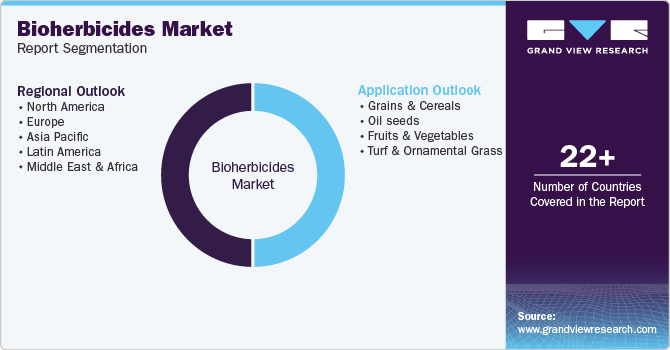
This report forecasts revenue and volume growth at global, regional, and country levels and provides an analysis of the latest industry trends in each of the sub-segments from 2021 to 2033. For this study, Grand View Research has segmented the global bioherbicides market report based on application and region.
 To learn more about this report, Download Free Sample Report
 -
Application Outlook (Revenue, USD Million, 2021 - 2033)
-
Grains & Cereals
-
Oil seeds
-
Fruits & Vegetables
-
Turf & Ornamental Grass
-
-
Regional Outlook (Revenue, USD Million, 2021 - 2033)
-
North America
-
U.S.
-
Canada
-
-
Europe
-
Germany
-
UK
-
-
Asia Pacific
-
China
-
India
-
Japan
-
Australia
-
-
Latin America
-
Brazil
-
-
Middle East & Africa
-
Saudi Arabia
-
-
Research Methodology
The bioherbicides market figures in this report are based on a proven research process that combines executive interviews with secondary research from proprietary databases, company filings, and recognized regulatory and institutional sources. Market size is built through value-chain sizing - reconciling supply-side and demand-side estimates - and triangulated with bottom-up and top-down approaches. Every estimate passes multiple levels of expert validation before publication, with each bioherbicides segment quantified using the revenue-capture definitions in the table below.
Segment Definition
Segment - Grade
Revenue capture definition
Grains & Cereals
Revenue is generated through the use of bioherbicides in wheat, corn, rice, barley, and other cereal crop cultivation to manage weeds while supporting sustainable farming practices and reducing dependence on synthetic herbicides.
Oil Seeds
Revenue is supported by biological weed management solutions utilized in soybean, canola, sunflower, and other oilseed production systems. Adoption is influenced by crop protection requirements, sustainability goals, and integrated weed management programs.
Fruits & Vegetables
Market value is derived from bioherbicide applications in high-value horticultural crops where growers seek residue reduction, environmental compliance, and improved crop quality. Growing organic cultivation continues to support demand within this segment.
Turf & Ornamental Grass
As the dominant application segment, revenue capture is driven by extensive use across golf courses, sports fields, parks, commercial landscapes, and residential turf management programs requiring environmentally responsible weed control solutions.
Estimation Model
Layer Name
Key Question
Description
Cultivated Land Layer
What forms the addressable base?
Identify global acreage under grains & cereals, oilseeds, fruits & vegetables, turfgrass, and ornamental cultivation where weed management solutions are required to maintain productivity and crop quality.
Biological Adoption Layer
Where are bioherbicides utilized?
Estimate the proportion of agricultural and non-agricultural land utilizing biological weed control products based on sustainability initiatives, organic farming practices, and integrated weed management adoption rates.
Treatment Intensity Layer
How much bioherbicide is consumed?
Analyze application frequencies, treatment rates, weed pressure levels, crop requirements, and regional farming practices to determine annual bioherbicide consumption across end-use applications.
Revenue Layer
How is market revenue generated?
Market revenue is quantified through the sale of microorganism-based, plant-derived, and naturally sourced bioherbicides supplied to farmers, landscape managers, turf operators, and agricultural service providers for weed control applications.
Delivered Customizations
This report has been delivered with the following In-depth customizations
Client Request
Customization Delivered
Value Adds
Regional Segmentation
The study delivers detailed additional country specific analysis across Thailand, Vietnam, etc., evaluating bioherbicide adoption trends, regulatory developments, organic farming acreage, and crop protection demand dynamics.
Enables stakeholders to identify high-growth regions, assess biological product adoption potential, and formulate expansion strategies aligned with sustainability initiatives and agricultural policy developments.
Cross-Segmentation Analysis
The study delivers detailed cross-segmentation analysis assessing bioherbicide demand across crop type by application, highlighting adoption patterns, performance requirements, market attractiveness, and growth opportunities across agricultural applications.
Helps companies identify the most promising formulation-crop combinations, optimize product development priorities, and target high-value demand segments within biological crop protection markets.
Opportunity Assessment
The study delivers comprehensive assessment of opportunities emerging from organic farming expansion, herbicide resistance management programs, regenerative agriculture initiatives, and increasing regulatory support for biological crop protection products.
Supports strategic planning by identifying future revenue pockets, evaluating underserved markets, and aligning business development initiatives with long-term sustainability and agricultural transformation trends.
Frequently Asked Questions About This Report
The global bioherbicides market is expected to grow at a compound annual growth rate of 15.3% from 2026 to 2033 to reach USD 12.1 billion by 2033.
The turf & ornamental grass segment dominated the market due to increasing demand for aesthetic landscaping, rising adoption of professional lawn management practices, and extensive use in golf courses, sports fields, and recreational spaces.
Some of the key players operating in the bioherbicides market include Marrone Bio Innovations Inc., Emery Oleochemicals, Harpe Bio, Verdesian Life Sciences, among others.
The key factors that are driving the bioherbicides market include the rising demand for organic food products coupled with increasing awareness of the harmful effects of chemical herbicides on human health.
North America led the bioherbicides market in 2025, accounting for 28.6% of market revenue, supported by strong adoption of sustainable agricultural practices and increasing regulatory support for bio-based crop protection solutions.
Limited field efficacy under varying environmental conditions and slower weed control performance compared to synthetic herbicides act as key restraints for the bioherbicides market, restricting wider adoption among conventional farmers.
Rising demand for sustainable agriculture and increasing regulatory restrictions on chemical herbicides present a major opportunity for the bioherbicides market, driving adoption across organic farming and environmentally sensitive crop production systems.
High production costs and limited large-scale commercialization, coupled with challenges in ensuring consistent performance across different climatic and soil conditions, remain key industry challenges for the bioherbicides market.
The global bioherbicides market size was estimated at USD 3.9 billion in 2025 and is expected to reach USD 4.5 billion in 2026.
About the Author(s)
Agrochemicals & Fertilizers Research Team
Bulk Chemicals · Agrochemicals & FertilizersThis report was authored by the agrochemicals & fertilizers research team at Grand View Research - comprising two research analysts, one senior research analyst, and one industry expert - with specialized expertise in the agrochemicals & fertilizers segment of the bulk chemicals industry. All findings are based on proprietary bulk chemicals databases, executive interviews, and regulatory analysis, subject to internal peer review prior to publication.
Last Updated:
Speak to Analyst

Customize this report to your needs - add regions, segments, or data points, with 20% free customization.
Or view our licence options:


ISO 9001:2015 & 27001:2022 Certified
We are GDPR and CCPA compliant! Your transaction & personal information is safe and secure. For more details, please read our privacy policy.


