
- Home
- »
- Advanced Interior Materials
- »
-
Commercial Flooring Market Size & Share Report, 2026-2033GVR Report cover

Commercial Flooring Market (2026 - 2033)
Size, Share & Trends Analysis Report By Product (Wood & Laminate, LVT, Ceramics, Natural Stone, Linoleum & Rubber), By Region (North America, Asia Pacific), And Segment Forecasts
Market Size, 2025
$158.9BMarket Estimate, 2026
$167.0BMarket Forecast, 2033
$236.7BCAGR, 2026–2033
5.1%Commercial Flooring Market Summary
The global commercial flooring market size was valued at USD 158.9 billion in 2025 and is projected to grow from USD 167.0 billion in 2026 to USD 236.7 billion by 2033, at a CAGR of 5.1% from 2026 to 2033. Asia Pacific dominated the global market, accounting for the largest revenue share of 44.0%% in 2025. The growing commercial construction activities in developing countries are driving the demand for market growth.
Key Market Trends & Insights
- By product: The vitrified (ceramic) segment held the largest market share of over 27.5% in 2025.
Regional Highlights
- Largest regional market: Asia Pacific (44.0% revenue share, 2025)
- Fastest-growing regional market: Asia Pacific (highest CAGR, 2026-2033)
Market Size & Forecast
- Market size in 2025: USD 158.9 Billion
- Estimated market size in 2026: USD 167.0 Billion
- Projected market size by 2033: USD 236.7 Billion
- CAGR (2026-2033): 5.1%
Three ways to get this report
Buy it, customize it, or ask a question.Ask an Analyst
Analyst response in 1 business day
- AccessReport author, directly
- Reply timeWithin 1 working day
- No sales callDirect answer only
- FormatEmail reply
- CostFree, no cost
Get the Full Report
What the study covers
- FormatsPDF · Excel · Dashboard
- Timeline2026–2033 annual, 2025 base
- Coverage20+ countries, 5 regions
- Companies10+ key players profiled
Customize the Report
20% free customization
- IncludeCountries, segments, points
- TailorTo your product definition
- ExtendDeeper competitor detail
- OrA fully bespoke study
- Turnaround5–10 working days
Increasing government spending on infrastructure development on non-residential structures is expected to play a vital role in augmenting demand for flooring. The booming construction industry in developed economies, such as the U.S., and rapidly rising infrastructure activity in developing economies, such as China and India, are key factors influencing the global development of the non-residential construction market. Moreover, the emergence of India, Taiwan, and Mexico as the upcoming manufacturing hubs will not only result in the establishment of factories but also in a significant population migrating close to these centers, resulting in the development of new cities or the expansion of the existing towns. This factor is expected to play a crucial role in developing the commercial floorings industry over the next few years. Source: Grand View Research, IR Documents, Primary Interviews, Paid DatabasesTo learn more about this report,
 Download Free Sample Report
 Commercial areas are subject to high traffic and therefore require durable flooring, such as resilient or wooden flooring. Flooring products are used in numerous commercial building applications, including offices, convenience stores, shopping malls, and the construction of other retail stores. Commercial buildings are often designated as high-security zones, and local authorities usually enforce strict regulations in such areas. The increasing construction of commercial buildings, such as drugstores, grocery stores, and big-box stores, over the past few years, will benefit the segment's growth. A rise in the construction activities of commercial sub-sectors, such as institutional buildings, office complexes, public buildings, and municipal corporations, is also expected to significantly boost the commercial flooring industry over the next couple of years.
Moreover, the high demand for office spaces, especially in urban areas of emerging economies, is propelling the demand for high-quality flooring products. The market in North America is expected to witness significant growth over the coming years due to the increasing construction of commercial spaces in the region. There is a rapid shift toward the domestic production of commercial flooring products, such as ceramic tiles, carpets, wood, and laminate. Many Italian companies are increasingly investing in the North American market owing to the abundant raw material availability and a huge customer base.
Market Dynamics
The increasing construction of commercial buildings, including office complexes, healthcare facilities, educational institutions, shopping malls, hotels, and public infrastructure projects, is a major factor driving the market growth. Developing countries such as China, India, and Southeast Asian nations are heavily investing in commercial real estate and infrastructure development amid rapid urbanization and industrialization. Also, the recovery of the construction industry in developed countries and the growing demand for modern office spaces contribute to market growth. Commercial flooring products are popular for their durability, aesthetics, ease of cleaning, and long-lasting performance in high-traffic environments. Furthermore, the growing adoption of green buildings and sustainable construction practices is increasing demand for innovative flooring materials that enhance indoor air quality and improve building efficiency.
Fluctuations in the prices of key raw materials such as wood, vinyl, rubber, ceramic materials, and petrochemical-based products remain a significant challenge for the commercial flooring industry. Changes in the prices of raw materials directly affect the manufacturing costs and profit margins for the flooring manufacturer. Furthermore, high-end commercial flooring generally requires specific installation procedures, skilled labor, and a maintenance strategy, thereby increasing project costs. Limited budgets for commercial property owners and facility managers may limit the use of expensive flooring options, particularly in markets with higher price sensitivity. In addition, supply chain and transportation cost fluctuations pose challenges to both product availability and pricing for both the manufacturer and end-user.
The growing emphasis on sustainability and the increasing renovation and refurbishment of existing commercial spaces present significant opportunities for the commercial flooring industry. Environment-friendly flooring options such as recycled rubber, linoleum, low-VOC products, and sustainably harvested wood are becoming major investments for businesses to comply with green building standards and corporate sustainability initiatives. Rising spending on refurbishment in offices, stores, medical facilities, and hospitality establishments is driving demand for high-performance, attractive floor coverings. Technological advancements in luxurious vinyl tile, modular flooring systems, and wear-resistant surfaces are enabling increased product applicability. As companies focus on enhancing workplace environments and customer experiences, demand for innovative commercial flooring products is expected to present substantial growth opportunities over the forecast period.
Analyst Perspective
The commercial flooring market is expected to witness steady growth, driven by rising investments in commercial construction and renovation projects. Expanding healthcare, education, hospitality, retail, and office infrastructure is boosting demand for advanced flooring solutions. Growing preference for sustainable, recyclable, and low-emission materials is shaping market trends. Companies focusing on product innovation, customization, and environmentally compliant flooring solutions are expected to maintain a competitive edge.
Product Insights
The vitrified (ceramic) segment led the market with the largest revenue share of over 27.5% in 2025. Vitrified (ceramic) products are widely used because of their low porosity and serve as an alternative to granite and marble flooring. Ceramic tiles are used in commercial flooring due to their low maintenance, helping keep maintenance costs of commercial buildings to a minimum over the long term. These are also durable, can withstand moisture, and protect the sub-flooring of the buildings. Scratch-resistant tiles are used for special applications, such as staircase solutions, high-traffic tiles, external wall cladding, and swimming pool tiles. Furthermore, manufacturers are developing new products with high durability and functionality for use in spaces subject to heavy wear and tear, such as restaurants and passageways. Increasing investments in commercial offices, hotels, and other sectors are anticipated to augment the demand for ceramic flooring products over the forecast period.
The linoleum & rubber product segment is expected to record at the fastest CAGR over the forecast period. Linoleum is a natural ingredient-based floor covering, comprising ingredients including linseed oil, which is 100% biodegradable and obtained from flax plants, wood flour, limestone, and jute resin. These ingredients help linoleum products last longer and be more durable than vinyl solutions. Rubber as a raw material is highly expensive, which makes rubber flooring an expensive solution. However, the increasing use of recycled rubber flooring, primarily in gyms and yoga studios due to its low cost, is expected to drive segment growth over the projected period.
Regional Insights
Asia Pacific dominated the global commercial flooring market with the largest revenue share of over 44.0% in 2025 and is expected to record at the fastest CAGR from 2026 to 2033. This is attributed to the rapid urbanization and growing construction industry in the developing countries in the region. The growing population in major economies in the Asia Pacific region is driving the industrialization and construction of commercial buildings. This has triggered the demand for commercial flooring products, such as ceramics, porcelain, carpet, LVT, and natural stone, in the market. Moreover, the growing consumer disposable income has resulted in increased spending on the renovation and refurbishment of commercial spaces based on the color & texture of products.
 To learn more about this report, Download Free Sample Report
 Europe Commercial Flooring Market Trends
The commercial flooring market in Europe is expected to grow at a significant CAGR from 2026 to 2033. This is attributed to the growing number of commercial buildings, mainly the healthcare buildings & centers, and hospitality buildings. The region is experiencing significant growth in the number of tourists, which is triggering the demand for malls & shopping centers, auditoriums & theaters, and hotels & restaurants. This will drive the market for commercial flooring in the region over the coming years.
Key Commercial Flooring Company Insights
In the global commercial flooring industry, vendors are constantly developing innovative solutions, such as display and distribution systems, virtual assistants, and online catalogs, to help consumers choose the perfect product for the intended applications. Commercial flooring manufacturers aim to intensify their competitive positions by widening their customer base. Furthermore, these manufacturers are focusing on distribution, new product launches, and product expansion to gauge existing and future demand patterns in emerging application sectors.
Key Commercial Flooring Companies
The following key companies have been profiled for this study on the commercial flooring market.
-
Amtico
-
The Armstrong Flooring, Inc.
-
Congoleum
-
Flowcrete (RPM)
-
Forbo International SA
-
Gerflor
-
Interface, Inc.
-
IVC Group
-
James Halstead Plc.
-
Mannington Mills, Inc.
-
NOX Corp.
-
Tkflor
-
Nora
-
Toli Flooring
Recent Developments
-
In February 2026, Interface introduced Noravant, a PVC-free resilient rubber flooring platform, with woodgrain designs in rubber flooring. The innovation lies in the design flexibility, sustainability, and low-carbon impact performance of the material for commercial use.
-
In January 2025, Mannington Mills launched several new lines of luxury vinyl flooring under ADURA, which incorporates a wider range of technology and strength in its flooring offerings.
-
In June 2025, Armstrong Flooring unveiled Armstrong Flooring TimberTones Densified Hardwood, a dent-resistant flooring designed for high-traffic environments. The hardwood floor line uses a unique heat-and-pressure process, which increases indentation and scratch resistance for commercial use.
Commercial Flooring Market Report Scope
Report Attribute
Details
Market size in 2025
USD 158.9 billion
Estimated market size in 2026
USD 167.0 billion
Projected market size by 2033
USD 236.7 billion
Growth rate
CAGR of 5.1% from 2026 to 2033
Base year for estimation
2025
Historical data
2021 - 2024
Forecast period
2026 - 2033
Quantitative units
Revenue in USD million/billion, and CAGR from 2026 to 2033
Report coverage
Revenue forecast, company ranking, competitive landscape, growth factors, and trends
Segments covered
Product, region
Regional scope
North America; Europe; Asia Pacific; Central & South America; Middle East & Africa
Country scope
U.S.; Canada; Mexico; UK; Germany; France; Italy; Spain; Russia; Romania; Czech Republic; Portugal; Ukraine; Slovakia; Hungary; China; India; Japan; South Korea; Indonesia; Australia; Philippines; Vietnam; Saudi Arabia; Qatar; UAE; Egypt; Israel; South Africa; Morocco; Chile; Brazil; Argentina; Colombia; Peru
Key Companies Profiled
Amtico; The Armstrong Flooring, Inc.; Congoleum, Flowcrete (RPM); Forbo International SA; Gerflor; Interface Inc.; IVC Group; James Halstead Plc.; Mannington Mills Inc.; NOX Corp.; Tkflor; Nora; Toli Flooring
Customization scope
Free report customization (equivalent to up to 8 analysts’ working days) with purchase. Addition or alteration to country, regional & segment scope
Pricing and purchase options
Avail customized purchase options to meet your exact research needs. Explore purchase options
Global Commercial Flooring Market Report Segmentation
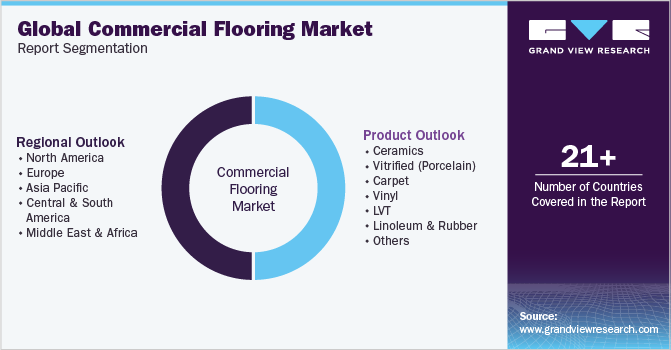
This report forecasts revenue growth and provides an analysis of the latest trends in each of the sub-segments from 2021 to 2033. For this report, Grand View Research has segmented the global commercial flooring market based on product and region:
 To learn more about this report, Download Free Sample Report
 -
Product Outlook (Volume, Million Square Meters; Revenue, USD Million, 2021 - 2033)
-
Ceramics
-
Vitrified (Porcelain)
-
Carpet
-
Vinyl
-
LVT
-
Linoleum & Rubber
-
Wood & Laminate
-
Natural Stone
-
Others
-
-
Regional Outlook (Volume, Million Square Meters; Revenue, USD Million, 2021 - 2033)
-
North America
-
U.S.
-
Canada
-
Mexico
-
-
Europe
-
UK
-
Germany
-
France
-
Italy
-
Spain
-
Russia
-
Romania
-
Czech Republic
-
Portugal
-
Ukraine
-
Slovakia
-
Hungary
-
-
Asia Pacific
-
China
-
India
-
Japan
-
South Korea
-
Australia
-
Indonesia
-
Philippines
-
Vietnam
-
-
Middle East & Africa
-
Saudi Arabia
-
UAE
-
Israel
-
Egypt
-
Qatar
-
South Africa
-
Morocco
-
-
Central & South America
-
Chile
-
Brazil
-
Colombia
-
Argentina
-
Peru
-
-
Frequently Asked Questions About This Report
The global commercial flooring market size was valued at USD 158.9 billion in 2025 and is estimated at USD 167.0 billion in 2026.
The global commercial flooring market is expected to grow at a CAGR of 5.1% from 2026 to 2033, reaching USD 236.7 billion.
Asia Pacific dominated with a revenue share of 44.0% in 2025.
Vitrified (ceramic) segment dominated the container security market with a share of 27.5% in 2025, while linoleum & rubber products are the fastest-growing segment.
Some of the key players operating in the Commercial Flooring market includes Amtico, The Armstrong Flooring, Inc, Congoleum, Flowcrete (RPM), Forbo International SA, Gerflor, Interface Inc., IVC Group, James Halstead Plc., Mannington Mills Inc, NOX Corporation, Tkflor, Nora, and Toli flooring.
About the Author(s)
Advanced Interior Materials Research Team
Advanced Materials · Advanced Interior MaterialsThis report was authored by the advanced interior materials research team at Grand View Research - comprising two research analysts, one senior research analyst, and one industry expert - with specialized expertise in the advanced interior materials segment of the advanced materials industry. All findings are based on proprietary advanced materials databases, executive interviews, and regulatory analysis, subject to internal peer review prior to publication.
Last Updated:
Speak to Analyst

Customize this report to your needs - add regions, segments, or data points, with 20% free customization.
Or view our licence options:


ISO 9001:2015 & 27001:2022 Certified
We are GDPR and CCPA compliant! Your transaction & personal information is safe and secure. For more details, please read our privacy policy.


