
- Home
- »
- Plastics, Polymers & Resins
- »
-
Flame Retardant Market Size, Share, Industry Report, 2033GVR Report cover
![Flame Retardant Market Size, Share & Trends Report]()
Flame Retardant Market (2025 - 2033) Size, Share & Trends Analysis Report By Product (Halogenated, Non Halogenated), By Application (Polyolefin, Epoxy Resins, UPE), By End Use (Construction, Electrical & Electronics), By Region, And Segment Forecasts
- Report ID: GVR-1-68038-281-5
- Number of Report Pages: 80
- Format: PDF
- Historical Range: 2018 - 2023
- Forecast Period: 2025 - 2033
- Industry: Bulk Chemicals
- Report Summary
- Table of Contents
- Segmentation
- Methodology
- Download FREE Sample
-
 Download Sample Report
Flame Retardant Market Summary
The global flame retardant market size was estimated at USD 9,867.1 million in 2024 and is projected to reach USD 18,098.1 million by 2033, growing at a CAGR of 7.0% from 2025 to 2033. The growing emphasis on fire safety regulations and standards across residential, commercial, and industrial sectors contribute to the market growth.
Key Market Trends & Insights
- Asia Pacific dominated the global flame retardant market with the largest revenue share of 44.0% in 2024.
- The flame retardant industry in the U.S. is expected to grow at a substantial CAGR of 6.7% from 2025 to 2033.
- By product, the non-halogenated segment held the highest revenue share of 62.5% in 2024.
- By application, the polyolefin is expected to grow at a significant CAGR of 7.3% from 2025 to 2033.
- By end use, the construction segment held the highest revenue share of 34.3% in 2024.
Market Size & Forecast
- 2024 Market Size: USD 9,867.1 Million
- 2033 Projected Market Size: USD 18,098.1 Million
- CAGR (2025-2033): 7.0%
- Asia Pacific: Largest Market in 2024
Governments and regulatory bodies worldwide have implemented stringent safety norms mandating the use of flame retardant materials in products such as building insulation, electronic housings, automotive components, and textiles. Another key growth factor for the flame retardant industry is the expansion of the construction and infrastructure sector, particularly in emerging economies across Asia-Pacific and the Middle East. Flame retardants are extensively used in construction materials like wiring cables, insulation foams, paints, and coatings to reduce the risk of fire-related accidents in residential and commercial spaces. Rapid urbanization and government investments in smart city projects have further amplified the adoption of flame retardant products, especially in energy-efficient building designs that require compliance with international fire safety codes.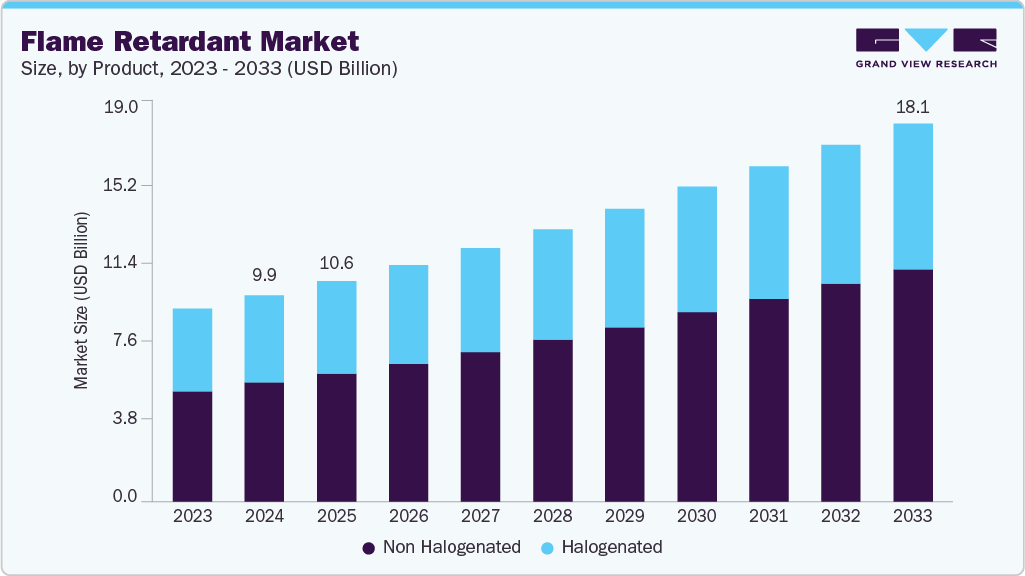
The electrical and electronics industry also serves as a major demand center for flame retardants, driven by the rising consumption of consumer electronics, electric vehicles (EVs), and renewable energy systems. Flame retardants are crucial in printed circuit boards (PCBs), connectors, and casings to prevent electrical fires caused by overheating. The global shift toward lightweight and miniaturized electronic components has accelerated the need for halogen-free and eco-friendly flame retardant technologies, such as phosphorous-based and aluminum hydroxide formulations, which provide fire resistance without toxic emissions.
The market is witnessing momentum from technological innovations and sustainability trends. Growing environmental awareness and regulatory restrictions on traditional halogenated flame retardants have encouraged the development of bio-based and non-halogenated alternatives that offer comparable fire resistance with improved recyclability and lower ecological footprint. Companies are investing in research and development to optimize performance across different polymers and composites, ensuring compliance with circular economy objectives. Together, these factors, regulatory enforcement, industrial expansion, technological innovation, and sustainability mandates, collectively reinforce the strong growth trajectory of the global market.
Market Concentration & Characteristics
The flame retardant market is characterized by a moderate to high level of concentration, with a few global players dominating production and distribution. Major companies such as Albemarle Corporation, Lanxess AG, Clariant International, ICL Group Ltd., and BASF SE hold significant market shares, supported by strong R&D capabilities, integrated supply chains, and diversified product portfolios.
These players focus on developing advanced, non-halogenated formulations to comply with environmental regulations and meet the growing demand for sustainable materials. The market’s entry barriers are relatively high due to the capital-intensive manufacturing process, stringent safety certifications, and regulatory compliance requirements, which limit participation to established chemical producers.
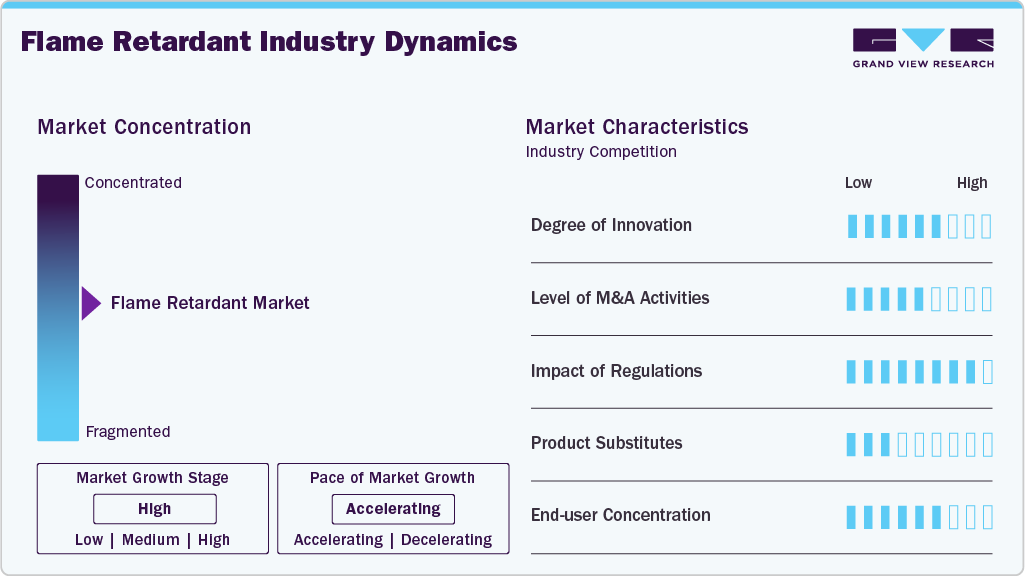
In terms of characteristics, the flame retardant industry is technology-driven and regulation-sensitive, with demand largely shaped by end-use industries such as construction, electronics, automotive, and textiles. Product differentiation is achieved through formulation innovation, performance enhancement, and compliance with eco-labeling standards.
The shift toward environmentally friendly flame retardants, particularly phosphorus-, nitrogen, and mineral-based types, is redefining competition and product development strategies. Additionally, long-term partnerships between material suppliers and downstream manufacturers ensure stable supply and customized solutions. Overall, the market exhibits steady growth with an increasing focus on safety, sustainability, and compliance, reflecting its strategic role in modern industrial applications
Product Insights
The non-halogenated segment accounted for the largest revenue share of 57.7% in 2024. This can be attributed to the increasing regulatory restrictions on halogen-based compounds and rising demand for environmentally safe alternatives. These retardants, primarily phosphorus-, nitrogen-, and mineral-based formulations, offer effective flame resistance with lower smoke and toxic gas emissions. They are widely used in electronics, construction materials, and automotive components to meet stringent fire safety and sustainability standards.
The halogenated segment is expected to grow significantly during the forecast period. This includes compounds based on bromine and chlorine, known for their high flame suppression efficiency and cost-effectiveness. These materials are widely used in electronics, textiles, and plastic components where strong flame resistance is required. However, growing environmental and health concerns regarding toxic emissions during combustion have led to regulatory restrictions and a gradual market shift toward non-halogenated alternatives.
Application Insights
The polyolefin segment led the flame retardant market with the largest revenue share of 25.8% in 2024. Increasing demand for materials like polypropylene (PP) and polyethylene (PE) used in wires, cables, and construction components. Flame retardants enhance the thermal stability and fire resistance of these polymers without compromising mechanical strength. The shift toward halogen-free formulations in polyolefin applications is driven by stringent safety and environmental standards, especially in electrical and building sectors.
The ETP segment is expected to grow significantly during the forecast period. The growth of the segment is driven by the use of materials such as polyamides (PA), polycarbonate (PC), and acrylonitrile butadiene styrene (ABS) in electrical, automotive, and electronic components. Flame retardants enhance these polymers’ heat resistance and safety performance under high operating temperatures. With the rise of electric vehicles and smart electronics, demand for halogen-free and high-performance flame retardants in ETPs is increasing.
End Use Insights
The electrical & electronics segment led the flame retardant industry with the largest revenue share of 41.6% in 2024. This essential for enhancing the fire safety of circuit boards, connectors, casings, and wiring components. These additives help prevent electrical fires caused by overheating or short circuits while maintaining material strength and insulation properties. The growing production of consumer electronics, electric vehicles, and renewable energy systems is driving demand for advanced, halogen-free flame retardant solutions. This segment is also influenced by strict global standards such as UL94 and IEC 60695 for fire performance and safety compliance.
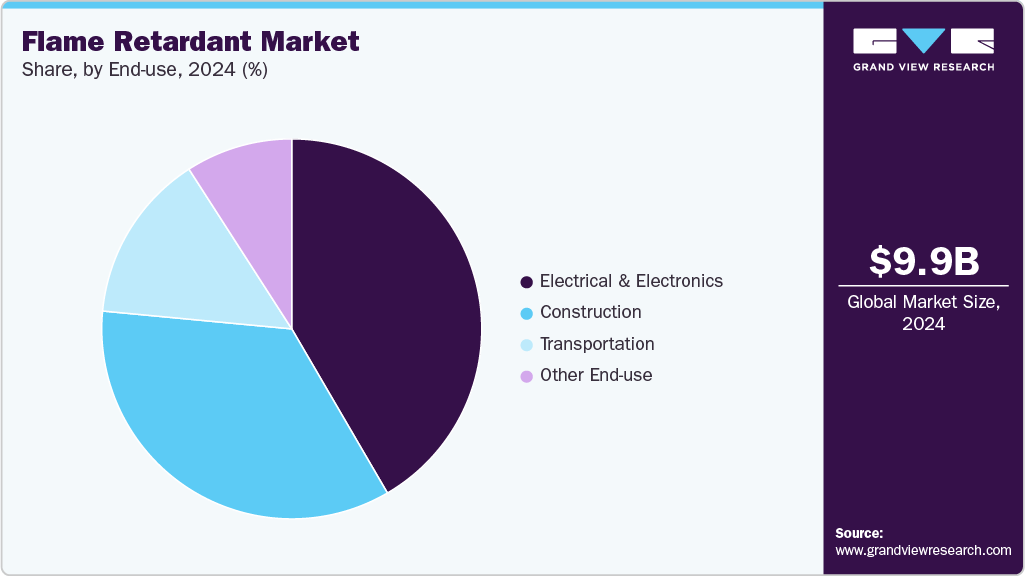
The construction segment is expected to grow at the fastest CAGR of 7.2% during the forecast period. The growth of the segment is driven by the need for fire-safe building materials such as insulation panels, cables, coatings, and structural plastics. Flame retardants are incorporated to enhance fire resistance, reduce smoke generation, and prevent flame propagation in residential and commercial buildings. Stringent building safety codes and energy efficiency standards across regions like North America and Europe further support market growth.
Regional Insights
The Asia Pacific flame retardant market accounted for the largest global revenue share of 44.0% in 2024. This can be attributed to the rapid industrialization, urban infrastructure growth, and strong demand from construction, electronics, and automotive sectors. Countries such as China, Japan, and South Korea lead in production and consumption, supported by expanding manufacturing bases and regulatory emphasis on fire safety.
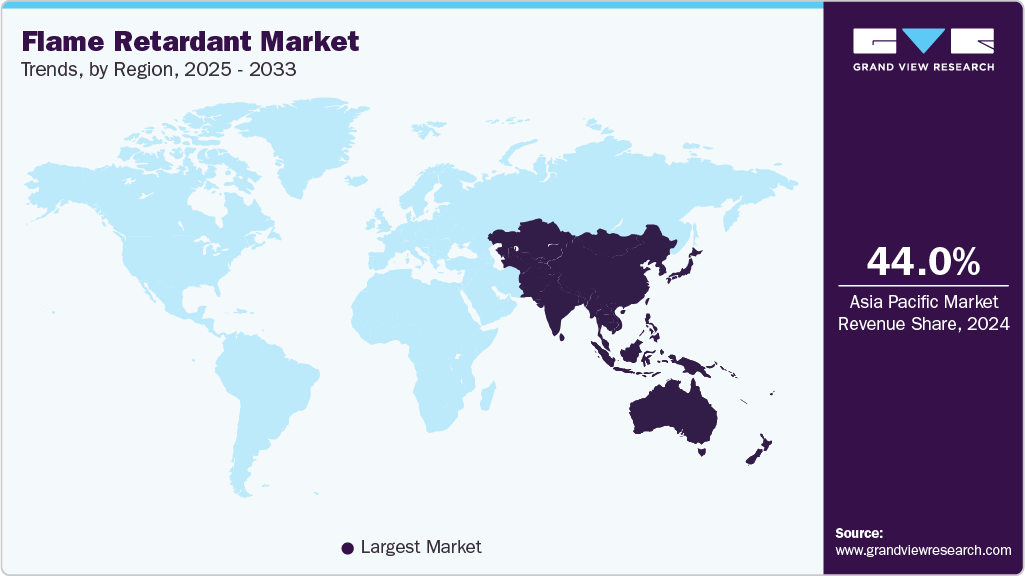
The China flame retardant market dominated Asia Pacific with a revenue market share of 44.0% in 2024. China is the largest producer and consumer of flame retardants globally, benefiting from its robust electronics and construction industries. Government initiatives promoting industrial safety and sustainable production are further boosting the adoption of advanced flame retardant technologies.
North America Flame Retardant Market Trends
The North America flame retardant industry is expected to grow over the forecast period. The growth of the regional market is supported by stringent fire safety regulations and growing use of halogen-free formulations in electronics, transportation, and building materials. The U.S. remains a key contributor due to advanced R&D capabilities and rising demand for sustainable flame retardant solutions.
U.S. Flame Retardant Market Trends
The U.S. flame retardant industry’s growth is driven by technological innovation, regulatory enforcement, and demand from automotive and electronics sectors. The growing emphasis on halogen-free and environmentally compliant materials continues to reshape the product landscape across key industries.
Europe Flame Retardant Market Trends
Europe’s flame retardant industry is shaped by environmental regulations such as REACH and RoHS, promoting the transition toward non-halogenated and bio-based alternatives. Demand is strong in automotive, electrical, and construction sectors, with countries like Germany and France focusing on material innovation and recyclability.
The Germany flame retardant market represents one of the most advanced markets for flame retardants in Europe. The growth of this market is driven by its strong automotive, electrical, and construction industries. The country emphasizes the use of non-halogenated and eco-friendly flame retardant formulations in compliance with stringent EU safety and environmental standards. German manufacturers are at the forefront of innovation in polymer integration and material engineering, developing high-performance flame retardant systems that combine fire resistance with recyclability and durability.
Latin America Flame Retardant Market Trends
The Latin America flame retardant industry is expanding gradually. The growth of the regional market is driven by urban development projects and industrialization in Brazil and Mexico. Rising safety awareness and the adoption of international building codes are supporting the use of flame retardant materials in infrastructure and consumer goods.
Middle East and Africa Flame Retardant Market Trends
The Middle East & Africa flame retardant industry is experiencing growth, primarily supported by construction and transportation projects, particularly in the Gulf countries. Increasing investments in commercial infrastructure and electrical systems are fostering gradual adoption of fire-safe materials.
Key Flame Retardant Company Insights
Some of the key players operating in the market include Albemarle Corporation, BASF SE, and ICL.
- BASF SE is a chemical manufacturing company with a presence across Asia Pacific, North America, Central & South America, Europe, and the Middle East & Africa. The company operates through six business segments, namely chemical, material, industrial solutions, surface technologies, agricultural solutions, and nutrition & care. The chemical segment includes petrochemicals and intermediaries. Material segment comprises performance polymers and monomers. The Industrial solutions segment includes performance chemicals and dispersions & pigments. Agricultural solution segment includes products for farming, landscape management, and pest control. Nutrition & care segment is further sub-segmented into nutrition & health and care. The company provides a wide range of surfactants for textile, paint & coatings, homecare, and food processing industries.
Key Flame Retardant Companies:
The following are the leading companies in the flame retardant market. These companies collectively hold the largest market share and dictate industry trends.
- Albemarle Corporation
- ICL
- LANXESS
- CLARIANT
- Italmatch Chemicals S.p.A.
- Huber Engineered Materials
- BASF SE
- THOR Group
- DOW Inc.
- STAHL HOLDINGS B.V.
- Nofia Solutions
- DuPont
Recent Developments
-
In May 2025, J.M. Huber Corporation announced the acquisition of R.J. Marshall Company’s assets covering alumina trihydrate (ATH), antimony-free flame retardants, and molybdate-based smoke suppressants. This deal will integrate these assets into Huber’s Advanced Materials (HAM) business unit, enhancing its non-halogenated fire-retardant portfolio and strengthening its leadership in North America. Huber emphasized that the acquisition supports its strategic goal of growing halogen-free flame retardant and smoke suppressant technologies, while offering cost-effective alternatives to antimony-trioxide-based products.
-
In January 2022, Huber Engineered Materials successfully acquired MAGNIFIN Magnesiaprodukte GmbH & Co KG (MAGNIFIN). The product lineup previously presented by MAGNIFIN and represented by Martinswerk GmbH has seamlessly become an integral part of Huber's strategic business unit, Fire Retardant Additives (FRA). This strategic integration bolsters Huber's array of smoke suppressants, halogen-free fire retardants, and specialized aluminum oxides, significantly amplifying its worldwide market influence.
Flame Retardant Market Report Scope
Report Attribute
Details
Market size value in 2025
USD 10,559.2 million
Revenue forecast in 2033
USD 18,098.1 million
Growth rate
CAGR of 7.0% from 2025 to 2033
Base year for estimation
2024
Historical data
2018 - 2023
Forecast period
2025 - 2033
Quantitative units
Volume in kilotons, revenue in USD million, and CAGR from 2025 to 2033
Report coverage
Revenue forecast, volume forecast, competitive landscape, growth factors, and trends
Segments covered
Product, application, end use, region
Regional scope
North America; Europe; Asia Pacific; Latin America; Middle East & Africa
Country scope
U.S.; Canada; Mexico; Germany; UK; France; Italy; Spain; China; India; Japan; South Korea; Brazil; Argentina; Saudi Arabia; South Africa
Key companies profiled
Albemarle Corporation; ICL; LANXESS; CLARIANT; Italmatch Chemicals S.p.A.; Huber Engineered Materials; BASF SE; THOR Group; DOW Inc.; STAHL HOLDINGS B.V.; Nofia Solutions; DuPont
Customization scope
Free report customization (equivalent up to 8 analyst’s working days) with purchase. Addition or alteration to country, regional, and segment scope.
Pricing and purchase options
Avail customized purchase options to meet your exact research needs. Explore purchase options
Global Flame Retardant Market Report Segmentation
This report forecasts volume & revenue growth at a global level and provides an analysis of the latest industry trends in each of the sub-segments from 2018 to 2033. For this study, Grand View Research has segmented the global flame retardant market report based on product, application, end use, and region:
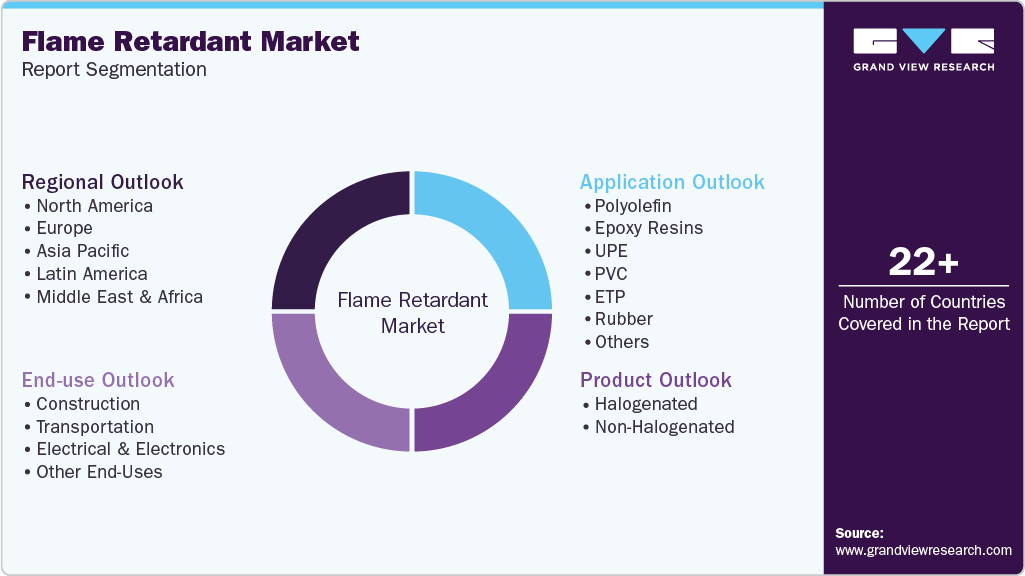
-
Product Outlook (Volume, Kilotons; Revenue, USD Million, 2018 - 2033)
-
Halogenated
-
Non-Halogenated
-
-
Application Outlook (Volume, Kilotons; Revenue, USD Million, 2018 - 2033)
-
Polyolefin
-
Epoxy Resins
-
UPE
-
PVC
-
ETP
-
Rubber
-
Styrenics
-
Other Applications
-
-
End Use Outlook (Volume, Kilotons; Revenue, USD Million, 2018 - 2033)
-
Construction
-
Transportation
-
Electrical & Electronics
-
Other End Uses
-
-
Regional Outlook (Volume, Kilotons; Revenue, USD Million, 2018 - 2033)
-
North America
-
U.S.
-
Canada
-
Mexico
-
-
Europe
-
Germany
-
UK
-
France
-
Italy
-
Spain
-
-
Asia Pacific
-
China
-
India
-
Japan
-
South Korea
-
-
Latin America
-
Brazil
-
Argentina
-
-
Middle East & Africa
-
Saudi Arabia
-
South Africa
-
-
Frequently Asked Questions About This Report
b. The global flame retardant market size was estimated at USD 9.87 billion in 2024 and is expected to reach USD 10.55 billion in 2025.
b. The global flame retardant market is expected to grow at a compound annual growth rate of 7.0% from 2025 to 2033 to reach USD 18.10 billion by 2033.
b. Asia Pacific dominated the flame retardant market with a share of 44.0% in 2024. This can be attributed to the rapid industrialization, urban infrastructure growth, and strong demand from construction, electronics, and automotive sectors.
b. Some key players operating in the flame retardant market include Albemarle Corporation; ICL; LANXESS; CLARIANT; Italmatch Chemicals S.p.A.; Huber Engineered Materials; BASF SE; THOR; STAHL HOLDINGS B.V.; Nofia Solutions; DuPont.
b. The growing emphasis on fire safety regulations and standards across residential, commercial, and industrial sectors contribute to the market growth. Governments and regulatory bodies worldwide have implemented stringent safety norms mandating the use of flame retardant materials in products such as building insulation, electronic housings, automotive components, and textiles.


Share this report with your colleague or friend.
Need a Tailored Report?
Customize this report to your needs — add regions, segments, or data points, with 20% free customization.


ISO 9001:2015 & 27001:2022 Certified
We are GDPR and CCPA compliant! Your transaction & personal information is safe and secure. For more details, please read our privacy policy.
Trusted market insights - try a free sample
See how our reports are structured and why industry leaders rely on Grand View Research. Get a free sample or ask us to tailor this report to your needs.













