Report Overview
The global healthcare smart contracts market size was valued at USD 1.6 billion in 2021 and is expected to expand at a compound annual growth rate (CAGR) of 20.5% from 2022 to 2030. Increased application of the blockchain technology in healthcare is anticipated to augment the demand for smart contracts in healthcare industry. The existing competencies of the healthcare industry are further improved by the introduction of modern and novel computer technologies comprising smart contracts. Healthcare organizations suffer from an inability to securely share data across platforms. Better data collaboration amongst providers could ultimately mean more effective treatments, more precise diagnoses, and more cost cost-effective care. Smart contracts play the role of rule as code-free with the advantages of automating platforms and reducing human control of platforms. Thus, it makes work simpler and cheaper for humans as well as for organizations which, in turn, contributes to market growth.
The COVID-19 Pandemic has shattered the financial system globally which exposing age-old cracks within supply chain systems. The pandemic has adversely affected facets of human life and various sectors, particularly the health sector. Healthcare systems are overwhelmed, with scientists and entrepreneurs scurrying to the help of all. Such conditions headed to the creation of new patterns of life that individuals have had to deal with to ease the spread of the pandemic by committing to social distancing, and others. Hence, technological organizations and governments had to take advantage of technological developments in the current era to overcome these challenges. Besides, Blockchain was identified as a critical infrastructure service under the COVID 19 guidelines by the U.S. government.
Besides, the advent and rapid spread of the COVID-19 pandemic have showed the restrictions in existing healthcare systems to handle patient records securely and transparently, and innovative protocols are essential to address such shortcomings. Application of Blockchain technology is gaining traction in healthcare and has the ability to alleviate these issues. For instance, a study published in January 2022 demonstrated that securely and quickly storing and retrieving COVID-19-related health information using smart contracts with the Ethereum blockchain allows the patient information protection while enabling more efficient research and communication. Thus, an attractive option of smart contracts to safeguard the storage of medical records and associated data logs will support the growth of the market for healthcare smart contracts.
Interoperability disparities are a top priority for the healthcare sector. Current industry statistics show the existing centralized IT systems for exchange of health data, utilizes the services of 150,000 individuals and costs $18.6 billion globally each year. Blockchain technology provides a decentralized system of health data exchange which protects and supports authenticate health information. Additionally, blockchain reduces the burden and cost related with data reconciliation by supporting easy access to real-time health information. Thus, promotes in market growth during forecast period.
Currently, reliable Blockchain type quality is crucial to being competitive in the market for healthcare smart contracts. Expectations on quality assurance and control in value chains are growing. For most manufactured and distributed goods, quality control is lawfully mandatory or a prerequisite for payment by the partners along the value chain. Quality control and assurance are still firmly human-based processes and thus relatively manual, costly, and prone to error. Thus, the corporations are utilizing digital technology to mitigate such issues, which in turn, supports market growth. For instance, the solution Merck KGaA are developing offers a framework to produce digital trust by simply transforming human trust in quality control into a more effective machine-to-machine (M2M) interaction. Its new, multi-patented technology, which is built on numerous blockchain layers, digital certificates, crypto anchors, and smart contracts will offer one “single source of truth”.
Blockchain Type Insights
The ethereum segment dominated the market for healthcare smart contracts and held the largest revenue share of over 30.0% in 2021. This type of blockchain can work with both external owned accounts and internal contract accounts. It also practices the idea of ‘gas’ to regulate computationally intensive smart contract code. The key reasons to select this type were the competence to be organized as both a permission-less and a permissioned blockchain network, in addition to the community-based development of the platform. Thus, supports in market growth.
The others segment is probable to witness the highest CAGR in the healthcare smart contracts market during the forecast period. the others are inclusive of Bitcoin, NXT, etc. Choosing a proper blockchain platform for a specific clinical or healthcare application may be challenging, because there is an extensive choice of technical features that are critical for its implementation in healthcare projects.
Application Insights
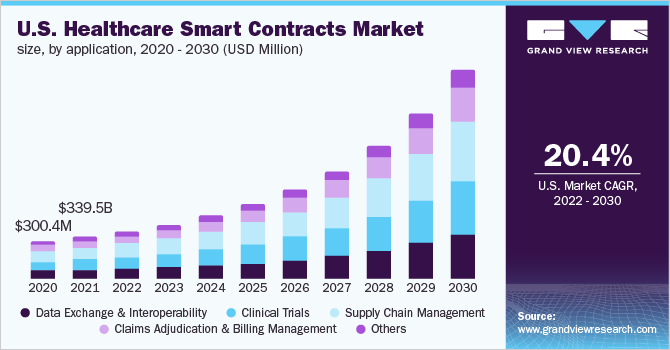
The supply chain management segment held the largest revenue share of over 28.0% in 2021. Many leading corporations, voluntarily, are taking the lead to implement the latest technologies for tracking their pharma produce. Throughout the pandemic, it was also seen that numerous companies were going for self-imposed tracking systems to win export orders, in the face of increasing awareness and demand for superior drugs. Thus, makes a perfect ground for smart contract technology to create adoption in the supply chain.
The data exchange and interoperability segment is expected to witness the highest CAGR during the forecast period. Healthcare records are becoming more valuable than ever owing to the rise of various new diseases and the current pandemic. Besides, there has been an upsurge in the requirement to store and secure medical data that can have substantial advantages for medical staff, healthcare facilities, and patients. The government of numerous nations is emphasizing on the digitalization of the healthcare system which supports in market growth.
End-use Insights
The drug and medical device companies segment held the largest revenue share of over 33.0% in 2021 owing to the reduced loses and cost of transportation. As per the Health Research Funding organization report, it is found that in developing nations anywhere from 10 to 30% of all pharmaceuticals for sale are fake. Africa, Latin America, and Asia are mainly hard hit by this illicit pharmaceutical trade.
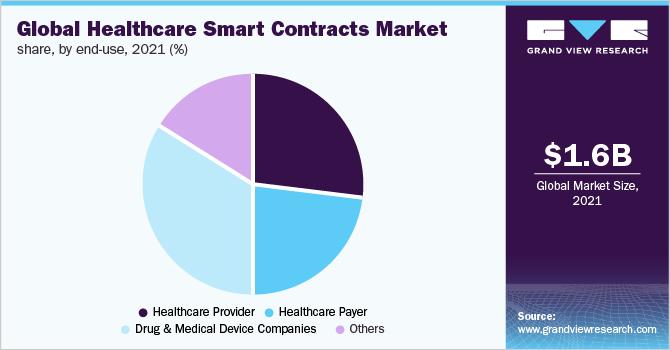
The payer segment is expected to witness the highest CAGR in the market for healthcare smart contracts during the forecast period. The growth is driven by the broad range of technology uses and applications of technology in healthcare. The benefits such as decrease in the incidence of health payers ending up paying for inaccurate claims drive the segment growth. Moreover, it can offer complete transparency to all parties.
Regional Insights
Europe dominated the market for healthcare smart contracts and accounted for the largest revenue share of over 35.0% in 2021. The European Union plans to make a multibillion-euro investment in technology development by putting money into blockchain, high-performance computing, and data infrastructure. North America is expected to command the second-largest market share during the forecast period. Recent advancements in blockchain technology together with numerous government initiatives supporting the acceptance of innovative platforms in healthcare supports in market growth.
Investment in developing technologies in the U.S. healthcare sector is growing, which further strengthens the market growth. This upsurges the demand for secure, safe, and managed data sharing between companies, due to which major players and other healthcare organizations are investing in the market for healthcare smart contracts. In November 2018, Change Healthcare and TIBCO Software have publicized a partnership to build the first healthcare smart contract system, using the TIBCO's smart contract developer project, “Project Dovetail” and Change Healthcare Intelligent Healthcare Network blockchain technology.
Key Companies & Market Share Insights
The market for healthcare smart contracts is highly competitive in nature. Initiatives taken by key companies and government, technological collaborations, and emerging startups are expected to propel market growth. Currently, the industry is in its nascent stage and expected to pick up a pace during forecast period. Some of the major players have entered collaborations to improve their own platforms or portfolio. For instance, in May 2017, PokitDok proclaimed that it has chosen the Linux Foundation’s Hyperledger Sawtooth, as its leading platform for recording DokChain healthcare transactions.Some of the prominent players in the healthcare smart contracts market include:
Healthcare Smart Contracts Market Report Scope
|
Report Attribute
|
Details
|
|
Market size value in 2022
|
USD 1,766.7 million
|
|
Revenue forecast in 2030
|
USD 7.83 billion
|
|
Growth rate
|
CAGR of 20.5% from 2022 to 2030
|
|
Base year for estimation
|
2021
|
|
Historical data
|
2017 - 2020
|
|
Forecast period
|
2022 - 2030
|
|
Quantitative units
|
Revenue in USD million and CAGR from 2022 to 2030
|
|
Report coverage
|
Revenue forecast, company ranking, competitive landscape, growth factors, and trends
|
|
Segments covered
|
Blockchain type, application, end-use, region
|
|
Regional scope
|
North America; Europe; Asia Pacific; Latin America; MiddleEast and Africa
|
|
Country scope
|
U.S.; Canada; Germany; U.K.; France; Italy; Spain; Japan; India; China; Brazil; Mexico; South Africa; Saudi Arabia
|
|
Key companies profiled
|
IBM, ScienceSoft USA Corporation, Blockchain AI Solutions Ltd (FarmaTrust), SmartData Enterprises, ION Medical Safety, Aetsoft Inc., Apriorit, ELEKS, Medicalchain, PokitDok
|
|
Customization scope
|
Free report customization (equivalent up to 8 analyst’s working days) with purchase. Addition or alteration to country, regional, and segment scope.
|
|
Pricing and purchase options
|
Avail customized purchase options to meet your exact research needs. Explore purchase options
|
Segments Covered in the Report
This report forecasts revenue growth at global, regional, and country levels and provides an analysis of the latest industry trends in each of the sub-segments from 2017 to 2030. For this study, Grand View Research has segmented the global healthcare smart contracts market report based on blockchain type, application, end-use, and region:
-
Blockchain Type Outlook (Revenue, USD Million, 2017 - 2030)
-
Hyperledger Fabric
-
MultiChain56
-
Ethereum
-
Others
-
Application Outlook (Revenue, USD Million, 2017 - 2030)
-
End-use Outlook (Revenue, USD Million, 2017 - 2030)
-
Regional Outlook (Revenue, USD Million, 2017 - 2030)
-
North America
-
Europe
-
Germany
-
U.K.
-
France
-
Italy
-
Spain
-
Asia Pacific
-
Latin America
-
Middle East & Africa
-
South Africa
-
Saudi Arabia
Frequently Asked Questions About This Report
b. The global healthcare smart contracts market size was estimated at USD 1.6 billion in 2021 and is expected to reach USD 1.78 billion in 2022.
b. The global healthcare smart contracts market is expected to grow at a compound annual growth rate of 20.5% from 2022 to 2030 to reach USD 7.83 billion by 2030.
b. Europe dominated the healthcare smart contracts market in 2021. This is attributable to European Union plans to make a multibillion-euro investment in technology development by putting money into blockchain.
b. Some key players operating in the healthcare smart contracts market include IBM, ScienceSoft USA Corporation , Blockchain AI Solutions Ltd (FarmaTrust), SmartData Enterprises, ION Medical Safety, and others.
b. Increased application of the blockchain technology in healthcare is anticipated to augment the demand for smart contracts in healthcare industry

 Download Sample Report