Intracranial Pressure Monitoring Devices Market Summary
The global intracranial pressure monitoring devices market size was valued at USD 1.82 billion in 2024 and is projected to reach USD 2.85 billion by 2030, growing at a CAGR of 7.9% from 2025 to 2030. Growth of this market is primarily driven by the increasing prevalence of neurological disorders, the rapidly growing geriatric population in Asia Pacific, especially in countries such as Japan, India, and China, and technological advancements that facilitate growing adoption.
Key Market Trends & Insights
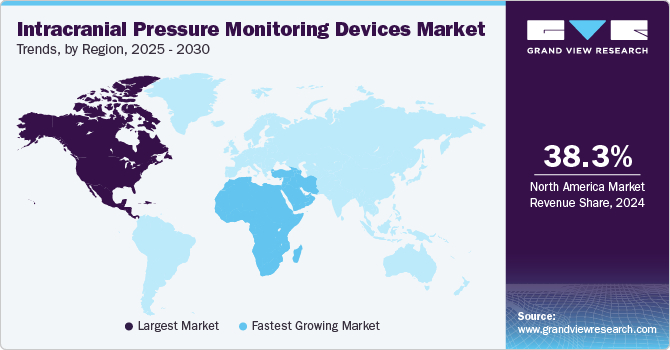
- North America dominated the global intracranial pressure monitoring devices industry with the largest revenue share of 38.3% in 2024.
- The U.S. held the largest revenue share of the regional market in 2024.
- Based on technique, the invasive technique segment dominated the intracranial pressure monitoring devices industry with a revenue share of 80.1% in 2024.
- Based on application, the traumatic brain injury segment held the largest revenue share of the global intracranial pressure monitoring devices industry.
Market Size & Forecast
- 2024 Market Size: USD 1.82 Billion
- 2030 Projected Market Size: USD 2.85 Billion
- CAGR (2025-2030): 7.9%
- North America: Largest Market in 2024
- Asia Pacific: Fastest growing market
Rising incidence of complex health conditions such as Traumatic Brain Injury (TBI), Subarachnoid Hemorrhage (SAH), Brain Tumor, and hydrocephalus is expected to drive the growth of intracranial pressure (ICP) monitoring devices market. A non-invasive intracranial pressure monitor may also be a significant research tool for studying pathophysiology and evaluating the efficiency of intracranial hypertension therapy. There might be prospects for space medical applications or studies on intracranial pressure responses at high altitudes. Hence, owing to the abovementioned factors, non-invasive intracranial pressure monitoring is expected to contribute to market growth, providing profitable opportunities for market participants. A high-impact primary driver of the market for intracranial pressure monitoring devices is the growing need for minimally invasive surgical techniques due to improved patient outcomes. In 2023, Cyban, a medical equipment manufacturer in East Melbourne, Australia, demonstrated the company's patented technology. Its non-invasive brain monitor delivered equivalent results to invasive method-based ICP monitoring.

In addition, the currently used ICP measurement requires puncturing a hole in the skull and inserting a catheter into the ventricular space to drain cerebrospinal fluid. Experienced specialists are scarce; hence, invasive procedures are impossible in various situations, including emergencies. Thus, non-invasive methods such as transcranial Doppler ultrasonography, MRI/CT, and optic nerve sheath diameter are promising techniques to overcome these problems. For instance, Vittamed 205, developed by Vittamed Corporation, and Cerepress, created by Third Eye Diagnostics, are designed to measure and monitor ICP noninvasively via the eye.
According to the WHO, nearly 1.19 million individuals die in fatal road traffic crashes each year. In addition, between 20 and 50 million more people suffer non-fatal injuries, with many incurring a disability because of their injury. Road accidents are more common in middle- or low-income countries. These injuries or traumas result in elevated ICP, which is expected to increase the demand for ICP monitoring devices. In addition, developing advanced devices, such as surgical microscopes, neurosurgery devices, ophthalmic surgical devices, and surgical robots, has reduced direct human interference in surgical procedures.
Technologically advanced ICP monitoring devices reduce the difficulties associated with invasive devices, such as a spontaneous shift in baseline pressure and leveling and de-bubbling associated with fluid-filled systems. For instance, medical robotics has witnessed a paradigm shift over the years due to technological advancements in 3D imaging. Recent innovations include high-definition microscope cameras, data recorders, data analytic systems, motion sensors, remote navigation systems, and robotically controlled catheters and transducers. Technological advancements aim to find new applications for existing platforms and create disruptive technologies that drive the market for intracranial pressure monitoring devices.
Market Concentration & Characteristics
The market growth stage is medium, and the pace of growth is accelerating. Continuous efforts by key market players to improve their market position and provide advanced technology-driven solutions have resulted in a fragmented market. Increasing adoption of noninvasive intracranial pressure monitoring devices has stimulated multiple strategic collaborations, enhanced research and development activities, innovation, and more.
A growing preference for non-invasive methods, technological advancements, significant investments in research, and ongoing research activities in educational institutes and universities primarily drive innovation in the intracranial pressure monitoring devices industry. For instance, in August 2024, Aesculap, Inc. announced that the FDA had granted Breakthrough Device Designation for a novel technology designed for intracranial pressure monitoring, the M.scio System. This non-invasive system has been developed to facilitate long-term cerebrospinal fluid (CSF) monitoring.

Mergers & acquisitions also play a significant role in the growth experienced by the intracranial pressure management monitoring devices industry. The impact of regulations is very high on this market. The invasive nature of traditional devices and the use of advanced technology in modern devices have led to stringent laws regarding the safety of devices, patient data protection, and more. The U.S. FDA regulates this industry through approval for clinical use and safety requirements. In the EU, the CE marking process, managed by authorities, regulates the intracranial pressure management devices market. In addition, voluntary consensus standards introduced by organizations such as the American National Standards Institute also influence the market.
Technique Insights
The invasive technique segment dominated the intracranial pressure monitoring devices industry with a revenue share of 80.1% in 2024. Invasive methods characterize traditional devices, as the process involves the insertion of a sensor or catheter into the brain or surrounding spaces. This method has been used to ensure real-time monitoring of pressure. Invasive ICP measurement can be performed at various intracranial anatomical locations (i.e., intraventricular, intraparenchymal, epidural, subdural, and subarachnoidal). Besides, according to the Department of Clinical Neurosciences, an intraventricular catheter coupled with an external pressure transducer is the gold standard for continuous ICP monitoring. This method is the most accurate and low-cost method available for ICP monitoring, and it can also be used for therapeutic cerebrospinal fluid (CSF) drainage and administration of drugs. The two invasive techniques currently used are external ventricular drain and micro-transducer ICP monitoring.
The noninvasive technique segment is expected to experience the fastest CAGR of 10.0% from 2025 to 2030. Invasive techniques involve various complications such as infection, hemorrhage, malfunction, obstruction, and inadequate positioning of the catheter. Risks associated with such complications and technological advancements drive the growing demand for noninvasive technology-driven devices. Alternative noninvasive procedures for measuring elevated ICP are being sought due to the intrusive nature, high expense, and other extra dangers of current ICP monitoring methods. Because of a scarcity of experienced specialists, invasive treatments are not viable in various situations, such as emergencies. Noninvasive treatments, including optic nerve sheath diameter, transcranial Doppler ultrasonography, and magnetic resonance imaging/computed tomography (MRI/CT), are promising in overcoming these challenges.
Application Insights
Based on application, the traumatic brain injury segment held the largest revenue share of the global intracranial pressure monitoring devices industry. Elevated ICP is the most common cause of mortality in patients suffering from traumatic brain injury. The success of treatment is largely based on the accurate assessment of ICP. New product developments and product launches by major companies are expected to influence the growth of this segment. For instance, in March 2025, Anuncia Inc., one of the key market participants in cerebrospinal fluid (CSF) management, announced that it received a Breakthrough Device Designation for its ReFlow EVD from the U.S. FDA. The company designs this innovation-driven solution for external ventricular drains (EVDs) to manage elevated intracranial pressure & brain swelling.

Stroke applications are anticipated to experience the fastest CAGR over the forecast period. This is attributed to the growing incidence of stroke, which is one of the major causes of death in patients with cardiovascular conditions worldwide. According to the WHO, nearly 15 million individuals experience stroke annually. Hummingbird Solo is a single-lumen, bolt-based monitor that measures the pressure within a patient's brain tissue, manages ICP after traumatic brain injury, and aids in diagnosing subarachnoid hemorrhage or stroke. This is expected to increase its usage in diagnosing traumatic brain injury and other applications.
The migraine segment is expected to grow rapidly during the forecast period. This is due to the strong association between elevated ICP and obesity. It can be anticipated that increasing obesity in the general population will increase the prevalence and socioeconomic disease burden.
Regional Insights
North America dominated the global intracranial pressure monitoring devices industry with the largest revenue share of 38.3% in 2024. This market is primarily influenced by the growing demand for advanced healthcare assistance, the increasing significance of non-invasive intracranial pressure monitoring devices, and the rising prevalence of chronic diseases such as cardiovascular disorders. The increasing incidence of traumatic brain injuries and strokes in the region is expected to result in growth for this market.
U.S. Intracranial Pressure Monitoring Devices Market Trends
The U.S. held the largest revenue share of the regional market in 2024. The growth of this market is mainly driven by the country's sophisticated healthcare system, which provides various solutions and treatments involving intracranial pressure monitoring devices. Multiple companies in the U.S. develop, manufacture, and market these devices. The growing incidence of traumatic brain injuries originating from various events, such as road accidents and others, is contributing to the increasing demand for effective treatments and intracranial pressure monitoring devices.
Asia Pacific Intracranial Pressure Monitoring Devices Market Trends
Asia Pacific was identified as one of the key regions of the global intracranial pressure monitoring industry in 2024. This market is significantly influenced by the growing demand for critical and post-traumatic care in highly populated countries such as China and India. The presence of a large geriatric population, especially in countries such as Japan, is expected to generate growth for this market over the forecast period.
Middle East & Africa Intracranial Pressure Monitoring Devices Market Trends
The Middle East & Africa intracranial pressure monitoring devices market is anticipated to experience the fastest CAGR of 9.7% from 2025 to 2030. This growth is mainly driven by rising demand for advanced intracranial pressure monitoring devices to manage critical health conditions such as traumatic brain injuries, strokes, and other disorders associated with the brain and spinal cord. The growing incidence of stroke in countries such as Saudi Arabia is expected to increase demand for intracranial pressure monitoring devices over the forecast period.
The South Africa intracranial pressure monitoring devices market accounted for the largest revenue share of the Middle East and Africa intracranial pressure monitoring devices industry in 2024. Significant growth in the prevalence of neurological disorders, such as hydrocephalus, and growth in healthcare expenditure are primarily driving the growth of this market. Enhancement of healthcare infrastructure, new installations in critical care centers, and focus on providing sophisticated healthcare services are expected to generate greater opportunities.
Key Intracranial Pressure Monitoring Devices Company Insights
Key players in the global intracranial pressure monitoring market include Medtronic, Integra LifeSciences, RAUMEDIC AG, Natus Medical, and Spiegelberg GmbH & Co. KG. Some of the major market participants rely on strategies such as incorporating advanced technology features, investing in R&D, conducting research-driven product developments, and collaborating with others.
-
Integra LifeSciences offers an extensive portfolio of innovation-based products and solutions designed for managing numerous complicated health conditions, such as brain tumors, hydrocephalus, hemorrhagic strokes, traumatic brain injuries, and others. Its portfolio features the CereLink ICP monitor, which assists in continuously monitoring intracranial pressure.
-
Natus Medical is a global healthcare technology company primarily operating in the neurosolutions and sensory solutions industry. It offers intracranial pressure monitoring systems & catheters, including the Camino intracranial pressure and temperature monitor, Camino 1104B series catheters for the Camino ICP monitor, Camino 1104G catheter for the Camino ICP monitor, and others.
Key Intracranial Pressure Monitoring Devices Companies:
The following are the leading companies in the intracranial pressure monitoring devices market. These companies collectively hold the largest market share and dictate industry trends.
- Medtronic
- Integra LifeSciences
- RAUMEDIC AG
- Sophysa
- Spiegelberg GmbH & Co. KG. (Luciole Medical AG)
- Natus Medical
- Digitimer Ltd
- NeuraSignal, Inc.
Recent Developments
-
In April 2024, Integra LifeSciences relaunched its CereLink ICP Monitoring System in the U.S. market, reinforcing its neurosurgical portfolio in the advanced healthcare technology industry.
-
In June 2023, Luciole Medical AG acquired Spiegelberg GmbH & Co. KG to strengthen its brain monitoring solutions portfolio. This has added significant strength to Luciole's manufacturing capacities.
Intracranial Pressure Monitoring Devices Market Report Scope
|
Report Attribute
|
Details
|
|
Market size value in 2025
|
USD 1.95 billion
|
|
Revenue forecast in 2030
|
USD 2.85 billion
|
|
Growth rate
|
CAGR of 7.9% from 2025 to 2030
|
|
Base year for estimation
|
2024
|
|
Historical data
|
2018 - 2023
|
|
Forecast period
|
2025 - 2030
|
|
Report updated
|
April 2025
|
|
Quantitative units
|
Revenue in USD million/billion and CAGR from 2025 to 2030
|
|
Report coverage
|
Revenue forecast, company ranking, competitive landscape, growth factors, trends
|
|
Segments covered
|
Technique, application, and region.
|
|
Country scope
|
U.S.; Canada; Mexico; Germany; UK; France; Italy; Spain; Russia; Japan; China; India; Australia; Thailand; South Korea; Singapore; Brazil; Colombia; Argentina; South Africa; Saudi Arabia; UAE; and Kuwait
|
|
Key companies profiled
|
Medtronic; Integra LifeSciences; RAUMEDIC AG; Sophysa; Spiegelberg GmbH & Co. KG.; Natus Medical; Digitimer Ltd; NeuraSignal, Inc.
|
|
Customization scope
|
Free report customization (equivalent up to 8 analysts working days) with purchase. Addition or alteration to country, regional & segment scope.
|
|
Pricing and purchase options
|
Avail customized purchase options to meet your exact research needs. Explore purchase options
|
Global Intracranial Pressure Monitoring Devices Market Report
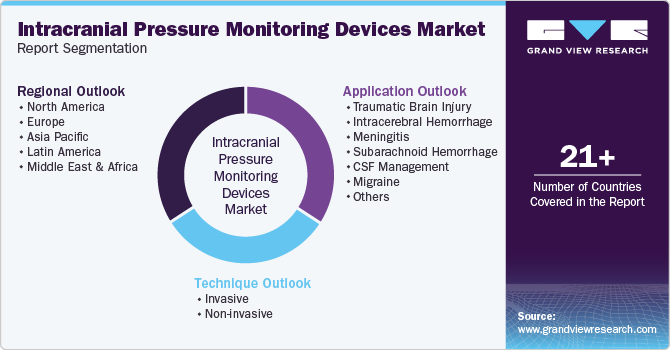
This report forecasts revenue growth at the global, regional, and country level and provides an analysis of the latest industry trends in each of the sub-segments from 2018 to 2030. For this study, Grand View Research has segmented the global intracranial pressure monitoring market report based on technique, application, and region.
-
Technique Outlook (Revenue, USD Million; 2018 - 2030)
-
Invasive
-
Non-invasive
-
Transcranial Doppler Ultrasonography
-
Tympanic Membrane Displacement (TMD)
-
Optic nerve Sheath diameter
-
MRI/CT
-
Fundoscopy (papilledema)
-
Application Outlook (Revenue, USD Million; 2018 - 2030)
-
Regional Outlook (Revenue, USD Million; 2018 - 2030)
-
North America
-
Europe
-
UK
-
Germany
-
Spain
-
France
-
Italy
-
Russia
-
Asia Pacific
-
Japan
-
China
-
India
-
South Korea
-
Australia
-
Thailand
-
Singapore
-
Latin America
-
Middle East & Africa
-
South Africa
-
Saudi Arabia
-
UAE
-
Kuwait

 Download Sample Report