Male Infertility Market Summary
The global male infertility market size was valued at USD 4.0 billion in 2022 and is expected to reach USD 5.9 billion by 2030, growing at a CAGR of 4.9% from 2023 to 2030. Increasing infertility rates across the globe and the adoption of assisted reproductive technologies (ARTs) are expected to drive the market for male infertility in the forthcoming years.
Key Market Trends & Insights
- Europe dominated the market with a revenue share of 37.30% in 2022.
- Asia Pacific is expected to witness the fastest growth with a CAGR of 5.60% over the forecast period.
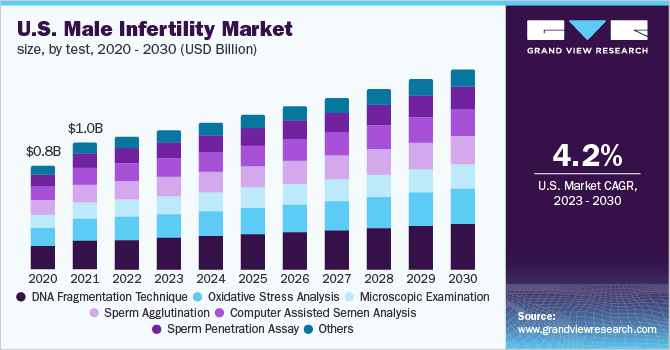
- By test, the DNA fragmentation segment accounted for the largest revenue share of 21.77% in 2022.
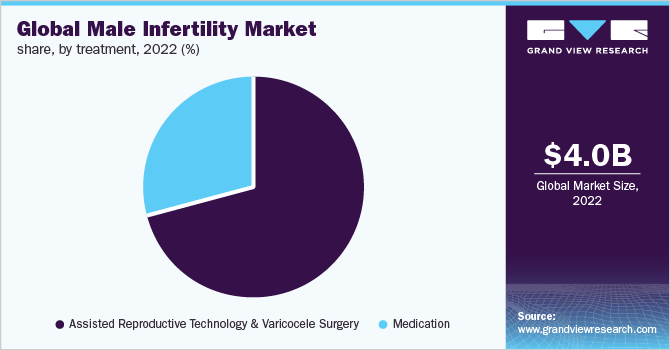
- By treatment, the ART and varicocele surgery segment dominated the market with a revenue share of 70.78% in 2022.
Market Size & Forecast
- 2022 Market Size: USD 4.0 Billion
- 2030 Projected Market Size: USD 5.9 Billion
- CAGR (2023-2030): 4.9%
- Europe: Largest market in 2022
- Asia Pacific: Fastest growing market
ARTs cover a wide spectrum of infertility treatments and offer solutions for males facing problems, such as low sperm count, abnormal sperm quality, and poor motility. Moreover, ARTs offer a high success rate as compared to medications. The market for male infertility is expected to witness significant growth in the future owing to technological advancements in the field of assisted reproductive technologies.
With the general acceptability and diagnostic techniques' ability to give an accurate analysis of sperm DNA integrity, DNA fragmentation technology is projected to grow steadily in the future. DNA fragmentation in sperm is one of the main reasons for male infertility. For diagnostic reasons, this technique is performed to diagnose male infertility. COVID-19 affected healthcare services severely. Only emergency medical procedures were allowed during the initial phase of the pandemic. The diagnostics, personal protection equipment, and critical medical supplies have seen increasing demand, while medical procedures have dropped by 50% to 60%, depending on the market.
The clinical disease generated by the SARS-CoV-2 virus, COVID-19, has been linked to a huge cytokine storm and organ system destruction. Despite the lack of evidence for SARS-CoV-2 virus detection in the testis, testicular injury and dysregulation of gonadotropins linked to inflammation have been documented in some studies. Furthermore, as a result of the pandemic's fast evolution, constantly updated medical therapies and governmental regulations that cause delays in care might affect fertility.
An increase in the global prevalence of infertility is a significant clinical problem. Around 48 million couples suffer from infertility worldwide. Of all cases, about 20% to 30% of cases are due to male factor infertility. This may be due to one or a combination of factors, such as abnormal morphology, lower sperm concentration, and poor sperm motility. Hence, increasing male infertility and growing awareness regarding the same have further prompted the use of drugs, hormonal therapy, and ART. Alcohol intake, smoking, obesity, stress, and lifestyle changes are some of the major factors that can be attributed to infertility in males. According to the National Center for Health Statistics, the fertility rate in males below 30 years has decreased globally by 15% from 2006 to 2010.
Continuous efforts in R&D are carried out for a better understanding of the idiopathic world of infertility. Hence, companies are investing in the development of devices for identifying the root cause and targeted treatment. Furthermore, the development and commercialization of hormonal therapy are likely to drive the market for male infertility during the forecast period. Governments of various countries have taken initiatives to improve the reimbursement scenario for infertility-related treatments. In addition, improved safety of patient data due to standardization of regulations is expected to increase patient preference for infertility treatments.
Test Insights
The DNA fragmentation segment accounted for the largest revenue share of 21.77% in 2022 owing to the ability of the diagnostic techniques to provide a reliable analysis of sperm DNA integrity. Adoption of this technique is increasing in the market as sperm DNA fragmentation is a leading cause of infertility in males. Based on test, the market is segmented into DNA fragmentation technique, oxidative stress analysis, microscopic examination, sperm agglutination, computer assisted semen analysis, sperm penetration assay, and others.
Computer-assisted semen analysis is expected to witness significant growth in the coming years due to technological advancements. Semen analysis is the most preferred test for the diagnosis and it can be performed through microscopic examination techniques. For instance, in April 2018, Sandstone Diagnostics received the U.S. FDA approval to launch Trak Volume Cup, a device that allows males to measure semen volume and diagnose hypospermia at home.
Treatment Insights
The ART and varicocele surgery segment dominated the market with a revenue share of 70.78% in 2022. The most preferred technique for the treatment of male infertility is enhancing spermatogenesis with the help of hormonal therapy for a natural pregnancy, especially among males with a low sperm count. Based on treatment, the market for male fertility is segmented into ART and varicocele surgery and medication.
ARTs are used to treat major factors responsible for male infertility, such as sperm autoantibodies, viral orchitis, epididymal dysfunction, accessory gland infection, chemotherapy, heat, trauma, and other idiopathic factors. The high cost of treatment and the requirement of several other therapy cycles are some of the major factors contributing to the segment growth. Increasing healthcare expenditure in developing countries, growing awareness about male infertility, and rising adoption in middle- and low-income countries are the key factors anticipated to drive the ART segment over the forecast period.
Regional Insights
In 2022, Europe dominated the market with a revenue share of 37.30%. This is attributed to the availability of well-equipped and advanced fertility clinics, higher adoption of costlier treatment, better coverage for diagnosis and treatment, and high awareness level. Furthermore, healthcare spending and the availability of well-established healthcare infrastructure are contributing significantly to the regional market growth.
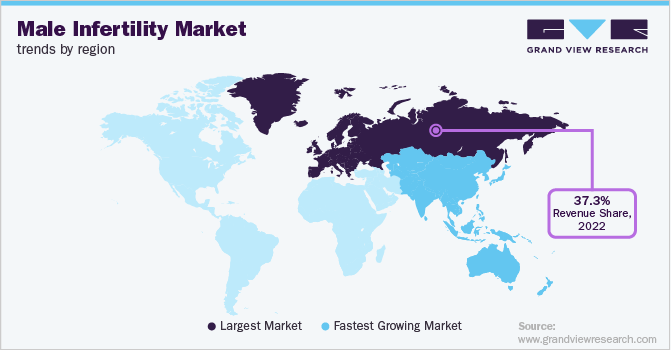
Asia Pacific is expected to witness the fastest growth with a CAGR of 5.60% over the forecast period. Emerging countries in the region, including India, China, and Singapore, have been witnessing strong economic growth. The Asian market is being driven by advancements in medical diagnostics as well as rising male infertility. The growing geriatric population, along with a rise in lifestyle-associated diseases, has resulted in an increase in the incidence rate of male infertility.
Key Companies & Market Share Insights
The market has been characterized by intense competition. Market players are expected to undertake strategies such as the development of innovative technologies for diagnosis and treatment, acquisitions, and partnerships or collaborations for the development and commercialization of products in order to remain competitive in the market. For instance, in November 2017, Aytu BioScience received approval from the Australian Therapeutic Goods Administration (TGA) for the MiOXSYS system as an aid in the assessment of semen quality.
Moreover, market players are availing certification from the regulatory agencies to strengthen their position in the market. For instance, in May 2019, the National Good Laboratory Practice (GLP) Compliance Monitoring Authority (NGCMA), Govt. of India, granted the Good Laboratory Practices Certification to Cadila Pharmaceuticals for its Dholka facility. The certification makes the company a GLP compliant facility and will provide recognition to its research work in all OECD member countries. Some prominent players in the global male infertility market include:
Male Infertility Market Report Scope
|
Report Attribute
|
Details
|
|
Market size value in 2023
|
USD 4.2 billion
|
|
Revenue forecast in 2030
|
USD 5.9 billion
|
|
Growth rate
|
CAGR of 4.95% from 2023 to 2030
|
|
Base year for estimation
|
2022
|
|
Historical data
|
2018 - 2021
|
|
Forecast period
|
2023 - 2030
|
|
Quantitative units
|
Revenue in USD million/billion & CAGR from 2023 to 2030
|
|
Report coverage
|
Revenue forecast, company share, competitive landscape, growth factors & trends
|
|
Segments covered
|
Test, treatment, region
|
|
Regional scope
|
North America; Europe; Asia Pacific; Latin America; MEA
|
|
Country scope
|
U.S.; Canada; U.K.; Germany; France; Italy; Spain; Japan; China; India; Australia, South Korea, Brazil; Mexico; Argentina, South Africa, Saudi Arabia, UAE
|
|
Key companies profiled
|
Bayer Healthcare; Andrology solutions; Aytu BioScience, Inc.; Cadila Healthcare Ltd.; Halotech DNA SL; EMD Sereno, Inc.; SCSA Diagnostics, Inc.; Intas Pharmaceuticals Ltd.
|
|
Customization scope
|
Free report customization (equivalent up to 8 analysts working days) with purchase. Addition or alteration to country, regional & segment scope.
|
|
Pricing and purchase options
|
Avail customized purchase options to meet your exact research needs. Explore purchase options
|
Global Male Infertility Market Segmentation
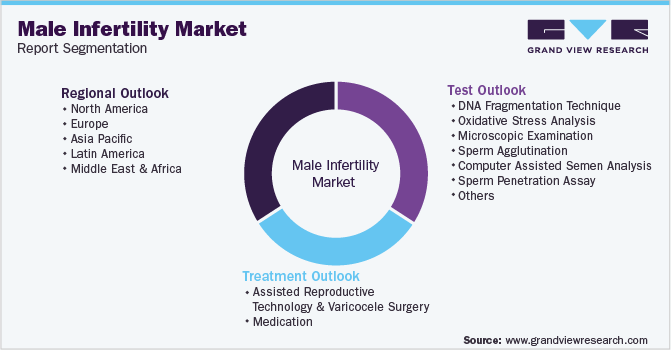
This report forecasts revenue growth at the global, regional, and country levels and provides an analysis of the latest industry trends and opportunities in each of the sub-segments from 2017 to 2030. For this study, Grand View Research has segmented the global male infertility market report based on test, treatment, and region:
-
Test Outlook (Revenue, USD Million, 2017 - 2030)
-
DNA Fragmentation Technique
-
Oxidative Stress Analysis
-
Microscopic Examination
-
Sperm Agglutination
-
Computer Assisted Semen Analysis
-
Sperm Penetration Assay
-
Others
-
Treatment Outlook (Revenue, USD Million, 2017 - 2030)
-
Regional Outlook (Revenue, USD Million, 2017 - 2030)
-
North America
-
Europe
-
U.K.
-
Germany
-
France
-
Italy
-
Spain
-
Asia Pacific
-
Japan
-
China
-
India
-
Australia
-
South Korea
-
Latin America
-
Middle East & Africa
-
South Africa
-
Saudi Arabia
-
UAE
Frequently Asked Questions About This Report
b. The global male infertility market size was estimated at USD 4.0 billion in 2022 and is expected to reach USD 4.2 billion in 2023.
b. The global male infertility market is expected to grow at a compound annual growth rate of 4.95% from 2023 to 2030 to reach USD 5.9 billion by 2030.
b. DNA fragmentation accounted for the largest market share of 21.77% in 2022 owing to the ability of the diagnostic techniques to provide a reliable analysis of sperm DNA integrity.
b. Some of the key industry participants are Bayer Healthcare; Andrology solutions; Aytu BioScience, Inc.; Cadila Healthcare Ltd.; Halotech DNA SL; EMD Sereno, Inc.; SCSA Diagnostics, Inc.; and Intas Pharmaceuticals Ltd.
b. Increasing infertility rate across the globe and adoption of assisted reproductive technologies (ARTs) are expected to drive the market for male infertility in the forthcoming years.

 Download Sample Report