
- Home
- »
- Medical Devices
- »
-
Neurorehabilitation Devices Market Size, Share Report, 2030GVR Report cover
![Neurorehabilitation Devices Market Size, Share & Trends Report]()
Neurorehabilitation Devices Market (2024 - 2030) Size, Share & Trends Analysis Report By Product (BCI, Wearable Devices, Neurorobotics), By Therapy Area (Stroke, Parkinson’s Disease, Cerebral Palsy), By Region, And Segment Forecasts
- Report ID: GVR-1-68038-139-9
- Number of Report Pages: 110
- Format: PDF
- Historical Range: 2018 - 2022
- Forecast Period: 2024 - 2030
- Industry: Healthcare
- Report Summary
- Table of Contents
- Interactive Charts
- Methodology
- Download FREE Sample
-
 Download Sample Report
Neurorehabilitation Devices Market Summary
The global neurorehabilitation devices market size was estimated at USD 2,001.5 million in 2023 and is projected to reach USD 4,977.7 million by 2030, growing at a CAGR of 13.9% from 2024 to 2030. The primary factors driving the market's growth are the rising geriatric population, the high prevalence of neurological disorders, and technological developments in neurorehabilitation devices.
Key Market Trends & Insights
- In terms of region, North America was the largest revenue generating market in 2023.
- Country-wise, U.S. is expected to register the highest CAGR from 2024 to 2030.
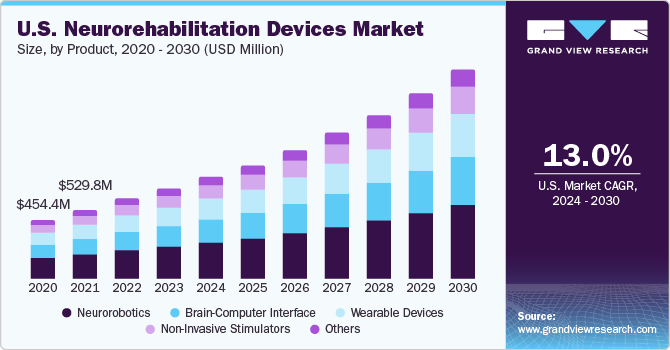
- In terms of segment, neurorobotics accounted for a revenue of USD 720.7 million in 2023.
- Wearable devices is the most lucrative product segment registering the fastest growth during the forecast period.
Market Size & Forecast
- 2023 Market Size: USD 2,001.5 Million
- 2030 Projected Market Size: USD 4,977.7 Million
- CAGR (2024-2030): 13.9%
- North America: Largest market in 2023
The increasing clinical studies, for product portfolio development, further drive the market’s growth. Moreover, the rising prevalence of neurological disorders supports industry growth. Parkinson’s disease (PD), Multiple sclerosis, and stroke, among other disorders are among several diseases falling under the category of neurological disorders.
Various reasons, including the rising aging population, changing lifestyles, and enhanced diagnostic capabilities, contribute to the rising prevalence of the mentioned disorders across various regions globally. For instance, as per reports by the National Library of Medicine in 2023, around 15% of the global population presently faces neurological illnesses, which are the leading reason for physical and cognitive disabilities. For instance, according to a study funded by the Parkinson's Foundation in 2022, each year, nearly 90,000 people in America develop PD.
When compared to the previously predicted rate of 60,000 diagnoses per year, this indicates an unexpected 50% growth in the prevalence of cases. Also, as per the reports published by the Alzheimer's Association in 2022, 6.7 million Americans were estimated to be suffering from Alzheimer's Dementia. 4.1 million of the 6.7 million Americans aged 65 years and older who have Alzheimer's disease were female, whereas 2.6 million were male. Technologcal advancements have a major impact on market growth, which covers a wide range of medical technologies and equipment utilized to rehabilitate people with neurological diseases or accidents.
These technological developments have led to better patient results, more access to rehabilitation services, and a noticeable rise in the degree of personalization in therapy programs. The need for innovative and efficient technologies is poised to grow, as more people require neurorehabilitation treatments. For example, in February 2023, MindMaze launched Izar, a brand-new tool that recently became available in the United States along with certain European nations, including Switzerland, Germany, and France. It is designed to assist patients with neurological conditions like PD in testing practice of their hand function.
The tool enhances patients' ability to hold & finger pinch and object-grasping abilities. Moreover, increasing investments by key players for the expansion of the rehabilitation sectors with clinical trials and ongoing research in the field of neurological rehabilitation support market growth. Positive study findings encourage increased adoption and utilization of neurorehabilitation equipment. For instance, to expand its product portfolio and begin clinical trials in the U.S., Neurofenix, a health tech business with UK origins, received a financial investment of USD 7.16 million in August 2022. The startup has employed a revolutionary, patient-centric approach to home rehabilitation and recovery, which is proven to be more supportive and engaging.
Therapy Area Insights
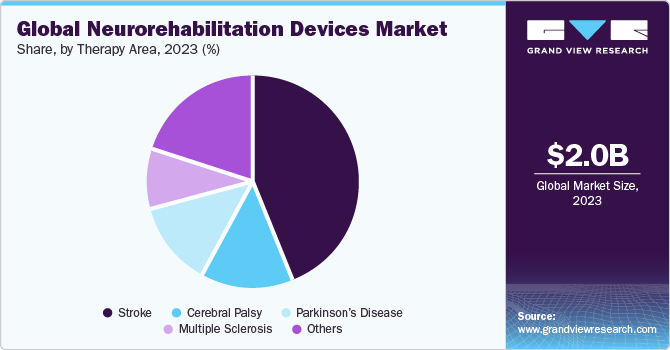
The stroke therapy segment held the highest revenue share of more than 44.3% in 2023. The demand for neurorehabilitation services has been greatly influenced by the rising aging demographic. As people become older, the risk of stroke increases, and they may need specialized rehabilitation to regain lost functional abilities in the body. Stroke generally leads to cognitive deficiencies, communication difficulties, and physical impairments, including weakness or paralysis. Robotic exoskeletons can aid in walking and other mobility aspects, while Functional Electrical Stimulation (FES) technology triggers muscular contractions to improve muscle strength. Treatment for stroke should start immediately after the first sign of symptoms.
Therefore, one of the main reasons for the high rate of survival in the U.S. is the accessibility of prompt treatment. In April 2022, the Centers for Disease Control and Prevention estimated that 795,000 Americans experience strokes each year and 610,000 of these are first-time instances. As per statistics, stroke is a leading cause of mortality in the United States; 1 case occurs in the country every 40 seconds. The market is expected to be driven by the growing number of stroke patients and the increasing demand for their treatment. The Parkinson’s disease segment is projected to advance at a significant CAGR through 2030.
The use of neurorehabilitation tools is crucial for assisting people with neurological diseases, such as PD, to recover or enhance their motor and cognitive abilities. Parkinson's disease is a neurodegenerative condition characterized by the gradual degeneration of neurons that produce dopamine in the brain, resulting in motor symptoms, such as shaking movements, stiffness, and bradykinesia (slowness of movement). More people are seeking medical care and getting a diagnosis of PD as a result of increased awareness about the symptoms and risk factors for the condition. Moreover, due to advancements in medical imaging and testing methods, the condition can now be diagnosed earlier and more accurately.
Product Insights
The neurorobotics segment held the largest revenue share of 36.0% in 2023 on account of the growing incidences of neurological disorders, along with the introduction of novel products in neurorobotics to address these disorders. Neurorehabilitation benefits greatly from the use of neurorobotic devices such as robotic arms, robotic exoskeletons, and brain-computer interfaces. These devices provide a targeted and repetitive training necessary for neurological repair. Neurorobotics-focused organizations are frequently developing and improving these products. Rehabilitation programs can be customized by using neurorobotics. Robotic equipment can also be modified to meet the unique needs and capabilities of each patient, resulting in more efficient and effective therapy.
Opportunities for neurorehabilitation are growing due to ongoing R&D in neurorobotics. Artificial intelligence (AI), virtual reality (VR), and neurofeedback are all being studied by scientists and engineers as methods to improve the rehabilitation process. The research investigations conducted to explore the effective functioning of the robotic technique in neurorehabilitation also contribute to device approval and thus fuel the segment's growth. For instance, as per the article published by Frontiers in Neurorobotics in May 2023, robotic devices can support balance and/or gait, help with joint movements, or reduce the need for compensatory walking mechanisms. Based on their ability to fit into exoskeletons, robotic devices can be used for gait rehabilitation across all age groups.
The research demonstrated that devices can be utilized for deficits of all kinds, including diplegia, hemiplegia, and quadriplegia. In early investigations, the device moderately improved functional results, such as speed and endurance. Due to their high efficacy in numerous studies, neurorobotic devices may become increasingly common, which would fuel the segment's growth. The wearable devices segment is expected to grow at the fastest CAGR over the forecast period. Wearable devices are essential for improving the rehabilitation process for people with neurological diseases, enhancing their quality of life, and providing medical professionals with accurate data. Wearable devices with sensors can track a patient's movements, muscle activity, and vital signs.
Examples of these sensors include accelerometers, gyroscopes, and electromyography (EMG) sensors. These tools offer real-time feedback to patients and therapists, assisting them in monitoring progress and modifying their treatment plans as needed. Moreover, the novel product launches by key players help drive market growth. For instance, in April 2023, Sensoria Health entered into a partnership with Padula Rehabilitation Technologies (PRT) and launched NeurOpTrek, a novel wearable device intended to enhance vision and help reduce the chance of falls, an important health issue, especially for elderly people.
Regional Insights
North America dominated the market and accounted for the largest revenue share of 39.08% in 2023. A key factor driving the market growth is the aging population in North America, particularly in the U.S. and Canada. Elderly individuals have a high risk of developing neurological diseases, which increases the need for neurorehabilitation equipment. For the market to be safe and effective for neurorehabilitation equipment, regulatory control was required. Manufacturers in the U.S. need to adhere to such requirements and get regulatory approval. Moreover, the market is anticipated to expand in the U.S. during the forecast period as a result of the rising activities by key players to raise awareness and the growing use of neurorehabilitation.
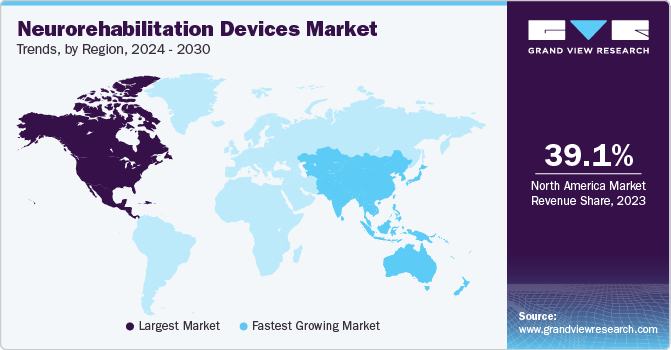
For instance, as per the data published by the World Health Organization in May 2023, the World Health Assembly adopted the historic agreement on enhancing rehabilitation in healthcare systems, which originated under Israel's supervision with the support of 20 additional countries. The resolution emphasized the value of rehabilitation in primary care as well as in emergency planning and response and demands for increasing and incorporating rehabilitation in healthcare systems within the framework of Universal Health Coverage (UHC). The Ontario Tech University based in Canada also supported the campaign led by the WHO. Asia Pacific is anticipated to witness the fastest CAGR over the forecast period.
This is attributed to factors, such as the growing aging population, increased lifestyle stress, rising incidence of hypertension, improvement in the quality of diagnosis, and increasing patient affordability. All the above-mentioned factors have together resulted in a significant volume of neurorehabilitation device procedures in the Asia Pacific region. Moreover, lucrative growth opportunities in developing countries are likely to contribute to the regional market growth. One of the major factors driving the market growth in the Asian market is the rising awareness coupled with constantly improving healthcare infrastructure.
Key Companies & Market Share Insights
The key players are focusing on growth strategies, such as new product launches, regulatory approvals, expansion, collaborations, acquisitions, and partnerships, to gain higher industry shares. For instance, in May 2023, in partnership with Alberta Health Services, the University of Calgary launched the Researching Strategies for Rehabilitation (RESTORE) Network, which will perform clinical studies and new treatments to enhance the quality of life for those suffering from neurological illnesses. This initiative is expected to boost the market growth during the forecast period.
Key Neurorehabilitation Devices Companies:
- Bioventus
- Ectron
- Hocoma
- Medtronic
- Tyromotion Inc.
- Biometrics Ltd.
- Bionik Laboratories Corp. (BNKL)
- BioXtreme Ltd.
- Ekso Bionics
- Kinestica
- Kinova Inc.
- Saebo, Inc.
- Abbott
Neurorehabilitation Devices Market Report Scope
Report Attribute
Details
Market size value in 2024
USD 2,278.5 million
Revenue forecast in 2030
USD 4.98 billion
Growth rate
CAGR of 13.9% from 2024 to 2030
Base year for estimation
2023
Historical data
2018 - 2022
Forecast period
2024 - 2030
Report updated
October 2023
Quantitative units
Revenue in USD million and CAGR from 2024 to 2030
Report coverage
Revenue forecast, company ranking, competitive landscape, growth factors, and trends
Segments covered
Product, therapy area, region
Regional scope
North America; Europe; Asia Pacific; Latin America; Middle East & Africa
Country scope
U.S.; Canada; U.K.; Germany; France; Italy; Spain; Denmark; Sweden; Norway; Japan; China; India; Australia; Thailand; South Korea; Brazil; Mexico; Argentina; South Africa; Saudi Arabia; UAE; Kuwait
Key companies profiled
Bioventus; Ectron; Hocoma; Medtronic; Tyromotion Inc; Biometrics Ltd.; Bionik Laboratories Corp. (BNKL); BioXtreme Ltd.; Ekso Bionics; Kinestica; Kinova Inc.; Saebo, Inc.; Abbott
Customization scope
Free report customization (equivalent up to 8 analyst’s working days) with purchase. Addition or alteration to country, regional & segment scope
Pricing and purchase options
Avail customized purchase options to meet your exact research needs. Explore purchase options
Global Neurorehabilitation Devices Market Report Segmentation
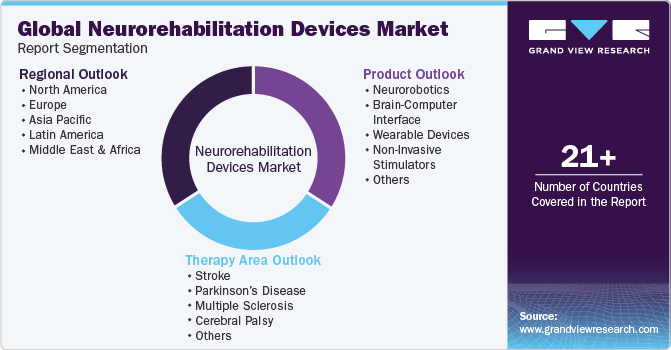
This report forecasts revenue growth at global, regional, and country levels and provides an analysis of the latest trends in each of the sub-segments from 2018 to 2030. For this study, Grand View Research has segmented the global neurorehabilitation devices market report on the basis of product, therapy area, and region:
-
Product Outlook (Revenue, USD Million, 2018 - 2030)
-
Neurorobotics
-
Brain-Computer Interface
-
Wearable Devices
-
Non-Invasive Stimulators
-
Others
-
-
Therapy Area Outlook (Revenue, USD Million, 2018 - 2030)
-
Stroke
-
Parkinson’s Disease
-
Multiple Sclerosis
-
Cerebral Palsy
-
Others
-
-
Regional Outlook (Revenue, USD Million, 2018 - 2030)
-
North America
-
U.S.
-
Canada
-
-
Europe
-
U.K.
-
Germany
-
France
-
Italy
-
Spain
-
Denmark
-
Sweden
-
Norway
-
-
Asia Pacific
-
Japan
-
China
-
India
-
Australia
-
Thailand
-
South Korea
-
-
Latin America
-
Brazil
-
Mexico
-
Argentina
-
-
Middle East & Africa
-
South Africa
-
Saudi Arabia
-
UAE
-
Kuwait
-
-
Frequently Asked Questions About This Report
b. The global neurorehabilitation devices market size was estimated at USD 2,001.5 million in 2023 and is expected to reach USD 2,278.5 million in 2024.
b. The global neurorehabilitation devices market is expected to grow at a compound annual growth rate of 13.9% from 2024 to 2030 to reach USD 4.98 billion by 2030.
b. North America dominated the neurorehabilitation devices market with a share of 39.08% in 2023. This is attributable to the increasing prevalence of neurological disorders such as stroke, multiple sclerosis, Parkinson's disease, and cerebral palsy.
b. Some of the key players operating in the neurorehabilitation devices market include Medtronic, Abbott, Ekso Bionics Holding Inc., Bioness Inc., Kinova Robotics, Ectron Corporation, and Hocoma AG.
b. Key factors that are driving the market growth include increasing prevalence and incidence of neurological diseases, technological advancements, and rising geriatric population across the globe.

Share this report with your colleague or friend.
Need a Tailored Report?
Customize this report to your needs — add regions, segments, or data points, with 20% free customization.


ISO 9001:2015 & 27001:2022 Certified
We are GDPR and CCPA compliant! Your transaction & personal information is safe and secure. For more details, please read our privacy policy.
Trusted market insights - try a free sample
See how our reports are structured and why industry leaders rely on Grand View Research. Get a free sample or ask us to tailor this report to your needs.













