
- Home
- »
- Healthcare IT
- »
-
Ophthalmology PACS Market Size, Share Report, 2026-2033GVR Report cover

Ophthalmology PACS Market (2026 - 2033)
Size, Share & Trends Analysis Report By Type (Integrated, Standalone), By Mode Of Action (Cloud-based, On-premise), By End Use (Hospitals, Specialty Clinics), By Region (North America, Europe, Asia Pacific, , Latin America, MEA), And Segment Forecasts
Market Size, 2025
$175.7MMarket Estimate, 2026
$188.9MMarket Forecast, 2033
$335.8MCAGR, 2026–2033
8.6%Ophthalmology PACS Market Summary
The global ophthalmology PACS market size was valued at USD 175.7 million in 2025 and is projected to grow from USD 188.9 million in 2026 to USD 335.8 million in 2033, at a CAGR of 8.6% from 2026 to 2033. North America dominated the market, accounting for a revenue share of 45.0% in 2025. Key drivers contributing to market growth include the increasing adoption of tele-ophthalmology solutions due to the shortage of skilled ophthalmologists and optometrists. Moreover, significant growth in Information Technology (IT) and its rising impact on ophthalmology practices are expected to drive industry growth.
Key Market Trends & Insights
- By Mode of Action: The cloud-based system segment held the largest market share in 2025.
- By End use: The hospitals segment held the largest market share in 2025.
- By Type: The integrated systems segment held the largest market share of around 60.0% in 2025.
Regional Insights
- Largest regional market: North America (45.0% revenue share, 2025)
- Fastest-growing regional market: Asia Pacific (highest CAGR, 2026-2033)
Market Size & Forecast
- Market size in 2025: USD 175.7 Million
- Estimated market size in 2026: USD 188.9 Million
- Projected market size by 2033: USD 335.8 Million
- CAGR (2026-2033): 8.6%
Prism AI by Grand View Research Free to tryAsk a question about the ophthalmology PACS marketTry asking✓Every figure cited from GVR research Prefer the report? Download free sample →The high prevalence of diabetes and related eye diseases, such as Diabetic Macular Edema (DME), diabetic retinopathy, cataracts, and glaucoma, is expected to drive market growth. For example, a study conducted by the Centers for Disease Control and Prevention (CDC) in June 2025 found that 37.3 million Americans have diabetes, which represents approximately 11.3% of the total population. The increasing burden of ophthalmic diseases, significant unmet medical needs in emerging economies, and rising public and private healthcare expenditures to improve vision care practices are also anticipated to boost demand. Additionally, the growing need for early and accurate detection methods is likely to propel market growth further in the coming years.
 Source: Grand View Research, IR Documents, Primary Interviews, Paid DatabasesTo learn more about this report,
 Download Free Sample Report
Electronic Health Record (EHR) and Electronic Medical Record (EMR) systems provide comprehensive and accurate information to healthcare providers, enhancing diagnosis and reducing medical errors. Consequently, government initiatives that promote the adoption of EHR and EMR systems will likely increase the use of ophthalmic picture archiving and communication systems (PACS).
Analyst Perspective
The ophthalmology market is expected to experience healthy growth due to rising rates of eye diseases and chronic conditions such as diabetes, which increase the risk of conditions like diabetic retinopathy, glaucoma, and cataracts. The increasing adoption of teleophthalmology solutions helps address shortages of skilled eye specialists and expand access to vision care across regions. Increased investment in health IT, such as the integration of EHR, EMR, and ophthalmic imaging systems, is expected to enhance diagnostic accuracy. Increasing healthcare spending, growing awareness of preventive eye care, and the demand for early diagnosis of eye disease are fueling market growth. With the ongoing adoption of IT and improved availability of ophthalmology services, the market is expected to experience favorable growth over the forecast period.
Mode of Action Insights
The cloud-based system segment is expected to experience the fastest growth during the forecast period, driven by the increasing need for efficient and accessible healthcare data management solutions. Cloud-based systems enable physicians and healthcare professionals to securely access patient records, diagnostic images, and clinical information from any location and at any time, improving workflow efficiency and supporting faster clinical decision-making. These systems are widely adopted by hospitals, diagnostic centers, and ophthalmology clinics to store, share, and manage large volumes of imaging data while reducing the need for expensive on-site infrastructure.
In addition, cloud-based platforms enable seamless collaboration among healthcare providers, facilitating faster sharing of imaging studies and medical reports across departments and healthcare facilities. The growing focus on telemedicine and remote patient care is also contributing to the adoption of these systems. Furthermore, companies are increasingly investing in product innovation and strategic partnerships to strengthen their cloud offerings. For instance, in May 2024, Topcon Healthcare expanded its partnership with Microsoft to accelerate the development of the Harmony digital health information platform for ophthalmic imaging data management and sharing.
End use Insights
The hospitals segment dominated the market in 2025 and is expected to grow rapidly over the forecast period, owing to government initiatives to increase the adoption of hospital systems in developed & developing economies. According to the Office of National Coordinator for Health Information Technology (ONC), approximately 78% of office-based physicians and 96% of non-federal acute care hospitals have adopted a certified EHR. New product launches and mergers & acquisitions in the market are expected to fuel market growth further.
The specialty clinics segment is expected to grow significantly over the forecast period due to rising demand for specialized, personalized healthcare services. Specialty clinics, including ophthalmology, cardiology, dermatology, and dental clinics, are increasingly adopting advanced healthcare IT systems to improve patient management, streamline workflows, and enhance diagnostic accuracy. The growing preference for outpatient care and minimally invasive procedures is further driving patient visits to specialty clinics across both developed and developing economies. Moreover, specialty clinics are increasingly adopting electronic health records (EHRs), cloud-based imaging platforms, and digital diagnostic solutions to improve operational efficiency and enable faster treatment decisions. The growing focus on patient-centered care and remote consultation services is also driving the adoption of advanced healthcare systems in these facilities.
Type Insights
The integrated systems segment accounted for over 60.0% of revenue in 2025 and is expected to grow at the fastest CAGR over the forecast period. These systems integrate clinical applications, including data, functional, context, and presentation integration. Thus, the systems used with diagnostic devices allow physicians to review patient reports and diagnostic outcomes from anywhere, at any time.
In February 2025, Topcon Healthcare updated its Harmony digital health information platform, which combines ophthalmic imaging devices, diagnostic data, electronic health records, and clinical workflows into a single solution. It allows providers to securely access patient imaging and diagnostic information from any location, enabling data consolidation and facilitating clinical decision-making.
Regional Insights
North America led the overall market in 2025 with a revenue share of around 45.0%, owing to well-developed healthcare infrastructure, government funding, and high public and private healthcare expenditure. The rising burden of ophthalmic diseases is expected to fuel the region’s growth further. For instance, in September 2025, the NEI (National Eye Institute) of the NIH (National Institutes of Health) committed further funding to ongoing research programs targeting AMD, diabetic retinopathy, glaucoma, and other blinding eye conditions. Such governmental commitment is essential for the progress in ophthalmic research, diagnostic methods, and treatment. These are being carried out in North America.
 To learn more about this report, Download Free Sample Report
Asia Pacific Ophthalmology PACS Market Trends
Asia Pacific is expected to register significant growth during the forecast period. The healthcare sector in this region is expected to experience robust growth, driven by increased budget allocations to improve healthcare outcomes, reduce disease burden, and address high unmet clinical needs. Moreover, government initiatives encouraging the usage of EHR and EMR will further fuel market growth. For instance, ‘Electronic Health Records Standards and Guidelines’ set by the Indian government and the Digital India Healthcare initiatives have uplifted the adoption of EHR in the country.
Key Ophthalmology PACS Market Companies Insights
The key companies focus on new product launches and M&A to deliver innovative product portfolios. For instance, in November 2025, Optain Health announced it had acquired EyePACS, a prominent tele-ophthalmology network in the U.S. The acquisition is particularly significant for the Ophthalmology PACS market due to the high volume of imaging and data management in ophthalmic networks, where image storage, transmission, and interoperability are critical, and ImageP PACS has the vast infrastructure to support them.
Key Ophthalmology PACS Companies
The following key companies have been profiled for this study on the ophthalmology PACS market.
-
Carl Zeiss Meditec AG
-
Topcon Corporation
-
Heidelberg Engineering GmbH
-
Sonomed Escalon
-
Visbion
-
EyePACS, LLC
-
VersaSuite
-
Merge Healthcare Inc (IBM Watson Health)
-
ScImage, Inc.
Recent Developments
-
In November 2025, Topcon Healthcare announced FDA 510(k) clearance and commercial launch of OMNIA, a fully automated system to provide objective refraction, keratometry, tonometry, and pachymetry all in one integrated device. With ophthalmic imaging and data management needs ever-growing, a solution like this helps manage diagnostic data collection and create multiple data streams within a connected system.
-
In July 2025, Heidelberg Engineering announced its new AI-integrated Eye2Gene initiative. It utilizes multimodal ophthalmic imaging data, such as fundus autofluorescence, IR reflectance, and OCT, to identify genetic disorders. It emphasizes the growing use of AI in multimodal ophthalmic imaging. It highlights the need for intelligent PACS systems capable of handling large volumes of image data for analytics and decision support.
Ophthalmology PACS Market Report Scope
Report Attribute
Details
Market size in 2025
USD 175.7 million
Estimated market size in 2026
USD 188.9 million
Projected market size by 2033
USD 335.8 million
Growth rate
CAGR of 8.6% from 2026 to 2033
Base year for estimation
2025
Historical data
2021 - 2024
Forecast period
2026 - 2033
Quantitative units
Revenue in USD million, and CAGR from 2026 to 2033
Report coverage
Revenue forecast, company ranking, competitive landscape, growth factors, and trends
Segments covered
Type, mode of action, end use, region
Regional Scope
North America; Europe; Asia Pacific; Central & South America; Middle East & Africa
Country Scope
U.S.; Canada; UK; Germany; France; Italy; Spain; Denmark; Sweden; Norway; Japan; China; India; Australia; Thailand; South Korea; Brazil; Mexico; Argentina; South Africa; Saudi Arabia; UAE; Kuwait
Key companies profiled
Carl Zeiss Meditec AG; Topcon Corporation; Heidelberg Engineering GmbH; Sonomed Escalon; Visbion; EyePACS, LLC; VersaSuite; Merge Healthcare Inc. (IBM Watson Health); ScImage, Inc.
Customization scope
Free report customization (equivalent up to 8 analysts working days) with purchase. Addition or alteration to country, regional & segment scope.
Pricing and purchase options
Avail of customized purchase options to meet your exact research needs. Explore purchase options
Ophthalmology PACS Market Report Segmentation
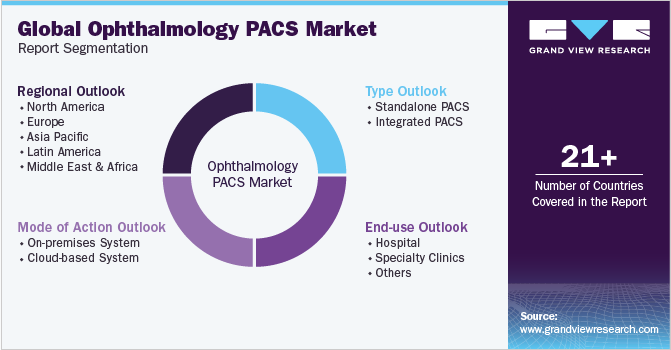
This report forecasts revenue growth at global, regional, and country levels and provides an analysis of the latest industry trends and opportunities in each of the sub-segments from 2021 to 2033. For this study, Grand View Research has segmented the global ophthalmology PACS market report based on type, mode of action, end use, and region:
 To learn more about this report, Download Free Sample Report
-
Type Outlook (Revenue, USD Million, 2021 - 2033)
-
Standalone PACS
-
Integrated PACS
-
-
Mode of Action Outlook (Revenue, USD Million, 2021 - 2033)
-
On-premises System
-
Cloud-based System
-
-
End-use Outlook (Revenue, USD Million, 2021 - 2033)
-
Hospital
-
Specialty Clinics
-
Others
-
-
Regional Outlook (Revenue, USD Million, 2021 - 2033)
-
North America
-
U.S.
-
Canada
-
-
Europe
-
U.K.
-
Germany
-
France
-
Italy
-
Spain
-
Denmark
-
Sweden
-
Norway
-
-
Asia Pacific
-
Japan
-
China
-
India
-
Australia
-
Thailand
-
South Korea
-
-
Latin America
-
Brazil
-
Mexico
-
Argentina
-
-
Middle East and Africa
-
South Africa
-
Saudi Arabia
-
UAE
-
Kuwait
-
-
Frequently Asked Questions About This Report
The global ophthalmology PACS market size was valued at USD 175.7 million in 2025 and is estimated at USD 188.9 million for 2026.
The global ophthalmology PACS market is expected to grow at a CAGR of 8.6% from 2026 to 2033, reaching USD 335.8 million.
Key players include Carl Zeiss Meditec AG; Topcon Corporation; Heidelberg Engineering GmbH; Sonomed Escalon; Visbion; EyePACS, LLC; VersaSuite; Merge Healthcare Inc. (IBM Watson Health); ScImage, Inc.
North America dominated with a 45.0% revenue share in 2025.
Integrated systems dominated the ophthalmology PACS market with a share of around 60.0% in 2025, while Asia Pacific is the fastest-growing regional market.
About the Author(s)
Healthcare IT Research Team
Healthcare · Healthcare ITThis report was authored by the healthcare it research team at Grand View Research - comprising two research analysts, one senior research analyst, and one industry expert - with specialized expertise in the healthcare it segment of the healthcare industry. All findings are based on proprietary healthcare databases, executive interviews, and regulatory analysis, subject to internal peer review prior to publication.
Last Updated:
Speak to Analyst

Customize this report to your needs - add regions, segments, or data points, with 20% free customization.
Or view our licence options:


ISO 9001:2015 & 27001:2022 Certified
We are GDPR and CCPA compliant! Your transaction & personal information is safe and secure. For more details, please read our privacy policy.


