
- Home
- »
- Organic Chemicals
- »
-
1,4 Butanediol Market Size And Share Report, 2026-2033GVR Report cover

1,4 Butanediol Market (2026 - 2033)
Size, Share & Trends Analysis Report By Application (Tetrahydrofuran (THF), Polybutylene Terephthalate (PBT), Polyurethane), By Region (North America, Europe, Asia Pacific, Latin America, Middle East & Africa), And Segment Forecasts
Market Size, 2025
$8.4BMarket Estimate, 2026
$9.2BMarket Forecast, 2033
$18.4BCAGR, 2026–2033
10.4%1,4 Butanediol Market Summary
The global 1,4 butanediol market size was valued at USD 8.4 billion in 2025 and is projected to grow from USD 9.2 billion in 2026 to USD 18.4 billion by 2033, at a CAGR of 10.4% from 2026 to 2033. The market in Asia Pacific dominated with a revenue share of 78.1% in 2025. The market growth is primarily attributed to the applications of polybutylene terephthalate (PBT), tetrahydrofuran (THF), and polyurethane (PU) in various industrial processes, as well as the increasing demand for spandex in textiles.
 Source: Grand View Research, IR Documents, Primary Interviews, Paid DatabasesTo learn more about this report,
 Download Free Sample Report
 Key Market Trends & Insights
- By application: Tetrahydrofuran (THF) segment held the largest market share of 52.6% in 2025.
Regional Highlights
- Largest regional market: Asia Pacific (78.1% revenue share, 2025)
- Fastest-growing regional market: Europe (highest CAGR, 2026-2033)
- By country: China held the largest market share in 2025
Market Size & Forecast
- Market size in 2025: USD 8.4 Billion
- Estimated market size in 2026: USD 9.2 Billion
- Projected market size by 2033: USD 18.4 Billion
- CAGR (2026-2033): 10.4%
Three ways to get this report
Buy it, customize it, or ask a question.Ask an Analyst
Analyst response in 1 business day
- AccessReport author, directly
- Reply timeWithin 1 working day
- No sales callDirect answer only
- FormatEmail reply
- CostFree, no cost
Get the Full Report
What the study covers
- FormatsPDF · Excel · Dashboard
- Timeline2026–2033 annual, 2025 base
- Coverage20+ countries, 5 regions
- Companies10+ key players profiled
Customize the Report
20% free customization
- IncludeCountries, segments, points
- TailorTo your product definition
- ExtendDeeper competitor detail
- OrA fully bespoke study
- Turnaround5–10 working days
This colorless liquid is one of the most stable isomers of butanediol derived from butane. The most common method for producing 1,4 butanediol (BDO) is the Reppe process, which involves the reaction of acetylene with formaldehyde. This method is widely utilized by major industry players such as DuPont and BASF. In addition, suppliers of 1,4 BDO have begun to integrate backward into the supply chain by starting their production of the necessary raw materials. To learn more about this report, Download Free Sample Report
 This strategy significantly reduces logistics costs and procurement challenges for companies over the long term. Consumers are becoming increasingly aware of the benefits and technologies of products. As a result, suppliers are maintaining quality throughout the production process. The growing global focus on green chemistry has prompted major market players, such as BioAmber, Genomatica, and Myriant, to develop alternative bio-based processing technologies, likely to drive market growth during the forecast period. In addition, increasing investments in sustainable technologies are expected to enhance existing processes and improve overall efficiency.
The Davy process technology, also known as the Maleic anhydride-based process, has gained popularity recently due to its reduced complexity, equipment requirements, and capital costs. In this process, maleic anhydride is converted into an ester, which then undergoes fixed-bed hydrogenolysis to produce a mixture of 1,4-butanediol (1,4 BDO), tetrahydrofuran (THF), and gamma-butyrolactone (GBL). BASF has integrated the Davy process with Huntsman Mars V/VI in Kuantan, Malaysia, to lower production costs and penetrate the lucrative Asia-Pacific market. Recent technological advancements—such as the hydrogenation of succinic acid, fermentation of sugars, and esterification—have also transformed the 1,4 BDO industry.
Biological methods for producing 1,4 BDO offer significant opportunities for new participants in the chemical market. Furthermore, government agencies like the U.S. Environmental Protection Agency (EPA) are incorporating the principles of green chemistry into chemical production and promoting renewable feedstock, further driving market growth.
The COVID-19 outbreak severely impacted the market by disrupting the supply chain of chemical products, leading to raw material price hikes. The global lockdown during the pandemic forced chemical manufacturers to halt their operations for an extended period in 2020, adversely affecting global market growth.
Market Dynamics
The butanediol market is being driven by its extensive use as a key chemical intermediate in the production of engineering plastics, polyurethanes, elastic fibers, solvents, and specialty chemicals. Demand is particularly influenced by the growth of industries such as automotive, construction, electronics, and textiles, where butanediol-derived materials provide durability, flexibility, and performance advantages. Increasing consumption of polybutylene terephthalate (PBT) resins and thermoplastic polyurethanes is supporting market expansion, especially as manufacturers seek lightweight and high-performance materials for industrial applications. At the same time, advancements in bio-based production technologies are creating new opportunities as companies look to reduce dependence on conventional petrochemical feedstocks and align with sustainability objectives
The growing demand for biodegradable plastics and sustainable polymer production is a major driver accelerating the growth of the Butanediol market. Butanediol serves as an important intermediate in the production of biodegradable polymers, particularly polybutylene succinate (PBS) and other environmentally friendly plastic materials that are increasingly being adopted across packaging, agriculture, consumer goods, and industrial applications. As governments, businesses, and consumers become more conscious of plastic waste and environmental pollution, manufacturers are actively seeking alternatives to conventional petroleum-based plastics. This shift is creating substantial demand for raw materials that can support the production of biodegradable and compostable polymer solutions without compromising performance characteristics. Butanediol-based polymers offer favorable mechanical strength, flexibility, and processability, making them suitable for replacing traditional plastics in numerous applications. As sustainability becomes a central consideration in material selection and product development, the consumption of butanediol is expected to increase alongside the expanding biodegradable plastics industry.
The transition toward circular economy models is further strengthening the role of butanediol in sustainable polymer production. Industries are increasingly focusing on reducing waste generation, improving recyclability, and minimizing the environmental footprint of manufactured products throughout their lifecycle. Biodegradable polymers derived from butanediol support these objectives by offering end-of-life solutions that reduce long-term environmental accumulation compared to conventional plastic materials. Manufacturers are investing heavily in research and development initiatives aimed at expanding the performance capabilities of sustainable polymers, which in turn increases the demand for high-quality butanediol feedstocks. The ability of butanediol-based polymers to align with corporate sustainability targets and environmental commitments makes them attractive for a wide range of commercial applications. As circular economy principles become more deeply integrated into industrial production strategies, the market for butanediol is likely to benefit from rising demand for sustainable polymer technologies.
Volatility in raw material prices is a significant restraint on the butanediol market, as it directly affects manufacturing costs and overall profitability. The production of butanediol relies on various chemical feedstocks, many of which are closely linked to petrochemical value chains and are therefore sensitive to fluctuations in crude oil, natural gas, and related commodity markets. When feedstock prices rise unexpectedly, manufacturers often face higher production costs that are difficult to immediately pass on to customers, particularly in highly competitive markets. Frequent price fluctuations create uncertainty in cost planning and make it challenging for producers to maintain stable profit margins over extended periods. This unpredictability can negatively impact investment decisions, production scheduling, and long-term supply agreements. As a result, raw material price instability creates operational and financial pressures that can limit market expansion and reduce the attractiveness of new production investments.
The impact of feedstock price volatility becomes even more pronounced when butanediol manufacturers operate under long-term contracts with customers that have fixed or semi-fixed pricing structures. In such situations, sudden increases in raw material costs can significantly reduce profitability because producers cannot adjust product prices quickly enough to offset higher costs. This creates a mismatch between production costs and revenue generation, forcing manufacturers to absorb a portion of the increased costs. Over time, repeated fluctuations can weaken financial performance and reduce the resources available for capacity expansion, research and development, and technological improvements. Smaller manufacturers are particularly vulnerable because they often possess less purchasing power and fewer risk management mechanisms than larger integrated chemical companies. Consequently, sustained feedstock volatility can create barriers to growth and limit competitive flexibility within the Butanediol market
The rapid growth of lightweight, energy-efficient solutions in the automotive and transportation sectors further strengthens this opportunity. High-performance polyurethane systems are extensively used in vehicle interiors, seating components, insulation materials, coatings, adhesives, and elastomers due to their ability to reduce weight while maintaining structural integrity. Butanediol contributes to the development of polyurethane materials that can withstand mechanical stress, temperature fluctuations, and long-term usage conditions. As vehicle manufacturers continue to focus on fuel efficiency, electric mobility, and enhanced durability, demand for advanced polyurethane products is likely to drive increased butanediol consumption.
The expanding construction industry also creates substantial opportunities for butanediol suppliers as the use of polyurethane-based insulation, sealants, coatings, and structural materials grows. Modern construction projects increasingly prioritize energy efficiency, moisture resistance, and long-term building performance, leading to greater adoption of high-performance polyurethane systems. Butanediol helps improve the physical and chemical properties of these materials, enabling them to meet stringent building requirements and performance standards. The increasing emphasis on sustainable, durable infrastructure development is therefore expected to drive additional demand for butanediol across construction-related applications.
Analyst Perspective
The 1,4-butanediol market continues to benefit from its strategic role as a key intermediate in the production of tetrahydrofuran (THF), polybutylene terephthalate (PBT), gamma-butyrolactone (GBL), and polyurethane materials. Demand growth is being supported by expanding applications across automotive, electronics, textiles, engineering plastics, and industrial manufacturing sectors. The increasing adoption of lightweight engineering plastics and high-performance polymers in electric vehicles and electronic devices is creating new opportunities for downstream BDO derivatives. At the same time, the industry is witnessing growing interest in bio-based BDO production technologies as manufacturers seek to reduce carbon emissions and improve sustainability profiles. Companies with integrated feedstock access, diversified derivative portfolios, and advanced process technologies are expected to be best positioned to capture long-term market growth.
Application Insights
Based on application, the tetrahydrofuran (THF) segment accounted for the largest share of 52.6% of total revenue in 2025. This substantial share is primarily attributed to the increased use of THF in producing poly-tetramethylene glycol (PTMEG), a polymer widely used to manufacture urethane elastomers and fibers. The demand for PTMEG has surged due to its superior properties, including exceptional flexibility and elasticity.
The PBT segment accounted for the second-largest revenue share of 20.7% in 2025. This growth is linked to the rising consumption of plastics in automotive applications, driven by a strong demand for lightweight vehicles. This trend is expected to boost PBT demand during the forecast period further. Other significant growth drivers for PBT consumption include replacing conventional metals in the automotive and electronics industries, introducing new-generation PBT grades, and developing bio-based PBT. In addition, the demand for polyurethane (PU) is anticipated to grow, fueled by the increasing emphasis on lightweight and durable products in sectors such as automotive, construction, and electronics, particularly in Asia.
Regional Insights
The 1,4-butanediol market in North America is anticipated to grow at a significant CAGR during the forecast period. The market is significantly influenced by the increasing demand for this chemical in various end-use industries. The automotive sector, in particular, is experiencing a surge in demand for lightweight materials that enhance fuel efficiency and reduce emissions. As manufacturers strive to meet stringent environmental regulations and consumer preferences for sustainable products, the demand for BDO-derived materials is expected to rise.
 To learn more about this report, Download Free Sample Report
 The 1,4 butanediol market in the U.S. is primarily driven by its increasing demand in key industrial applications, particularly in producing plastics, resins, and synthetic fibers. As the demand for products like spandex, polyurethane, and plastics continues to rise across various industries such as automotive, construction, textiles, and electronics, the need for high-quality BDO as a versatile chemical building block also expands.
Asia Pacific 1,4 Butanediol Market
Asia Pacific 1,4 butanediol market dominated the global market with the largest revenue share of 78.1% in 2025. The growing automotive, construction, and electronics industries in countries such as China, India, and Japan are major contributors to the demand for BDO. The rise in consumer demand for lightweight and durable materials in these sectors has spurred the need for advanced polymers and coatings, where BDO plays an essential role. Moreover, the shift toward bio-based BDO production methods is gaining traction, providing an added growth avenue for the market as manufacturers look to meet sustainability goals.
Europe 1,4 Butanediol Market
The 1,4 butanediol market in Europe has made significant strides in advancing chemical recycling and green chemistry initiatives, which has helped improve the overall cost-effectiveness of BDO production processes. As Europe continues to focus on decarbonization and achieving its climate goals, BDO is increasingly being produced via bio-based and low-carbon processes, aligning with the region's commitment to a circular economy.
Latin America 1,4 Butanediol Market Trends
The 1,4 butanediol market in Latin America is anticipated to grow at a significant CAGR during the forecast period. As Latin American economies continue to industrialize and consumer purchasing power improves, the need for high-performance materials in manufacturing processes is rising, further boosting BDO demand. In addition, the electronics industry's rapid expansion, especially in Brazil and Mexico, contributes to the demand for BDO in producing electronic components and consumer goods, further driving market growth.
Middle East & Africa 1,4 Butanediol Market Trends
The 1,4 butanediol market in the Middle East & Africa is expected to grow at a significant CAGR during the forecast period. The region’s expanding manufacturing sector, especially in countries like Saudi Arabia and the UAE, fosters a higher consumption of BDO as it is integral to producing materials such as polyurethane and polybutylene terephthalate (PBT). In addition, the rise in automotive production and construction activities across these regions further propels the need for BDO-based products, which are essential for enhancing durability and performance.
Key 1,4 Butanediol Company Insights
Some of the key players operating in the market include BASF SE, Ashland, and Evonik Industries AG.
-
BASF SE is a chemical production company. It has more than 340 production facilities worldwide and conducts business through subsidiaries and joint partnerships in over 80 countries. The company also offers a variety of system solutions and services. These include products for the automotive, chemical, construction, agriculture, oil, electrical, plastics, electronics, furniture, and paper sectors.
-
Ashland is engaged in manufacturing and distributing specialty chemicals to several end-use industries, including architectural coating, adhesives, automotive, construction, food & beverage, pulp & paper, energy, pharmaceuticals, and personal care. It operates through three business segments, namely, specialty ingredients, composites, and intermediates & solvents. The specialty ingredients segment includes cellulose ethers, vinyl pyrrolidone, and biofunctionals.
Key 1,4 Butanediol Companies
The following key companies have been profiled for this study on the 1,4 butanediol market.
-
BASF SE
-
Ashland
-
DCC
-
Mitsubishi Chemical Group Corporation
-
Evonik Industries AG
-
LyondellBasell Industries Holdings B.V.
-
Sipchem Company
-
SINOPEC (China Petrochemical Corporation)
-
Genomatica, Inc.
Competitive Benchmarking
Category
Operating Strategies
Competitive Edge
Weakness
Established Players (BASF SE, Mitsubishi Chemical Group Corporation, Evonik Industries AG, LyondellBasell Industries Holdings B.V., Sipchem Company, SINOPEC (China Petrochemical Corporation), DCC, Taiyo Nippon Sanso Corporation)
- Focus on expanding integrated BDO production capacities and strengthening downstream derivatives such as THF, PBT, GBL, and polyurethanes.
- Invest in process optimization, feedstock integration, and energy-efficient manufacturing technologies to improve production economics.
- Strengthen strategic partnerships with automotive, electronics, textile, and industrial manufacturers.
- Expand global supply networks through capacity additions, joint ventures, and regional manufacturing investments.
- Emphasize development of sustainable and bio-based BDO production pathways.
- Strong feedstock integration and large-scale manufacturing capabilities.
- Extensive global distribution networks and established customer relationships.
- Diversified derivative portfolios supporting multiple end-use industries.
- Significant financial resources supporting technology development and capacity expansion.
- Strong technical expertise in specialty chemicals and performance materials.
- Exposure to crude oil, natural gas, acetylene, and butane feedstock price volatility.
- High capital intensity associated with BDO production and downstream integration.
- Increasing environmental compliance and sustainability-related operating costs.
- Dependence on cyclical industries such as automotive, construction, and electronics.
- Longer investment cycles for large-scale capacity expansion projects.
Emerging / Regional Players (Ashland, Genomatica, Inc., Indian Oil Corporation Limited, C-Chem Co., Ltd)
- Focus on specialty BDO applications, bio-based production technologies, and regional market expansion.
- Develop strategic collaborations and licensing agreements to commercialize sustainable BDO manufacturing routes.
- Target niche opportunities within advanced materials, specialty chemicals, and sustainable polymers.
- Strengthen regional distribution networks and customer-specific product development initiatives.
- Emphasize innovation in low-carbon and renewable chemical production technologies.
- Greater flexibility in adopting emerging production technologies and sustainable manufacturing processes.
- Strong focus on niche and high-value application segments.
- Faster commercialization of innovative bio-based chemical solutions.
- Ability to address region-specific customer requirements and market opportunities.
- Growing positioning in sustainability-focused value chains
- Limited production capacities compared to large multinational competitors.
- Smaller global market presence and distribution capabilities.
- Lower financial resources for large-scale capacity expansion.
- Dependence on technology adoption and commercialization success.
- Greater exposure to regional market fluctuations and competitive pressures.
Recent Developments
-
In September 2023, BASF agreed with Qore LLC to secure long-term access to QIRA's bio-based 1,4 butanediol. This strategic move supports BASF's expansion of its bio-based derivatives portfolio, including tetrahydrofuran and polytetrahydrofuran, with commercial quantities anticipated by Q1 2025.
-
In October 2022, BASF SE announced the manufacturing of 1,4 butanediol through renewable feedstock, which includes Genomatica's patented GENO BDO technology. The moves toward bio-based technologies for producing 1,4 butanediol align with BASF SE and Genomatica, Inc. goal of promoting sustainable development in the industry.
1,4 Butanediol Market Report Scope
Report Attribute
Details
Market size in 2025
USD 8.4 billion
Estimated market size in 2026
USD 9.2 billion
Projected market size by 2033
USD 18.4 billion
Growth rate
CAGR of 10.4% from 2026 to 2033
Base year for estimation
2025
Historical data
2021 - 2024
Forecast period
2026 - 2033
Quantitative units
Volume, Kilotons; Revenue in USD million/billion and CAGR from 2026 to 2033
Report coverage
Revenue & Volume forecast, company ranking, competitive landscape, growth factors, and trends
Segments covered
Application & region
Regional scope
North America; Europe; Asia Pacific; Latin America; MEA
Country scope
U.S.; Canada; Mexico; Germany; UK; France; Italy; Spain; Netherlands; Russia; China; India; Japan; South Korea; Australia; Vietnam; Brazil; Argentina; Saudi Arabia; and South Africa
Key companies profiled
BASF SE; Ashland; DCC; Mitsubishi Chemical Group Corporation; Evonik Industries AG; LyondellBasell Industries Holdings B.V.; Sipchem Company; SINOPEC (China Petrochemical Corporation); Genomatica, Inc.; Taiyo Nippon Sanso Corporation.
Customization scope
Free report customization (equivalent up to 8 analysts' working days) with purchase. Addition or alteration to country, regional & segment scope.
Pricing and purchase options
Avail customized purchase options to meet your exact research needs. Explore purchase options
Global 1,4 Butanediol Market Report Segmentation
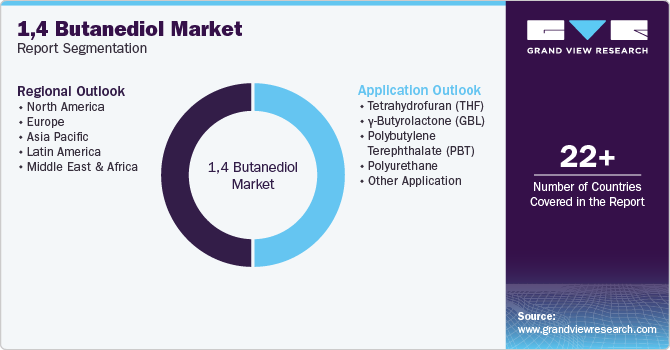
This report forecasts revenue and volume growth at global, regional, and country levels and analyzes the latest industry trends in each of the sub-segments from 2021 to 2033. For this study, Grand View Research has segmented the global 1,4 Butanediol market report based on the application, and region.
 To learn more about this report, Download Free Sample Report
 -
Application Outlook (Revenue, USD Million, Volume, Kilotons; 2021 - 2033)
-
Tetrahydrofuran (THF)
-
γ-Butyrolactone (GBL)
-
Polybutylene Terephthalate (PBT)
-
Polyurethane
-
Other Application
-
-
Regional Outlook (Revenue, USD Million, Volume, Kilotons; 2021 - 2033)
-
North America
-
U.S.
-
Canada
-
Mexico
-
-
Europe
-
Germany
-
UK
-
France
-
Italy
-
Spain
-
Netherlands
-
Russia
-
-
Asia Pacific
-
China
-
India
-
Japan
-
South Korea
-
Australia
-
Vietnam
-
-
Latin America
-
Brazil
-
Argentina
-
-
Middle East & Africa
-
Saudi Arabia
-
South Africa
-
-
Research Methodology
The 1,4 butanediol market figures in this report are based on a proven research process that combines executive interviews with secondary research from proprietary databases, company filings, and recognized regulatory and institutional sources. Market size is built through value-chain sizing - reconciling supply-side and demand-side estimates - and triangulated with bottom-up and top-down approaches. Every estimate passes multiple levels of expert validation before publication, with each 1,4 butanediol segment quantified using the revenue-capture definitions in the table below.
Segment Definition
Segment - Application
Revenue capture definition
Tetrahydrofuran (THF)
Revenue generated from the use of 1,4-butanediol as a primary feedstock in the production of tetrahydrofuran (THF), which is subsequently utilized in the manufacture of spandex fibers, polytetramethylene ether glycol (PTMEG), solvents, and specialty chemical intermediates. This segment represents one of the largest consumption pathways for BDO globally.
γ-Butyrolactone (GBL)
Revenue generated from the consumption of 1,4-butanediol in the production of gamma-butyrolactone (GBL), a key intermediate used in agrochemicals, pharmaceuticals, electronics, specialty solvents, and chemical synthesis applications. Demand is driven by growing industrial and specialty chemical manufacturing activities
Polybutylene Terephthalate (PBT)
Revenue generated from the use of 1,4-butanediol in the production of PBT engineering resins utilized across automotive components, electrical & electronics equipment, consumer appliances, and industrial applications requiring high-performance thermoplastics with excellent mechanical and thermal properties
Polyurethane
Revenue generated from the consumption of 1,4-butanediol as a chain extender and intermediate in polyurethane production. Demand is supported by applications across footwear, automotive interiors, adhesives, coatings, sealants, elastomers, construction materials, and industrial products requiring enhanced durability and flexibility
Other Applications
Revenue generated from the utilization of 1,4-butanediol in solvents, specialty chemicals, pharmaceuticals, elastic fibers, industrial intermediates, and other niche applications. This segment includes emerging uses of BDO in advanced materials, sustainable chemicals, and specialty manufacturing processes
Estimation Model
Layer Name
Key Question
Description
End-Use Industry Demand Layer
What forms the demand base?
Identify global demand across major end-use industries including automotive, electronics, textiles, construction, industrial manufacturing, consumer goods, and packaging. This layer establishes the addressable demand base by evaluating consumption of engineering plastics, elastomers, polyurethanes, solvents, and specialty chemicals that utilize BDO-derived products
1,4 Butanediol Adoption Layer
Where are 1,4 Butanediol used?
Estimate the penetration of BDO across key derivative markets including tetrahydrofuran (THF), gamma-butyrolactone (GBL), polybutylene terephthalate (PBT), polyurethanes, and specialty chemical applications. Assess adoption levels across regions, manufacturing technologies, and downstream industries
Consumption Intensity Layer
How much 1,4 Butanediol is used?
Analyze average BDO consumption requirements across derivative manufacturing processes. Consumption intensity is influenced by production technologies, conversion efficiencies, derivative product specifications, regional manufacturing practices, and end-use demand patterns
Revenue Layer
How is market revenue generated?
Market revenue is generated through the sale of 1,4-butanediol to manufacturers of THF, GBL, PBT, polyurethane products, solvents, elastomers, and specialty chemicals. Revenue is driven by increasing demand for engineering plastics, spandex fibers, performance materials, and industrial chemical intermediates across global manufacturing industries
Delivered Customizations
This report has been delivered with the following In-depth customizations
Client Request
Customization Delivered
Value Adds
Regional Segmentation
Detailed regional assessment of the 1,4-butanediol (BDO) market across North America, Europe, Asia Pacific, Latin America, and Middle East & Africa, including country-level analysis of production capacity, feedstock availability, manufacturing footprint, import-export dynamics, downstream derivative demand, and regulatory developments. The study further evaluates regional consumption trends across THF, GBL, PBT, polyurethane, and other downstream applications to identify key growth markets and supply-demand dynamics
Enables identification of high-growth regional markets, production hubs, and emerging consumption centers. Supports capacity expansion planning, sourcing strategies, geographic prioritization, and investment decision-making through enhanced visibility into regional demand patterns and competitive positioning.
Cross- Segmentation Benchmarking
Detailed cross-segmentation analysis assessing BDO demand across key application segments including THF, GBL, PBT, polyurethane, and other applications, mapped against major end-use industries such as automotive, electronics, textiles, construction, consumer goods, and industrial manufacturing. The analysis identifies high-growth application-end-use combinations, demand concentration trends, and evolving consumption patterns across global markets
Supports portfolio optimization and market prioritization by identifying the most attractive application-end-use combinations. Enables targeted business development initiatives, efficient resource allocation, and improved revenue generation opportunities across the BDO value chain
Pricing Analysis
Comprehensive assessment of historical and current BDO pricing trends across major regions, including feedstock cost movements (butane, acetylene, propylene, and natural gas), production economics, energy costs, supply-demand balances, and downstream derivative market influences. The study also evaluates pricing variations across regions and the impact of capacity utilization rates and trade flows on market pricing
Supports procurement planning, supplier negotiations, margin optimization, and pricing strategy development through enhanced understanding of cost structures, price volatility factors, and future pricing outlooks across the BDO value chain
Frequently Asked Questions About This Report
Some key players operating in the 1,4 butanediol market include BASF SE, Ashland, DCC, Mitsubishi Chemical Group Corporation, Evonik Industries AG, LyondellBasell Industries Holdings B.V., Sipchem Company, SINOPEC (China Petrochemical Corporation), Genomatica, Inc.
Key factors that are driving the 1,4 butanediol market growth include growing applications of tetrahydrofuran (THF), polybutylene terephthalate (PBT), and polyurethane (PU) in various industrial processes along with the growing demand for spandex in textiles.
The global 1,4 butanediol market size was estimated at USD 8.4 billion in 2025 and is expected to reach USD 9.2 billion in 2026.
The global 1,4 butanediol market is expected to grow at a compound annual growth rate of 10.4% from 2026 to 2033 to reach USD 18.4 billion by 2033.
The Asia Pacific dominated the 1,4 butanediol market with a share of 78.1% in 2025. This is attributable to rapidly expanding industries, a wide consumer pool with growing income levels, and the presence of low-cost labor & resources.
THF segment dominated the market with a revenue share of 52.6% in 2025.
THF segment is expected to grow the fastest with a compound annual growth rate of 11.1% during the forecast period.
Europe is expected to grow the fastest with a compound annual growth rate of 11.1% during the forecast period.
China dominated the 1,4 butanediol market in the Asia Pacific region with a revenue share of 66.3% in 2025.
About the Author(s)
Organic Chemicals Research Team
Bulk Chemicals · Organic ChemicalsThis report was authored by the organic chemicals research team at Grand View Research - comprising two research analysts, one senior research analyst, and one industry expert - with specialized expertise in the organic chemicals segment of the bulk chemicals industry. All findings are based on proprietary bulk chemicals databases, executive interviews, and regulatory analysis, subject to internal peer review prior to publication.
Last Updated:
Speak to Analyst

Customize this report to your needs - add regions, segments, or data points, with 20% free customization.
Or view our licence options:


ISO 9001:2015 & 27001:2022 Certified
We are GDPR and CCPA compliant! Your transaction & personal information is safe and secure. For more details, please read our privacy policy.


