
- Home
- »
- Organic Chemicals
- »
-
Paraxylene Market Size, Share & Growth Report, 2026-2033GVR Report cover

Paraxylene Market (2026 - 2033)
Size, Share & Trends Analysis Report By Application (Dimethyl Terephthalate, Purified Terephthalic Acid), By Region (North America, Europe, Asia Pacific, Latin America, MEA), And Segment Forecasts
Market Size, 2025
$92.6BMarket Estimate, 2026
$103.4BMarket Forecast, 2033
$250.8BCAGR, 2026–2033
13.5%Paraxylene Market Size & Trends
The global paraxylene market size was valued at USD 92.6 billion in 2025 and is projected to grow from USD 103.4 billion in 2026 to USD 250.8 billion by 2033, at a CAGR of 13.5% from 2026 to 2033. The market in Asia Pacific dominated with a revenue share of 83.8% in 2025. This growth is attributed to the increasing demand for polyester fabrics, where paraxylene is a crucial raw material. The expansion of PET bottle production, especially in the beverage industry, also boosts demand for paraxylene.
 Source: Grand View Research, IR Documents, Primary Interviews, Paid DatabasesTo learn more about this report,
 Download Free Sample Report
Key Market Trends & Insights
- By application: Purified terephthalic acid (PTA) segment held the largest market share of 97.2% in 2025.
- Dimethyl terephthalate (DMT) segment is expected to grow at the fastest CAGR of 13.7% from 2026 to 2033.
Regional Highlights
- Largest regional market: Asia Pacific (83.8% revenue share, 2025)
- By country: China held the largest market share in 2025
Market Size & Forecast
- Market size in 2025: USD 92.6 Billion
- Estimated market size in 2026: USD 103.4 Billion
- Projected market size by 2033: USD 250.8 Billion
- CAGR (2026-2033): 13.5%
Prism AI by Grand View Research Free to tryAsk a question about the paraxylene marketTry asking✓Every figure cited from GVR research Prefer the report? Download free sample →
In addition, the growing use of polyester in the textile and packaging sectors significantly contributes to market growth. Furthermore, increasing adoption in the automotive industry and capacity expansions by major companies also play a role in market growth. Paraxylene, known for its sweet aroma, is a crucial chemical primarily derived from benzene. This clear, flammable hydrocarbon serves as a fundamental building block in the manufacturing of numerous industrial materials, most notably polyethylene terephthalate, commonly known as PET, and various polyester fabrics. Obtaining paraxylene involves sophisticated processes, including the catalytic reforming of petroleum derivatives. Refinement methods such as crystallization and the reaction of ethylbenzene play a pivotal role in isolating this valuable compound. To learn more about this report, Download Free Sample Report
The widespread adoption of paraxylene stems from its role as a key raw material in the production of essential industrial chemicals. These chemicals, including terephthalic acid and dimethyl terephthalate, serve as critical intermediates in the creation of PET polyesters. These PET polymers exhibit exceptional qualities, including remarkable strength and shatter resistance, rendering them ideally suited for a diverse range of applications. The bottling of beverages, for example, relies heavily on PET's ability to maintain structural integrity and prevent carbonation loss.
In addition, the textile industry also benefits significantly from paraxylene's properties, with polyester fibers contributing to clothing, upholstery, and various fabrics. Moreover, PET films are employed in numerous packaging solutions, providing barrier properties and protection for various goods. Furthermore, the growth of the paraxylene market is closely tied to the escalating demand for PET across various industries. This surge in demand is, in turn, propelled by factors such as rapid urbanization and population growth, which fuel the need for textiles and consumer goods. Moreover, the construction and electrical sectors utilize paraxylene-derived materials in applications such as electrical insulation and specialized fabrics, contributing to the overall market expansion.
Market Dynamics
The paraxylene market is driven by the growing demand for purified terephthalic acid (PTA), a key feedstock for polyester fibers, polyethylene terephthalate (PET) resins, and packaging materials. Expanding textile production, increasing consumption of PET bottles, and rising demand for lightweight packaging across food & beverage and consumer goods industries continue to support market growth. At the same time, fluctuations in crude oil and naphtha prices, stringent environmental regulations, and the increasing adoption of recycled PET (rPET) are influencing market dynamics.
The increasing consumption of polyester fibers and polyethylene terephthalate (PET) across the textile, packaging, and consumer goods industries is a key driver of the paraxylene market. Paraxylene is the primary feedstock to produce purified terephthalic acid (PTA), which is extensively used in manufacturing polyester fibers, PET bottles, and polyester films. Growing demand for packaged beverages, ready-to-eat food products, and synthetic textiles, particularly in emerging economies, continues to support higher paraxylene consumption.
Rapid urbanization, rising disposable incomes, and expanding manufacturing activities are driving investments in polyester and PET production capacities. The increasing use of lightweight and durable PET packaging in the food & beverage, pharmaceutical, and personal care industries, coupled with ongoing capacity expansions by petrochemical manufacturers, is further strengthening the demand for paraxylene. These factors are expected to sustain market growth over the forecast period.
Fluctuations in crude oil prices and the cost of key feedstocks, such as naphtha and mixed xylene, pose a significant challenge for the paraxylene market. Since paraxylene production is closely linked to petrochemical refining operations, changes in crude oil prices directly impact production costs, profit margins, and overall pricing stability. Unpredictable feedstock availability and price variations can create operational uncertainties for manufacturers and affect long-term investment decisions.
Geopolitical tensions, supply chain disruptions, and changes in global energy markets can further contribute to raw material price volatility. These factors increase cost pressures across the paraxylene value chain, making it challenging for producers to maintain stable pricing and profitability, thereby limiting market growth potential.
The growing focus on sustainable materials and the transition toward low-carbon chemical production are creating new opportunities for the paraxylene market. Increasing demand for bio-based PET and renewable packaging solutions is encouraging manufacturers to explore alternative production pathways, including bio-based paraxylene derived from renewable feedstocks. These sustainable solutions help reduce dependence on fossil-based raw materials while supporting the environmental goals of end-use industries.
Rising adoption of recycled PET (rPET) and increasing investments in circular economy initiatives are expected to drive innovation across the polyester value chain. Petrochemical companies are focusing on developing advanced technologies and expanding sustainable product portfolios, creating opportunities for paraxylene producers to address evolving customer preferences and regulatory requirements.
Analyst Perspective
The paraxylene market is expected to witness steady growth, supported by rising demand for polyester fibers, PET packaging, and downstream aromatic derivatives. Established players with integrated refining capabilities, strong feedstock access, and large-scale production capacity are likely to maintain market dominance. However, increasing focus on sustainability, recycling initiatives, and evolving petrochemical regulations will encourage manufacturers to improve operational efficiency, invest in advanced technologies, and explore more sustainable production pathways to strengthen their competitive position.
Application Insights
By application, purified terephthalic acid (PTA) held a dominant position, contributing 97.2% of total revenue in 2025. This growth is attributed to its widespread use in producing PET resins, a cornerstone of the packaging, textile, and beverage sectors. In addition, escalating demand for polyester fibers, especially in apparel and home furnishings, significantly drives PTA consumption. The ever-growing packaged beverage industry relies heavily on PET, thus contributing to PTA's market growth. Furthermore, the automotive sector's increasing adoption of PET-based components for lightweighting purposes provides a substantial boost to overall PTA demand, and it’s also used in coating solutions.
Dimethyl terephthalate (DMT) application segment is expected to grow at the fastest CAGR of 13.7% from 2026 to 2033, owing to its role in the creation of polyester films, crucial for packaging and electronics. DMT's application in engineering resins, valued for their durability and heat resistance, further fuels its demand, especially in the automotive sector. In addition, the need for specialized polymers that utilize DMT as an intermediate also bolsters market expansion. Moreover, the construction industry requires DMT for manufacturing, and its demand is also fueled by the increased use of polyester film for coating purposes.
Regional Insights
Asia Pacific dominated the paraxylene market with the highest revenue share of 83.8% in 2025, primarily driven by the robust demand for polyethylene terephthalate from the plastics industry. In addition, rapid industrialization and economic growth, coupled with the expansion of the textile industry, further contribute to market growth. Furthermore, rising e-commerce and increased consumption of packaged goods also drive the need for plastics, supporting paraxylene demand.
 To learn more about this report, Download Free Sample Report
The paraxylene market in China led the Asia Pacific market and accounted for the largest revenue share in 2025, driven by its position as a major production hub and consumer. The country's extensive petrochemical infrastructure and substantial production capacity drive paraxylene sales. Furthermore, growing demand for PET in the packaging and textile sectors is a key driver for the market growth. Moreover, the rise of e-commerce and increasing tech-savviness among the population boosts demand for plastic resins.
North America Paraxylene Market Trends
The North America paraxylene market is expected to grow at a CAGR of 11.6% over the forecast period, owing to the demand for PET in packaging and the automotive sector. In addition, the increasing awareness of sustainable materials is driving the adoption of bio-based PET, creating growth opportunities. Furthermore, the region's economic development and consumer spending contribute to the demand for plastic products, thereby driving the growth of the market.
The paraxylene market in the U.S. led the North American market and held for the highest revenue share in 2025, primarily driven by the demand for PET in the packaging and beverage industries. Furthermore, growing consumer spending and a focus on convenience contribute to the consumption of packaged goods, boosting the need for PET resins. The automotive industry's use of PET-based components for lightweighting also supports the market. Moreover, an increasing emphasis on recycling and sustainable packaging solutions influences market trends.
Europe Paraxylene Market Trends
The Europe paraxylene market is expected to grow significantly over the forecast period, owing to stringent environmental regulations and a focus on sustainability. In addition, the demand for bio-based PET and recycled plastics is growing, driven by environmental awareness. Furthermore, the packaging, textile, and automotive industries contribute to paraxylene consumption.
The growth of the paraxylene market in Germany is expected to be driven by its strong industrial base and focus on high-quality products. The automotive industry's demand for PET-based components and engineering plastics drives market growth. In addition, stringent environmental regulations promote the use of recycled and bio-based materials. Furthermore, the packaging sector's need for PET resins also contributes to paraxylene consumption.
Key Paraxylene Company Insights
Major players in the paraxylene industry include Sinopec, Reliance, ONGC, and others. These players strategically focus on technology launches, acquisitions, and robust research and development activities to enhance their product lines and market presence. In addition, expanding production capacity to meet rising polyester demand is also key strategy implemented by the companies to gain competitive edge.
-
Sinopec is involved in the production of PTA and PET. The company utilizes reformate C6+ to produce paraxylene, essential for synthetic fiber and engineering plastics. Sinopec has developed efficient PX suite technology. The company’s operations span industrial investment, petroleum and natural gas exploration, refining, coal production, and sales.
-
GS Caltex is involved in the aromatics business, which includes paraxylene production, using it as a feedstock for manufacturing PTA and other petrochemical products. The company operates in the refining and petrochemical segments, similar to other major players in the industry, transforming crude oil and other raw materials into a range of fuels and chemical products.
Key Paraxylene Companies
The following key companies have been profiled for this study on the paraxylene market.
-
Sinopec
-
JX Nippon Oil & Energy Corp
-
CNPC
-
Reliance
-
NPC Iran
-
GS Caltex
-
ONGC
-
Orpic, Oman Oil Refineries and Petroleum Industries Company
-
Jurong Aromatics Corp
-
China National Offshore Oil Corporation (CNOOC)
-
Lotte KP Chemical
-
ExxonMobil
-
Saudi Aramco
-
Dalian Fujia Dahua
-
Idemitsu Kosan Co.Ltd.
-
Toyo
-
Teijin Fibers
Competitive Benchmarking
Category
Operating Strategies
Competitive Edge
Weakness
Established Players (Sinopec, CNPC, Reliance Industries Limited, GS Caltex, ExxonMobil, Saudi Aramco, JX Nippon Oil & Energy Corp, Idemitsu Kosan Co., Ltd., China National Offshore Oil Corporation (CNOOC))
- These companies focus on expanding paraxylene production capacity, strengthening integrated refining and petrochemical operations, optimizing production efficiency, and developing long-term supply agreements with downstream polyester and PET manufacturers.
- Strong feedstock integration, large-scale production capacity, established global distribution networks, advanced refining technologies, and strong financial capabilities enable these players to maintain a competitive position.
- High dependence on crude oil and petrochemical market cycles, significant capital requirements for capacity expansion, and increasing pressure from sustainability regulations and alternative materials.
Emerging Players (NPC Iran, Orpic (Oman Oil Refineries and Petroleum Industries Company), Jurong Aromatics Corporation, Lotte KP Chemical, Dalian Fujia Dahua, Toyo Engineering Corporation, Teijin Fibers)
- These companies focus on expanding regional production capabilities, improving operational efficiency, strengthening downstream partnerships, and increasing participation in growing Asian and Middle Eastern petrochemical markets.
- Regional market presence, access to cost-competitive feedstocks, specialized technical capabilities, and opportunities for capacity expansion provide growth potential.
- Smaller production scale compared with global majors, limited geographical reach, and higher exposure to regional market fluctuations and supply-demand imbalances.
Recent Developments
-
In January 2025, Lotte Chemical is expanding its collaboration with Hyundai Motor and Kia to develop eco-friendly plastic solutions for vehicles. Lotte Chemical is expected to supply innovative materials, including bio-PET, which uses paraxylene derived from biomass, and recycled plastics, reducing reliance on fossil fuels and promoting sustainability. The partnership aims to increase the application of these materials in Hyundai and Kia models, enhancing vehicle sustainability and contributing to a circular economy. This collaboration reflects a commitment to environmental responsibility and innovation in automotive materials.
-
In November 2024, Aramco, Fujian Petrochemical, and SINOPEC, have started construction of a major incorporated refining and petrochemical complex in Fujian Province, China. The complex is expected to have a 16 million tons’ oil refining unit, per annum, a 1.5 million tons- ethylene unit per annum, and a two million tons paraxylene capacity. Aramco and SINOPEC each hold a 25% stake, while FPCL owns 50%. The project supports China's petrochemicals demand and strengthens the China-Saudi partnership. It is expected to be operational by the end of 2030.
Paraxylene Market Report Scope
Report Attribute
Details
Market size in 2025
USD 92.6 billion
Estimated market size in 2026
USD 103.4 billion
Projected market size by 2033
USD 250.8 billion
Growth rate
CAGR of 13.5% from 2026 to 2033
Base year for estimation
2025
Historical data
2021 - 2024
Forecast period
2026 - 2033
Quantitative units
Volume in kiloton, revenue in USD million/billion, and CAGR from 2025 to 2033
Report coverage
Volume forecast, revenue forecast, company ranking, competitive landscape, growth factors, and trends
Segments covered
Application and region
Regional scope
North America; Europe; Asia Pacific; Latin America; MEA
Country scope
U.S.; Germany; UK; France; China; India; Japan; Brazil; Argentina; Saudi Arabia; South Africa
Key companies profiled
Sinopec; JX Nippon Oil & Energy Corp; CNPC; Reliance; NPC Iran; GS Caltex; ONGC; Orpic, Oman Oil Refineries and Petroleum Industries Company; Jurong Aromatics Corp; China National Offshore Oil Corporation (CNOOC); Lotte KP Chemical; ExxonMobil; Saudi Aramco; Dalian Fujia Dahua; Idemitsu Kosan Co.Ltd.; Toyo; Teijin Fibers
Customization scope
Free report customization (equivalent up to 8 analysts' working days) with purchase. Addition or alteration to country, regional & segment scope.
Pricing and purchase options
Avail customized purchase options to meet your exact research needs. Explore purchase options
Global Paraxylene Market Report Segmentation
This report forecasts revenue growth at global, regional, and country levels and analyzes the latest industry trends in each sub-segment from 2021 to 2033. For this study, Grand View Research has segmented the global paraxylene market report based on application, and region:
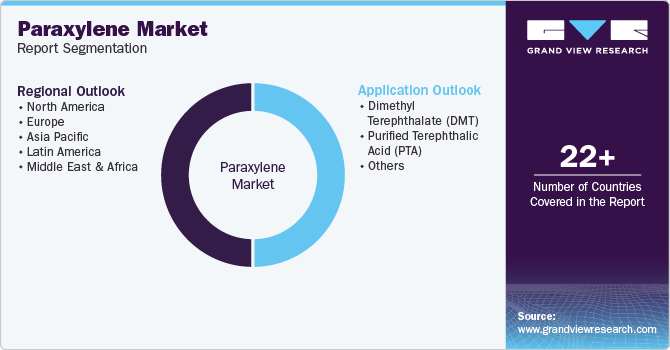 To learn more about this report, Download Free Sample Report
-
Application Outlook (Volume, Kilotons; Revenue, USD Million, 2021 - 2033)
-
Dimethyl Terephthalate (DMT)&
-
Purified Terephthalic acid (PTA)
-
Others
-
-
Regional Outlook (Volume, Kilotons; Revenue, USD Million, 2021 - 2033)
-
North America
-
U.S.
-
-
Europe
-
Germany
-
France
-
UK
-
-
Asia Pacific
-
China
-
India
-
Japan
-
-
Latin America
-
Middle East and Africa
-
Research Methodology
The paraxylene market figures in this report are based on a proven research process that combines executive interviews with secondary research from proprietary databases, company filings, and recognized regulatory and institutional sources. Market size is built through value-chain sizing - reconciling supply-side and demand-side estimates - and triangulated with bottom-up and top-down approaches. Every estimate passes multiple levels of expert validation before publication, with each paraxylene segment quantified using the revenue-capture definitions in the table below.
Segment Definition
Application
Revenue capture definition
DMT
Revenue captured from the sale of paraxylene used as a raw material in the production of dimethyl terephthalate (DMT), which is further utilized in manufacturing polyester fibers, films, and specialty polymer applications.
PTA
Revenue captured from paraxylene consumption for purified terephthalic acid (PTA) production, primarily used in polyester fiber manufacturing, PET resin production, and packaging applications. This segment represents the major application area for paraxylene demand.
Others
Revenue captured from paraxylene utilization in other applications, including specialty chemicals, solvents, and niche industrial processes where paraxylene serves as a feedstock or intermediate material.
Estimation Model
Layer No.
Layer Name
Key Question
Description
01
Application-Based Demand Analysis
How is paraxylene utilized across different applications?
Estimates paraxylene demand based on major applications, including PTA, DMT, and other specialty uses, by analyzing production trends and consumption patterns.
02
Production Capacity & Supply Analysis
What is the available paraxylene production capacity?
Assesses global and regional paraxylene manufacturing capacities, plant expansions, operational utilization rates, and supply availability from key producers.
03
Feedstock Availability & Cost Evaluation
How do raw material factors influence paraxylene production?
Analyzes availability and pricing trends of major feedstocks such as mixed xylene and naphtha, along with their impact on production economics and market pricing.
04
Company Revenue & Market Share Assessment
How much revenue is generated by key market participants?
Estimates revenues of major paraxylene producers by analyzing production capacity, product portfolio, regional presence, and pricing trends.
Delivered Customizations
This report has been delivered with the following In-depth customizations
Client Request
Customization Delivered
Value Adds
Pricing Analysis
Historical and current paraxylene pricing trends were analyzed by assessing crude oil fluctuations, naphtha and mixed xylenes feedstock costs, refinery operating conditions, supply-demand balances, and regional price variations. The assessment also examined the impact of PTA and polyester market conditions on paraxylene pricing movements.
Strengthens pricing strategy and procurement planning through improved understanding of cost drivers and market volatility. Supports margin management, contract negotiations, and commercial decision-making.
Competitive Benchmarking
Major paraxylene producers were benchmarked based on production capacity, refinery integration, feedstock security, PTA/DMT integration, geographic presence, operational efficiency, and strategic investments. The assessment also evaluated competitive positioning across integrated petrochemical and polyester manufacturing value chains.
Helps identify competitive strengths, integration advantages, and market positioning differences among key participants. Facilitates strategic benchmarking, partnership evaluation, and investment planning.
Opportunity Assessment
Growth opportunities were assessed across expanding polyester fiber demand, PET packaging applications, integrated petrochemical projects, and emerging capacity additions in high-consumption regions. The analysis also examined opportunities linked to increasing demand for recyclable polyester and advancements in downstream PET technologies.
Enables identification of high-potential growth areas and strategic investment opportunities. Supports capacity expansion planning, downstream integration, and long-term business development initiatives.
Frequently Asked Questions About This Report
The global paraxylene market size was valued at USD 92.6 billion in 2025 and is estimated at USD 103.4 billion for 2026.
Key factors that are driving the market growth include rising demand for polyester from textiles, construction material, and packaging industries.
By application, PTA held a dominant position, contributing 97.2% of total revenue in 2025. This leadership is primarily driven by PTA's role as the principal downstream derivative of paraxylene and its extensive consumption in the production of polyester fibers, polyethylene terephthalate (PET) resins, and polyester films.
DMT is expected to be the fastest-growing segment, registering a CAGR of 13.7% during the forecast period. The segment's growth is driven by increasing demand for specialty polyester resins, engineering plastics, and high-performance polyester films used in electrical, electronics, automotive, and industrial applications.
The paraxylene market is highly dependent on petroleum-based feedstocks such as naphtha and reformate, making production costs vulnerable to fluctuations in crude oil prices. Unpredictable raw material costs compress profit margins and create pricing uncertainty across the value chain. Additionally, stringent environmental regulations governing greenhouse gas emissions, hazardous air pollutants, and aromatic hydrocarbon production require manufacturers to invest in cleaner technologies and emission control systems, increasing operational and compliance costs. These factors collectively limit market expansion, particularly for small and mid-sized producers.
Growing investments in polyester fiber and PET resin manufacturing, particularly across emerging economies in Asia Pacific and the Middle East, are creating sustained demand for paraxylene. At the same time, increasing industry focus on sustainability is encouraging the development of bio-based paraxylene derived from renewable feedstocks such as biomass and plant-based sugars. Advances in catalytic conversion technologies and strategic collaborations between chemical producers and technology developers are expected to accelerate commercialization of sustainable paraxylene, opening new avenues for market growth while addressing evolving environmental regulations and consumer preferences.
The global paraxylene market is expected to grow at a CAGR of 13.5% from 2026 to 2033, reaching USD 250.8 billion by 2033.
Some key players operating in the paraxylene market include Sinopec; JX Nippon Oil & Energy Corp; CNPC; Reliance; NPC Iran; GS Caltex; ONGC; Orpic, Oman Oil Refineries and Petroleum Industries Company; Jurong Aromatics Corp; China National Offshore Oil Corporation (CNOOC); Lotte KP Chemical; ExxonMobil; Saudi Aramco; Dalian Fujia Dahua; Idemitsu Kosan Co.Ltd.; Toyo; Teijin Fibers.
Asia Pacific dominated the paraxylene market with the highest revenue share of 83.8% in 2025. This is attributable to rising demand for polyester in packaging and textile applications and rapid industrialization.
About the Author(s)
Organic Chemicals Research Team
Bulk Chemicals · Organic ChemicalsThis report was authored by the organic chemicals research team at Grand View Research - comprising two research analysts, one senior research analyst, and one industry expert - with specialized expertise in the organic chemicals segment of the bulk chemicals industry. All findings are based on proprietary bulk chemicals databases, executive interviews, and regulatory analysis, subject to internal peer review prior to publication.
Last Updated:
Speak to Analyst

Customize this report to your needs - add regions, segments, or data points, with 20% free customization.
Or view our licence options:


ISO 9001:2015 & 27001:2022 Certified
We are GDPR and CCPA compliant! Your transaction & personal information is safe and secure. For more details, please read our privacy policy.


