
- Home
- »
- Plastics, Polymers & Resins
- »
-
Polyethylene Terephthalate Market Size Report, 2026-2033GVR Report cover

Polyethylene Terephthalate Market (2026 - 2033)
Size, Share & Trends Analysis Report By Application (Packaging, Films & Sheets), By Packaging Application (Bottled Water, Juices, Alcoholic Beverages, Thermoforming Trays), By Region, And Segment Forecasts
Market Size, 2025
$41.5BMarket Estimate, 2026
$41.5BMarket Forecast, 2033
$63.3BCAGR, 2026–2033
5.4%Polyethylene Terephthalate Market Summary
The global polyethylene terephthalate market size was valued at USD 41.5 billion in 2025 and is projected to grow from USD 44.0 billion in 2026 to USD 63.3 billion by 2033, at a CAGR of 5.4% from 2026 to 2033. Asia Pacific was the leading region in the demand for global market and accounted for 38.0% market share in terms of revenue in 2025. The increasing demand from the food and beverage, textiles and apparel, consumer goods and packaging, electrical and electronics, automotive, and industrial and machinery industries, owing to its lightweight nature, moisture-resistant properties, food and consumer safety compliance, and ease of recyclability, is expected to drive the growth of the polyethylene terephthalate market in the coming years.
 Source: Grand View Research, IR Documents, Primary Interviews, Paid DatabasesTo learn more about this report,
 Download Free Sample Report
 Key Market Trends & Insights
- By packaging application: The Carbonated Soft Beverages segment led the automotive plastics market and accounted for the largest revenue share of 36.6% in 2025.
- By application: Packaging emerged as the leader under the application segment and accounted for 82.4% revenue share in 2025.
Regional Highlights
- Largest regional market: Asia Pacific (38.0% revenue share, 2025)
- By country: The China held the largest market share in 2025.
Market Size & Forecast
- Market size in 2025: USD 41.5 Billion
- Estimated market size in 2026: USD 44.0 Billion
- Projected market size by 2033: USD 63.3 Billion
- CAGR (2026-2033): 5.4%
Three ways to get this report
Buy it, customize it, or ask a question.Ask an Analyst
Analyst response in 1 business day
- AccessReport author, directly
- Reply timeWithin 1 working day
- No sales callDirect answer only
- FormatEmail reply
- CostFree, no cost
Get the Full Report
What the study covers
- FormatsPDF · Excel · Dashboard
- Timeline2026–2033 annual, 2025 base
- Coverage20+ countries, 5 regions
- Companies10+ key players profiled
Customize the Report
20% free customization
- IncludeCountries, segments, points
- TailorTo your product definition
- ExtendDeeper competitor detail
- OrA fully bespoke study
- Turnaround5–10 working days
In addition, its widespread packaging, textiles, automotive, and electronics applications further enhance its market appeal. Furthermore, rapid urbanization and economic growth in developing regions lead to higher packaged goods consumption. Moreover, advancements in production technologies and the rising demand for processed foods contribute to the PET market's overall expansion. To learn more about this report, Download Free Sample Report
 Polyethylene terephthalate (PET) is a versatile polymer widely used in various applications, particularly in packaging, textiles, and consumer goods. The increasing demand for recycled PET from sectors such as packaging, food and beverages, and automotive is creating substantial growth opportunities in the market. PET is recognized for its recyclability, making it a preferred choice compared to other polymers.
 To learn more about this report, Download Free Sample Report
 The packaging industry significantly drives the demand for PET, as it is commonly molded into bottles and containers for beverages, personal care products, and food items. In addition, its cost-effectiveness, high strength, and lightweight properties make it an ideal material for packaging solutions requiring reduced transportation costs. The rise of e-commerce has further fueled the use of PET containers due to their convenience and efficiency in shipping.
Furthermore, the consumption of PET straps in trade applications is on the rise. These straps are essential for safely shipping various metal products used across industries such as automotive and construction. With their high tensile strength and shock-absorbing capabilities, PET straps ensure secure transport while being recyclable and cost-effective compared to metal alternatives. Moreover, the combination of growing awareness around sustainability, increased consumption of packaged goods, and advancements in recycling technologies positions the polyethylene terephthalate market for continued expansion in the coming years.
Market Dynamics
The polyethylene terephthalate (PET) market is witnessing growing demand for advanced recycling solutions as brand owners and regulators prioritize circular material flows and higher recycled content targets. The industry is increasingly adopting chemical and enzymatic depolymerization technologies that can process contaminated, colored, and difficult-to-recycle PET waste into virgin-grade resin. This is expanding feedstock flexibility and improving material recovery rates. Market development is also supported by emerging efforts to upcycle PET waste into high-value materials for batteries, supercapacitors, sensors, and other electrochemical applications. However, high capital requirements and the need to achieve commercial-scale economics continue to influence the pace of technology adoption across the value chain.
The polyethylene terephthalate (PET) market is significantly influenced by growing demand for beverage and food packaging. PET remains the preferred packaging material for bottled water, carbonated soft drinks, energy drinks, ready-to-drink teas, fruit juices, sports drinks, yogurt-based beverages, and alcoholic beverages because of its lightweight design, clarity, strength, and compliance with food-grade safety standards. Rising urbanization and higher disposable incomes are accelerating the consumption of packaged and convenience foods. This trend is driving sustained demand for PET packaging across both developed and emerging economies.
The growth of quick commerce and e-commerce platforms is further strengthening PET consumption across the packaging value chain. Brand owners and beverage manufacturers are increasingly adopting PET containers to support high-volume distribution, application protection, and extended shelf life requirements. The material’s recyclability and compatibility with circular packaging initiatives are also supporting wider adoption amid evolving sustainability objectives. Consequently, PET continues to play a critical role in modern food and beverage packaging systems, driving market expansion through increasing packaged application consumption and distribution efficiency.
The polyethylene terephthalate (PET) market faces significant challenges as increasingly stringent environmental regulations target plastic packaging waste. Governments across major economies have restricted single-use plastics and implemented policies to reduce reliance on conventional plastic packaging. Several regions have also established extended producer responsibility frameworks, recycled-content mandates, and packaging-waste reduction targets. These measures are limiting the growth potential of virgin PET consumption, particularly in packaging applications, where regulatory scrutiny is highest.
The market is also affected by evolving sustainability requirements imposed by brand owners, retailers, and regulatory agencies. PET producers face growing pressure to increase recycled content, improve collection rates, and invest in circular-economy initiatives. Compliance with these requirements often requires substantial capital investment in recycling infrastructure, material recovery systems, and certification processes. The resulting cost burden can erode profit margins and create competitive challenges, particularly for manufacturers with limited access to recycling capabilities and sustainable feedstock sources.
The polyethylene terephthalate (PET) market is seeing significant opportunities driven by the rapid expansion of circular-economy initiatives and the growing adoption of recycled PET (rPET) across packaging value chains. Brand owners and beverage producers are increasing their use of rPET to meet sustainability commitments and regulatory requirements for recycled content. This transition is driving strong demand for advanced collection, sorting, and bottle-to-bottle recycling systems. Investments in food-grade rPET application capacity are accelerating as manufacturers seek secure access to high-quality recycled feedstock and premium sustainable packaging markets.
The opportunity is further strengthened by tightening regulations on plastic waste management and by growing consumer preference for environmentally responsible packaging solutions. The limited availability of food-grade rPET continues to create supply-demand imbalances, encouraging investment in chemical recycling technologies and closed-loop recycling infrastructure. PET producers and recyclers are expanding partnerships across the value chain to improve feedstock recovery and material traceability. These developments are expected to support long-term growth opportunities across the packaging, food and beverage, and consumer goods industries.
Analyst Perspective
The market for polyethylene terephthalate (PET) continues to thrive due to its extensive applications in packaging, textiles, and industrial sectors. The demand is particularly robust in the food and beverage packaging industry, where PET is appreciated for being lightweight, durable, transparent, and recyclable. The rising consumer demand for convenient and sustainable packaging options is further fueling market growth. Additionally, the increasing investment in recycling facilities and the rising use of recycled PET (rPET) are transforming the industry's landscape. Although changes in raw material costs and evolving environmental regulations may impact market dynamics, the long-term perspective for PET remains optimistic, propelled by its adaptability and well-established presence in various end-use sectors.
Application Insights
Packaging emerged as the leader under the application segment and accounted for 82.4% revenue share in 2025. This growth can be attributed to the increasing demand for sustainable and recyclable materials. In addition, as consumers become more environmentally conscious, industries are shifting towards eco-friendly packaging solutions, with PET being a leading choice due to its recyclability and lightweight properties. Furthermore, the rise in e-commerce has boosted the need for durable packaging that ensures product safety during transit. Moreover, the versatility of PET in various applications, such as food and beverage containers, further enhances its market presence, making it an essential material in modern packaging solutions.
The films and sheets segment is expected to grow at a CAGR of 5.5% over the forecast period, owing to its superior mechanical strength and flexibility, which make it ideal for a variety of applications, including pressure-sensitive adhesives and magnetic tapes. In addition, the increased use of stretched PET in producing biaxially-oriented films (BoPET) also contributes to market growth. Furthermore, the rising adoption of PET sheets in consumer goods packaging and the need for reliable straps in heavy-load applications highlight the material's versatility. Moreover, as industries continue to seek lightweight and durable solutions, the films and sheets segment of the PET market is poised for significant expansion.
Packaging Application Insights
The packaging application segment is further categorized into carbonated soft beverages, juices, thermoforming trays, alcoholic beverages, bottled water, food packaging, and non-food packaging. The Carbonated Soft Beverages segment led the automotive plastics market and accounted for the largest revenue share of 36.6% in 2025, primarily driven by the increasing demand for lightweight and durable packaging solutions. In addition, PET bottles are preferred for carbonated drinks due to their excellent barrier properties, which help maintain carbonation and freshness. Furthermore, PET's versatility allows manufacturers to create bottles in various shapes and sizes, catering to consumer preferences. Moreover, the shift from glass and metal containers to PET is also influenced by its cost-effectiveness and recyclability, making it an ideal choice for beverage companies seeking sustainable packaging options.
 To learn more about this report, Download Free Sample Report
 The juices packaging segment is expected to grow at a CAGR of 5.9% from 2026 to 2033, owing to the rising demand for convenient and portable beverage options. In addition, PET's lightweight nature and high clarity make it an attractive choice for juice packaging, ensuring product visibility while maintaining quality. Furthermore, PET is easier to recycle compared to other materials, aligning with the growing consumer preference for eco-friendly packaging solutions. Moreover, the expanding health-conscious consumer base is also driving demand for juice products, further enhancing the need for effective and sustainable packaging solutions such as PET.
Regional Insights
Asia Pacific was the leading region in the demand for polyethylene terephthalate and accounted for 38.0% market share in terms of revenue in 2025. This growth can be attributed to rising consumer demand for sustainable packaging solutions. In addition, the region's booming population and increasing disposable income are driving the demand for packaged goods, particularly in the food and beverage sector. Furthermore, the growing emphasis on recycling and eco-friendly materials aligns with government initiatives promoting sustainability. Moreover, the expansion of the e-commerce industry also contributes to higher PET consumption as it requires efficient and reliable packaging solutions for product delivery.
 To learn more about this report, Download Free Sample Report
 China Polyethylene Terephthalate Market Trends
The polyethylene terephthalate market in China held the largest share in the Asia Pacific region in 2025, driven by its rapid industrial growth and urbanization. As one of the largest consumers of PET globally, China’s expanding packaging, automotive, and electronics sectors are major drivers of demand. In addition, the country’s focus on environmental sustainability has led to increased investments in recycling technologies, enhancing PET's appeal as a recyclable material. Furthermore, the rise in health-conscious consumers is boosting the demand for bottled beverages and packaged foods, further propelling the growth of the PET market in China.
North America Polyethylene Terephthalate Market Trends
The North America polyethylene terephthalate market is expected to grow significantly over the forecast period, owing to an increasing focus on sustainability among consumers and businesses alike. In addition, the growing popularity of bottled beverages and ready-to-eat meals fuels the demand for efficient packaging solutions that maintain product quality. Furthermore, regulatory pressures encouraging recycling initiatives have led manufacturers to invest in technologies that enhance PET recyclability.
U.S. Polyethylene Terephthalate Market Trends
The U.S. polyethylene terephthalate market led the North American market and accounted for the largest revenue share in 2025, driven by the rising trend of health-conscious consumers seeking bottled water and natural juices. Furthermore, innovations in lightweighting technologies allow manufacturers to produce more efficient packaging while reducing material usage. This combination of factors positions the U.S. as a significant contributor to the overall growth of the polyethylene terephthalate market in North America.
Middle East & Africa Polyethylene Terephthalate Market Trends
The Middle East and Africa polyethylene terephthalate market is expected to grow at a CAGR of 6.3% over the forecast period, owing to the increasing urbanization and a growing population. Furthermore, the demand for packaged foods and beverages is rising as lifestyles change, leading to greater consumption of convenient products. Moreover, regional governments are implementing regulations to promote recycling and reduce plastic waste, encouraging manufacturers to adopt PET for its recyclability. Investments in infrastructure and manufacturing capabilities are also enhancing the availability of PET products in this region.
Europe Polyethylene Terephthalate Market Trends
The polyethylene terephthalate market in Europe held a significant revenue share of 26.3% in 2025, primarily driven by stringent regulations to reduce plastic waste and promote recycling initiatives. The European Union's commitment to sustainability has led to increased consumer awareness regarding eco-friendly packaging solutions. in addition, the demand for recycled PET is on the rise, particularly in food and beverage packaging, as brands seek to enhance their sustainability profiles. Furthermore, technological advancements in recycling processes are improving the efficiency of PET reuse, further driving market growth.
Germany polyethylene terephthalate market dominated the European market and accounted for the largest revenue share in 2025 due to its strong manufacturing base and commitment to sustainability. In addition, the country’s rigorous environmental regulations encourage companies to adopt recyclable materials such as PET in their packaging solutions. With a robust beverage industry, Germany sees a high demand for lightweight and durable PET bottles that meet consumer preferences for convenience. Furthermore, innovations in production technologies enhance PET products' quality and performance, supporting their widespread adoption across various sectors.
Key Polyethylene Terephthalate Company Insights
Key players in the global polyethylene terephthalate industry include DAK Americas, Nan Ya Plastics Corporation, SABIC, and others. These companies are adopting various strategies to improve their market presence. These include investing in advanced recycling technologies to improve sustainability and reduce environmental impact. In addition, companies are also forming strategic partnerships and collaborations to expand their product offerings and distribution networks. Furthermore, they are focusing on capacity expansions to meet the increasing demand for PET across diverse applications, particularly in packaging, textiles, and automotive sectors.
-
Far Eastern New Century Corporation (FENC) specializes in the production of food-grade recycled PET resin and various PET products. The company operates in multiple segments, including PET resin, sheets, and preforms, catering to diverse applications such as packaging for beverages and food items. The company focuses on innovative solutions that enhance its products' recyclability and environmental performance, positioning itself as a key player in the global market.
-
Lotte Chemical Corporation manufactures high-quality PET resins and related products. The company operates across various segments, including packaging materials for food and beverages, textiles, and industrial applications. The company emphasizes technological advancements and sustainable practices in its production processes and meets the growing demand for eco-friendly materials.
Key Polyethylene Terephthalate Companies:
The following key companies have been profiled for this study on the polyethylene terephthalate market.
-
Indorama Ventures
-
Far Eastern New Century
-
DAK Americas
-
Nan Ya Plastics Corporation
-
SABIC
-
Dupont
-
Lotte Chemical Corporation
-
LAVERGNE, Inc.
-
Amcor plc
-
Reliance Industries
-
Octal Petrochemicals
-
Jiangsu Sanfangxiang Group Co., Ltd.
-
Eastman Chemical Company
Competitive Benchmarking
Category
Operating Strategies
Competitive Edge
Weakness
Established Players (Indorama Ventures, Nan Ya Plastics Corporation, DuPont, Lotte Chemical Corporation, Reliance Industries, Amcor plc, Eastman Chemical Company, Jiangsu Sanfangxiang Group Co., Ltd.)
- Focus on integrated PET value chains encompassing feedstocks, polyester intermediates, PET resins, packaging solutions, and recycling operations. Emphasis on capacity expansion, operational excellence, sustainability initiatives, specialty grade development, and strategic customer partnerships to enhance competitiveness, strengthen market presence, and support long-term growth across global end-use industries.
- Strong vertical integration across the PET value chain, large-scale manufacturing capabilities, secure raw material access, advanced recycling expertise, robust R&D resources, cost-efficient operations, and well-established relationships with global packaging, polyester, and consumer goods manufacturers.
- These companies face challenges from PET price fluctuations, cyclical packaging and polyester demand, petrochemical margin pressure, limited exposure to certain high-volume PET segments, reliance on external resin supply, regional market concentration, and varying levels of participation in sustainable packaging and recycling-driven growth opportunities.
Emerging Players (Octal Petrochemicals, LAVERGNE, Inc.)
- Focuses on advanced PET packaging and recycled PET solutions, emphasizing lightweight, sustainable materials, post-consumer recycling, and high-performance resin products that support food, consumer goods, and circular economy requirements.
- Leveraging expertise in PET sheet manufacturing, thermoformed packaging, and advanced recycling technologies, these companies offer lightweight, recyclable, and customized rPET solutions, strengthening their position in premium and sustainable packaging markets.
- More limited production scale and geographic presence compared to leading integrated PET manufacturers. Dependence on niche packaging applications and recycled feedstock availability, combined with raw material volatility and competitive market pressures, can increase exposure to growth and market expansion challenges.
Recent Developments
-
In May 2024, Pact Collective and Eastman announced the qualification of clean, multicolor polyethylene terephthalate (PET) waste as feedstock for Eastman’s methanolysis technology. This innovative process addresses the recycling challenges posed by multicolored PET, which is often unsuitable for mechanical recycling. The collaboration aims to convert this waste into high-quality copolyesters and PET for the beauty industry, promoting sustainability and reducing reliance on less eco-friendly disposal methods. This initiative represents a significant step toward a circular economy in beauty packaging.
-
In August 2023, Indorama Ventures announced the expansion of its polyethylene terephthalate (PET) recycling facility in Juiz de Fora, Brazil, nearly tripling its capacity from 9,000 to 25,000 tons per year. This initiative, supported by a 'Blue Loan' from the International Finance Corporation (IFC), aimed to enhance sustainability by utilizing post-consumer recycled PET material.
-
In April 2023, SABIC introduced its new LNP ELCRIN WF0051iQ compound, enhancing sustainability in the electrical industry by incorporating post-consumer polyethylene terephthalate (PET) water bottles. This innovative compound features thin-wall, non-brominated/non-chlorinated flame retardance and contributes to SABIC's goal of diverting over 400 million PET bottles from landfills. The compound reduces the carbon footprint by 11% compared to traditional fossil-based resins, showcasing SABIC's commitment to chemical upcycling and sustainable practices in manufacturing electrical components and medical devices.
Polyethylene Terephthalate Market Report Scope
Report Attribute
Details
Market size in 2025
USD 41.5 billion
Estimated market size in 2026
USD 44.0 billion
Projected market size by 2033
USD 63.3 billion
Growth rate
CAGR of 5.4% from 2026 to 2033
Base year for estimation
2025
Historical data
2021 - 2024
Forecast period
2026 - 2033
Quantitative units
Volume in Kilotons, Revenue in USD million/billion, and CAGR from 2026 to 2033
Report coverage
Volume and Revenue forecast, company ranking, competitive landscape, growth factors, and trends
Segments covered
Application, packaging application, region
Regional scope
North America; Europe; Asia Pacific; Latin America; Middle East & Africa
Country scope
U.S.; Canada; Germany; Italy, France; Spain, UK; China; India; Japan; Southeast Asia, Brazil; Mexico
Key companies profiled
Indorama Ventures, Far Eastern New Century, DAK Americas, Nan Ya Plastics Corporation, SABIC, DuPont, Lotte Chemical Corporation, LAVERGNE, Inc., Amcor plc, Reliance Industries, Octal Petrochemicals, Jiangsu Sanfangxiang Group Co., Ltd., Eastman Chemical Company
Customization scope
Free report customization (equivalent up to 8 analysts' working days) with purchase. Addition or alteration to country, regional & segment scope.
Pricing and purchase options
Avail customized purchase options to meet your exact research needs. Explore purchase options
Global Polyethylene Terephthalate Market Report Segmentation
This report forecasts revenue growth at global, regional, and country levels and analyzes the latest industry trends in each sub-segment from 2021 to 2033. For this study, Grand View Research has segmented the global polyethylene terephthalate market report based on application, packaging application, and region:
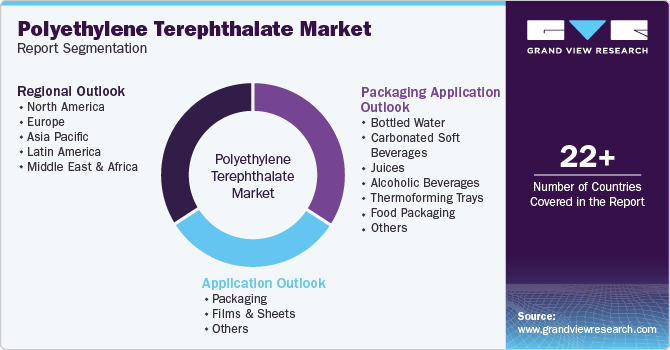 To learn more about this report, Download Free Sample Report
 -
Application Outlook (Volume, Kilotons; Revenue, USD Million, 2021 - 2033)
-
Packaging
-
Films & Sheets
-
Others
-
-
Packaging Application Outlook (Volume, Kilotons; Revenue, USD Million, 2021 - 2033)
-
Bottled Water
-
Carbonated Soft Beverages
-
Juices
-
Alcoholic Beverages
-
Thermoforming Trays
-
Food Packaging
-
Non-Food Packaging
-
Others
-
-
Regional Outlook (Volume, Kilotons; Revenue, USD Million, 2021 - 2033)
-
North America
-
U.S.
-
Canada
-
-
Europe
-
Germany
-
Italy
-
France
-
Spain
-
UK
-
-
Asia Pacific
-
China
-
India
-
Japan
-
Southeast Asia
-
-
Latin America
-
Brazil
-
Mexico
-
-
Middle East and Africa
-
Research Methodology
Segment Definition
Segment - Application
Revenue capture definition
Packaging
Revenue is generated through the extensive use of PET in beverage bottles, food containers, personal care packaging, household products, and pharmaceutical packaging. PET offers high clarity, lightweight properties, impact resistance, and excellent barrier performance against moisture and gases. Growing demand for sustainable packaging and increasing adoption of recycled PET content continue to support revenue growth. Stringent regulations promoting recyclable packaging and circular economy initiatives further strengthen market demand across global consumer goods industries.
Films & Sheets
Revenue is generated through the use of PET films and sheets in food packaging, industrial laminates, thermoformed trays, labels, release liners, and protective films. PET provides high tensile strength, dimensional stability, transparency, and chemical resistance, making it suitable for demanding applications. Growth in flexible packaging, electronics, and industrial processing industries continues to drive consumption. Increasing demand for recyclable and lightweight materials further supports the expansion of this segment.
Others
Revenue is generated through PET applications in textiles, automotive components, electrical and electronic parts, consumer goods, and industrial products. PET fibers remain widely used in apparel, home furnishings, and technical textiles due to their durability and cost efficiency. In automotive and electrical sectors, PET is utilized for insulation, engineering components, and performance parts. Expanding industrialization, rising consumer spending, and growing demand for high-performance recyclable materials contribute to steady revenue generation across these diversified applications.
Segment - Packaging Application
Revenue capture definition
Bottled Water
Revenue is generated through large-scale consumption of PET bottles in packaged drinking water applications. PET offers clarity, lightweight properties, durability, and cost efficiency, making it the preferred packaging material for water brands. Growing bottled water consumption, urbanization, and demand for convenient packaging continue to support strong PET demand in this segment.
Carbonated Soft Beverages
Revenue is generated through the extensive use of PET bottles for carbonated soft drinks. PET provides high strength, pressure resistance, transparency, and excellent barrier performance required for carbonated beverage packaging. Rising consumption of soft drinks and increasing adoption of recyclable packaging solutions contribute to sustained market growth.
Juices
Revenue is generated through PET packaging used for fruit juices, functional beverages, and ready-to-drink products. PET supports product visibility, lightweight transportation, and effective protection against moisture and contamination. Growing demand for convenient and on-the-go beverage packaging strengthens PET consumption across this segment.
Alcoholic Beverages
Revenue is generated through the increasing use of PET bottles in selected beer, wine, spirits, and ready-to-drink alcoholic beverage applications. PET offers lower transportation costs, improved handling efficiency, and reduced breakage risk compared to glass. Expanding adoption in emerging markets supports market expansion.
Thermoforming Trays
Revenue is generated through PET sheet conversion into thermoformed trays used for fresh produce, bakery products, meat, and prepared foods. PET delivers excellent transparency, rigidity, and recyclability while supporting product protection and shelf appeal. Growing demand for packaged foods continues to drive consumption in this segment.
Food Packaging
Revenue is generated through PET usage in containers, jars, cups, clamshells, and flexible packaging structures for food applications. PET offers food safety compliance, durability, moisture resistance, and strong visual presentation. Expanding packaged food consumption and sustainability initiatives support long-term market demand.
Non-Food Packaging
Revenue is generated through PET packaging used in personal care, household products, pharmaceuticals, and consumer goods. PET provides chemical resistance, transparency, lightweight performance, and design flexibility. Growth in e-commerce and consumer product packaging requirements continues to create demand for PET materials.
Others
Revenue is derived from PET applications in industrial packaging, specialty containers, straps, films, and emerging sustainable packaging solutions. Demand is supported by PET's versatility, recyclability, and cost-effectiveness across diverse end-use industries. Continuous product innovation and circular economy initiatives further contribute to market opportunities.
Estimation Model
Layer Name
Key Question
Description
Global PET Demand Base Layer
Who has the need for PET?
Beverage producers, food packaging companies, textile manufacturers, consumer goods companies, and industrial converters generate demand for PET. These industries require lightweight, durable, transparent, and recyclable materials to improve packaging efficiency, product protection, and sustainability performance.
PET Penetration Layer
Who can be reached via PET adoption?
Packaging converters, bottle manufacturers, thermoforming companies, fiber producers, and brand owners increasingly utilize PET across packaging and industrial applications. PET adoption is supported by its cost efficiency, design flexibility, food contact compliance, and growing compatibility with circular economy initiatives.
Food-Grade and rPET Adoption Layer
Who actively uses PET and rPET solutions?
Global beverage brands, bottled water producers, food packaging manufacturers, retailers, and consumer goods companies are expanding the use of PET and recycled PET. Adoption is driven by regulatory recycled-content targets, corporate sustainability commitments, and demand for closed-loop packaging systems that support circularity objectives.
Revenue Realization Layer
How is revenue generated?
Revenue is generated through the supply of virgin PET resin, food-grade PET, recycled PET flakes, and rPET pellets used in bottles, food containers, thermoformed packaging, fibers, and industrial applications. Additional value is created through premium food-grade rPET, recycling services, material certification, and long-term supply agreements with converters and brand owners.
Delivered Customizations
This report has been delivered with the following In-depth customizations
Client Request
Customization Delivered
Value Adds
Regional Segmentation
Detailed PET market analysis across North America, Europe, Asia Pacific, Latin America, and the Middle East & Africa, including market size, growth rates, demand patterns, regulatory landscape, and key country-level developments.
Enables identification of high-growth regions, investment hotspots, supply-demand dynamics, and region-specific market entry opportunities.
Cross-Segmentation
Comprehensive analysis across resin type, recycled content, application, end-use industry, and geography. Includes evaluation of bottle-grade PET, fiber-grade PET, film-grade PET, and rPET across major application segments.
Provides deeper visibility into high-growth niches, emerging demand pockets, and segment-specific revenue opportunities for strategic planning.
Competitive Benchmarking
Benchmarking of major PET producers based on production capacity, product portfolio, geographic presence, recycling capabilities, strategic initiatives, vertical integration, and sustainability positioning.
Supports competitive intelligence, partner identification, market positioning assessment, and benchmarking against industry leaders and emerging participants.
Frequently Asked Questions About This Report
The global polyethylene terephthalate market size was estimated at USD 41.5 billion in 2025 and is expected to reach USD 44.0 billion in 2026.
Key factors that are driving the market growth include polyethylene terephthalates application for food packaging and non-food packaging, and its application for films & sheets, and others.
The global polyethylene terephthalate market is expected to grow at a compound annual growth rate of 5.4% from 2026 to 2033 to reach USD 63.3 billion by 2033.
Asia Pacific dominated the polyethylene terephthalate market with a share of 38.0% in 2025. This is attributable to increasing consumption of packaged food coupled with the growing demand for automobile films in countries such as China, India, Indonesia, and Malaysia.
Some key players operating in the polyethylene terephthalate market include Indorama Ventures, Far Eastern New Century, DAK Americas, Nan Ya Plastics Corporation, SABIC, DuPont, Lotte Chemical Corporation, LAVERGNE, Inc., Amcor plc, Reliance Industries, Octal Petrochemicals, Jiangsu Sanfangxiang Group Co., Ltd., Eastman Chemical Company
Carbonated Soft Beverages dominated the packaging application in 2025, accounting for 36.6% of the market in 2025, owing to their requirement for lightweight, shatter-resistant, and cost-effective bottles that ensure product safety, shelf-life stability, and large-scale distribution efficiency.
India is the fastest-growing country in the Asia Pacific PET market, driven by rising consumption of packaged foods and beverages, expanding textile production, and increasing investments in recycling and sustainable packaging solutions.
Which is the fastest-growing packaging application segment in the polyethylene terephthalate market?Juices packaging application is expected to grow at the fastest compound annual growth rate of 5.9% from 2026 to 2033.
About the Author(s)
Plastics, Polymers & Resins Research Team
Bulk Chemicals · Plastics, Polymers & ResinsThis report was authored by the plastics, polymers & resins research team at Grand View Research - comprising two research analysts, one senior research analyst, and one industry expert - with specialized expertise in the plastics, polymers & resins segment of the bulk chemicals industry. All findings are based on proprietary bulk chemicals databases, executive interviews, and regulatory analysis, subject to internal peer review prior to publication.
Last Updated:
Speak to Analyst

Customize this report to your needs - add regions, segments, or data points, with 20% free customization.
Or view our licence options:


ISO 9001:2015 & 27001:2022 Certified
We are GDPR and CCPA compliant! Your transaction & personal information is safe and secure. For more details, please read our privacy policy.


