- Home
- »
- Next Generation Technologies
- »
-
Anti-drone Market Size And Share, Industry Report, 2030GVR Report cover
![Anti-drone Market Size, Share & Trends Report]()
Anti-drone Market (2025 - 2030) Size, Share & Trends Analysis Report By Component (Hardware, Software), By Type (Ground Based, Handheld), By Range (Less than 5 km), By Technology, By Mitigation, By Defense, By End Use, By Region, And Segment Forecasts
- Report ID: GVR-1-68038-241-9
- Number of Report Pages: 179
- Format: PDF
- Historical Range: 2018 - 2023
- Forecast Period: 2025 - 2030
- Industry: Technology
- Report Summary
- Table of Contents
- Interactive Charts
- Methodology
- Download FREE Sample
-
 Download Sample Report
Anti-drone Market Summary
The global anti-drone Market size was estimated at USD 2.45 billion in 2024 and is projected to reach USD 10.58 billion by 2030, growing at a CAGR of 27.2% from 2025 to 2030. The market is primarily driven by the rising demand for advanced unmanned aerial vehicle (UAV) technology and the escalating concerns regarding security threats posed by unauthorized drone activities.
Key Market Trends & Insights
- The North America accounted for the highest revenue share of over 42% in 2024.
- The U.S. anti-drone market held a dominant position in 2024.
- Based on component, the hardware segment accounted for the largest market share of over 68% in 2024.
- Based on range, the less than 5 km segment dominated the market in 2024.
- Based on technology, the anti-drone radar segment dominated the market in 2024.
Market Size & Forecast
- 2024 Market Size: USD 2.45 Billion
- 2030 Projected Market Size: USD 10.58 Billion
- CAGR (2025-2030): 27.2%
- North America: Largest market in 2024
- Asia Pacific: Fastest growing market
The proliferation of drones has led to heightened security concerns, particularly in sensitive areas such as military installations, airports, and public events. Governments and organizations are investing heavily in anti-drone technologies to mitigate these risks which is expected to further fuel the market growth in the coming years.
Continuous innovations in drone technology, including AI-driven systems and advanced sensors, are prompting a parallel development of more sophisticated anti-drone solutions. These innovations include jamming devices, laser systems, and net-based capture mechanisms. Such advancements have led to the development of sophisticated anti-drone systems that can effectively neutralize threats without causing collateral damage. These advancements are crucial for the effective detection and neutralization of rogue drones, which further boosts the market innovation.
The integration of artificial intelligence (AI) and machine learning into detection systems has enhanced the accuracy and efficiency of identifying rogue drones by analyzing flight patterns and behaviors in real-time. Additionally, there is a growing emphasis on developing multi-layered defense strategies that combine various countermeasures for comprehensive protection against diverse drone threats. Furthermore, partnerships between government agencies and private companies are becoming more common as they collaborate on research and development initiatives aimed at improving anti-drone capabilities.
In addition, governments worldwide are establishing frameworks to govern drone operations while simultaneously promoting the development of countermeasures. For instance, regulations that mandate airports to implement anti-drone systems have created a substantial market opportunity for solution providers. Moreover, international collaborations focused on standardizing counter-drone technologies are expected to facilitate market expansion by ensuring interoperability among different systems.
Furthermore, the increasing adoption of drones across various industries for commercial purposes such as aerial photography, agriculture monitoring, infrastructure inspection and delivery services is driving demand for anti-drone systems. However, the accessibility of drones has also led to their misuse in illicit activities, including smuggling, surveillance, and even potential threats to public safety. As drones become more accessible and affordable, the need for effective countermeasures against potential misuse grows, which is expected to drive the market growth in coming years.
Moreover, companies are heavily investing in research and development to innovate new anti-drone technologies, including directed energy weapons (DEWs) and jamming systems and in advanced detection and neutralization technologies, such as high-energy lasers and artificial intelligence systems. For instance, in June 2024, Safran Group launched the Skyjacker system, which utilizes spoofing technology to disrupt drone navigation, designed to enhance security against unauthorized UAVs. This innovative system employs advanced technologies, including a combination of radar and electro-optical sensors, to detect and neutralize drones effectively.
Component Insights
The hardware segment accounted for the largest market share of over 68% in 2024, owing to the essential role that hardware components such as sensors, radars, and jammers play in detecting and neutralizing unauthorized drones. As drone-related security incidents increase globally, governments and military organizations are investing heavily in robust hardware solutions to enhance their defense capabilities. The continuous advancements in hardware technology further bolster this segment, making it a critical aspect of anti-drone systems.
The software segment is expected to witness the fastest CAGR from 2025 to 2030, driven by rapid technological advancements and the increasing integration of artificial intelligence and machine learning into anti-drone software applications. As organizations seek to enhance their drone threat mitigation strategies, the demand for sophisticated software solutions that can analyze and respond to drone activities in real time is expected to rise significantly in the coming years.
Type Insights
The ground-based segment accounted for the largest market share in 2024. This growth can be attributed to the ability of ground-based anti-drones to provide immediate responses to drone threats, particularly in sensitive areas such as military installations and critical infrastructure. The versatility of these systems makes them a popular choice for various applications, including event security and border protection.
The UAV-based segment is expected to register the fastest CAGR from 2025 to 2030. The increasing reliance on unmanned aerial vehicles for surveillance and counter-drone operations. As technology evolves, UAVs are becoming more capable of detecting and neutralizing threats autonomously, which enhances their appeal in both military and commercial sectors.
Range Insights
The less than 5 km segment dominated the market in 2024, owing to its suitability for urban environments and critical infrastructure protection. Short-range systems are particularly effective in scenarios where immediate response capabilities are essential, such as at public events or within densely populated areas.
The more than 5 km segment is expected to register the fastest CAGR from 2025 to 2030, driven by the increasing demand for long-range anti-drone solutions that can secure larger areas and provide comprehensive surveillance capabilities. As threats evolve and become more sophisticated, organizations seek advanced systems capable of monitoring extensive airspace effectively.
Technology Insights
The anti-drone radar segment dominated the market in 2024, owing to its advanced detection features, such as long-range capabilities and high accuracy in differentiating between drones and other aerial objects. In addition, the integration of artificial intelligence into radar technology has further enhanced its effectiveness in threat identification and mitigation, thereby driving the segmental growth.
The thermal image segment is expected to register the fastest CAGR from 2025 to 2030. The growing adoption of thermal imaging technology is driven by its ability to detect drones under various environmental conditions, including low visibility scenarios. As organizations prioritize comprehensive surveillance solutions, thermal imaging is becoming an increasingly critical component of anti-drone strategies, further fueling the market growth.
Mitigation Insights
The destructive segment dominated the market in 2024, owing to its effectiveness in neutralizing drone threats quickly and decisively. Destructive measures are often preferred in high-stakes environments where immediate action is necessary to prevent potential harm or breaches. This trend is expected to further fuel the segmental growth in the coming years.
The non-destructive segment is expected to register the fastest CAGR from 2025 to 2030. The growing preference for solutions that can neutralize threats without causing collateral damage or violating regulations is driving segmental growth. Non-destructive methods are increasingly seen as essential for maintaining safety while managing drone-related risks effectively, which further presents lucrative opportunities for the segment’s growth in the coming years.
Defense Insights
The drone detection & disruption systems segment dominated the market in 2024. This growth can be attributed to the comprehensive capabilities these systems offer in identifying and mitigating drone threats effectively. Organizations are increasingly investing in integrated solutions that provide both detection and disruption functionalities.

The detection segment is expected to register the fastest CAGR from 2025 to 2030, driven by the increasing adoption in enterprise applications, particularly in logistics, manufacturing, and Education, where real-time data overlay and hands-free navigation improve efficiency. Smart glasses are increasingly used for remote collaboration, enabling experts to guide field technicians without being on-site.
End Use Insights
The military & defense segment dominated the market in 2024. This growth can be attributed to the escalating threats posed by unauthorized drones in military operations. Governments worldwide are investing heavily in advanced anti-drone technologies to protect critical assets and personnel from potential drone attacks.
The commercial segment is projected to grow at the fastest CAGR from 2025 to 2030,driven by the increasing use of drones across various industries has highlighted the need for effective countermeasures against unauthorized drone activities. As businesses recognize the risks associated with drone incursions, demand for commercial anti-drone solutions is expected to rise significantly.
Regional Insights
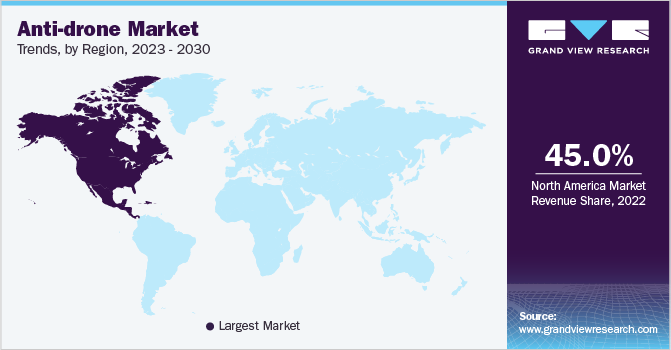
The anti-drone market in North America accounted for the highest revenue share of over 42% in 2024, driven by escalating security concerns, particularly regarding unauthorized drone activities that threaten critical infrastructure and public safety. The rise of industries such as Gaming & Entertainment, retail, and Education utilizing AR to enhance customer experience and improve training and diagnostics has led to increasing demand.The increasing use of drones for commercial purposes has further amplified the demand for reliable anti-drone systems to mitigate risks associated with potential misuse, such as surveillance or sabotage.
U.S. Anti-drone Market Trends
The U.S. anti-drone market held a dominant position in 2024.The U.S. government has been proactive in implementing stringent regulations and investing heavily in counter-drone technologies, particularly through agencies such as the Department of Homeland Security and the Department of Defense, which is expected to further drive the market growth in coming years.
Europe Anti-drone Market Trends
The Europe anti-drone market was identified as a lucrative region in 2024.The market is primarily driven by the rising concerns over security threats posed by the increasing prevalence of consumer and commercial drones.The regulatory landscape is evolving as governments recognize the need for robust countermeasures to protect sensitive areas from potential drone incursions.
The UK anti-drone market is expected to grow rapidly in the coming years. The government of the UK is actively investing in advanced counter-drone technologies to enhance security measures, particularly in urban environments and at high-profile events.
The Germany anti-drone market held a substantial market share in 2024 owing to the country's strong focus on security and defense technologies has led to a heightened demand for anti-drone systems as a response to increasing threats from unmanned aerial vehicles (UAVs).
Asia Pacific Anti-drone Market Trends
The anti-drone market in the Asia Pacific region is expected to grow at the highest CAGR of over 30% from 2025 to 2030. Rapid economic development and the proliferation of smart cities have heightened the need for effective drone detection and mitigation technologies. Local governments are actively engaging with international suppliers while fostering partnerships with domestic firms to enhance their counter-drone capabilities.
The Japan anti-drone market is expected to grow rapidly in the coming years, driven by increasing incidents of drone-related breaches, particularly around sensitive locations like airports and government buildings. The Japanese government is investing in advanced technologies for drone detection and neutralization, emphasizing collaboration with international suppliers and local firms.
The China anti-drone market held a substantial market share in 2024, driven by the escalating concerns over airspace security amid the proliferation of drones for commercial and recreational use. The country has seen an increase in incidents involving unauthorized drones, prompting government agencies and private enterprises to invest in advanced counter-drone technologies.
Key Anti-drone Company Insights
Some of the key players operating in the market include Lockheed Martin Corporation, Thales Group, and Raytheon Company.
-
Lockheed Martin Corporation is a global aerospace, defense, arms, security, and advanced technologies company and operates through four main business segments: Aeronautics, Missiles and Fire Control, Rotary and Mission Systems, and Space. Lockheed Martin is known for its advanced military aircraft such as the F-35 Lightning II fighter jet and the F-22 Raptor. The company also provides various defense and security solutions, including missile defense systems, naval systems, cybersecurity solutions, and space exploration technologies.
-
Thales Group is a multinational company that operates in the aerospace, defense, transportation, and security markets. The company specializes in providing solutions for critical infrastructure protection, cybersecurity, air traffic management, satellite navigation systems, and communication networks. Thales has a strong focus on innovation and technology development to meet the evolving needs of its customers worldwide. The company’s diverse portfolio includes products such as avionics systems for aircraft, radar systems for defense applications, transportation systems for railways and urban mobility, as well as digital security solutions.
Blighter Surveillance Systems, Dedrone and DeTect, Inc. are some of the emerging participants in the market.
-
Blighter Surveillance Systems is a UK-based company specializing in the development and manufacturing of advanced electronic-scanning radars and surveillance solutions. The company’s anti-drone systems are designed to detect, track, and classify drones in various environments, providing real-time situational awareness to security forces and organizations. Blighter’s technology integrates radar, cameras, and software to offer a comprehensive solution for countering unauthorized drone activities.
-
Dedrone is a global company in airspace security, offering a range of anti-drone solutions to protect critical infrastructure, government facilities, public events, and private properties from the threats posed by drones. Dedrone’s platform combines RF sensors, cameras, and AI-based software to detect and mitigate unauthorized drone incursions effectively. The company focuses on providing scalable and customizable anti-drone systems that can be tailored to meet the specific needs of different clients.
Key Anti-drone Companies:
The following are the leading companies in the anti-drone market. These companies collectively hold the largest market share and dictate industry trends.
- Advanced Radar Technologies S.A.
- Airbus SE
- Blighter Surveillance Systems
- Dedrone
- DeTect, Inc.
- Droneshield LLC
- Enterprise Control Systems
- Israel Aerospace Industries Ltd. (IAI)
- Liteye Systems, Inc.
- Lockheed Martin Corporation
- Orelia
- Prime Consulting and technologies
- Raytheon Company
- Saab AB
- Selex Es Inc.
- Thales Group
- The Boeing Company
Recent Developments
-
In September 2024, Thales Group announced that the company will showcase its advanced air defense technologies at the MSPO fair in Kielce, featuring the GM200 Multi-Mission family of radars designed for air surveillance and defense. These radars can detect a wide range of targets up to 250 km away and 24 km in altitude, with both mobile versions tailored for various military applications.
-
In June 2024, Dedrone launched DedroneOnTheMove (DedroneOTM), a mobile counter-drone solution designed for military and defense applications, providing on-demand capabilities for detecting and mitigating unauthorized drones.
-
In May 2024, Droneshield announced the release of DroneSentry C2 Next-Gen v1.00, an advanced command-and-control system that enhances the capabilities of anti-drone systems by providing centralized monitoring and control functionalities. It allows users to efficiently manage multiple sensors and countermeasures to protect critical infrastructure, public events, military installations, and other sensitive areas from potential drone threats.
Anti-drone Market Report Scope
Report Attribute
Details
Market size value in 2025
USD 3,180.9 million
Revenue forecast in 2030
USD 10.58 billion
Growth Rate
CAGR of 27.2% from 2025 to 2030
Base year for estimation
2024
Historical data
2018 - 2023
Forecast period
2025 - 2030
Report updated
October 2024
Quantitative units
Revenue in USD Million and CAGR from 2025 to 2030
Report coverage
Revenue forecast, company ranking, competitive landscape, growth factors, and trends
Segments covered
Component, type, range, technology, mitigation, defense, end use, regional
Regional scope
North America; Europe; Asia Pacific; Latin America; Middle East & Africa
Country scope
U.S.; Canada; Mexico; UK; Germany; France; Italy; China; Australia; Japan; India; South Korea; Brazil; South Africa; Saudi Arabia; UAE
Key companies profiled
Advanced Radar Technologies S.A.; Airbus SE; Blighter Surveillance Systems; Dedrone; DeTect, Inc.; Droneshield LLC; Enterprise Control Systems; Israel Aerospace Industries Ltd. (IAI); Liteye Systems, Inc.; Lockheed Martin Corporation; Orelia; Prime Consulting and Technologies; Raytheon Company; Saab AB; Selex ES Inc.; Thales Group; The Boeing Company
Customization scope
Free report customization (equivalent to up to 8 analyst’s working days) with purchase. Addition or alteration to country, regional & segment scope.
Pricing and purchase options
Avail customized purchase options to meet your exact research needs. Explore purchase options
Global Anti-drone Market Report Segmentation
This report forecasts revenue growth at global, regional, and country levels and provides an analysis of the latest industry trends in each of the sub-segments from 2018 to 2030. For this study, Grand View Research has segmented the global anti-drone market report based on component, type, range, technology, mitigation, defense, end use, and region:
-
Component Outlook (Revenue, USD Million; 2018 - 2030)
-
Hardware
-
Radars
-
Acoustic Sensors
-
Infrared and Video Surveillance Systems
-
RF Detectors
-
Jammers
-
Others
-
-
Software
-
-
Type Outlook (Revenue, USD Million; 2018 - 2030)
-
Ground Based
-
Fixed
-
Mobile
-
-
Handheld
-
UAV Based
-
-
Range Outlook (Revenue, USD Million; 2018 - 2030)
-
Less than 5 km
-
More than 5 km
-
-
Technology Outlook (Revenue, USD Million; 2018 - 2030)
-
Anti-drone Radar
-
RF Scan
-
Thermal Image
-
Others
-
-
Mitigation Outlook (Revenue, USD Million; 2018 - 2030)
-
Destructive System
-
Laser System
-
Missile Effector
-
Electronic Countermeasure
-
-
Non-destructive System
-
-
Defense Outlook (Revenue, USD Million; 2018 - 2030)
-
Drone Detection & Disruption Systems
-
Drone Detection System
-
-
End Use Outlook (Revenue, USD Million; 2018 - 2030)
-
Military & Defense
-
Commercial
-
Government
-
Others
-
-
Regional Outlook (Revenue, USD Million; 2018 - 2030)
-
North America
-
U.S.
-
Canada
-
Mexico
-
-
Europe
-
UK
-
Germany
-
France
-
Italy
-
Spain
-
-
Asia Pacific
-
China
-
Australia
-
Japan
-
India
-
South Korea
-
-
Latin America
-
Brazil
-
-
Middle East & Africa
-
South Africa
-
Saudi Arabia
-
UAE
-
-
Frequently Asked Questions About This Report
b. The global anti-drone market size was estimated at USD 2,446.9 million in 2024 and is expected to reach USD 3,180.9 million in 2025.
b. The global anti-drone market is expected to grow at a compound annual growth rate of 27.2% from 2025 to 2030 to reach USD 10.58 billion by 2030.
b. North America dominated the anti-drone market with a share of 42% in 2024. This is attributable to the aerospace and defense sector, especially in U.S., which is witnessing a growing adoption of anti-drone systems and technologies.
b. Some key players operating in the anti-drone market include Dedrone GmbH, Advanced Radar Technologies, Droneshield, Thales Group, Blighter Surveillance Systems, Airbus Group SE, and The Boeing Company.
b. Key factors that are driving the anti-drone market growth include a significant rise in the adoption of unmanned aerial vehicles (UAVs) for commercial and recreational applications and an increase in the number of security breach incidents in public places and critical government infrastructure.

Share this report with your colleague or friend.
Need a Tailored Report?
Customize this report to your needs — add regions, segments, or data points, with 20% free customization.


ISO 9001:2015 & 27001:2022 Certified
We are GDPR and CCPA compliant! Your transaction & personal information is safe and secure. For more details, please read our privacy policy.
Trusted market insights - try a free sample
See how our reports are structured and why industry leaders rely on Grand View Research. Get a free sample or ask us to tailor this report to your needs.