
- Home
- »
- Electronic Security
- »
-
Thermal Imaging Market Size And Share Report, 2026-2033GVR Report cover

Thermal Imaging Market (2026 - 2033)
Size, Share & Trends Analysis Report By Application (Military & Defense, Industrial, Commercial, Residential), By Region (North America, Europe, Asia Pacific), And Segment Forecasts
Market Size, 2025
$7.9BMarket Estimate, 2026
$8.7BMarket Forecast, 2033
$16.6BCAGR, 2026–2033
9.2%Thermal Imaging Market Summary
The global thermal imaging market size was valued at USD 7.9 billion in 2025 and is projected to grow from USD 8.7 billion in 2026 to USD 16.6 billion by 2033, growing at a CAGR of 9.2% from 2026 to 2033. The market in North America dominated with a revenue share of 33.0% in 2025. Better technological advancement and cost-effectiveness of camera hardware due to mass production are driving the market for thermal imaging. High demand across the commercial and residential sectors is expected to be a key growth factor. Mass production has led to the availability of cost-effective cameras.
Key Market Trends & Insights
- By application: Military & defense segment captured the largest revenue share of over 46.0% in 2025.
Regional Highlights
- Largest regional market: North America (33.0% revenue share, 2025)
- Fastest-growing regional market: Asia Pacific (highest CAGR, 2026-2033)
Market Size & Forecast
- Estimated market size in 2026: USD 8.7 Billion
- Projected market size by 2033: USD 16.6 Billion
- Market size in 2025: USD 7.9 Billion
- CAGR (2026-2033): 9.2%
Three ways to get this report
Buy it, customize it, or ask a question.Ask an Analyst
Analyst response in 1 business day
- AccessReport author, directly
- Reply timeWithin 1 working day
- No sales callDirect answer only
- FormatEmail reply
- CostFree, no cost
Get the Full Report
What the study covers
- FormatsPDF · Excel · Dashboard
- Timeline2026–2033 annual, 2025 base
- Coverage20+ countries, 5 regions
- Companies10+ key players profiled
Customize the Report
20% free customization
- IncludeCountries, segments, points
- TailorTo your product definition
- ExtendDeeper competitor detail
- OrA fully bespoke study
- Turnaround5–10 working days
The surge in demand across diverse application areas is the primary factor driving the thermal imaging systems market. Technological innovations have led to the development of better microbolometers. These uncooled thermal sensors offer better operational performance than the cooled version, as they do not require an external cooling system, resulting in more compact and efficient thermal imaging gear. Further, the absence of an external cooling system results in lower upfront and maintenance costs. Consequently, effective thermal imaging solutions are made available not only to commercial, industrial, and defense applications, but also for residential and recreational purposes.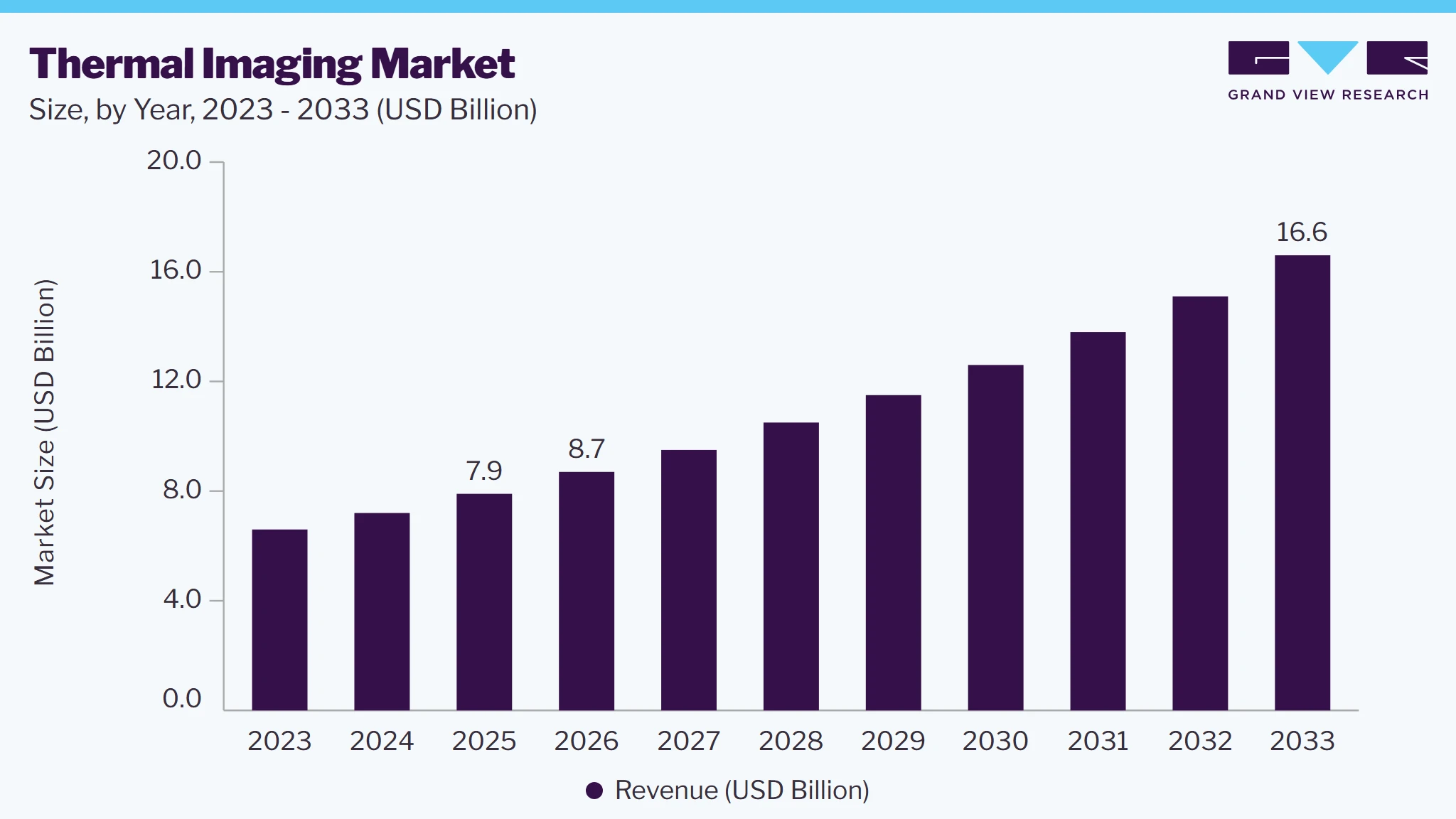 Source: Grand View Research, IR Documents, Primary Interviews, Paid DatabasesTo learn more about this report,
 Download Free Sample Report
 Growing demand for security and surveillance applications across private and public environments is expected to drive the thermal imaging industry. Owing to the need for increased security among citizens and employees, temperature mapping for electrical grids, HVAC inspection, and mechanical wear assessment in industrial applications, the demand for thermal imaging is gradually being adopted across these applications. Rapid urbanization is expected to impose increased demand for additional advanced security solutions. Rising investment in infrastructure systems and surging demand for professional surveillance are expected to positively impact the growth of the thermal imaging systems market over the forecast period.
Market Dynamics
The thermal imaging technology is progressively perceived as a vital tool across different applications, heightened security needs, and technological advancements. The growing adoption of thermal cameras in defense and military operations for surveillance, night- vision capabilities, border monitoring, and target detection is one of the primary drivers. Majorly, the concerns over public safety and infrastructure security are also encouraging the demand for thermal imaging systems in critical facilities, airports, transit routes, and smart city projects, among others.
Advancements in technology, such as better image resolution, integration with AI and IoT systems, and miniaturization, are further boosting the capabilities of existing thermal imaging systems. Besides, such thermal sensors are being used in advanced driver assistance systems (ADAS) to make modern automotive safer. There has been an increase in the use of thermal imaging for firefighting, environmental monitoring, consumer electronics, and energy audits. This is one of the key drivers of the global thermal imaging market.
High cost of thermal imaging cameras and associated components acts as major restraining factor for market growth. Advanced systems that offer high resolution, extended detection ranges, and enhanced analytics capabilities are often priced far higher than low-resolution alternatives. Consequently, the affordability of the system, which requires significant investment in procurement and maintenance, appears to be a major restraining factor. Furthermore, high cost makes it difficult for small firms to adopt the thermal imagery system.
The process of thermal imaging depends on detecting the heat signature and not visual images. Therefore, limits its effectiveness for uses that involve object identification processes. Environmental factors, including rain and fog, may reduce its effectiveness in performance. In addition, the problem of calibration accuracy and integration problems may deter purchases. Consequently, technical limitations become one of the restraints in the effort to broaden the coverage of the market.
The thermal imaging market presents significant growth opportunities through its practical utility across emerging industries and advanced technology ecosystems. The use of thermal sensors with AI has increased, IoT technologies have made it possible to enhance monitoring and predicting while automating decision-making processes for commercial applications and industries. The use of thermal cameras by autonomous cars and advanced driver assistance systems (ADAS) holds much promise in terms of safety due to their capability to enhance vehicle visibility.
The thermal imaging market also having opportunities in the field of medicine for diagnostics, patient monitoring, and early detection of diseases. For developing cities, heavy investments are made to protect vital infrastructure, helping renewable energy plants, and conducting energy efficiency assessments of buildings have further increased the demand.
Moreover, thermal imaging cameras are being developed for various consumer electronics, unmanned aerial vehicles, and mobile devices.
Analyst Perspective
The increasing adoption of thermal imaging in defense, industrial inspection, healthcare, automotive, and security applications is helping the market grow consistently. Advancements in uncooled microbolometer technology are improving affordability, portability, and accessibility, enabling broader commercial deployment. Rising investments in surveillance, predictive maintenance, and smart infrastructure projects are further supporting market expansion. As thermal imaging systems become more compact and cost-effective, their adoption is expected to accelerate across both established and emerging application areas.
Application Insights
Based on the application, the global market for thermal imaging is segmented into military & defense, industrial, commercial, and residential. The military & defense segment captured the largest revenue share of over 46.0% in 2025 and is expected to grow at the fastest CAGR during the forecast period. The rising demand for unmanned aerial vehicles (UAVs) or drones in military operations has significantly boosted the adoption of thermal imaging technology. Drones with thermal cameras offer valuable capabilities, including aerial surveillance, target tracking, and reconnaissance in both day and night conditions. The ability to capture thermal signatures from a bird's-eye view provides military forces with valuable intelligence, facilitating strategic decision-making and operational planning.
Commercial applications primarily include airport security and building diagnostics. Further, surging demand across numerous security applications is also expected to positively impact the demand in the future.
The residential sector is expected to increase due to high product penetration and the availability of low-cost devices. The technology helps reduce the time and expense of invasive investigations. It is used extensively in energy audits to detect moisture in ceilings, walls, and roofs, as well as plumbing leaks or blockages.
The industrial sector is expected to grow at a significant CAGR of over 7.0% during the forecast period. The increasing need for efficient and reliable monitoring and inspection systems in manufacturing, oil, gas, and energy has fueled the demand for thermal imaging technology. This technology enables non-contact, non-destructive inspection of equipment, pipelines, and structures, allowing early detection of faults, leaks, and potential hazards.
Regional Insights
North America dominated the market and accounted for the largest revenue share of 33.0% in 2025. On account of the high demand for thermal imaging devices across several law enforcement activities, the North America thermal imaging market is expected to emerge as the dominant region. Further, growth across both industrial and commercial sectors is expected to drive product demand over the forecast period. The industrial sector in North America is also embracing thermal imaging technology for inspection and maintenance purposes. Thermal imaging cameras enable efficient and non-destructive testing of equipment and infrastructure, allowing companies to identify potential issues and prevent costly breakdowns.
 To learn more about this report, Download Free Sample Report
 Asia Pacific Thermal Imaging Market Trends
Asia Pacific is expected to register the highest CAGR of over 9.0% over the forecast period. Advancements in thermal imaging technology, including developing high-resolution cameras and improved image processing algorithms, are further propelling market growth in the region.
Key Thermal Imaging Company Insights
The industry players are undertaking strategies such as investments, launches, acquisitions, and collaborations to increase their global reach. Manufacturers focus on global deployment, innovation of new technologies and unique products, ability to design for large volumes, and at the same time, lower the production cost, rapid product development cycles, enhanced customer service, and controlling multiple production inputs through vertically integrated operations. There exists a high degree of vertical integration between the suppliers and the manufacturers.
For instance, in April 2024, Tether Investments Limited made a strategic investment of USD 30 billion in Satellogic. This move by Tether supported Satellogic’s growth strategy, enhance its competitive advantage in the Earth observation industry, and expand its capabilities for serving both commercial and government customers across the globe.
Key Thermal Imaging Companies
The following key companies have been profiled for this study on the thermal imaging market.
-
Axis Communications AB
-
BAE Systems, Inc.
-
Leonardo DRS
-
Teledyne FLIR LLC
-
Honeywell International Inc.
-
Lockheed Martin Corporation
-
Raytheon Technologies Corporation
-
Safran Group
-
Lynred USA
-
Testo SE & Co. KGaA
-
Thermoteknix Systems Ltd
Recent Developments
-
In June 2024, Teledyne FLIR, a global technological organization that specializes in designing and manufacturing, expanded its next-generation Hadron 640 series by launching the Hadron 640R+ dual thermal-visible camera modules. The new products feature thermal sensitivity and a size, weight, and power-optimized design for seamless integration into unmanned aerial systems (UAS), unmanned ground vehicles (UGVs), robotics platforms, and AI-powered applications.
-
In May 2024, L3Harris Technologies, a major American technology company, entered into an agreement with Millennium Space Systems to design eight EO/IR payload systems for the SDA’s FOO Fighter system. The IR payloads will improve the missile detection, tracking, and warning capability using the latest thermal imaging technology. This marks the growing focus on state-of-the-art infrared imaging systems in the defense sector.
Thermal Imaging Market Report Scope
Report Attribute
Details
Market size in 2025
USD 7.9 billion
Estimated market size in 2026
USD 8.7 billion
Projected market size by 2033
USD 16.6 billion
Growth rate
CAGR of 9.2% from 2026 to 2033
Base year for estimation
2025
Historical data
2021 - 2024
Forecast period
2026 - 2033
Quantitative units
Revenue in USD billion, and CAGR from 2026 to 2033
Report coverage
Revenue forecast, company ranking, competitive landscape, growth factors, and trends
Segments covered
Application, region
Regional Scope
North America; Europe; Asia Pacific; Latin America; Middle East & Africa
Country Scope
U.S.; Canada; UK; Germany; France; China; India; Japan; South Korea; Australia; Rest of world
Key companies profiled
Axis Communications AB; BAE Systems; Inc.; Leonardo DRS; Teledyne FLIR LLC; Honeywell International Inc.; Lockheed Martin Corporation; Raytheon Technologies Corporation; Safran Group; Lynred USA; Testo SE & Co. KGaA; Thermoteknix Systems Ltd
Customization scope
Free report customization (equivalent up to 8 analysts working days) with purchase. Addition or alteration to country, regional & segment scope.
Pricing and purchase options
Avail of customized purchase options to meet your exact research needs. Explore purchase options
Global Thermal Imaging Market Report Segmentation
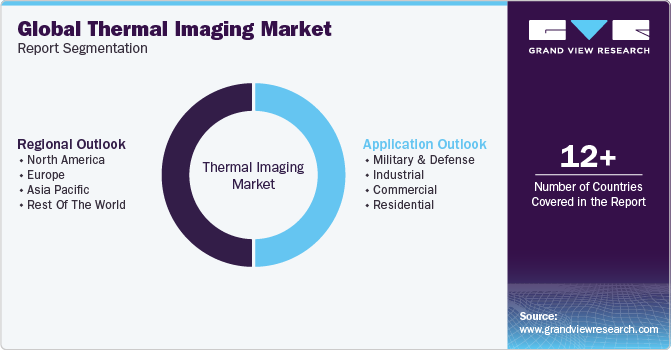
This report forecasts revenue growth at global, regional, and country levels and provides an analysis of the latest industry trends in each of the sub-segments from 2021 to 2033. For this study, Grand View Research has segmented the global thermal imaging market report based on application and region:
 To learn more about this report, Download Free Sample Report
 -
Application Outlook (Revenue, USD Billion, 2021 - 2033)
-
Military & Defense
-
Industrial
-
Commercial
-
Residential
-
-
Regional Outlook (Revenue, USD Billion, 2021 - 2033)
-
North America
-
U.S.
-
Canada
-
-
Europe
-
UK
-
Germany
-
France
-
-
Asia Pacific
-
China
-
Japan
-
India
-
Australia
-
South Korea
-
-
Rest of World
-
Frequently Asked Questions About This Report
North America dominated with a 33.0% revenue share in 2025.
Military & defense dominated the thermal imaging market with a share of 46.0% in 2025.
The global thermal imaging market size was valued at USD 7.9 billion in 2025 and is estimated at USD 8.7 billion for 2026.
The global thermal imaging market is expected to grow at a CAGR of 9.2% from 2026 to 2033, reaching USD 16.6 billion.
Key players include Axis Communications AB; BAE Systems; Inc.; Leonardo DRS; Teledyne FLIR LLC; Honeywell International Inc.; Lockheed Martin Corporation; Raytheon Technologies Corporation; Safran Group; Lynred USA; Testo SE & Co. KGaA; Thermoteknix Systems Ltd
About the Author(s)
Electronic Security Research Team
Semiconductors & Electronics · Electronic SecurityThis report was authored by the electronic security research team at Grand View Research - comprising two research analysts, one senior research analyst, and one industry expert - with specialized expertise in the electronic security segment of the semiconductors & electronics industry. All findings are based on proprietary semiconductors & electronics databases, executive interviews, and regulatory analysis, subject to internal peer review prior to publication.
Last Updated:
Speak to Analyst

Customize this report to your needs - add regions, segments, or data points, with 20% free customization.
Or view our licence options:


ISO 9001:2015 & 27001:2022 Certified
We are GDPR and CCPA compliant! Your transaction & personal information is safe and secure. For more details, please read our privacy policy.


