
- Home
- »
- Pharmaceuticals
- »
-
Bipolar Disorder Market Size And Share Report, 2026-2033GVR Report cover
![Bipolar Disorder Market (2026 - 2033)Report]()
Bipolar Disorder Market (2026 - 2033)
Size, Share & Trends Analysis Report By Type (Mood Stabilizer, Anticonvulsants, Antipsychotic Drugs), By Drug Class (Benzodiazepines, Beta blockers, Tricyclic antidepressant drugs), By Distribution Channel, By Region, And Segment Forecasts
Market Size, 2025
$5.1BMarket Estimate, 2026
$5.3BMarket Forecast, 2033
$6.4BCAGR, 2026–2033
2.7%Bipolar Disorder Market Summary
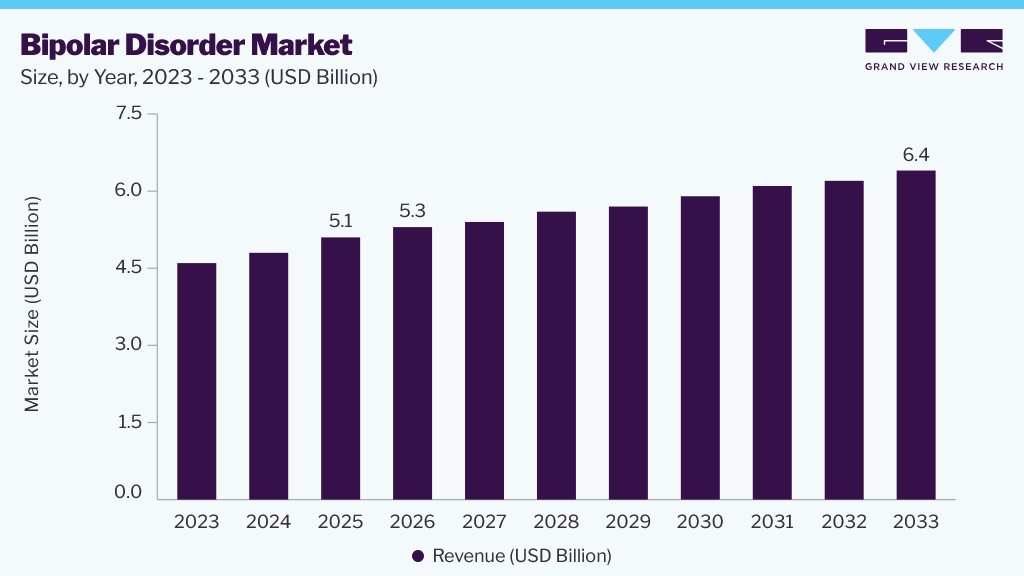
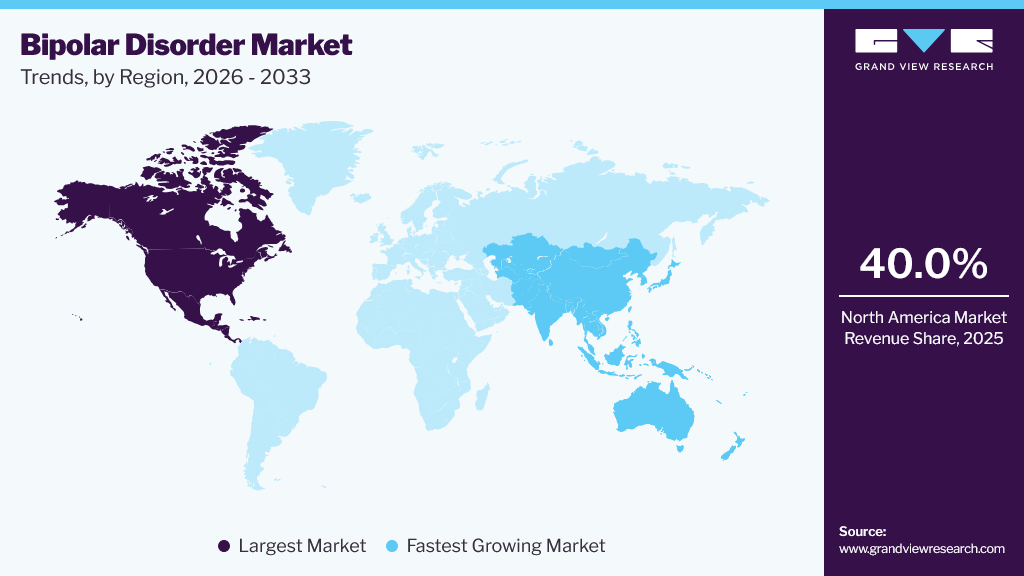
The global bipolar disorder market was valued at USD 5.1 billion in 2025 and is projected to grow from USD 5.3 billion in 2026 to USD 6.4 billion in 2033, at a CAGR of 2.7% from 2026 to 2033. North America dominated the market, accounting for a revenue share of 40.0% in 2025. The growth of this market is primarily driven by the increasing prevalence of bipolar disorder and rising government investments to enhance awareness and support advancements in healthcare and research institutions. Furthermore, rapid urbanization and evolving lifestyles have contributed to higher levels of stress and substance abuse, leading to a growing incidence of bipolar disorder. Consequently, the need for effective diagnosis, treatment, and long-term management is driving the market growth.
Key Market Trends & Insights
- By type: The mood stabilizer segment held the largest market share of around 35.0% in 2025.
- By drug class: The selective serotonin reuptake inhibitor segment held the largest market share of over 25.0% in 2025.
- By distribution channel: The hospital pharmacies segment held the largest market share of around 50.0% in 2025.
Regional Highlights
- Largest regional market: North America (40.0% revenue share, 2025)
- Fastest-growing regional market: Asia Pacific (highest CAGR, 2026-2033)
Market Size & Forecast
- Market size in 2025: USD 5.1 Billion
- Estimated market size in 2026: USD 5.3 Billion
- Projected market size by 2033: USD 6.4 Billion
- CAGR (2026-2033): 2.7%
Three ways to get this report
Buy it, customize it, or ask a question.Ask an Analyst
A direct answer, usually in 1 working day
- AccessReport author, directly
- Reply timeWithin 1 working day
- No sales callDirect answer only
- FormatEmail reply
- CostFree, no cost
Get the Full Report
What the study covers
- FormatsPDF · Excel · Dashboard
- Timeline2026–2033 annual, 2025 base
- Coverage20+ countries, 5 regions
- Companies10+ key players profiled
Customize the Report
20% free customization
- IncludeCountries, segments, points
- TailorTo your product definition
- ExtendDeeper competitor detail
- OrA fully bespoke study
- Turnaround5–10 working days
Bipolar disorder can occur due to various genetic and environmental factors, such as stressful life events, trauma, or emotional abuse, which can lead to the triggering of the condition. Due to changing lifestyles and an increase in stressful work environments, there is a rise in the diagnosis of bipolar disorders. Furthermore, increased awareness of bipolar disorders due to initiatives led by governments and NGOs has increased the number of patients seeking medical help to diagnose and treat their mental health. These initiatives have resulted in a change of perspective and the elimination of stigma related to bipolar disorders, which has further helped in the growth of this market.
Furthermore, substantial investments by leading medical institutes in research and development for bipolar disorder and its treatment have contributed to market growth. Therefore, there is an increase in the number of medicines available to treat bipolar disorders. Due to increased awareness, there is a rise in demand for diagnosis and medication for bipolar disorders. With the increase in the consumption of medicines related to bipolar disorders, companies are increasing the number of drugs in the market by getting approvals from regulatory bodies.
Analyst Perspective
The global bipolar disorder market is evolving from conventional symptom management toward more personalized and long-term treatment strategies supported by advancements in neuroscience and digital mental health technologies. Rising awareness of mental health, increasing diagnosis rates, and growing acceptance of psychiatric treatment are driving demand for innovative therapies, including long-acting injectable and novel antipsychotic agents. North America continues to lead the market owing to its advanced healthcare infrastructure and robust research ecosystem, while the Asia Pacific is emerging as a high-growth region due to improving healthcare access and increasing mental health awareness. Over the next decade, market participants will differentiate themselves by developing therapies that improve treatment adherence, enable early intervention, and deliver better long-term outcomes for patients with bipolar disorder.
Type Insights
The mood stabilizer segment held the largest market share of around 35.0% in 2025 due to the rising prevalence of bipolar disorder. The rise in the demand for mood stabilizer drugs is attributed to their property of managing mood swings and stabilizing the mental and emotional condition of patients who have bipolar disorder. With increased awareness of bipolar disorders, patients are now seeking medical help to treat their disorders. Due to this increase in diagnosis, reliance on drugs such as mood stabilizers has increased, as they help the patient function better. For instance, in October 2025, Teva Pharmaceuticals and Medincell received U.S. FDA approval for UZEDY (risperidone) extended-release injectable suspension as monotherapy or adjunctive therapy to lithium or valproate for the maintenance treatment of Bipolar I disorder in adults. The approval expands long-term treatment options for patients and highlights the growing focus on sustained mood stabilization therapies in bipolar disorder management.
The antipsychotic drugs segment is expected to witness a significant growth rate over the forecast period, attributed to the rise in the diagnosis of bipolar disorders and various other mental disorders. These drugs are prescribed to treat symptoms such as delusions, hallucinations, mood swings, and more, which are related to these disorders. Furthermore, advancements in the drug forms have contributed to the market growth of this segment as newer forms of antipsychotic drugs, such as long acting injectable (LAIs), have improved stability and adherence. For instance, in February 2026, Vanda Pharmaceuticals announced the U.S. FDA approval of BYSANTI (milsaperidone), a new atypical antipsychotic indicated for the acute treatment of manic or mixed episodes associated with bipolar disorder and for schizophrenia in adults. The approval represents a significant innovation in atypical antipsychotic therapies for bipolar disorder.
Drug Class Insights
The selective serotonin reuptake inhibitor segment held the largest market share, exceeding 25.0% in 2025. The factors responsible for the market growth are the efficacy and safety profile of selective serotonin reuptake inhibitors (SSRIs), which are effective in managing the depressive symptoms occurring due to bipolar disorder. SSRIs are a better alternative to the old antidepressants as they have better safety with fewer side effects. Furthermore, increased investment in research and development has increased the availability of effective SSRIs.
The benzodiazepines segment is anticipated to showcase a significant growth rate during the forecast period due to their properties of controlling agitation, insomnia, and restlessness until mood stabilizing drugs take effect. Therefore, benzodiazepines play a crucial role in managing bipolar disorder symptoms. Constantly evolving treatment methods and growing research have further contributed to the increased demand for the benzodiazepines segment.
Distribution Channel Insights
The hospital pharmacies segment held the largest market share of around 50.0% in 2025. This market growth was attributed to the increase in the number of patients seeking a diagnosis of their mental health. Growing awareness about mental health due to various initiatives taken by government bodies and NGOs has made the population seek medical help. This has resulted in an increase in the sale of medicines in hospital pharmacies. Patients prefer hospital pharmacies for their convenience and trustworthiness, as they are integrated with the hospital. These factors are responsible for the positive market growth of this segment.
The retail pharmacies segment is likely to experience substantial growth over the forecast period. This market growth was due to retail pharmacies' high presence and strong distribution network. Retail pharmacies allow customers to shop for all types of medicines under one roof. Furthermore, by shopping frequently at the same retail pharmacy, customers build a relationship of trust with the pharmacy. These pharmacies also help customers by providing prescription free medicines during emergencies. For instance, in September 2025, Lupin Limited received U.S. FDA approval for Risperidone for extended-release injectable suspension through its proprietary Nanomi long-acting injectable platform. The approval expands the availability of long-acting antipsychotic treatment options and reflects continued innovation aimed at improving treatment adherence among patients with bipolar disorder and other psychiatric conditions.
Regional Insights
The North America market dominated with a revenue share of approximately 40.0% in 2025. This is attributed to the increased cases of bipolar disorders and the presence of significant medical institutes in the region. Due to urbanization and a stressful environment, more people are seeking medical help to treat their mental health. This has become possible due to the government's initiatives to spread awareness of the importance of mental health. In addition, the region continues to witness significant research activity aimed at improving understanding of disease and patient outcomes. For instance, in July 2025, BD² (Breakthrough Discoveries for Thriving with Bipolar Disorder) and Brain Canada announced a partnership and the establishment of a new international research site in Canada as part of the landmark BD² Integrated Network for bipolar disorder research. The initiative aims to improve diagnosis, interventions, and patient outcomes through advanced brain imaging, monitoring technologies, and collaborative research, further strengthening North America's bipolar disorder treatment and research ecosystem.
p style="padding-left: 69px; text-align: justify;">
U.S. Bipolar Disorder Market Trends
TheU.S. bipolar disorder market dominated the North America market in 2025 with a market share of around 90.0%. The dominance is largely credited to the presence of better medical infrastructure and an increased number of patients for the treatment of mental disorders. High stress environments, increasing substance use, and unhealthy eating and sleeping habits have resulted in an increase in the diagnosis of mental health issues among the population in the country. Furthermore, the presence of key companies has helped drive market growth by facilitating the availability of various treatment options for bipolar disorders. For instance, in August 2025, BioXcel Therapeutics announced positive pre sNDA meeting comments from the U.S. FDA for BXCL501 (IGALMI) for the at-home treatment of agitation associated with bipolar disorders or schizophrenia. The development highlights continued innovation in neuropsychiatric therapies and reinforces the United States' leadership in advancing novel treatment approaches for bipolar disorder management.
Europe Bipolar Disorder Market Trends
Europe bipolar disorder market emerged as a lucrative market in 2025, supported by the growing prevalence of bipolar disorder and increasing awareness surrounding mental health conditions. Urbanization, changing lifestyles, and rising psychosocial stress levels have contributed to a greater focus on mental health assessment and treatment, leading to improved diagnosis rates and increased demand for bipolar disorder therapies across the region. Furthermore, the presence of key market players selling various medicines to treat bipolar disorder has also fueled market growth in this region.
The UK bipolar disorder market is expected to grow rapidly due to the increasing awareness spread by the government to help the population seek medical help to treat their mental illnesses. Due to increased awareness, the stigma related to the treatment of mental health has been eliminated. Furthermore, the presence of leading pharmaceutical companies, ongoing research initiatives, and a well-established healthcare infrastructure continues to support market growth in the country. For instance, in July 2025, Sheffield Health and Social Care NHS Foundation Trust announced the establishment of a new Sheffield research clinic dedicated to supporting people living with bipolar disorder and other mood disorders across Yorkshire. The clinic will participate in the international BD² Integrated Network and focus on improving diagnosis, monitoring, and treatment approaches, highlighting the UK's increasing investment in bipolar disorder research and patient care infrastructure.
Asia Pacific Bipolar Disorder Market Trends
Asia Pacific is projected to register the fastest growth during the forecast period, driven by a growing population and the development of healthcare infrastructure. With awareness initiatives undertaken by the governments of several countries, there is an increase in the number of patients seeking diagnosis and treatment for their mental health. Furthermore, technological advancements in smartphones, smartwatches, and other wearable devices have enabled the easy detection of mood patterns and mental health parameters. These factors are responsible for the upward market growth in this country.
The China bipolar disorder market held a substantial share in 2025 due to the presence of key manufacturing industries and a strong distribution network. Rapid urbanization and an increase in stressful environments have led to increased mental health diagnoses among the population. Moreover, government initiatives and increased drug approvals have also contributed to upward market growth in this country.
Key Bipolar Disorder Company Insights
Some of the major companies in the global bipolar disorder market are AstraZeneca, Eli Lilly and Company, GSK plc, Johnson & Johnson Services, Inc., and Pfizer, Inc. Companies are focusing on developing medicines and therapies to target various types of cancer. Companies are also focusing on reducing the side effects of medicines and treatments involved in treating bipolar disorders.
Key Bipolar Disorder Companies
The following key companies have been profiled for this study on the bipolar disorder market:
-
AstraZeneca
-
Eli Lilly and Company
-
GSK plc
-
Johnson & Johnson Services, Inc
-
Pfizer Inc.
-
AbbVie Inc.
-
Otsuka Holdings Co., Ltd.
-
Bristol-Myers Squibb Company
-
Teva Pharmaceutical Industries Ltd.
-
Sumitomo Pharma America, Inc.
Recent Developments
-
In January 2026, LB Pharmaceuticals Inc. announced the initiation of the Phase 2 ILLUMINATE-1 trial evaluating LB-102 for the treatment of bipolar depression. The study expands the clinical development of LB-102 beyond schizophrenia and aims to address the significant unmet need for novel therapies in patients with bipolar depression.
-
In July 2025, Johnson & Johnson announced the submission of a supplemental New Drug Application (sNDA) to the U.S. FDA for CAPLYTA (lumateperone), based on long-term Phase 3 data demonstrating relapse-prevention benefits. The development further strengthens the company's neuroscience portfolio, which includes CAPLYTA for bipolar depression and supports broader long-term management strategies for mood disorders.
-
In July 2025, BioXcel Therapeutics announced that an independent Data Safety Monitoring Board recommended continuing its SERENITY At Home Phase 3 safety trial without modification. The study is evaluating BXCL501 for the acute treatment of agitation associated with bipolar disorder or schizophrenia, supporting the development of innovative neuropsychiatric therapies for patients in home-based care settings.
Bipolar Disorder Market Report Scope
Report Attribute
Details
Market size in 2025
USD 5.1 billion
Estimated market size in 2026
USD 5.3 billion
Projected market size by 2033
USD 6.4 billion
Growth rate
CAGR of 2.7% from 2026 to 2033
Base year for estimation
2025
Historical data
2021 - 2024
Forecast period
2026 - 2033
Quantitative units
Revenue in USD billion, and CAGR from 2026 to 2033
Report coverage
Revenue forecast, company ranking, competitive landscape, growth factors, and trends
Segments covered
Type, drug class, distribution channel, region
Regional Scope
North America; Europe; Asia Pacific; Central & South America; Middle East & Africa
Country Scope
U.S., Canada, Mexico, UK, Germany, France, Italy, Spain, Denmark, Sweden, Norway, Japan, China, India, Australia, South Korea, Thailand, Brazil, Argentina, South Africa, Saudi Arabia, UAE, Kuwait
Key companies profiled
AstraZeneca; Eli Lilly and Company; GSK plc; Johnson & Johnson Services, Inc.; Pfizer Inc.; AbbVie Inc.; Otsuka Holdings Co., Ltd.; Bristol-Myers Squibb Company; Teva Pharmaceutical Industries Ltd.; Sumitomo Pharma America, Inc.
Customization scope
Free report customization (equivalent up to 8 analysts working days) with purchase. Addition or alteration to country, regional & segment scope.
Pricing and purchase options
Avail of customized purchase options to meet your exact research needs. Explore purchase options
Global Bipolar Disorder Market Report Segmentation
This report forecasts revenue growth at the global, regional, and country levels and provides an analysis of the latest industry trends and opportunities across each sub-segment from 2021 to 2033. For the purpose of this study, Grand View Research has segmented the global bipolar disorder market report based on type, drug class, distribution channel, and region:
-
Type Outlook (Revenue, USD Billion, 2021 - 2033)
-
Mood stabilizer
-
Anticonvulsants
-
Antipsychotic drugs
-
Antidepressant drugs
-
Antianxiety drugs
-
Other Types
-
-
Drug Class Outlook (Revenue, USD Billion, 2021 - 2033)
-
Selective serotonin reuptake inhibitor
-
Serotonin norepinephrine reuptake inhibitor
-
Tricyclic antidepressant drugs
-
Monoamine oxidase inhibitors
-
Benzodiazepines
-
Beta blockers
-
Other Drug Classes
-
-
Distribution Channel Outlook (Revenue, USD Billion, 2021 - 2033)
-
Hospital Pharmacies
-
Retail Pharmacies
-
Online Pharmacies
-
- Regional Outlook (Revenue, USD Billion, 2021 - 2033)
-
North America
-
U.S.
-
Canada
-
Mexico
-
-
Europe
-
UK
-
Germany
-
France
-
Italy
-
Spain
-
Denmark
-
Sweden
-
Norway
-
-
Asia Pacific
-
Japan
-
China
-
India
-
Australia
-
South Korea
-
Thailand
-
-
Latin America
-
Brazil
-
Argentina
-
-
Middle East and Africa (MEA)
-
South Africa
-
Saudi Arabia
-
UAE
-
Kuwait
-
-
Frequently Asked Questions About This Report
North America dominated with a 40.0% revenue share in 2025.
Key players in the market include AstraZeneca, Eli Lilly and Company, GSK plc, Johnson & Johnson Services, Inc., Pfizer Inc., AbbVie Inc., Otsuka Holdings Co., Ltd., Bristol-Myers Squibb Company, Teva Pharmaceutical Industries Ltd., Sumitomo Pharma America, Inc., and others.
The global bipolar disorder market size was valued at USD 5.1 billion in 2025 and is estimated at USD 5.3 billion in 2026.
The mood stabilizer bipolar disorder segment accounted for the largest revenue share of approximately 35.0% in 2025.
The major factors responsible for the growth of this market are the rising prevalence of bipolar disorder and the increase in government investment in order to spread awareness and advancements in medical institutes.
About the Author(s)
Pharmaceuticals Research Team
Healthcare · PharmaceuticalsThis report was authored by the pharmaceuticals research team at Grand View Research - comprising two research analysts, one senior research analyst, and one industry expert - with specialized expertise in the pharmaceuticals segment of the healthcare industry. All findings are based on proprietary healthcare databases, executive interviews, and regulatory analysis, subject to internal peer review prior to publication.
Last Updated:
Speak to Analyst


Customize this report to your needs - add regions, segments, or data points, with 20% free customization.
Or view our licence options:


ISO 9001:2015 & 27001:2022 Certified
We are GDPR and CCPA compliant! Your transaction & personal information is safe and secure. For more details, please read our privacy policy.


