
- Home
- »
- Paints, Coatings & Printing Inks
- »
-
Corrosion Protective Coatings Market Size Report, 2026-2033GVR Report cover

Corrosion Protective Coatings Market (2026 - 2033)
Size, Share & Trends Analysis Report By Product (Solvent-borne, Water-borne and Powder Coatings), By Material (Alkyd, Polyurethane, Zinc), By Application, By Region, And Segment Forecasts
Market Size, 2025
$33.5BMarket Estimate, 2026
$35.0BMarket Forecast, 2033
$50.1BCAGR, 2026–2033
5.3%Corrosion Protective Coatings Market Summary
The global corrosion protective coatings market size was valued at USD 33.5 billion in 2025 and is projected to grow from USD 35.0 billion in 2026 to USD 50.1 billion by 2033, at a CAGR of 5.3% from 2026 to 2033. Asia Pacific dominated the market, accounting for a revenue share of 36.4% in 2025. The booming industrialization and infrastructure projects across the globe are driving significant demand for corrosion protective coatings.
 Source: Grand View Research, IR Documents, Primary Interviews, Paid DatabasesTo learn more about this report,
 Download Free Sample Report
Key Market Trends & Insights
- By product: Solvent-borne held a dominant position, contributing 74.2% of total revenue in 2025.
- By material: Epoxy segment accounted for the largest revenue share of 41.2% in 2025.
- By application: Construction segment captured the largest revenue share of 24.2% in 2025.
Regional Highlights
- Largest regional market: Asia Pacific (36.4% revenue share, 2025)
- By country: The China held the largest market share in 2025.
Market Size & Forecast
- Market size in 2025: USD 33.5 Billion
- Estimated market size in 2026: USD 35.0 Billion
- Projected market size by 2033: USD 50.1 Billion
- CAGR (2026-2033): 5.3%
Three ways to get this report
Buy it, customize it, or ask a question.Ask an Analyst
Analyst response in 1 business day
- AccessReport author, directly
- Reply timeWithin 1 working day
- No sales callDirect answer only
- FormatEmail reply
- CostFree, no cost
Get the Full Report
What the study covers
- FormatsPDF · Excel · Dashboard
- Timeline2026–2033 annual, 2025 base
- Coverage20+ countries, 5 regions
- Companies10+ key players profiled
Customize the Report
20% free customization
- IncludeCountries, segments, points
- TailorTo your product definition
- ExtendDeeper competitor detail
- OrA fully bespoke study
- Turnaround5–10 working days
Rising concerns about asset lifespan, increasing focus on safety and asset protection across various industries, driven by regulatory compliance, are further stimulating market demand. The oil and gas industry is one of the largest consumers of corrosion protective coatings due to the harsh environments in which equipment operates. With rising global energy demands and increased investments in oil exploration, particularly offshore, there is a significant need for effective corrosion protection to ensure the longevity and reliability of infrastructure. The global focus on infrastructure development, including bridges, dams, pipelines, and buildings, drives the need for durable and protective coatings.
 To learn more about this report, Download Free Sample Report
Rapid urbanization leads to higher construction activities and infrastructure requirements in urban areas. This trend necessitates robust protective measures against corrosion for buildings and other structures exposed to various environmental conditions. Protective coatings offer a long-term solution, reducing maintenance costs and extending asset life.
Market Dynamics
The corrosion protective coatings market is witnessing steady growth, driven by increasing investments in infrastructure modernization, industrial asset protection, and maintenance activities across the oil & gas, marine, power generation, transportation, and construction sectors. Asset owners are increasingly adopting high-performance coating systems to extend the service life of critical infrastructure, reduce maintenance frequency, and minimize lifecycle costs in corrosive operating environments. At the same time, stringent environmental regulations governing volatile organic compound (VOC) emissions are accelerating the shift toward waterborne, high-solids, and other environmentally compliant coating technologies. Consequently, manufacturers are focusing on developing advanced coating formulations that offer enhanced corrosion resistance, durability, and regulatory compliance while meeting the evolving performance requirements of end-use industries.
Governments and private asset owners are increasing investments in the maintenance, rehabilitation, and modernization of aging infrastructure to improve operational reliability and extend asset life. Bridges, pipelines, storage tanks, ports, power plants, and industrial facilities are continuously exposed to moisture, chemicals, saltwater, and harsh weather conditions that accelerate corrosion. As a result, corrosion protective coatings are being increasingly adopted to safeguard these assets, reduce structural deterioration, and lower long-term maintenance and replacement costs. This has led to sustained demand for high-performance epoxy, polyurethane, zinc-rich, and other protective coating systems across infrastructure and heavy industrial sectors.
Industries such as oil & gas, marine, power generation, and transportation are placing greater emphasis on asset integrity management and lifecycle cost optimization. Rather than replacing corroded equipment, operators are investing in advanced protective coating solutions that improve durability, minimize downtime, and ensure compliance with stringent safety and operational standards. The growing focus on preventive maintenance and infrastructure resilience is encouraging coating manufacturers to develop longer-lasting, high-performance formulations, thereby supporting continued market expansion across both developed and emerging economies.
Stringent environmental regulations governing the use of volatile organic compounds (VOCs) and hazardous air pollutants (HAPs) are posing a significant challenge for the corrosion protective coatings market. Regulatory authorities across North America, Europe, and other regions are enforcing stricter emission standards for industrial coatings, requiring manufacturers to reduce solvent content and transition toward waterborne, high-solids, powder, and other environmentally compliant formulations. This transition often requires substantial investments in research and development, reformulation, production upgrades, and regulatory certification, increasing overall operating costs for coating manufacturers.
End users expect environmentally compliant coatings to deliver the same level of corrosion resistance, durability, and application performance as conventional solvent-based products. Achieving this balance can increase formulation complexity and production costs, particularly for coatings designed for harsh industrial environments such as offshore platforms, chemical processing facilities, and marine infrastructure. Consequently, regulatory compliance and continuous product development remain key challenges for manufacturers seeking to maintain competitiveness while meeting evolving environmental standards.
The rapid expansion of offshore wind farms and renewable energy infrastructure presents a significant growth opportunity for the corrosion protective coatings market. Wind turbine towers, foundations, transmission structures, and associated marine infrastructure operate in highly corrosive environments characterized by saltwater exposure, humidity, and fluctuating temperatures. These assets require high-performance protective coatings to ensure long service life, minimize maintenance requirements, and reduce lifecycle costs. As governments worldwide continue investing in renewable energy projects to achieve decarbonization targets, demand for durable corrosion-resistant coating systems is expected to increase substantially.
Developers and asset operators are prioritizing coating technologies that offer extended maintenance intervals, enhanced weather resistance, and improved adhesion under extreme operating conditions. This is encouraging manufacturers to develop advanced epoxy, polyurethane, and zinc-rich coating systems specifically designed for renewable energy applications. The continued expansion of offshore wind capacity and related infrastructure is expected to create long-term growth opportunities for coating manufacturers capable of delivering high-performance, environmentally compliant protective solutions.
Analyst Perspective
The corrosion protective coatings market is expected to witness sustained growth, supported by increasing investments in infrastructure modernization, industrial asset maintenance, and energy projects worldwide. Demand is shifting toward high-performance, long-life coating systems that enhance asset durability, reduce maintenance frequency, and comply with evolving environmental regulations. At the same time, the growing adoption of water-borne and other low-VOC coating technologies is reshaping product development strategies across the industry. Manufacturers that invest in advanced coating formulations, expand their presence in high-growth sectors such as marine, renewable energy, and oil & gas, and strengthen technical service capabilities are expected to enhance their competitive position over the forecast period.
Product Insights
By product, solvent-borne held a dominant position, contributing 74.2% of total revenue in 2025. This is due to its superior performance characteristics, including excellent adhesion, durability, and chemical resistance. It offers exceptional protection against harsh environments, making them ideal for applications in industries such as oil & gas, marine, and infrastructure. Furthermore, advancements in formulation technologies have led to the development of low-VOC (volatile organic compound) solvent-borne products that comply with stringent environmental regulations while maintaining high performance standards. This combination of effectiveness and regulatory compliance is driving the growth of solvent-borne coatings in various industries.
The powder coatings segment is anticipated to witness a significant CAGR of 8.0% over the forecast period. This upward trend is due to its environmentally friendly nature, high transfer efficiency, and excellent corrosion resistance. The absence of volatile organic compounds (VOCs) makes them compliant with stringent environmental regulations, while their ability to create thick, uniform coatings enhances protection against corrosion. In addition, powder coatings offer cost-effective application processes, reduced material waste, and durable finishes, driving their adoption across various industries, including automotive, appliances, and construction.
Material Insights
Epoxy segment accounted for the largest revenue of 41.2% in 2025. This is due to their exceptional corrosion resistance, durability, and versatility. These coatings offer excellent adhesion to various substrates, forming a protective barrier against harsh environments. Additionally, epoxy coatings exhibit superior chemical resistance, making them ideal for applications in industries such as oil & gas, chemical processing, and marine. The increasing demand for robust and long-lasting coatings is driving the expansion of the epoxy coatings segment.
The zinc segment is anticipated to witness significant CAGR of 8.4% over the forecast period. These coatings provide excellent corrosion resistance by acting as sacrificial anodes, protecting the underlying metal from corrosion. Zinc-rich coatings are widely used in industries exposed to harsh environments, such as infrastructure, marine, and oil & gas. The growing emphasis on asset protection and the need for cost-effective corrosion prevention solutions are contributing to the increasing demand for zinc-based coatings.
Application Insights
In 2025, the construction segment captured the largest revenue share of 24.2% in the market. The increasing emphasis on infrastructure development and building restoration are significant factors driving the growth of corrosion protective coatings in the construction sector. The need to protect concrete, steel, and other building materials from the harsh effects of weather, pollution, and chemical exposure is driving demand for coatings that offer durability, aesthetics, and long-term protection.
 To learn more about this report, Download Free Sample Report
The industrial segment is projected to grow at a CAGR of 4.6% over the forecast period. This is due to the exposure of industrial equipment and machinery to harsh operating conditions. Industries such as oil & gas, chemical processing, and manufacturing rely heavily on these coatings to protect assets from corrosion, extend equipment life, and ensure safety. Moreover, stringent environmental regulations and the increasing cost of equipment replacement are driving the adoption of advanced corrosion protection solutions in the industrial sector.
Regional Insights
The North America corrosion protective coatings market is anticipated to grow at a CAGR of 4.1% during the forecast period. It is attributable to robust industrialization, extensive infrastructure, and stringent environmental regulations. The presence of key industries such as oil & gas, automotive, and construction, coupled with a growing emphasis on asset protection and maintenance, fuels the demand for corrosion-resistant coatings.
U.S. Corrosion Protective Coatings Market Trends
The U.S. corrosion protective coatings market held a dominant position in 2023. The country's focus on infrastructure, coupled with the growing demand for corrosion protection in the oil & gas, automotive, and construction sectors, is propelling market expansion.
Asia Pacific Corrosion Protective Coatings Market Trends
Asia Pacific dominated the corrosion protective coatings market with the highest revenue share of 36.4% in 2025. The market is expected to grow during the forecast period due to the rapid industrialization and urbanization and a surge in construction activities. The region's burgeoning economies, coupled with increasing investments in oil & gas, shipbuilding, and automotive sectors, are fuelling demand for corrosion protection. China dominated the Asia Pacific corrosion protective coatings market in 2025.
 To learn more about this report, Download Free Sample Report
Europe Corrosion Protective Coatings Market Trends
The Europe corrosion protective coatings market was identified as a lucrative region in 2023driven by robust industrial base and extensive infrastructure. The region's focus on infrastructure renewal, coupled with the growing demand for corrosion protection in the oil & gas, marine, and automotive sectors, is propelling market expansion. The UK corrosion protection coatings market held a substantial market share in 2023 driven by its industrial heritage, maritime activities, and a focus on infrastructure maintenance.
Key Corrosion Protective Coatings Company Insights
Some key companies in the corrosion protective coatings market include Akzo Nobel N.V., PPG Industries, Inc., Jotun, Sherwin Williams Co., Kansai Paint Co. Ltd., 3M and others.
-
Akzo Nobel N.V. specializes in the production of paints, coatings, and specialty chemicals. Company operates through two primary segments i.e. decorative paints and performance coatings.
Key Corrosion Protective Coatings Companies
The following key companies have been profiled for this study on the corrosion protective coatings market.
-
Akzo Nobel N.V.
-
PPG Industries, Inc.
-
Jotun
-
Sherwin Williams Co.
-
Kansai Paint Co., Ltd.
-
3M
-
Sika AG
-
Axalta Coating Systems Ltd.
-
BASF SE
-
Nippon Paint Holdings Co., Ltd.
-
NYCOTE
-
Hempel A/S
Competitive Benchmarking
Category
Operating Strategies
Competitive Edge
Weakness
Established Players (Akzo Nobel N.V., PPG Industries, Inc., Sherwin Williams Co., Kansai Paint Co., Ltd., 3M, Sika AG, Axalta Coating Systems Ltd., BASF SE, Nippon Paint Holdings Co., Ltd., Hempel A/S)
- Focus on expanding high-performance coating portfolios, investing in R&D for low-VOC and sustainable coating technologies, strengthening global manufacturing and distribution networks, securing long-term contracts for infrastructure and industrial projects, and pursuing strategic acquisitions and partnerships to expand regional presence.
- Extensive global footprint, diversified product portfolios, advanced formulation capabilities, strong regulatory compliance, established relationships with EPC contractors and industrial customers, and significant investments in innovation enable these companies to maintain market leadership.
- High operating and compliance costs, complex global supply chains, and exposure to fluctuations in raw material prices can impact profitability and reduce operational flexibility in highly competitive markets.
Emerging Players (Jotun, NYCOTE)
- Focus on specialized corrosion protection technologies, niche industrial applications, customized coating solutions, and strategic collaborations with regional distributors and OEMs to expand market presence.
- Strong technical expertise in niche coating technologies, greater operational flexibility, faster product customization, and the ability to address specialized customer requirements provide a competitive advantage in selected applications.
- Limited manufacturing scale, lower global brand recognition, narrower product portfolio, and comparatively limited distribution network restrict their ability to compete for large multinational infrastructure and industrial projects.
Recent Developments
-
In June 2023, AkzoNobel’s Powder Coatings business announced the launch of Interpon Redox portfolio to offer corrosion protection, especially within regions with high humidity and coastal areas.
-
In April 2023, PETRONAS announced the launch of ProShield+, a corrosion protection technology. It is an advanced based technology to protect assets from corrosion, which has been tested in company’s units operating in downstream and upstream sectors.
Corrosion Protective Coatings Market Report Scope
Report Attribute
Details
Market size in 2025
USD 33.5 billion
Estimated market size in 2026
USD 35.0 billion
Projected market size by 2033
USD 50.1 billion
Growth rate
CAGR of 5.3% from 2026 to 2033
Base year for estimation
2025
Historical data
2021 - 2024
Forecast period
2026 - 2033
Quantitative units
Revenue in USD million, Volume in kilotons and CAGR from 2026 to 2033
Report coverage
Volume & revenue forecast, company ranking, competitive landscape, growth factors, and trends
Segments covered
Product, material, application, region
Regional scope
North America; Europe; Asia Pacific; Latin America; MEA
Country scope
U.S., Canada, Mexico, UK, Germany, France, Italy, Spain, China, Japan, India, South Korea, Argentina, Brazil, Saudi Arabia, UAE, Qatar, Oman, South Africa
Key companies profiled
Akzo Nobel N.V., PPG Industries, Inc., Jotun, Sherwin Williams Co., Kansai Paint Co., Ltd., 3M, Sika AG, Axalta Coating Systems Ltd., BASF SE, Nippon Paint Holdings Co., Ltd., NYCOTE, Hempel A/S
Customization scope
Free report customization (equivalent up to 8 analysts' working days) with purchase. Addition or alteration to country, regional & segment scope.
Pricing and purchase options
Avail customized purchase options to meet your exact research needs. Explore purchase options
Global Corrosion Protective Coatings Market Report Segmentation
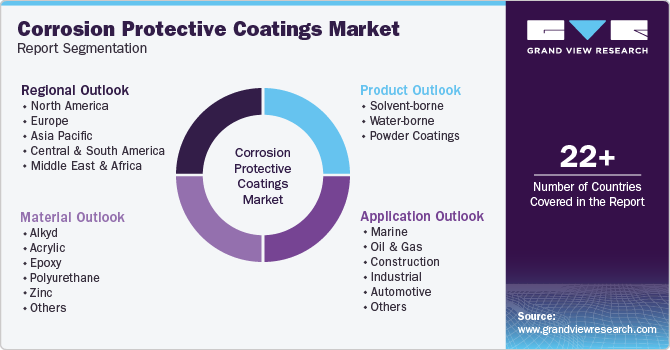
This report forecasts revenue growth at global, regional, and country levels and provides an analysis of the latest industry trends in each of the sub-segments from 2018 to 2030. For this study, Grand View Research has segmented the global corrosion protective coatings market report based on product, material, application, and region:
 To learn more about this report, Download Free Sample Report
-
Product Outlook (Revenue, USD Million, Volume in Kilo Tons, 2021 - 2033)
-
Solvent-borne
-
Water-borne
-
Powder Coatings
-
-
Material Outlook (Revenue, USD Million, Volume in Kilo Tons, 2021 - 2033)
-
Alkyd
-
Acrylic
-
Epoxy
-
Polyurethane
-
Zinc
-
Others
-
-
Application Outlook (Revenue, USD Million, Volume in Kilo Tons, 2021 - 2033)
-
Marine
-
Oil & Gas
-
Construction
-
Industrial
-
Automotive
-
Others
-
-
Regional Outlook (Revenue, USD Million, Volume in Kilo Tons, 2021 - 2033)
-
North America
-
U.S.
-
Canada
-
Mexico
-
-
Europe
-
Germany
-
UK
-
France
-
Italy
-
Spain
-
-
Asia Pacific
-
China
-
Japan
-
India
-
South Korea
-
-
Central & South America
-
Argentina
-
Brazil
-
-
Middle East and Africa (MEA)
-
Saudi Arabia
-
UAE
-
Qatar
-
Oman
-
South Africa
-
-
Research Methodology
The corrosion protective coatings market figures in this report are based on a proven research process that combines executive interviews with secondary research from proprietary databases, company filings, and recognized regulatory and institutional sources. Market size is built through value-chain sizing - reconciling supply-side and demand-side estimates - and triangulated with bottom-up and top-down approaches. Every estimate passes multiple levels of expert validation before publication, with each corrosion protective coatings segment quantified using the revenue-capture definitions in the table below.
Segment Definition
Segment – Product
Revenue capture definition
Solvent-borne
Revenue generated from the sale of solvent-borne corrosion protective coatings used across industrial, marine, oil & gas, infrastructure, and transportation applications requiring high durability and superior surface performance.
Water-borne
Revenue generated from water-borne corrosion protective coatings supplied for applications requiring low-VOC, environmentally compliant solutions while providing effective corrosion resistance for industrial and infrastructure assets.
Powder Coatings
Revenue generated from powder-based corrosion protective coatings applied to metal components and fabricated products, offering enhanced durability, abrasion resistance, and environmental compliance.
Segment – Material
Revenue capture definition
Alkyd
Revenue generated from alkyd-based corrosion protective coatings used for general industrial, infrastructure, and maintenance applications requiring cost-effective corrosion protection and decorative performance.
Acrylic
Revenue generated from acrylic-based coatings utilized for corrosion protection in architectural, industrial, transportation, and infrastructure applications where UV resistance and weatherability are critical.
Epoxy
Revenue generated from epoxy-based corrosion protective coatings used in marine, oil & gas, industrial, and infrastructure applications requiring superior chemical resistance, adhesion, and long-term asset protection.
Polyurethane
Revenue generated from polyurethane-based coatings applied as protective and finishing layers to provide excellent weather resistance, abrasion resistance, color retention, and long-term durability for industrial assets.
Zinc
Revenue generated from zinc-rich coatings supplied for steel structures, pipelines, bridges, marine assets, and industrial equipment requiring cathodic corrosion protection in aggressive environments.
Others
Revenue generated from corrosion protective coatings formulated using other resin and material technologies, including vinyl ester, fluoropolymer, silicone, polyester, and hybrid systems for specialized industrial applications.
Segment – Application
Revenue capture definition
Marine
Revenue generated from corrosion protective coatings used on ships, offshore platforms, ports, docks, and other marine structures exposed to seawater and harsh environmental conditions.
Oil & Gas
Revenue generated from coatings supplied for upstream, midstream, and downstream oil & gas infrastructure, including pipelines, storage tanks, refineries, processing facilities, and offshore assets.
Construction
Revenue generated from corrosion protective coatings applied to bridges, commercial buildings, industrial structures, highways, and other infrastructure to enhance durability and extend asset service life.
Industrial
Revenue generated from coatings used to protect manufacturing facilities, process equipment, storage vessels, power plants, heavy machinery, and other industrial assets from corrosion and chemical exposure.
Automotive
Revenue generated from corrosion protective coatings used on automotive components, commercial vehicles, chassis, underbody systems, and transportation equipment to improve corrosion resistance and product longevity.
Others
Revenue generated from corrosion protective coatings supplied to additional applications, including railways, aerospace, utilities, water treatment facilities, and other specialized industrial sectors requiring corrosion protection.
Estimation Model
Layer No.
Layer Name
Key Question
Description
01
Product Segmentation
Which product technologies contribute to market revenue?
Market revenue was allocated across Solvent-borne, Water-borne, and Powder Coatings based on production volumes, adoption rates, regulatory trends, application suitability, and average selling prices.
02
Material Analysis
Which coating materials generate the highest market demand?
Revenue was distributed among Alkyd, Acrylic, Epoxy, Polyurethane, Zinc, and Other Materials by evaluating their usage across industrial sectors, performance characteristics, and procurement trends.
03
Regional Assessment
Which regions represent the largest revenue opportunities?
Market estimates were developed for North America, Europe, Asia Pacific, Latin America, and the Middle East & Africa based on industrial output, infrastructure development, marine activities, energy investments, and regional coating consumption patterns.
04
Market Validation & Data Triangulation
How was the market estimate validated?
The final market size was validated through company annual reports, production capacities, import-export statistics, industry association data, distributor insights, and primary interviews with coating manufacturers, suppliers, and end users to ensure accuracy and consistency across all segments.
Delivered Customizations
This report has been delivered with the following In-depth customizations
Client Request
Customization Delivered
Value Adds
Competitive Benchmarking
Leading corrosion protective coating manufacturers were benchmarked based on product portfolio, coating technology capabilities, material expertise, manufacturing footprint, distribution network, sustainability initiatives, innovation pipeline, and presence across infrastructure and industrial sectors. Strategic developments and competitive positioning were also evaluated.
Helps identify competitive strengths, technology leadership, and market differentiation opportunities. Facilitates strategic planning, partnership evaluation, and competitive positioning across high-value applications.
Cross-Segmentation Analysis
The relationship between coating technology, material type, and end-use application was assessed to evaluate adoption trends across solvent-borne, water-borne, and powder coating systems. Material suitability for marine, oil & gas, construction, industrial, and automotive environments was analyzed to identify performance-driven demand patterns and high-value application segments.
Enables identification of the most attractive material-technology-application combinations. Supports product portfolio optimization, targeted product development, and strategic commercialization initiatives.
Opportunity Assessment
Growth opportunities were assessed across offshore infrastructure, renewable energy installations, industrial asset maintenance, transportation infrastructure, and sustainable coating technologies. The analysis also examined opportunities arising from increasing investment in corrosion management, asset life extension, and low-VOC coating solutions.
Enables identification of high-growth investment areas and emerging application segments. Supports innovation planning, portfolio expansion, and long-term strategic growth initiatives across infrastructure and industrial markets.
Frequently Asked Questions About This Report
The global corrosion protective coatings market size was valued at USD 33.5 million in 2025 and is projected to grow from USD 35.0 million in 2026.
The global corrosion protective coatings market is expected to grow at a CAGR of 5.3% from 2026 to 2033, reaching USD 50.1 million by 2033.
Asia Pacific dominated the corrosion protective coatings market with the highest revenue share of 36.4% in 2025.
Some key players operating in the corrosion protective coatings market include AkzoNobel N.V., BASF, PPG Industries Inc., The Sherwin-Williams Company, and Jotun.
Key factors that are driving the market growth include rising demand from end-use industries including oil & gas, manufacturing, and automotive, and growing use of epoxy-based paints and coatings in production industries for general purpose corrosion protection.
By product, solvent-borne held a dominant position, contributing 74.2% of total revenue in 2025, owing to its superior adhesion, excellent corrosion resistance, and proven durability in harsh industrial and marine environments. Its widespread use in heavy-duty infrastructure, oil & gas, power generation, and industrial maintenance applications, where high-performance protective coatings are essential, continues to support its market leadership.
Epoxy segment accounted for the largest revenue share of 41.2% in 2025, driven by its exceptional adhesion, chemical resistance, and long-lasting corrosion protection, making it the preferred material for protective coatings used in industrial infrastructure, marine, oil & gas, power generation, and water treatment applications.
In 2025, the construction segment captured the largest revenue share of 24.2% in the market, driven by rising investments in residential, commercial, and infrastructure development projects, along with the growing need to protect steel structures, bridges, pipelines, and reinforced concrete from corrosion, moisture, and harsh environmental conditions.
The Corrosion Protective Coatings Market faces several restraints, including stringent environmental regulations on volatile organic compound (VOC) emissions, which limit the use of conventional solvent-borne coatings and increase compliance costs for manufacturers. In addition, fluctuations in the prices of key raw materials such as epoxy resins, polyurethane resins, pigments, and solvents affect production costs and profit margins.
About the Author(s)
Paints, Coatings & Printing Inks Research Team
Bulk Chemicals · Paints, Coatings & Printing InksThis report was authored by the paints, coatings & printing inks research team at Grand View Research - comprising two research analysts, one senior research analyst, and one industry expert - with specialized expertise in the paints, coatings & printing inks segment of the bulk chemicals industry. All findings are based on proprietary bulk chemicals databases, executive interviews, and regulatory analysis, subject to internal peer review prior to publication.
Last Updated:
Speak to Analyst

Customize this report to your needs - add regions, segments, or data points, with 20% free customization.
Or view our licence options:


ISO 9001:2015 & 27001:2022 Certified
We are GDPR and CCPA compliant! Your transaction & personal information is safe and secure. For more details, please read our privacy policy.


