
- Home
- »
- Next Generation Technologies
- »
-
Gas Sensor Market Size & Share, Industry Report, 2030GVR Report cover
![Gas Sensor Market Size, Share & Trends Report]()
Gas Sensor Market (2025 - 2030) Size, Share & Trends Analysis Report By Product (Oxygen/Lambda Sensor, Carbon Dioxide Sensor), By Type (Wired, Wireless), By Technology, By End-use, By Region, And Segment Forecasts
- Report ID: 978-1-68038-083-5
- Number of Report Pages: 113
- Format: PDF
- Historical Range: 2018 - 2024
- Forecast Period: 2025 - 2030
- Industry: Technology
- Report Summary
- Table of Contents
- Interactive Charts
- Methodology
- Download FREE Sample
-
 Download Sample Report
Gas Sensor Market Summary
The global gas sensor market size was estimated at USD 3,144.7 million in 2024 and is projected to reach USD 5,489.7 million by 2030, growing at a CAGR of 9.9% from 2025 to 2030. The major factor driving the gas sensor industry’s growth is the development of wireless capabilities and miniaturization, coupled with the improvement in communication technologies that enable their integration into various devices and machines to detect toxic gases at a safe distance.
Key Market Trends & Insights
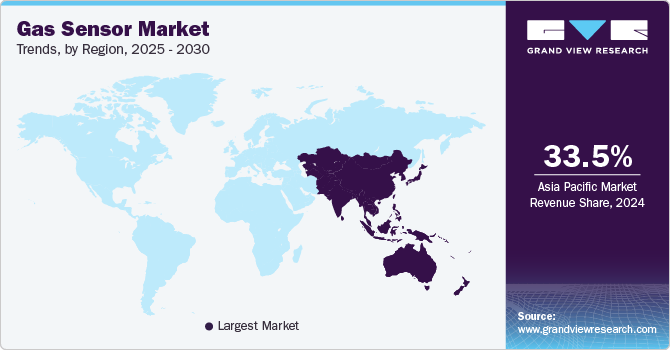
- Asia Pacific dominated the gas sensor industry in 2024 and accounted for a revenue share of 33.5%.
- The gas sensor market in China is undergoing rapid transformation.
- By product, the carbon dioxide (CO2) sensors segment dominated the market in 2024 and accounted for a revenue share of 31.4%.
- By type, the wired segment dominated the market, accounting for a revenue share of more than 54.0% in 2024.
- Based on technology, the electrochemical segment dominated the market in 2024 and accounted for a revenue share of more than 21.0%.
- Based on end use, the industrial segment dominated the market in 2024 and accounted for a revenue share of more than 19.0%.
Market Size & Forecast
- 2024 Market Size: USD 3,144.7 Million
- 2030 Projected Market Size: USD 5,489.7 Million
- CAGR (2025-2030): 9.9%
- Asia Pacific: Largest market in 2024
Gas sensors are used to constantly control and monitor gas emissions from various industrial processes, ranging from domestic and industrial. Additionally, the rising demand to control the harmful emissions from critical industries also bodes well for the growth of the market.
Advances and innovations in technology are allowing gas sensor manufacturers to develop smart gas sensors. Various companies are also developing drone-based gas leak detection systems to provide better safety for the operators of pipelines across the globe. For instance, in April 2021, ABB Ltd. launched HoverGuard, a drone-based gas leak detection system. HoverGuard detects, maps, and quantifies leaks up to 100 meters from natural gas distribution and storage facilities, transmission pipelines, gathering lines, and other potential sources safely, quickly, and reliably. Such technological developments bode well for the growth of the market.
Numerous industries, such as chemical, oil & gas, and power, use gas sensors to detect the presence of various combustible and toxic gases. A huge number of gases, such as carbon monoxide, carbon dioxide, hydrocarbons, and ammonia, are released into the air by these industries. An excess number of emissions of these gases can adversely affect human health. Moreover, for power generation, methane is being used widely. Methane is a greenhouse gas that is highly inflammable and forms explosive mixes in the air if the methane leaks are not detected properly. Hence, new sensor technologies are being developed, such as substance-specific electrochemical sensors and Non-dispersive Infrared (NDIR) sensors that are used to detect methane and other gases in industries.
Stringent government regulations to reduce emissions from cars are expected to drive the demand in the gas sensor industry over the forecast period.Rules and regulations are imposed by government bodies across the world on the emission of gas from cars. For instance, in April 2020, the Corporate Average Fuel Economy and greenhouse gas emission standards for passenger cars were amended by the National Highway Traffic Safety Administration and the EPA. Thus, the imposed limitation on gas emission from vehicles creates demand for gas sensors as it decreases atmospheric pollution and increases fuel efficiency.
Product Insights
The carbon dioxide (CO2) sensors segment dominated the gas sensor market in 2024 and accounted for a revenue share of 31.4%. Carbon dioxide sensors are mainly used for monitoring indoor air quality in homes, office buildings, automotive, healthcare, and other applications. Numerous companies are focusing on developing MEMS-based carbon dioxide sensors for various applications. For instance, in January 2021, TDK Corporation introduced its TCE-11101, a miniaturized, low-power MEMS gas sensor platform for direct and accurate measurement of carbon dioxide in-home, healthcare, automotive, IoT, and other applications. Such initiatives bode well for the segment's growth.
The carbon monoxide (CO) sensors segment is anticipated to register a significant CAGR over the forecast period. Fatalities stemming from carbon monoxide poisoning are driving the need for carbon monoxide sensors. Government regulations to ensure safety in workplaces are increasing the growth of the carbon monoxide sensors market. For instance, in the U.S., carbon monoxide poisoning has prompted the government to deploy carbon monoxide detectors across various states in the U.S. As such, school buildings in the U.S. states, such as Connecticut, California, Maryland, Illinois, and Maine, are required to have carbon monoxide detectors.
Type Insights
The wired segment dominated the market, accounting for a revenue share of more than 54.0% in 2024. The wired gas sensors offer benefits, such as low maintenance, compact size, low cost, and higher accuracy. In many situations, wired sensors are among the most reliable systems. They directly link the sensor to the device receiving the input, making them suitable for use in mines, oil rigs, and nuclear power plants. Additionally, the increasing adoption of wired gas sensors in residential applications is a significant factor responsible for the segment's growth.
The benefits provided by wireless gas sensors, such as high scalability and flexibility, cost-effectiveness, and ease of portability, are expected to drive the growth of the segment. Wireless sensors can be used in a wide range of industries, including petrochemical, manufacturing, and oil & gas. In the oil & gas sector, these sensors provide continuous monitoring of gases remotely. They can be operated from the base stations, thus reducing the chances of leakage and explosion of hazardous gases.
Technology Insights
The electrochemical segment dominated the market in 2024 and accounted for a revenue share of more than 21.0%. This growth is primarily attributed to the low power consumption, enhanced safety, and high specificity for target gases. Its ability to detect toxic gases through efficient electrochemical reactions makes it especially valuable in hazardous environments like mining. These advantages are expected to drive continued adoption across industries seeking reliable and precise gas monitoring solutions.
The infrared segment is anticipated to register the fastest CAGR over the forecast period. Infrared gas sensors detect various gases, including methane, carbon monoxide, and Volatile Organic Compounds (VOCs) such as acetylene, benzene, butane, and others. These gas sensors are also used in monitoring oxygen levels in ventilators and incubators. The growth of the segment can also be attributed to the rising levels of pollution across the globe.
End Use Insights
The industrial segment dominated the market in 2024 and accounted for a revenue share of more than 19.0%. Industrial gas sensors are used to monitor and detect hazardous vapors and gases and trigger visual and audible alarms. Numerous gas sensor manufacturers are focusing on developing miniature industrial gas sensors. For instance, in October 2020, DD-Scientific, a sensor manufacturer, announced the launch of the newest range of high-performance industrial gas sensors that provide the same reliability and robustness as a bigger sensor in a miniature package. Additionally, in March 2022, Sensorix GmbH, a global manufacturer and supplier of electrochemical gas sensors, announced the launch of its sensor range, namely, Sensorix AsH3 1, Sensorix SiH4 50, Sensorix PH3 1, Sensorix SeH2 5, Sensorix B2H6 1, Sensorix HCl 30, and Sensorix GeH4 5 for hydrogen chloride and hydrides, which are used extensively in the semiconductor manufacturing industry.

The petrochemicals segment is anticipated to register the fastest CAGR over the forecast period. The LPG and LNG industry verticals have been aggressively deploying gas sensors as these industry verticals require monitoring at every step of storage, production, and transportation of gas. While natural gas production has been growing worldwide, the emphasis on safety and security at the processing facilities has also been equally strengthening. The continued growth in natural gas products is expected to drive the growth of the segment. Gas sensors are being integrated into IoT networks, enabling remote monitoring and control of gas concentrations in various settings. This trend is driven by the growing adoption of IoT technologies in various industries, including healthcare, automotive manufacturing, and environmental monitoring.
Regional Insights
Asia Pacific dominated the gas sensor industry in 2024 and accounted for a revenue share of 33.5%. Increasing awareness about the impact of air pollutants on human health across countries in the Asia Pacific, such as India and China, is driving the demand for gas sensors for air quality monitoring. Continued urbanization in the region is also contributing to the rising demand for gas sensors. Moreover, the governments in the Asia Pacific regions are investing heavily in smart city projects, thus creating significant potential for smart sensor devices. Such factors bode well for the regional market growth. For instance, under the Union Budget 2021 - 22, the Smart City Mission in India has been granted a budget of USD 868 million (Rs. 6,450 crore ) for the fiscal year 2021 - 22, which is an increase from the previous fiscal year’s (2020 - 21) allocation of USD 457 million (Rs. 3,400 crore).
China Gas Sensor Market Trends
The gas sensor market in China is undergoing rapid transformation, driven by the country’s intensified focus on industrial safety, environmental protection, and smart technologies. One of the primary drivers behind this growth is China’s aggressive industrial expansion, which necessitates robust safety protocols and compliance measures in manufacturing, petrochemical, and mining sectors.
The India gas sensor market is expected to grow during the forecast period. Government initiatives like the National Clean Air Programme (NCAP), aiming to reduce air pollution levels in 102 cities by 20-30% by 2024, are propelling the demand for advanced gas sensors. Additionally, India's commitment to attaining USD 300 billion in electronics manufacturing and USD 120 billion in exports by 2025-26 underscores the country's focus on integrating smart sensor technologies.
Europe Gas Sensor Market Trends
Europe is expected to witness steady growth over the forecast period. Stringent norms related to the emissions of gases and the subsequent need for emissions monitoring are expected to drive the regional market growth. In Europe, the safety requirements require all the vehicle OEMs to include the gas sensor technologies in their offers. As the rules to curb the pollution levels are becoming more rigorous, the popularity of gas sensors in the automotive sector to decrease pollution is expected to increase over the coming years. In addition, several regional market players are developing advanced gas sensors, which are ultimately propelling the market’s growth. For instance, in March 2022, Gas Sensing Solutions, the U.K.-based company that specializes in LED-based NDIR infra-red gas sensors, introduced a line of methane gas sensors during the Sensor+Test 2022 event. These sensors are equipped with ultra-bright LEDs and an internal architecture and deliver exceptional accuracy and minimal power usage.
The UK gas sensor market is poised for growth during the forecast period. One of the key drivers is the country's strong emphasis on environmental sustainability, particularly in urban centers where air pollution monitoring has become a top priority. The rise of smart homes and buildings equipped with integrated air monitoring systems is also fostering demand for compact and energy-efficient gas sensors. Additionally, the shift toward hydrogen and alternative fuels in the energy and transportation sectors has introduced new safety and monitoring requirements, further expanding sensor applications.
North America Gas Sensor Market Trends
A significant driver is the stringent environmental regulations enforced by agencies like the U.S. Environmental Protection Agency (EPA), which necessitate the adoption of gas sensors across various sectors to monitor and control emissions In the automotive industry, the shift towards electric and hybrid vehicles has increased the demand for gas sensors to ensure safety and compliance with emission standards. Additionally, the rise of smart home technologies and the integration of Internet of Things (IoT) devices have expanded the application of gas sensors in residential settings, enhancing indoor air quality monitoring.
The rise of smart home technologies and the integration of Internet of Things (IoT) devices in the U.S. have expanded the application of gas sensors in residential settings, enhancing indoor air quality monitoring. The healthcare sector also contributes to market growth, utilizing gas sensors in medical devices for patient monitoring and diagnostics. Furthermore, the increasing awareness of workplace safety has led industries to implement gas detection systems to protect employees from hazardous exposures.
Key Gas Sensor Company Insights
Some of the key companies operating in the gas sensor market are ABB Ltd.; AlphaSense Inc.; City Technology Ltd.; and Dynament. Market players are pursuing various strategies such as mergers & acquisitions, new product launches, and strategic partnerships, among others, for expanding their market presence. Market players are also investing aggressively in R&D to enhance their product offerings. Benefits associated with wireless devices are prompting market players to provide wireless gas sensors mainly.
-
ABB Ltd. is a Swedish-Swiss multinational corporation headquartered in Zurich, Switzerland, specializing in electrification and automation technologies. The company operates through four main business areas: Electrification, Motion, Process Automation, and Robotics & Discrete Automation. ABB's offerings include products and services such as electric vehicle chargers, industrial robots, control systems, and digital solutions under the ABB Ability platform.
-
City Technology Ltd., a subsidiary of Honeywell International Inc., is a manufacturer of gas sensors based in Portsmouth, U.K. Established in 1977, the company specializes in designing and producing electrochemical gas sensors for detecting a wide range of gases, including oxygen (O₂), carbon monoxide (CO), nitrogen dioxide (NO₂), hydrogen sulfide (H₂S), and volatile organic compounds (VOCs). These sensors are utilized across various sectors such as industrial safety, environmental monitoring, medical applications, and automotive emissions control.
Key Gas Sensor Companies:
The following are the leading companies in the gas sensor market. These companies collectively hold the largest market share and dictate industry trends.
- ABB Ltd.
- AlphaSense Inc.
- City Technology Ltd.
- Dynament
- Figaro Engineering Inc.
- Membrapor
- Nemoto & Co. Ltd.
- Robert Bosch LLC
- Siemens
- GfG Gas Detection UK Ltd.
- FLIR Systems, Inc.
Recent Developments
-
In October 2024, AlphaSense introduced PIDX, a new PID (Photoionization Detector) sensor technology designed to improve gas detection capabilities. The sensor offers higher sensitivity and accuracy, particularly for detecting volatile organic compounds (VOCs) at low concentrations. Its enhanced design also increases durability, leading to a longer operational lifespan and reduced maintenance requirements. The technology provides faster response times, which is critical for real-time monitoring in safety-sensitive environments.
-
In March 2023, Sensorix GmbH revealed its new range of sensors for toxic gases at Sensor + Test 2023. The showcase features the company’s variety of gas sensors that are highly prevalent in various industries. The company is addressing the worldwide demand for top-quality gas sensors and is presenting mechanical adaptations and customized solutions for gas detectors to meet customers' requirements, as well as sensors for exotic toxic gases.
-
In October 2022, Alphasense Inc. expanded its range of products with the launch of a series of photo-ionization detection (PID) sensors to deliver its customers with exceptional performance and a broader choice of detection ranges.
Gas Sensor Market Report Scope
Report Attribute
Details
Market size value in 2025
USD 3,425.1 million
Revenue forecast in 2030
USD 5,489.7 million
Growth rate
CAGR of 9.9% from 2025 to 2030
Base year for estimation
2024
Historical data
2018 - 2024
Forecast period
2025 - 2030
Report updated
May 2025
Quantitative units
Revenue in USD million/billion and CAGR from 2025 to 2030
Report coverage
Revenue forecast, company ranking, competitive landscape, growth factors, and trends
Segments covered
Product, type, technology, end use, and region
Regional scope
North America; Europe; Asia Pacific; Latin America; MEA
Country scope
U.S.; Canada; Mexico; UK; Germany; France; China; India; Japan; Australia; South Korea; Brazil; UAE; Saudi Arabia; South Africa
Key companies profiled
ABB Ltd.; AlphaSense Inc.; City Technology Ltd., Dynament; Figaro Engineering Inc.; Membrapor; Nemoto & Co. Ltd.; Robert Bosch LLC; Siemens; GfG Gas Detection UK Ltd.; FLIR Systems, Inc.
Customization scope
Free report customization (equivalent up to 8 analysts working days) with purchase. Addition or alteration to country, regional & segment scope.
Pricing and purchase options
Avail customized purchase options to meet your exact research needs. Explore purchase options
Global Gas Sensor Market Report Segmentation
The report forecasts revenue growth at the global, regional, and country levels and provides an analysis of the latest industry trends in each of the sub-segments from 2018 to 2030. For this study, Grand View Research has segmented the gas sensor market report based on product, type, technology, end use, and region:
-
Product Outlook (Volume, Million Units; Revenue, USD Million, 2018 - 2030)
-
Oxygen/Lambda Sensor
-
Carbon Dioxide Sensor
-
Carbon Monoxide Sensor
-
NOx Sensor
-
Methyl Mercaptan Sensor
-
Others (Hydrogen, Ammonia, Hydrogen Sulfide)
-
-
Type Outlook (Revenue, USD Million, 2018 - 2030)
-
Wireless
-
Wired
-
-
Technology Outlook (Revenue, USD Million, 2018 - 2030)
-
Electrochemical
-
Semiconductor
-
Solid State/MOS
-
Photo-Ionization Detector (PID)
-
Catalytic
-
Infrared (IR)
-
Others
-
-
End Use Outlook (Volume, Million Units; Revenue, USD Million, 2018 - 2030)
-
Medical
-
Building Automation & Domestic Appliances
-
Environmental
-
Petrochemical
-
Automotive
-
Industrial
-
Agriculture
-
Others
-
-
Regional Outlook (Volume, Million Units; Revenue, USD Million, 2018 - 2030)
-
North America
-
U.S.
-
Canada
-
Mexico
-
-
Europe
-
UK
-
Germany
-
France
-
-
Asia Pacific
-
China
-
India
-
Japan
-
South Korea
-
Australia
-
-
Latin America
-
Brazil
-
-
Middle East & Africa
-
Kingdom of Saudi Arabia
-
UAE
-
South Africa
-
-
Frequently Asked Questions About This Report
b. The global gas sensor market size was estimated at USD 3,144.7 million in 2024 and is expected to reach USD 3,425.2 million in 2025.
b. The global gas sensor market is expected to grow at a compound annual growth rate of 9.9% from 2025 to 2030 to reach USD 5,489.7 million by 2030.
b. Asia Pacific dominated the gas sensor market with a share of 33.5% in 2024. Increasing awareness about the impact of air pollutants on human health across the countries in the Asia Pacific, such as India and China, is driving the demand for gas sensors for air quality monitoring.
b. Some key players operating in the gas sensor market include ABB Ltd.; AlphaSense Inc.; City Technology Ltd., Dynament; Figaro Engineering Inc.; Membrapor; Nemoto & Co. Ltd.; Robert Bosch LLC; Siemens; GfG Gas Detection UK Ltd.; FLIR Systems, Inc.
b. Key factors driving the gas sensor market growth include the increased extensive application of gas sensors in process and manufacturing industries for detecting various toxic, including hydrogen sulfide and nitrogen dioxide.

Share this report with your colleague or friend.
Need a Tailored Report?
Customize this report to your needs — add regions, segments, or data points, with 20% free customization.


ISO 9001:2015 & 27001:2022 Certified
We are GDPR and CCPA compliant! Your transaction & personal information is safe and secure. For more details, please read our privacy policy.
Trusted market insights - try a free sample
See how our reports are structured and why industry leaders rely on Grand View Research. Get a free sample or ask us to tailor this report to your needs.













