
- Home
- »
- Petrochemicals
- »
-
Petrochemical Market Size And Share Report, 2026-2033GVR Report cover

Petrochemical Market (2026 - 2033)
Size, Share & Trends Analysis Report By Product (Ethylene, Propylene, Butadiene, Benzene, Xylene, Toluene, Methanol), By Region (North America, Europe, Asia Pacific, Latin America, Middle East), And Segment Forecasts
Market Size, 2025
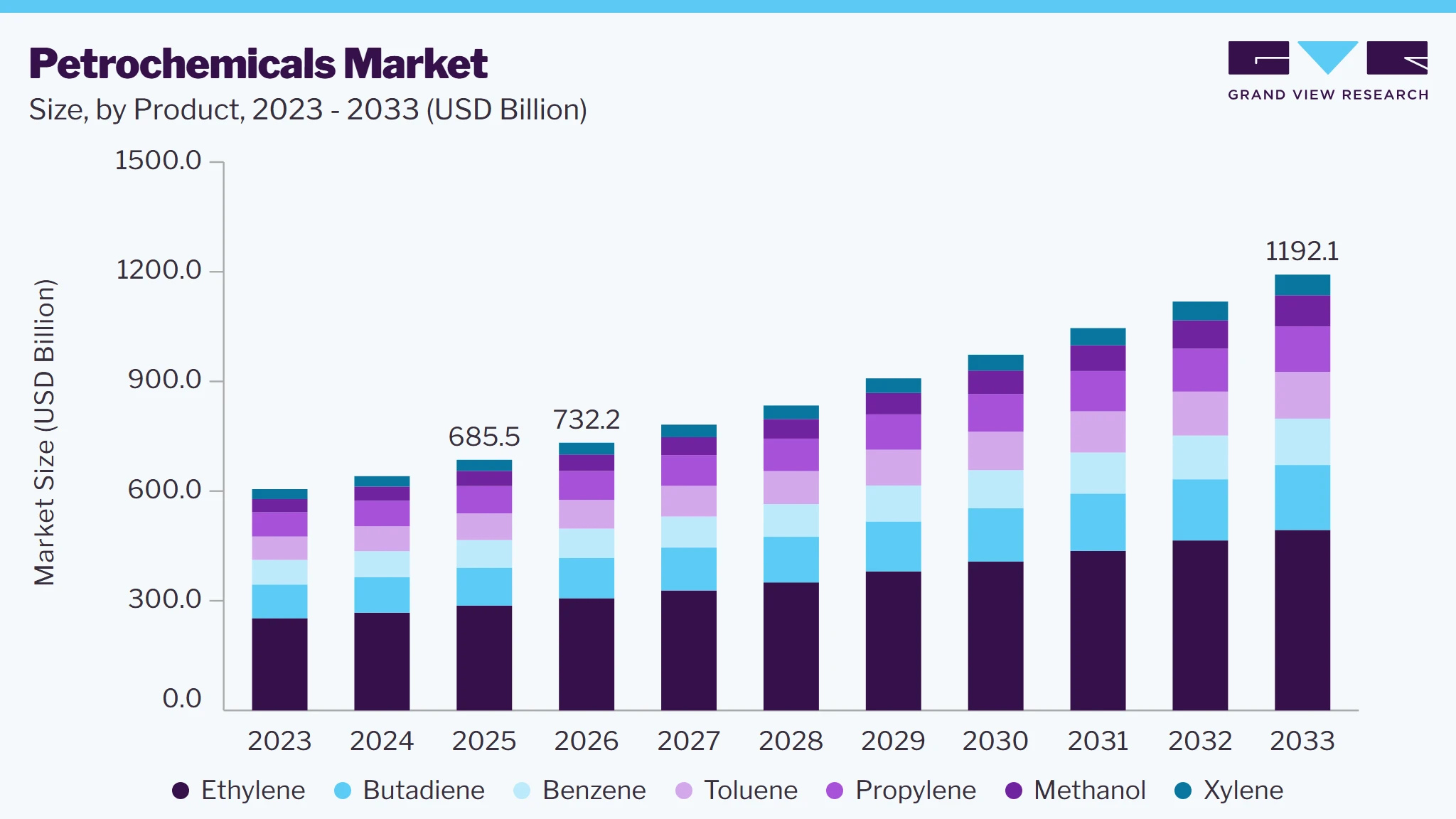
$685.5BMarket Estimate, 2026
$732.2BMarket Forecast, 2033
$1,192.1BCAGR, 2026–2033
7.2%Petrochemical Market Summary
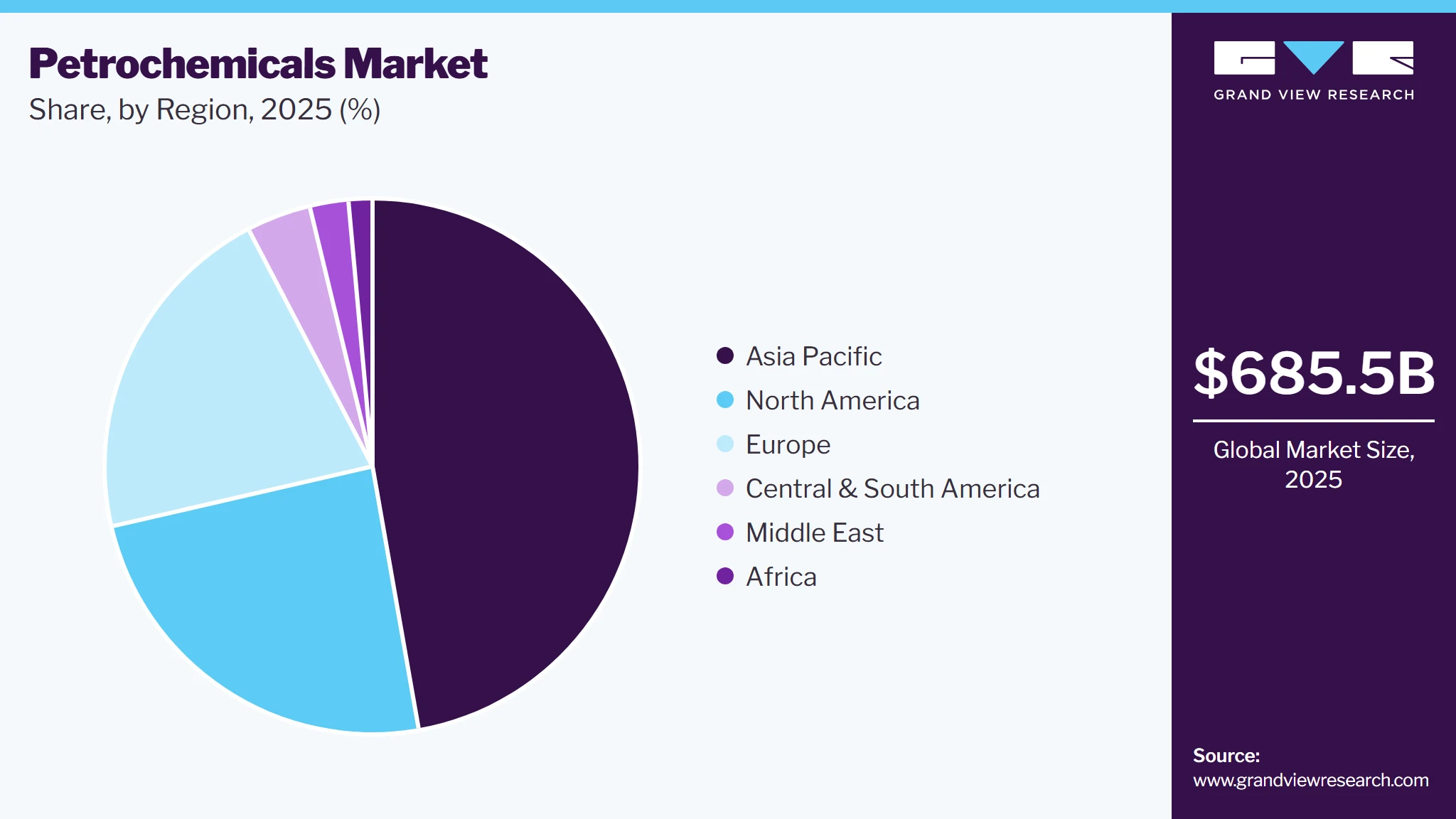
The global petrochemical market size was valued at USD 685.5 billion in 2025 and is projected to grow from USD 732.2 billion in 2026 to USD 1,192.1 billion by 2033, at a CAGR of 7.2% from 2026 to 2033. Asia Pacific dominated the market, accounting for a revenue share of 47.2% in 2025. The global petrochemical market is primarily driven by rising demand for plastics across packaging, automotive, construction, and consumer goods industries.
 Source: Grand View Research, IR Documents, Primary Interviews, Paid DatabasesTo learn more about this report,
 Download Free Sample Report
Key Market Trends & Insights
- By product: Ethylene segment accounted for the largest revenue share of 41.8% in 2025.
Regional Highlights
- Largest regional market: Asia Pacific (47.2% revenue share, 2025)
- By country: China held the largest market share in 2025.
Market Size & Forecast
- Market size in 2025: USD 685.5 Billion
- Estimated market size in 2026: USD 732.2 Billion
- Projected market size by 2033: USD 1,192.1 Billion
- CAGR (2026-2033): 7.2%
Three ways to get this report
Buy it, customize it, or ask a question.Ask an Analyst
Analyst response in 1 business day
- AccessReport author, directly
- Reply timeWithin 1 working day
- No sales callDirect answer only
- FormatEmail reply
- CostFree, no cost
Get the Full Report
What the study covers
- FormatsPDF · Excel · Dashboard
- Timeline2026–2033 annual, 2025 base
- Coverage20+ countries, 5 regions
- Companies10+ key players profiled
Customize the Report
20% free customization
- IncludeCountries, segments, points
- TailorTo your product definition
- ExtendDeeper competitor detail
- OrA fully bespoke study
- Turnaround5–10 working days
Synthetic fibers, and industrial chemicals across key end-use industries such as packaging, automotive, construction, and consumer goods. Additionally, the availability of low-cost feedstock’s, particularly in regions like North America and the Middle East, has enhanced production economics, prompting significant capacity expansions and strategic investments.The petrochemical market encompasses the production, distribution, and application of chemical products derived primarily from petroleum and natural gas. These chemicals, including ethylene, propylene, benzene, toluene, xylene, methanol, and butadiene, serve as essential building blocks for a wide range of downstream products. The market plays a critical role within the broader chemical industry, driven by its deep integration into manufacturing, transportation, infrastructure, and consumer goods sectors globally.
 To learn more about this report, Download Free Sample Report
Petrochemical are vital to the modern economy, as they form the foundation for countless products such as plastics, synthetic rubber, fertilizers, solvents, textiles, detergents, and pharmaceuticals. Their versatility and cost-effectiveness make them indispensable in supporting industrialization, technological advancement, and urban development. As global consumption patterns evolve, the strategic importance of Petrochemical continues to grow, especially in enabling innovations in packaging, mobility, energy storage, and sustainable materials.
Market Dynamics
The petrochemical market is influenced by evolving feedstock economics, expanding industrial manufacturing, and increasing demand from downstream sectors such as packaging, automotive, construction, electronics, and consumer goods. Market growth is supported by capacity expansions in integrated refining and petrochemical complexes, rising investments in high-value chemical production, and the transition toward specialty petrochemical.
The sustained expansion of downstream industries, including packaging, automotive, construction, consumer goods, electronics, and healthcare, is a primary factor driving growth in the petrochemical market. Petrochemical derivatives such as olefins, aromatics, and polymers serve as essential raw materials for a broad range of industrial and consumer applications. Rapid urbanization, infrastructure development, and increasing consumption of manufactured goods, particularly across emerging economies, continue to strengthen demand for petrochemical products and encourage capacity additions across the value chain.
Increasing investments in integrated refinery-petrochemical complexes are enhancing production efficiency, optimizing feedstock utilization, and improving supply chain resilience. Producers are expanding their portfolios toward high-value specialty chemicals and performance materials to address evolving customer requirements while improving profitability. These strategic investments, coupled with advancements in process optimization and production technologies, are reinforcing the long-term growth prospects of the global petrochemical market.
Fluctuations in crude oil and natural gas prices remain a significant restraint for the petrochemicals market, as these commodities represent the primary feedstocks for petrochemical production. Unpredictable changes in raw material costs directly affect production expenses, profit margins, and pricing strategies, creating uncertainty for manufacturers and downstream industries. Additionally, supply chain disruptions and geopolitical tensions can further impact feedstock availability, resulting in operational challenges and investment delays.
Increasingly stringent environmental regulations targeting greenhouse gas emissions, plastic waste management, and industrial pollution are compelling petrochemical producers to invest in cleaner production technologies and sustainable manufacturing practices. While these initiatives support long-term environmental objectives, they also increase capital expenditure and compliance costs. The need to balance regulatory compliance with operational efficiency continues to pose a challenge for market participants, particularly in regions with rigorous environmental policies.
The increasing global emphasis on sustainability and resource efficiency is creating significant opportunities for the petrochemicals market through the adoption of circular economy practices. Rising investments in chemical recycling, advanced waste processing technologies, and bio-based feedstocks are enabling manufacturers to reduce dependence on virgin fossil resources while addressing growing regulatory and consumer demand for sustainable materials. These developments are encouraging innovation across the petrochemical value chain and opening new revenue streams for industry participants.
Expanding investments in integrated petrochemical complexes, specialty chemicals, and high-performance materials are creating opportunities to serve rapidly growing end-use industries such as electric vehicles, renewable energy, electronics, and advanced packaging. Companies are increasingly focusing on product diversification, process optimization, and strategic collaborations to strengthen their competitive position and capitalize on the evolving demand for value-added petrochemical products in both developed and emerging markets.
Analyst Perspective
The global petrochemical market is expected to maintain steady growth over the forecast period, supported by rising demand from downstream manufacturing industries, ongoing investments in integrated refining and petrochemical complexes, and expanding consumption of polymers and specialty chemicals. While feedstock price volatility and increasingly stringent environmental regulations present operational challenges, industry participants are strengthening their competitive position through capacity expansions, process optimization, product diversification, and investments in sustainable production technologies. The growing adoption of circular economy practices and increasing demand for high-performance materials across automotive, packaging, construction, and electronics sectors are expected to create long-term opportunities, reinforcing the market's growth trajectory.Product Insights
Ethylene segment accounted for the largest revenue of 41.8% in 2025. The ethylene segment is anticipated to hold the largest market share in the petrochemical market by product during the forecast period due to its extensive application base and high-volume consumption across multiple end-use industries. Ethylene is a key feedstock in the production of polyethylene (HDPE, LDPE, LLDPE), ethylene oxide, ethylene dichloride, and other essential chemicals used in packaging, construction materials, automotive components, textiles, and consumer goods. The rising global demand for lightweight, durable, and cost-effective packaging materials-especially in the food and e-commerce sectors-continues to fuel the consumption of polyethylene, which in turn drives the dominance of ethylene in the overall market.
Additionally, ethylene production has become increasingly cost-effective in regions with abundant feedstocks such as ethane from shale gas in North America and naphtha in the Middle East, enabling large-scale investments and capacity expansions. Technological advancements in steam cracking and the emergence of integrated petrochemical complexes have further optimized ethylene output. With the global push for industrialization, urban infrastructure development, and consumer product manufacturing, ethylene’s versatility and strong demand fundamentals position it as the most commercially significant product within the petrochemical value chain, supporting its leading market share through the forecast period.
The ethylene segment held the largest market share in the petrochemical market, owing to its critical role as a foundational building block for high-demand derivatives such as polyethylene, ethylene oxide, and ethylene dichloride. These downstream products are widely used across key industries, including packaging, construction, automotive, and consumer goods. The surge in global demand for lightweight, durable, and cost-effective materials, particularly in food packaging and industrial applications, continues to drive ethylene consumption. Moreover, cost advantages derived from abundant feedstocks like ethane in North America and naphtha in the Middle East have spurred capacity expansions and technological innovation in ethylene production, reinforcing its dominance within the global petrochemical value chain.
Regional Insights
Asia Pacific dominated the petrochemical market with the highest revenue share of 47.2% in 2025 the global petrochemical market due to its rapidly expanding industrial base, high population density, and strong demand from end use sectors such as packaging, automotive, construction, and textiles. Countries like China, India, Australia, and Japan are major manufacturing hubs, driving significant consumption of petrochemical derivatives. Additionally, the region benefits from favorable government policies, growing foreign direct investment, and the presence of large-scale, cost-efficient production facilities. Strategic integration of petrochemical complexes with refineries and the growing adoption of advanced technologies further enhances regional competitiveness, solidifying Asia Pacific’s leadership in the global market.
 To learn more about this report, Download Free Sample Report
China Petrochemical Market Trends
China dominated the Asia Pacific petrochemical market in 2025, extensive domestic demand, and strategic government support for industrial growth. The country is home to numerous large-scale, integrated petrochemical complexes, enabling cost-efficient production and economies of scale.
North America Petrochemical Market Trends
petrochemical market in North America held the second largest market share in the global petrochemical market primarily due to its access to abundant and low-cost shale gas, which serves as a competitive feedstock for ethylene and other petrochemical production. The region, particularly the United States, has witnessed significant investments in new and expanded petrochemical facilities along the Gulf Coast, driven by favorable energy economics and export-oriented growth strategies. Strong demand from the packaging, automotive, and construction sectors, along with technological advancements and well-established supply chain infrastructure, further contribute to North America’s prominent position in the global market.
U.S. Petrochemical Market Trends
The US held the largest market share in the North American petrochemical market due to its abundant shale gas reserves, which provide a cost-effective and reliable feedstock for large-scale petrochemical production. The country has established itself as a global export hub, supported by robust infrastructure, advanced manufacturing capabilities, and strategic investments in ethylene, propylene, and methanol capacity.
Europe Petrochemical Market Trends
Europe is anticipated to witness a CAGR of 6.5% over the forecasted period. This is attributed due to the ongoing recovery of the overall manufacturing sector from the global pandemic in Europe coupled with the addition to oil & gas capacity in the region is anticipated to drive the industry’s growth. Western Europe is anticipated to witness stagnant growth owing to market saturation. Increasing ethylene production in key countries, such as Germany, France, and the UK, of the region has led to a surged demand for petrochemical from manufacturers to produce various industrial chemicals.
Latin America Petrochemical Market Trends
In Latin America, the petrochemical market is experiencing moderate growth, driven by industrial development and increasing demand for plastics, fertilizers, and synthetic materials across sectors such as agriculture, packaging, and construction. Brazil and Argentina serve as key production hubs, supported by domestic feedstock availability and expanding downstream industries. However, the market’s growth is tempered by infrastructure limitations, economic volatility, and regulatory challenges in certain countries, which may impact large-scale investments and operational efficiency.
Middle East Petrochemical Market Trends
The Middle East petrochemical market is witnessing steady growth, fueled by abundant hydrocarbon reserves, low production costs, and strong government support for downstream diversification. Countries like Saudi Arabia, the UAE, and Qatar are investing heavily in integrated petrochemical complexes to enhance value addition and reduce dependence on crude oil exports. Additionally, strategic partnerships with global players and expanding export capacities are positioning the region as a key supplier to international markets, particularly in Asia and Europe.
Key Petrochemical Company Insights
Some of the key players operating in the market include SABIC, ExxonMobil Corporation, and BASF SE.
-
SABIC, a global leader in petrochemical, emphasizes a diversified product portfolio ranging from basic chemicals to specialty products. It focuses on innovation, sustainability, and operational excellence. SABIC often invests in R&D to enhance product quality, efficiency, and explore eco-friendly alternatives.
-
ExxonMobil is a leading player in the petrochemical industry, focusing on integrated downstream operations. Its strategy involves technological innovation, cost leadership, and a commitment to sustainability. ExxonMobil continuously invests in advanced technologies to improve efficiency and reduce environmental impact.
Key Petrochemical Companies:
The following key companies have been profiled for this study on the petrochemical market.
-
BASF SE
-
Chevron Corporation
-
China National Petroleum Corporation (CNPC)
-
China Petrochemical Corporation
-
ExxonMobil Corporation
-
INEOS Group Ltd.
-
LyondellBasell Industries Holdings B.V.
-
Royal Dutch Shell PLC
-
SABIC
-
Dow
Competitive Benchmarking
Category
Operating Strategies
Competitive Edge
Weakness
Established Players (BASF SE, ExxonMobil Corporation, China Petrochemical Corporation (Sinopec), China National Petroleum Corporation (CNPC), SABIC, Dow.)
- Focus on expanding integrated refining and petrochemical complexes, investing in specialty and high-value chemicals, improving operational efficiency through digitalization, strengthening global supply chains, pursuing strategic partnerships and acquisitions, and increasing investments in low-carbon technologies and circular economy initiatives.
- Strong global manufacturing footprint, diversified product portfolios, economies of scale, advanced R&D capabilities, secure feedstock access, robust distribution networks, and strong financial resources that support continuous capacity expansion and innovation.
- High capital investment requirements, exposure to crude oil and natural gas price volatility, increasing environmental compliance costs, and slower organizational adaptability due to large-scale operations.
Emerging Players (Chevron Corporation, INEOS Group Ltd., LyondellBasell Industries Holdings B.V., Royal Dutch Shell plc.)
- Focus on regional capacity expansion, niche product development, strategic collaborations, technology licensing, and strengthening domestic market presence before international expansion.
- Greater operational flexibility, faster adoption of modern technologies, ability to target niche or underserved markets, and comparatively lower organizational complexity.
- Limited production scale, weaker global brand recognition, restricted financial resources, dependence on third-party technologies or feedstock suppliers, and lower bargaining power compared to multinational petrochemical companies.
Recent Developments
-
In November 2023, Dow announced invest of USD 8.9 billion for a net-zero petrochemical plant project in Alberta's Industrial Heartland, Canada. It is projected to produce around 3 million tons of low-emission ethylene and polyethylene derivatives. The construction of the project is set to start construction in 2024.
-
In July 2023, SABIC introduced its latest PCR-based NORYLTM portfolio to reduce carbon footprint by incorporating bio-based and recycled materials in petrochemical products, a step for making the chemical sector environment friendly.
Petrochemical Market Report Scope
Report Attribute
Details
Market size in 2025
USD 685.5 billion
Estimated market size in 2026
USD 732.2 billion
Projected market size by 2033
USD 1,192.1 billion
Growth rate
CAGR of 7.2% from 2026 to 2033
Base year for estimation
2025
Historical data
2021 - 2024
Forecast period
2026 - 2033
Quantitative units
Revenue in USD million/billion and CAGR from 2026 to 2033
Report coverage
Revenue forecast, company ranking, competitive landscape, growth factors, and trends
Segments covered
Product, region
Regional scope
North America; Europe; Asia Pacific; Latin America; Middle East; Africa
Country scope
US; Canada; Mexico; Germany; UK; Italy; Netherlands; Belgium; France; Russia; China; India; Japan; Malaysia; Indonesia; Vietnam; Australia; New Zealand; Brazil; Argentina; Columbia; Peru; Saudi Arabia; Iran; Oman; UAE; Qatar; Kuwait; South Africa; Angola; Nigeria
Key companies profiled
BASF SE; Chevron Corporation; China National Petroleum Corporation (CNPC); China Petrochemical Corporation; ExxonMobil Corporation; INEOS Group Ltd.; LyondellBasell Industries Holdings B.V.; Royal Dutch Shell PLC; SABIC; Dow
Customization scope
Free report customization (equivalent up to 8 analysts' working days) with purchase. Addition or alteration to country, regional & segment scope.
Pricing and purchase options
Avail customized purchase options to meet your exact research needs. Explore purchase options
Global Petrochemical Market Report Segmentation
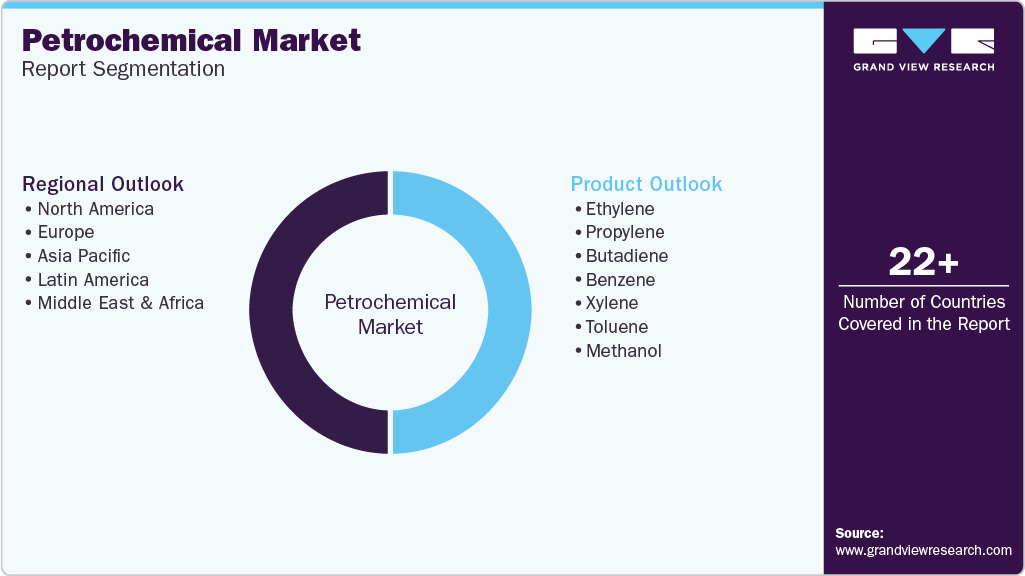
This report forecasts revenue and volume growth at global, regional, and country levels and provides an analysis of the latest industry trends in each of the sub-segments from 2021 to 2033. For this study, Grand View Research has segmented the global petrochemical market report based on product and region.
 To learn more about this report, Download Free Sample Report
-
Product Outlook (Volume, Million Tons; Revenue, USD Million, 2021 - 2033)
-
Ethylene
-
Propylene
-
Butadiene
-
Benzene
-
Xylene
-
Toluene
-
Methanol
-
-
Regional Outlook (Volume, Million Tons; Revenue, USD Million, 2021 - 2033)
-
North America
-
U.S.
-
Canada
-
Mexico
-
-
Europe
-
Germany
-
UK
-
Italy
-
France
-
Belgium
-
Netherlands
-
Russia
-
-
Asia Pacific
-
China
-
India
-
Japan
-
Malaysia
-
Indonesia
-
Vietnam
-
Australia
-
New Zealand
-
-
Latin America
-
Brazil
-
Argentina
-
Columbia
-
Peru
-
-
Middle East
-
Saudi Arabia
-
Iran
-
Oman
-
UAE
-
Qatar
-
Kuwait
-
-
Africa
-
South Africa
-
Angola
-
Nigeria
-
-
Research Methodology
The petrochemical market figures in this report are based on a proven research process that combines executive interviews with secondary research from proprietary databases, company filings, and recognized regulatory and institutional sources. Market size is built through value-chain sizing-reconciling supply-side and demand-side estimates-and triangulated with bottom-up and top-down approaches. Every estimate passes multiple levels of expert validation before publication, with each petrochemical segment quantified using the revenue-capture definitions in the table below.
Segment Definition
Segment - Product
Revenue capture definition
Ethylene
Revenue generated from the production and sale of ethylene used as a primary feedstock for manufacturing polyethylene, ethylene oxide, ethylene glycol, vinyl chloride monomer (VCM), and other petrochemical derivatives across packaging, automotive, construction, and industrial applications.
Propylene
Revenue derived from the commercialization of propylene utilized in the production of polypropylene, propylene oxide, acrylonitrile, cumene, and other intermediates serving automotive, packaging, textile, and consumer goods industries.
Butadiene
Revenue generated from the supply of butadiene used in the manufacturing of synthetic rubber, latex, ABS resins, nitrile rubber, and specialty elastomers for tire, automotive, footwear, and industrial applications.
Benzene
Revenue earned from the production and sale of benzene used as a feedstock for styrene, phenol, cyclohexane, aniline, and other aromatic derivatives supporting plastics, resins, detergents, pharmaceuticals, and synthetic fiber production.
Xylene
Revenue generated from the sale of xylene, including mixed xylene and its isomers, primarily consumed in the production of purified terephthalic acid (PTA), dimethyl terephthalate (DMT), solvents, and polyester-based products.
Toluene
Revenue derived from the commercialization of toluene used in the production of solvents, toluene diisocyanate (TDI), benzene, gasoline blending components, and chemical intermediates for coatings, adhesives, and polyurethane applications.
Methanol
Revenue generated from the production and sale of methanol used in formaldehyde, acetic acid, methyl tertiary butyl ether (MTBE), olefins, biodiesel, fuels, and various industrial and chemical manufacturing applications.
Estimation Model
Layer Name
Key Question
Description
Industry Assessment
What is the overall size and structure of the global petrochemical market?
Establishes the total market by evaluating global production, consumption, trade flows, and demand across major petrochemical products and key producing regions.
Product Segmentation
Which petrochemical products contribute the highest revenue and volume?
Estimates market size by product, including ethylene, propylene, butadiene, benzene, xylene, toluene, and methanol, based on production, pricing, and end-use demand.
Regional Market Assessment
Which regions account for the largest market share and growth potential?
Assesses production capacity, downstream industrial demand, feedstock availability, trade dynamics, and investments across North America, Europe, Asia Pacific, Latin America, and the Middle East & Africa.
Market Forecasting
What factors will influence future market growth?
Forecasts market revenue and volume using historical trends, capacity additions, feedstock economics, downstream demand growth, regulatory developments, and technological advancements.
Delivered Customizations
This report has been delivered with the following In-depth customizations
Client Request
Customization Delivered
Value Adds
Regional Segmentation
A comprehensive regional assessment of the petrochemical market was conducted across North America, Europe, Asia Pacific, Latin America, and Middle East & Africa. The study evaluated country-level demand and production trends for ethylene, propylene, butadiene, benzene, xylene, toluene, and methanol while examining feedstock availability, refinery integration, downstream manufacturing activity, and capacity additions across major producing regions.
Provides greater visibility into regional production hubs, demand centers, and investment hotspots. Supports capacity planning, geographic expansion, and strategic market prioritization across key petrochemical value chains.
Competitive Benchmarking
Leading petrochemical producers were benchmarked based on production capacity, feedstock integration, product portfolio, refinery integration, manufacturing footprint, operational efficiency, sustainability initiatives, and recent strategic developments. Competitive positioning across olefins, aromatics, and methanol production was also evaluated.
Helps identify competitive strengths, operational advantages, and market positioning gaps. Facilitates partnership evaluation, capacity expansion planning, and long-term competitive strategy development.
Opportunity Assessment
Growth opportunities were assessed across integrated petrochemical complexes, downstream specialty chemical manufacturing, sustainable feedstock adoption, circular economy initiatives, and expanding demand from packaging, automotive, construction, and consumer goods industries. The analysis also examined investment prospects in capacity expansions and high-value petrochemical derivatives.
Enables identification of attractive investment opportunities and emerging downstream applications. Supports long-term business expansion, product diversification, and strategic decision-making across the petrochemical value chain.
Frequently Asked Questions About This Report
Key players include BASF SE, British Petroleum Plc, Chevron Corporation, China National Petroleum Corporation (CNPC), China Petrochemical Corporation (SINOPEC), ExxonMobil Corporation, INEOS Group Ltd., LyondellBasell Industries Inc., Royal Dutch Shell PLC, and SABIC.
Key factors that are driving the petrochemicals market growth include rising demand for downstream products from end-use industries and capacity additions in the base chemical industry.
Asia Pacific market dominated, with a revenue share of 47.2% in 2025.
The global petrochemicals market is expected to grow at a CAGR of 7.2% from 2026 to 2033 to USD 1,192.1 billion by 2033.
The global petrochemicals market size was valued at USD 685.5 billion in 2025 and is estimated at USD 732.2 billion in 2026.
Ethylene segment accounted for the largest revenue of 41.8% in 2025.
About the Author(s)
Petrochemicals Research Team
Bulk Chemicals · PetrochemicalsThis report was authored by the petrochemicals research team at Grand View Research - comprising two research analysts, one senior research analyst, and one industry expert - with specialized expertise in the petrochemicals segment of the bulk chemicals industry. All findings are based on proprietary bulk chemicals databases, executive interviews, and regulatory analysis, subject to internal peer review prior to publication.
Last Updated:
Speak to Analyst

Customize this report to your needs - add regions, segments, or data points, with 20% free customization.
Or view our licence options:


ISO 9001:2015 & 27001:2022 Certified
We are GDPR and CCPA compliant! Your transaction & personal information is safe and secure. For more details, please read our privacy policy.


