
- Home
- »
- Power Generation & Storage
- »
-
Natural Gas Storage Market Size & Share Report, 2026-2033GVR Report cover

Natural Gas Storage Market (2026 - 2033)
Size, Share & Trends Analysis Report By Type (Aboveground, Underground (Depleted Gas Reservoir, Aquifer Reservoir, Salt Caverns)), By Region (North America, Asia Pacific, Europe, Latin America, MEA), And Segment Forecasts
Market Size, 2025
$587.7BMarket Estimate, 2026
$612.7BMarket Forecast, 2033
$880.8BCAGR, 2026–2033
5.3%Natural Gas Storage Market Summary
The global natural gas storage market size was valued at 587.7 BCM in 2025 and is projected to grow from 612.7 BCM in 2026 to 880.8 BCM by 2033, at a CAGR of 5.3% from 2026 to 2033. North America dominated the market, accounting with the largest share of 40.2% in 2025. This growth is attributed to the increasing reliance on natural gas as a cleaner energy source and the rising demand for electricity generation.
 Source: Grand View Research, IR Documents, Primary Interviews, Paid DatabasesTo learn more about this report,
 Download Free Sample Report
Key Market Trends & Insights
- By type: Underground segment led the market with the largest share of 92.0% in 2025.
Regional Highlights
- Largest regional market: North America (40.2% revenue share, 2025)
- By country: The U.S. held the largest market share in 2025
Market Size & Forecast
- Market size in 2025: 587.7 BCM
- Estimated market size in 2026: 612.7 BCM
- Projected market size by 2033: 880.8 BCM
- CAGR (2026-2033): 5.3%
Three ways to get this report
Buy it, customize it, or ask a question.Ask an Analyst
Analyst response in 1 business day
- AccessReport author, directly
- Reply timeWithin 1 working day
- No sales callDirect answer only
- FormatEmail reply
- CostFree, no cost
Get the Full Report
What the study covers
- FormatsPDF · Excel · Dashboard
- Timeline2026–2033 annual, 2025 base
- Coverage20+ countries, 5 regions
- Companies10+ key players profiled
Customize the Report
20% free customization
- IncludeCountries, segments, points
- TailorTo your product definition
- ExtendDeeper competitor detail
- OrA fully bespoke study
- Turnaround5–10 working days
In addition, the deregulation of the natural gas market has made storage essential for managing supply and demand fluctuations. Moreover, seasonal variations in consumption, particularly during winter, further necessitate robust storage capabilities to ensure energy security and accommodate growing industrial and residential needs.Natural gas storage refers to the practice of reserving natural gas for future use, akin to maintaining a savings account. This process is essential for managing supply and demand fluctuations, particularly during peak usage periods in winter and summer. Typically, natural gas is stored underground in depleted reservoirs, aquifers, or salt caverns, allowing for efficient retrieval when needed.
 To learn more about this report, Download Free Sample Report
Favorable government initiatives are significantly enhancing the market for natural gas stockpiling. Globally, governments are expanding tax incentives to encourage the adoption of liquefied natural gas (LNG) vehicles and infrastructure. In countries such as India and China, there is a concerted effort to finance the development of compressed natural gas (CNG) technologies. This includes providing loans and grants for constructing CNG fueling stations, which aim to reduce emissions and improve air quality and stimulate job creation within the economy.
Furthermore, the sports industry is witnessing a surge in the adoption of wearable technology integrated with real-time location systems (RTLS). This trend is driven by significant sports media and broadcasting investments, as organizations seek innovative methods to enhance engagement and performance analysis. RTLS technology allows for detailed tracking of athletes' performance across various sports, including basketball and football, thereby facilitating data-driven decision-making in competitive settings.
Market Dynamics
The natural gas storage market is driven by increasing demand for energy security, seasonal demand balancing, and the need to manage fluctuations in natural gas supply and consumption. Rising natural gas production, expansion of pipeline networks, and growing adoption of gas-fired power generation are supporting investments in storage infrastructure. The market is witnessing a shift toward advanced storage technologies, including enhanced monitoring systems and optimized reservoir management solutions, to improve operational efficiency. However, high development costs, regulatory complexities, and geological limitations remain key challenges. Going forward, demand for flexible and reliable storage capacity is expected to increase as natural gas continues to support grid stability and energy transition strategies.
The natural gas storage market is primarily driven by the growing need for energy security, seasonal demand management, and supply reliability amid fluctuations in natural gas production and consumption. Storage facilities enable utilities and energy companies to balance peak demand periods, manage supply disruptions, and optimize gas availability across regions. Rising natural gas consumption for power generation, industrial applications, and heating, along with increasing integration of intermittent renewable energy sources, is further increasing the need for flexible gas storage capacity.
In 2025, the European Union continued strengthening natural gas storage security by maintaining high storage levels ahead of the winter heating season, following energy supply uncertainties caused by reduced pipeline gas availability and geopolitical risks. The EU’s focus on securing adequate storage inventories and flexible gas supply arrangements highlighted the growing importance of underground gas storage facilities for seasonal demand balancing, grid reliability, and energy security.
The market faces challenges due to the high capital costs associated with developing underground storage facilities, LNG storage infrastructure, and associated pipeline networks. Site selection, geological suitability, permitting requirements, and environmental regulations can significantly increase project development timelines and costs. Fluctuations in natural gas prices and uncertainty around long-term gas demand may impact investment decisions, creating challenges for new storage capacity expansion.
Growing adoption of renewable energy sources is creating new opportunities for the natural gas storage market by increasing the need for flexible and reliable energy balancing solutions. Natural gas storage enables power systems to manage fluctuations in renewable generation by providing backup supply during periods of low renewable output. Investments in hydrogen-ready storage facilities, advanced monitoring technologies, and flexible gas infrastructure are further expanding market opportunities. Rising focus on energy security and resilient gas networks is expected to support the development of modern storage solutions.
Analyst Perspective
The natural gas storage market is gaining strategic importance as energy security concerns, seasonal demand fluctuations, and supply chain uncertainties increase the need for flexible gas reserves. A key trend is the integration of natural gas storage facilities with LNG infrastructure and the development of hydrogen-ready storage solutions to support the energy transition. Established operators are strengthening their position through asset expansion, pipeline integration, and capacity optimization, while specialized players focus on advanced storage technologies and project execution. However, high capital investments, regulatory complexities, and long development cycles continue to influence market growth.
Type Insights
Based on type, the underground segment led the market with the largest share of 92.0% in 2025, owing to its capacity to store large volumes of gas for extended periods. This type of storage is crucial for balancing seasonal fluctuations in energy demand, particularly in regions with high natural gas consumption. In addition, underground facilities, such as depleted reservoirs and salt caverns, provide efficient means to manage excess supply during low-demand periods and ensure availability during peak usage. Furthermore, advancements in technology and infrastructure have enhanced the operational efficiency of these storage systems, making them more attractive for meeting the dynamic energy needs of various sectors, including industrial and residential applications.
The above-ground natural gas storage segment is expected to grow at a CAGR of 4.2% from 2025 to 2030. Its flexibility and lower operational costs drive this growth. Above-ground facilities, such as LNG storage tanks, allow for rapid access to stored gas, which is beneficial during sudden spikes in demand. In addition, the increasing adoption of LNG as a cleaner fuel option across various industries also propels this segment forward. Furthermore, regulatory support and investments in infrastructure are encouraging the development of above-ground storage solutions that can be easily integrated into existing energy systems.
Underground Type Insights
The depleted gas reservoir segment dominated the underground type segment and accounted for the largest share of 75.9% in 2025, driven by its established infrastructure and cost-effectiveness for natural gas storage. In addition, these reservoirs, which have already been tapped for fossil fuel extraction, provide a ready-made solution for storing natural gas, benefiting from the existing wells and facilities. Furthermore, their geological characteristics allow for efficient gas storage, with the ability to maintain pressure levels that facilitate gas retrieval. Moreover, the growing demand for energy security and the transition to cleaner energy sources drive investments in these reservoirs, making them a viable option for meeting fluctuating energy needs.
Salt caverns are expected to grow at a CAGR of 11.0% over the forecast period, owing to their unique structural properties and operational advantages. Salt formations' high integrity and strength make them ideal for creating caverns that can withstand significant pressure changes without risk of collapse. Furthermore, this type of storage allows for rapid injection and gas withdrawal, making it particularly useful for balancing supply and demand fluctuations. Moreover, salt caverns support high storage efficiencies and lower operational costs, which appeal to an increasingly competitive energy market.
Regional Insights
North America dominated the natural gas storage market with the largest share of 40.2% in 2025. This growth is attributed to the region's extensive infrastructure and high production levels. In addition, the region dominates this market, accounting for a significant share due to the operation of over 400 underground storage sites. Furthermore, increasing demand for natural gas, particularly for heating and industrial applications, enhances the need for reliable storage solutions.
 To learn more about this report, Download Free Sample Report
U.S. Natural Gas Storage Market Trends
The natural gas storage market in U.S. held the largest share in the North America region in 2025, driven by robust production capabilities and a well-established network of storage facilities. In addition, the country’s transition towards cleaner energy sources has led to increased investments in natural gas infrastructure, including depleted reservoirs and salt caverns. Furthermore, the growing emphasis on energy security and the need to balance supply with fluctuating demand further drive the expansion of storage capacity. Moreover, technological advancements in monitoring and managing storage systems are enhancing operational efficiency, making U.S. natural gas storage a vital component of the energy landscape.
Asia Pacific Natural Gas Storage Market Trends
The Asia Pacific natural gas storage market is expected to grow at a CAGR of 5.8% over the forecast period, owing to rapid economic development and urbanization. In addition, countries in this region are increasingly shifting towards natural gas to reduce coal dependency and improve air quality. Furthermore, investments in infrastructure, including regasification terminals and distribution networks, are essential to support this growth and ensure that natural gas can meet rising energy demands.
The natural gas storage market in China led the Asia Pacific market and accounted for the largest share in 2024, driven by government initiatives aimed at increasing the share of natural gas. This shift is driven by concerns over air quality and a commitment to reducing greenhouse gas emissions. Investments in domestic production and infrastructure development are crucial for meeting the anticipated surge in demand. In addition, as China continues to urbanize and industrialize, the need for efficient natural gas storage solutions becomes increasingly important for maintaining energy security.
Europe Natural Gas Storage Market Trends
Europe natural gas storage market is expected to witness substantial growth over the forecast period, driven by countries seeking to enhance energy security amid geopolitical uncertainties. In addition, the region's reliance on imported natural gas necessitates robust storage capabilities to manage supply disruptions and seasonal demand variations. Investments in underground facilities, such as depleted reservoirs and salt caverns, are critical for ensuring a stable natural gas supply during peak periods. Furthermore, European policies promoting renewable energy integration drive demand for flexible storage solutions that accommodate varying energy sources.
The growth of the natural gas storage market in Germany is attributed to a commitment to transitioning towards a low-carbon economy. As part of its energy transition strategy (Energiewende), Germany is increasing its reliance on natural gas as a transitional fuel while phasing out coal and nuclear power. In addition, this shift necessitates enhanced storage capacity to manage fluctuations in supply and ensure reliability during periods of high demand. Furthermore, investments in infrastructure improvements are essential for integrating renewable energy sources into the existing grid while maintaining adequate backup supplies from natural gas storage facilities.
Key Natural Gas Storage Company Insights
Key companies in the global natural gas storage industry include McDermott International, Inc., NAFTA A.S., TransCanada Corp., and others. These companies adopt various strategies to enhance their competitive edge. These strategies include investing in advanced technologies for efficient storage solutions, optimizing existing infrastructure, and expanding storage capacity to meet rising demand. Furthermore, companies focus on forming strategic partnerships and collaborations to enhance service offerings and improve market reach.
-
TransCanada Corp. specializes in unregulated natural gas storage, offering services that include supply security, operational balancing, and risk management for various clients, such as utilities and producers. Operating primarily in the underground storage segment, the company energy leverages its strategically located facilities to meet the growing demand for natural gas while ensuring reliable service and operational efficiency.
-
Royal Vopak N.V. operates in the energy and chemicals sectors, focusing on providing safe and efficient storage solutions for its customers. The company manages above-ground facilities that cater to the needs of the LNG market. By enhancing its service offerings and expanding its terminal network, it aims to support the increasing demand for natural gas as a cleaner energy source worldwide.
Key Natural Gas Storage Companies:
The following key companies have been profiled for this study on the natural gas storage market.
- McDermott International, Inc.
- NAFTA A.S.
- TransCanada Corp.
- Royal Vopak N.V.
- Chart Industries
- Uniper
- Sempra
- Enbridge, Inc.
- Gazprom
- Martin Midstream Partners L.P.
Competitive Benchmarking
Category
Operating Strategies
Competitive Edge
Weakness
Established Players (TC Energy Corporation; Royal Vopak N.V.; Sempra; Chart Industries; Uniper; Enbridge, Inc.; Gazprom; Kinder Morgan)
- Focus on expanding and optimizing large-scale natural gas storage infrastructure, including underground storage facilities, LNG terminals, and integrated pipeline networks to enhance supply reliability.
- Leverage long-term contracts, strategic partnerships, and geographically diversified assets to secure stable revenue streams from utilities, energy companies, and industrial customers.
- Invest in modernization, digital monitoring systems, LNG infrastructure, and low-carbon solutions such as hydrogen-ready storage to align with evolving energy transition requirements.
- Strong asset ownership with extensive storage capacity, pipeline connectivity, and established customer relationships across major gas markets.
- High financial capability enables large-scale infrastructure investments, acquisitions, and expansion into emerging gas storage hubs.
- Integrated operations across gas transportation, LNG, and storage provide operational synergies and supply chain advantages.
- High capital expenditure requirements and long project development timelines for new storage infrastructure.
- Exposure to regulatory changes, environmental restrictions, and declining long-term demand for natural gas in some regions due to energy transition policies.
- Large legacy asset bases may create operational challenges and require significant investment for modernization and emissions reduction.
Emerging Players (McDermott International, Inc.; NAFTA A.S.)
- Focus on specialized capabilities such as engineering, construction, and development of gas storage infrastructure rather than owning large storage portfolios.
- Target niche opportunities in regional storage projects, underground gas storage development, and LNG infrastructure expansion through project-based contracts.
- Build competitiveness through technical expertise, customized solutions, and partnerships with utilities, governments, and energy infrastructure operators.
- Greater flexibility and specialization allow faster adaptation to regional storage requirements and emerging technologies.
- Strong engineering expertise in complex gas infrastructure projects, including underground storage development and LNG facilities.
- Ability to serve underserved markets and support new storage capacity additions without the burden of owning large asset networks.
- Limited ownership of large-scale storage assets reduces recurring revenue opportunities compared with integrated storage operators.
- Greater dependence on project awards, customer investment cycles, and infrastructure spending trends.
- Smaller geographic presence and lower financial scale can limit competitiveness in large international storage projects.
Recent Developments
-
In June 2024, Aramco and Sempra announced a non-binding Heads of Agreement for a 20-year LNG offtake agreement from the Port Arthur LNG Phase 2 development project. This deal includes a commitment of 5 million tonnes per annum and Aramco’s 25% equity participation in the project. Both companies aim to enhance global energy security and reduce carbon emissions through this strategic partnership, which is expected to facilitate the distribution of U.S. natural gas worldwide.
-
In June 2024, Vopak and Gasunie initiated a market consultation to explore the future use of the EemsEnergyTerminal in Eemshaven, Netherlands, focusing on liquefied natural gas (LNG), hydrogen, and CO2. This effort aims to extend the terminal's operation beyond its initial five-year contract, enhancing energy security amid reduced Russian gas supplies. The consultation will assess market interest in LNG imports post-2027 and investigate conditions for hydrogen development and carbon capture, supporting the transition to a sustainable energy system.
Natural Gas Storage Market Report Scope
Report Attribute
Details
Market Definition
The natural gas storage market refers to the global installed working gas storage capacity of natural gas infrastructure, measured in billion cubic meters (BCM). BCM represents the volumetric capacity of underground and above-ground storage facilities.
Market size in 2025
587.7 BCM
Estimated market size in 2026
612.7 BCM
Projected market size by 2033
880.8 BCM
Growth rate
CAGR of 5.3% from 2026 to 2033
Base year for estimation
2025
Historical data
2021 - 2024
Forecast period
2026 - 2033
Quantitative units
Volume in BCM and CAGR from 2026 to 2033
Report coverage
Volume forecast, company ranking, competitive landscape, growth factors, and trends
Segments covered
Type, region
Regional scope
North America, Europe, Asia Pacific, Latin America, Middle East & Africa
Country scope
U.S.; Canada; Mexico; China; Australia; Germany; UK; France; Italy; Ukraine; Brazil; Argentina; UAE; South Africa
Key companies profiled
McDermott International, Inc.; NAFTA A.S.; TC Energy Corporation; Royal Vopak N.V.; Sempra; Chart Industries; Uniper; Enbridge, Inc.; Gazprom; Kinder Morgan
Customization scope
Free report customization (equivalent up to 8 analysts' working days) with purchase. Addition or alteration to country, regional & segment scope.
Pricing and purchase options
Avail customized purchase options to meet your exact research needs. Explore purchase options
Global Natural Gas Storage Market Report Segmentation
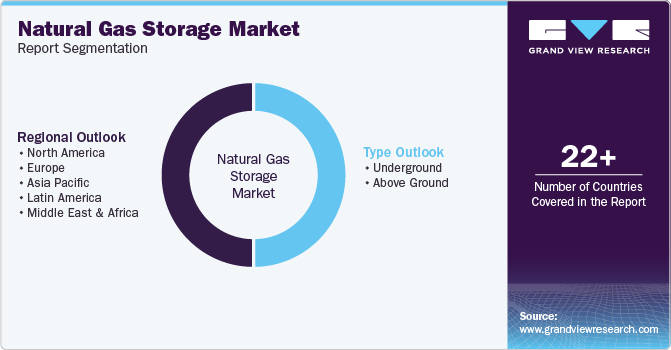
This report forecasts revenue growth at global, regional, and country levels and analyzes the latest industry trends in each sub-segment from 2021 to 2033. For this study, Grand View Research has segmented the global natural gas storage market report based on type and region.
 To learn more about this report, Download Free Sample Report
-
Type Outlook (Volume, BCM, 2021 - 2033)
-
Underground
-
Depleted gas Reservoir
-
Aquifer Reservoir
-
Salt Caverns
-
-
Above Ground
-
-
Regional Outlook (Volume, BCM, 2021 - 2033)
-
North America
-
U.S.
-
Canada
-
Mexico
-
-
Europe
-
Germany
-
Russia
-
UK
-
France
-
Italy
-
Ukraine
-
-
Asia Pacific
-
China
-
Australia
-
-
Latin America
-
Brazil
-
Argentina
-
-
Middle East and Africa
-
UAE
-
South Africa
-
-
Research Methodology
The Natural gas storage market figures in this report are based on a proven research process that combines executive interviews with secondary research from proprietary databases, company filings, and recognized regulatory and institutional sources. Market size is built through value-chain sizing - reconciling supply-side and demand-side estimates - and triangulated with bottom-up and top-down approaches. Every estimate passes multiple levels of expert validation before publication, with each natural gas Storage segment quantified using the revenue-capture definitions in the table below.
Segment Definition
Segment - Type
Capacity definition
Underground
Underground Natural Gas Storage refers to storage facilities where natural gas is injected and stored in subsurface geological formations for seasonal demand balancing, supply security, and market flexibility. Capacity is calculated by storage capacity leasing, injection and withdrawal services, and natural gas storage services provided to utilities, energy companies, and industrial users.
Depleted gas Reservoir
Depleted Gas Reservoir Natural Gas Storage refers to storage facilities that utilize depleted oil and gas fields to store natural gas within previously producing geological formations. Capacity is calculated by the leasing of storage capacity, gas injection and withdrawal operations, and storage services offered to utilities, pipeline operators, and gas suppliers.
Aquifer Reservoir
Aquifer Reservoir Natural Gas Storage refers to underground storage systems that use naturally occurring water-bearing rock formations to contain and store natural gas under pressure. Capacity is calculated by contracted storage capacity, natural gas injection and extraction services, and operational services provided to energy suppliers and utilities.
Salt Caverns
Salt Cavern Natural Gas Storage refers to storage facilities created by dissolving underground salt formations to form high-pressure cavities capable of rapidly injecting and withdrawing natural gas. Capacity is calculated by storage capacity rentals, high-volume gas cycling services, and peak demand balancing solutions provided to power generators, utilities, and gas traders.
Above Ground
Above Ground Natural Gas Storage refers to surface-based storage facilities that store natural gas in above-ground tanks or containment systems, primarily including LNG storage tanks and compressed natural gas storage systems. Capacity is calculated by the sales of storage capacity, LNG/CNG storage services, and handling and management services provided to energy companies, industrial users, and distribution networks.
Estimation Model
Layer Name
Key Question
Description
Natural Gas Storage Capacity & Infrastructure Layer
What drives the availability of natural gas storage capacity?
Identify key storage infrastructure sources, including underground storage facilities (depleted gas reservoirs, aquifer reservoirs, and salt caverns) and above-ground storage systems. Assess factors such as natural gas demand fluctuations, pipeline infrastructure availability, storage capacity additions, geological suitability, and investment in storage facility development that influence overall storage availability.
Natural Gas Storage Type & Technology Layer
What types of storage systems are utilized for natural gas storage?
Analyze adoption of major natural gas storage types, including underground storage and above-ground storage. Assess storage utilization based on geological formations such as depleted gas reservoirs, aquifer reservoirs, and salt caverns, along with factors influencing storage efficiency, injection and withdrawal rates, operational flexibility, safety requirements, and technology advancements.
Natural Gas Storage Application & End-Use Layer
Where is stored natural gas utilized?
Evaluate natural gas storage demand across key applications, including power generation, residential and commercial heating, industrial consumption, and gas trading activities. Assess demand drivers such as seasonal demand balancing, energy security requirements, peak load management, renewable energy integration, and supply reliability across end-use sectors.
Storage Capacity Estimation Layer
How is the total market size quantified?
The market size is quantified by aggregating the installed working gas storage capacity across underground and above-ground natural gas storage facilities. The overall market is determined by assessing operational storage capacity, new capacity additions, facility utilization trends, infrastructure expansion, and regional storage development, with results expressed in billion cubic meters (BCM).
Delivered Customizations
This report has been delivered with the following In-depth customizations
Client Request
Customization Delivered
Value Adds
Competitive Landscape Assessment
Benchmarked key natural gas storage market participants based on storage capacity, facility ownership, geographic presence, pipeline integration, operational capabilities, infrastructure expansion strategies, and technological advancements. Evaluated the competitive positioning of established operators and specialized infrastructure providers.
Supported competitor benchmarking, identification of leading storage operators, and assessment of strategic expansion opportunities in natural gas storage infrastructure development.
Storage Type Assessment
Analyzed key natural gas storage types, including underground storage and above-ground storage systems, based on capacity characteristics, operational flexibility, storage efficiency, and application suitability. Evaluated adoption trends and growth potential across different storage technologies.
Supported identification of high-growth storage segments, understanding of infrastructure preferences, and assessment of investment opportunities across the natural gas storage value chain.
Market Opportunity Assessment
Assessed emerging opportunities in natural gas storage, including LNG storage expansion, hydrogen-ready storage infrastructure, renewable energy balancing, and strategic gas reserve development.
Supported identification of future growth avenues and investment opportunities across evolving natural gas storage markets.
Frequently Asked Questions About This Report
Asia Pacific is anticipated to register the fastest CAGR of 6.5% over the forecast period.
Based on type, the underground segment accounted for largest share of 92.0% in 2025.
Based on type, the above ground segment is expected to register second fastest CAGR of 4.7% for the forecast period.
The key players operating in the natural gas storage market are TC Energy Corporation, Royal Vopak N.V., Sempra, Chart Industries, Uniper, Enbridge, Inc., Gazprom, Kinder Morgan, McDermott International, Inc., NAFTA A.S., and others.
The natural gas storage market size was estimated at 587.7 BCM in 2025 and is expected to reach 612.7 BCM in 2026.
The natural gas storage market is expected to grow at a CAGR of 5.3% from 2026 to 2033 to reach 880.8 BCM by 2033.
The natural gas storage market is primarily driven by increasing energy security requirements, seasonal demand fluctuations, expansion of LNG infrastructure, growing need for supply reliability, and investments in storage capacity expansion to support grid stability and market flexibility.
The North America region dominated the natural gas storage market with a share of 40.2% in 2025.
The U.S. dominated the North America region market with a share of 66.6% in 2025.
About the Author(s)
Power Generation & Storage Research Team
Energy & Power · Power Generation & StorageThis report was authored by the power generation & storage research team at Grand View Research - comprising two research analysts, one senior research analyst, and one industry expert - with specialized expertise in the power generation & storage segment of the energy & power industry. All findings are based on proprietary energy & power databases, executive interviews, and regulatory analysis, subject to internal peer review prior to publication.
Last Updated:
Speak to Analyst

Customize this report to your needs - add regions, segments, or data points, with 20% free customization.
Or view our licence options:


ISO 9001:2015 & 27001:2022 Certified
We are GDPR and CCPA compliant! Your transaction & personal information is safe and secure. For more details, please read our privacy policy.


