
- Home
- »
- Power Generation & Storage
- »
-
Power Generation Market Size And Growth Report, 2026-2033GVR Report cover

Power Generation Market (2026 - 2033)
Size, Share & Trends Analysis Report By Type (Hydro, Fossil Fuel, Nuclear, Solar, Wind, Geothermal, Biomass), By Grid (Off Grid, On Grid), By End Use (Industrial, Commercial), By Region, And Segment Forecasts
Market Size, 2025
$2,386.6BMarket Estimate, 2026
$2,574.5BMarket Forecast, 2033
$4,451.3BCAGR, 2026–2033
8.1%Power Generation Market Summary
The global power generation market size was valued at USD 2,386.6 billion in 2025 and is projected to grow from USD 2,574.5 billion in 2026 to USD 4,451.3 billion by 2033, at a CAGR of 8.1% from 2026 to 2033. The Asia Pacific held the largest share of 49.9% of the global market in 2025. The market is experiencing steady growth as governments and utilities increasingly prioritize energy security, grid reliability, and sustainable electricity supply to meet rising global demand.
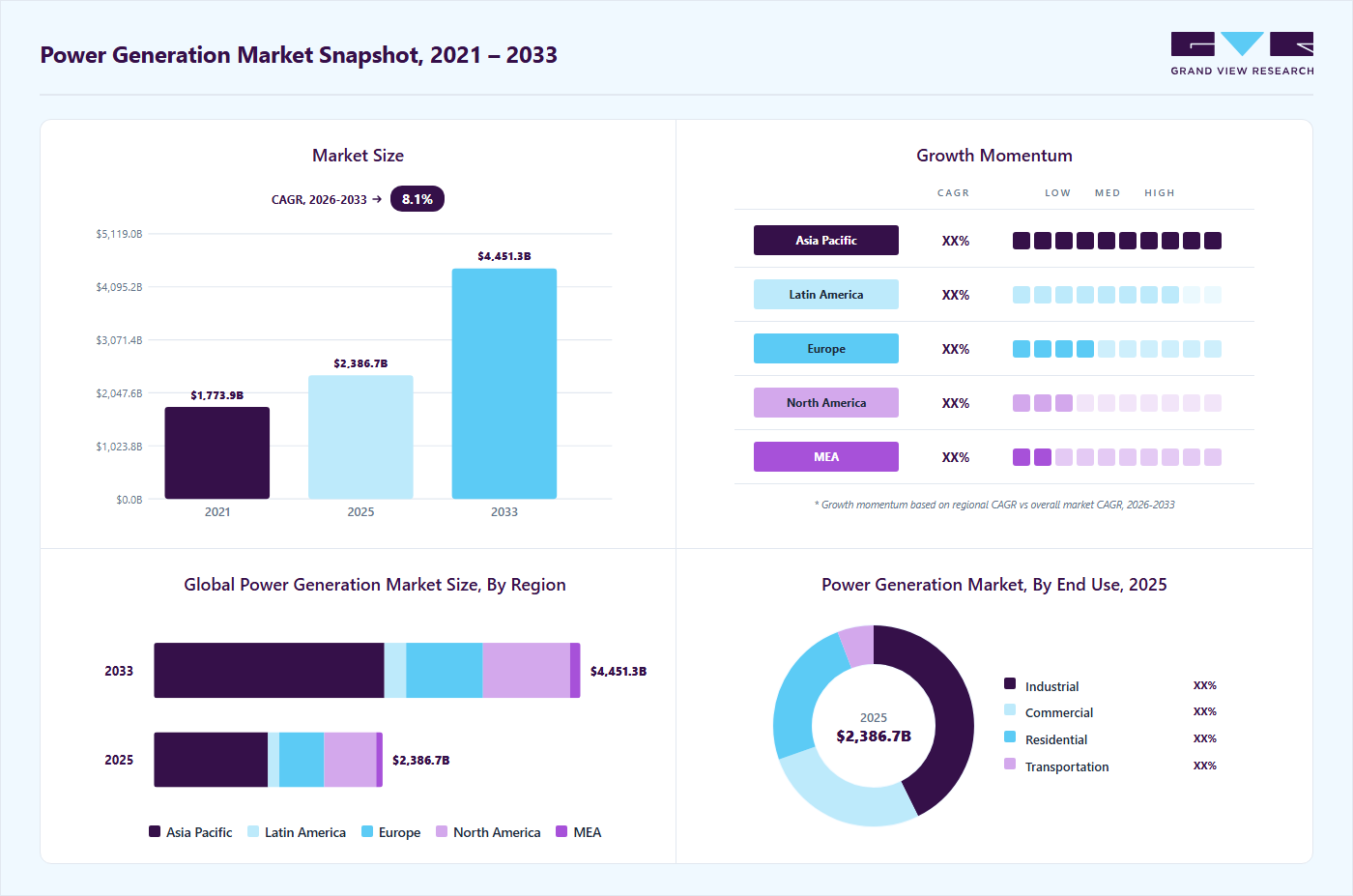 Source: Grand View Research, IR Documents, Primary Interviews, Paid DatabasesTo learn more about this report,
 Download Free Sample Report
 Key Market Trends & Insights
- By type: Fossil fuel segment held the largest market share of 58.6% in 2025.
- By grid: On-grid segment accounted for the largest market share of 92.6% in 2025.
- By end use: Industrial segment accounted for the largest revenue share of 42.6% in 2025.
Regional Highlights
- Largest regional market: Asia Pacific (49.9% revenue share, 2025)
- Fastest-growing regional market: Asia Pacific (9.2% CAGR, 2026-2033)
- By country: China held a significant share of the global market in 2025.
Market Size & Forecast
- Market size in 2025: USD 2,386.6 Billion
- Estimated market size in 2026: USD 2,574.5 Billion
- Projected market size by 2033: USD 4,451.3 Billion
- CAGR (2026-2033): 8.1%
Three ways to get this report
Buy it, customize it, or ask a question.Ask an Analyst
A direct answer, usually in 1 working day
- AccessReport author, directly
- Reply timeWithin 1 working day
- No sales callDirect answer only
- FormatEmail reply
- CostFree, no cost
Get the Full Report
What the study covers
- FormatsPDF · Excel · Dashboard
- Timeline2026–2033 annual, 2025 base
- Coverage20+ countries, 5 regions
- Companies10+ key players profiled
Customize the Report
20% free customization
- IncludeCountries, segments, points
- TailorTo your product definition
- ExtendDeeper competitor detail
- OrA fully bespoke study
- Turnaround5–10 working days
Advancements in power generation technologies, including high-efficiency gas turbines, renewable energy systems, and hybrid generation models, are enabling improved operational efficiency, reduced emissions, and optimized energy output across diverse generation sources.Rising global electricity consumption driven by urbanization, industrialization, and digital transformation is accelerating investments in new power generation capacity. Countries are expanding their generation mix through the integration of renewable energy sources such as solar, wind, and hydropower, alongside conventional sources such as coal, natural gas, and nuclear energy. Aging power infrastructure in several regions is further driving modernization efforts, including the deployment of smart grids, distributed energy resources, and advanced energy storage systems to enhance grid stability and ensure uninterrupted power supply across both developed and emerging economies.
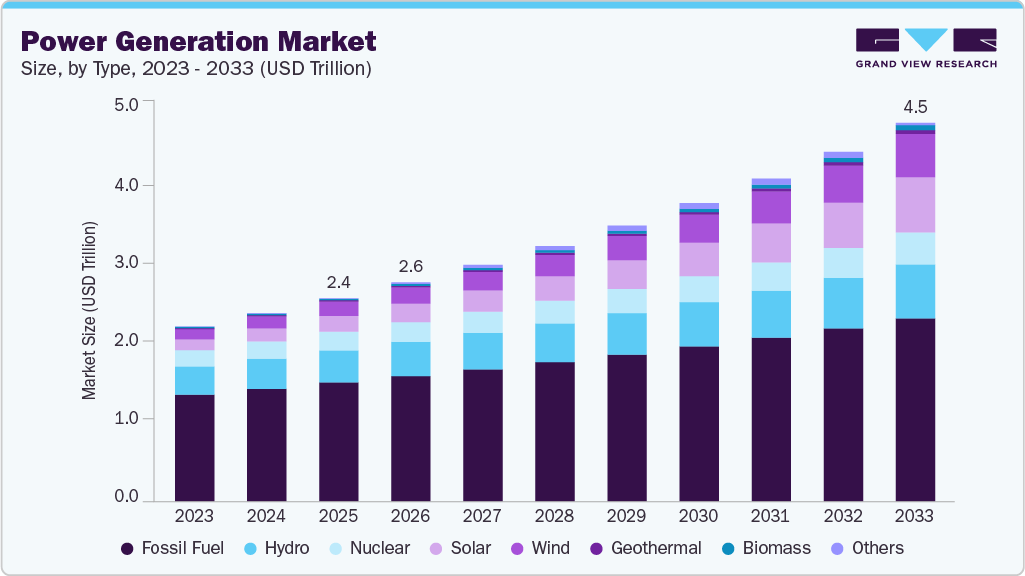 To learn more about this report, Download Free Sample Report
 Increasing regulatory focus on decarbonization and environmental sustainability is reshaping the power generation landscape. Governments and regulatory bodies are implementing stringent emission norms and promoting clean energy adoption through incentives, subsidies, and policy frameworks. Technology providers are integrating digital solutions such as artificial intelligence, predictive analytics, and cloud-based energy management systems to optimize generation performance and enable real-time monitoring. As the global energy transition accelerates and the demand for reliable and low-carbon electricity grows, power generation technologies are becoming critical for building resilient, efficient, and environmentally sustainable energy systems.
Drivers, Opportunities & Restraints
The primary driver of the power generation industry is the rising global demand for reliable and uninterrupted electricity supply, supported by rapid urbanization, industrial expansion, and increasing electrification across transportation, manufacturing, and residential sectors. Governments and utilities are focusing on strengthening energy security, reducing dependency on imports, and ensuring grid stability through diversified power generation portfolios. The transition toward cleaner energy sources, coupled with stringent emission regulations, is accelerating investments in renewable power generation such as solar, wind, and hydropower, alongside the modernization of conventional thermal and nuclear power plants. Additionally, aging generation infrastructure in developed regions is driving refurbishment, efficiency upgrades, and the deployment of advanced generation technologies to improve output and reduce environmental impact.
A significant opportunity lies in the integration of digital technologies, energy storage systems, and distributed energy resources within power generation networks. The adoption of smart grids, artificial intelligence, predictive analytics, and cloud-based energy management platforms is enabling real-time monitoring, demand forecasting, and optimized generation dispatch. Emerging economies in the Asia Pacific, the Middle East, and Africa are witnessing substantial investments in new power generation capacity to meet rising electricity demand and support economic development. Furthermore, the increasing deployment of hybrid energy systems combining renewable and conventional sources, along with advancements in battery storage and green hydrogen production, is creating new avenues for market growth and innovation in the global power generation landscape.
However, the market faces restraints related to high capital investment requirements and long project development timelines associated with large-scale power generation projects, particularly in nuclear and thermal segments. Regulatory uncertainties, land acquisition challenges, and environmental concerns can delay project approvals and increase overall costs. Additionally, the intermittent nature of renewable energy sources such as solar and wind poses challenges for grid stability and requires significant investments in storage and grid infrastructure. Variations in policy frameworks across regions and the financial constraints of utilities in developing economies may further limit market expansion. Despite these challenges, ongoing advancements in generation technologies, supportive government policies, and the global push toward decarbonization are expected to sustain steady growth in the market over the forecast period.
Type Insights
Based on type, the fossil fuel segment accounted for the largest market revenue share of 58.6% in 2025, driven by its established infrastructure, consistent power output, and widespread adoption across both developed and developing economies. Fossil fuel-based power generation, including coal, natural gas, and oil, continues to serve as the backbone of global electricity supply due to its ability to provide baseload power and support grid stability. Many countries rely heavily on thermal power plants to meet rising electricity demand, particularly in regions where renewable energy integration is still evolving. Additionally, ongoing investments in high-efficiency technologies such as combined cycle gas turbines and ultra-supercritical coal plants are improving generation efficiency and reducing emissions, further sustaining the dominance of fossil fuel-based power generation in the global energy mix.
The solar segment is projected to register the fastest CAGR of 17.0% during the forecast period, supported by the accelerating global transition toward clean and renewable energy sources. Solar power generation is witnessing rapid adoption due to declining photovoltaic (PV) module costs, supportive government policies, and increasing investments in utility-scale and distributed solar projects. The scalability, low operational costs, and minimal environmental impact of solar energy are making it an attractive alternative to conventional power sources. Furthermore, advancements in energy storage technologies and grid integration solutions are enhancing the reliability of solar power, enabling higher penetration across electricity networks. As countries intensify their decarbonization efforts and expand renewable capacity targets, solar power is expected to play a pivotal role in reshaping the global power generation landscape.
Grid Insights
Based on grid, the on-grid segment accounted for the largest market revenue share of 92.6% in 2025, driven by its critical role in supporting large-scale electricity generation and distribution through centralized transmission and distribution networks. On-grid power generation systems are widely deployed across urban and industrial regions to meet high and continuous electricity demand. These systems enable efficient power distribution, grid stability, and integration of multiple energy sources, including thermal, nuclear, and renewable energy. Increasing investments in grid infrastructure, smart grid technologies, and large-scale renewable energy projects are further strengthening the dominance of on-grid systems in the global market.
The off-grid segment is projected to register the fastest CAGR of 15.5% during the forecast period, supported by its growing importance in providing electricity access to remote and underserved regions where centralized grid infrastructure is limited or unavailable. Off-grid solutions, including solar home systems, diesel generators, and hybrid microgrids, offer flexibility, rapid deployment, and energy independence, making them highly suitable for rural electrification and decentralized power generation.
End Use Insights
Based on end use, the industrial segment accounted for the largest market revenue share of 42.6% in 2025, driven by high and continuous electricity demand across manufacturing, mining, oil & gas, chemicals, and heavy industries. Industrial operations require a reliable and large-scale power supply to maintain production efficiency, minimize downtime, and support energy-intensive processes. Many industries rely on captive power plants and dedicated generation systems to ensure uninterrupted operations and reduce dependency on grid fluctuations. Additionally, increasing industrialization in emerging economies and the expansion of energy-intensive sectors are further strengthening the demand for robust power generation solutions within the industrial segment.
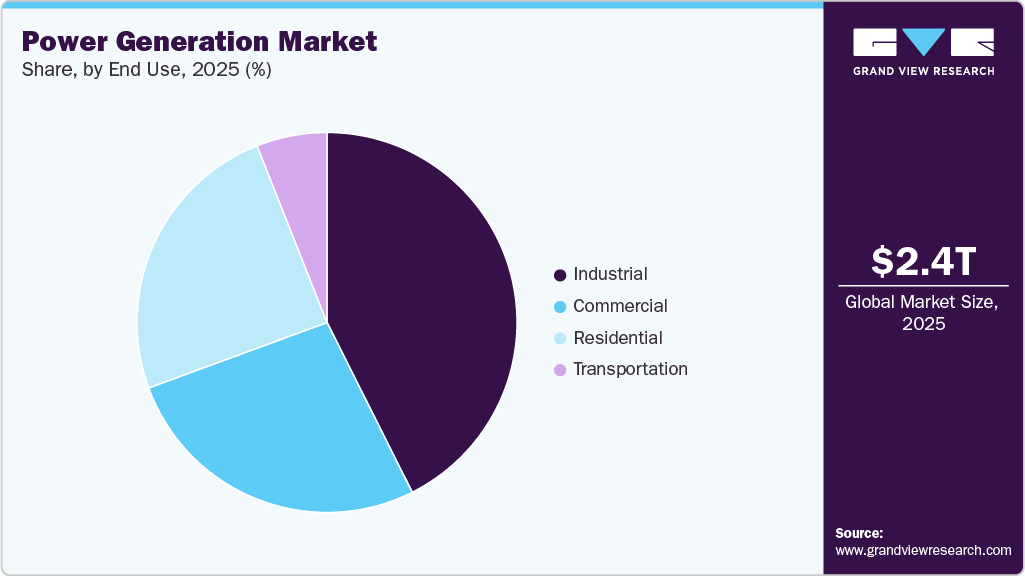 To learn more about this report, Download Free Sample Report
 The residential segment is projected to register the fastest CAGR of 9.0% during the forecast period, supported by rising household electricity consumption and increasing electrification rates across developing regions. Rapid urbanization, population growth, and improving living standards are driving higher demand for electricity for appliances, heating, cooling, and digital connectivity. The growing adoption of distributed energy systems such as rooftop solar panels and home energy storage solutions is also contributing to the expansion of residential power generation.
Regional Insights
Asia Pacific power generation industry accounted for the largest revenue share of 49.9% in 2025, driven by rapid urbanization, industrialization, and rising electricity demand across emerging economies. Countries such as China, India, Japan, and Southeast Asian nations are investing heavily in expanding power generation capacity to support economic growth and energy security. The region continues to rely on a balanced energy mix, including thermal power for baseload supply and rapidly expanding renewable energy sources such as solar and wind.
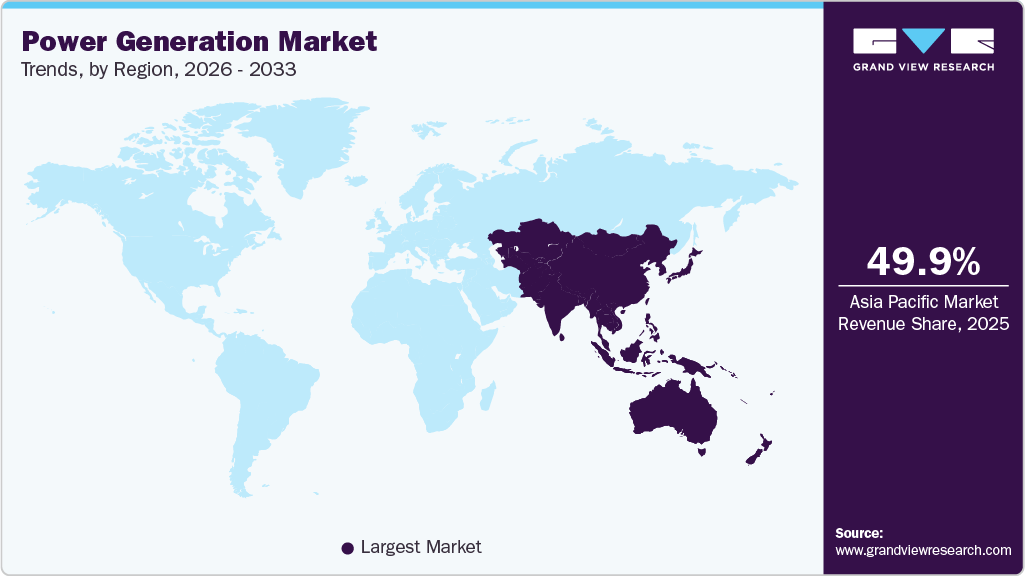 To learn more about this report, Download Free Sample Report
 The region’s strong CAGR growth of 9.2% is further supported by increasing investments in grid infrastructure, energy storage systems, and digital energy management platforms aimed at improving efficiency and reliability. Government initiatives promoting renewable energy adoption, rural electrification, and decarbonization are accelerating capacity additions across both utility-scale and distributed generation systems. Furthermore, the growing deployment of microgrids, rooftop solar installations, and hybrid energy systems is enhancing energy accessibility and supporting sustained market expansion across the Asia Pacific.
China power generation industry is a major contributor to the global power generation industry, driven by its large-scale industrial base, rapid urbanization, and continuously rising electricity demand. The country has one of the largest installed power generation capacities globally, supported by a mix of coal, hydropower, nuclear, wind, and solar energy sources. While coal continues to play a significant role in ensuring baseload power supply, China is aggressively expanding its renewable energy capacity through large-scale solar parks, wind farms, and hydropower projects.
In addition, strong government policies, long-term energy transition plans, and investments in ultra-high voltage (UHV) transmission networks are enhancing power distribution efficiency across regions. The integration of advanced digital technologies, smart grids, and energy storage systems is further strengthening China’s power generation infrastructure, positioning it as a key growth engine in the global market.
Europe Power Generation Market Trends
Europe power generation industry is experiencing consistent growth in the market, driven by aggressive decarbonization targets and strong regulatory frameworks promoting renewable energy adoption. Countries across the region are phasing out coal-based power plants and increasing investments in wind, solar, and hydropower generation. Cross-border electricity trading, expansion of offshore wind projects, and modernization of existing infrastructure are key factors supporting market growth. Additionally, the integration of smart grid technologies and energy storage systems is improving grid stability and enabling higher penetration of renewable energy sources.
North America Power Generation Market Trends
North America power generation industry is witnessing steady growth in the market, supported by strong investments in grid modernization, renewable energy integration, and advanced power generation technologies. The region has a well-established electricity infrastructure with a diversified energy mix, including natural gas, nuclear, and an increasing share of renewables such as wind and solar. Governments and utilities are focusing on enhancing grid resilience, reducing carbon emissions, and ensuring a reliable power supply through the deployment of smart grids and energy storage systems. In addition, ongoing replacement of aging power plants and growing electrification across industries are driving demand for efficient and flexible power generation solutions.
Latin America Power Generation Market Trends
Latin America power generation industry is witnessing gradual growth in the market, supported by increasing investments in renewable energy and the expansion of electricity access. Countries such as Brazil, Mexico, and Chile are focusing on hydropower, solar, and wind energy projects to diversify their energy mix and reduce dependency on fossil fuels. Government policies and international investments are encouraging the development of large-scale renewable projects, while ongoing infrastructure improvements are enhancing power distribution and reliability across the region.
Middle East & Africa Power Generation Market Trends
The Middle East & Africa power generation industry is expanding steadily, driven by rising electricity demand, population growth, and economic diversification efforts. The region continues to rely on fossil fuel-based power generation, particularly natural gas, while gradually increasing investments in renewable energy projects such as solar and wind. Governments are focusing on expanding power infrastructure, improving grid connectivity, and promoting sustainable energy solutions to meet long-term demand. In Africa, rural electrification initiatives and investments in decentralized power generation systems are further supporting market growth.
Key Power Generation Company Insights
Some of the key participants in the global power generation industry include State Grid Corporation of China, NextEra Energy, Inc., Iberdrola S.A., Enel S.p.A., China Yangtze Power Co., Ltd., Duke Energy Corporation, The Southern Company, Électricité de France (EDF), NTPC Limited, and Abu Dhabi National Energy Company (TAQA). These companies continue to strengthen their competitive positioning by expanding their power generation portfolios across fossil fuel, nuclear, and renewable energy sources, while focusing on improving generation efficiency, grid reliability, and sustainability. Their operations typically include large-scale thermal power plants, renewable energy assets such as solar and wind farms, hydropower facilities, and integrated energy management systems aimed at ensuring a stable and efficient electricity supply.
Industry leaders are increasingly focusing on the transition toward clean and sustainable energy through significant investments in renewable power generation, energy storage systems, and digital grid technologies. The adoption of advanced solutions such as artificial intelligence, predictive analytics, and smart grid infrastructure is enabling real-time monitoring, optimized load management, and improved operational efficiency across power generation networks. In addition, companies are investing in hybrid energy systems, battery storage integration, and green hydrogen projects to enhance flexibility and support decarbonization goals. These advancements are helping utilities balance supply-demand dynamics while reducing carbon emissions and improving overall system performance.
As global electricity demand continues to rise and the energy transition accelerates, power generation companies are focusing on expanding capacity, modernizing aging infrastructure, and diversifying their energy mix. Strategic collaborations, cross-border energy projects, and investments in emerging markets remain key growth strategies for industry participants. Furthermore, ongoing developments in distributed energy resources, digital energy platforms, and decentralized power generation systems are reshaping the competitive landscape. Continuous innovation in clean energy technologies and grid integration solutions is expected to strengthen market competitiveness and support the long-term growth of the global market.
Key Power Generation Companies:
The following key companies have been profiled for this study on the power generation market.
- Abu Dhabi National Energy Company (TAQA)
- China Yangtze Power Co., Ltd.
- Duke Energy Corporation
- Électricité de France (EDF)
- Enel S.p.A.
- Iberdrola S.A.
- NextEra Energy, Inc.
- NTPC Limited
- State Grid Corporation of China
- The Southern Company
Recent Developments
-
In 2025, NextEra Energy, Inc. continued to expand its renewable energy portfolio through large-scale solar and battery storage projects across the United States. The company announced new investments in hybrid energy systems integrating solar generation with energy storage to enhance grid reliability and support peak demand management. These developments are aimed at accelerating clean energy deployment while improving operational flexibility and reducing dependence on fossil fuel-based power generation.
-
In 2024, NTPC Limited advanced its clean energy strategy by increasing investments in renewable energy capacity, including utility-scale solar and green hydrogen projects in India. The company initiated new solar power installations and pilot projects focused on green hydrogen production to support long-term decarbonization goals. These initiatives are aligned with national energy transition targets and are expected to strengthen NTPC’s position in sustainable power generation while diversifying its energy mix.
Power Generation Market Report Scope
Report Attribute
Details
Market Definition
The power generation market refers to the global revenue generated from the production of electricity through various energy sources, including fossil fuels, nuclear energy, and renewable sources such as solar, wind, and hydropower, supported by advanced generation technologies, grid infrastructure, and energy management systems.
Market size in 2025
USD 2,386.6 billion
Estimated market size in 2026
USD 2,574.5 billion
Projected market size by 2033
USD 4,451.3 billion
Growth rate
CAGR of 8.1% from 2026 to 2033
Base year for estimation
2025
Historical data
2021 - 2024
Forecast period
2026 - 2033
Quantitative Units
Revenue in USD billion and CAGR from 2026 to 2033
Report coverage
Revenue forecast, competitive landscape, growth factors, and trends
Segments covered
Type, grid, end use, region
Regional scope
North America; Europe; Asia Pacific; Latin America; Middle East & Africa
Country scope
U.S.; Canada; Mexico; Germany; UK; France; Italy; Spain; China; India; Australia;Japan; South Korea; Brazil; Argentina;Saudi Arabia; UAE; South Africa
Key companies profiled
State Grid Corporation of China; NextEra Energy, Inc.; Iberdrola S.A.; Enel S.p.A.; China Yangtze Power Co., Ltd.; Duke Energy Corporation; The Southern Company; Électricité de France (EDF); NTPC Limited; Abu Dhabi National Energy Company (TAQA)
Customization scope
Free report customization (equivalent up to 8 analysts working days) with purchase. Addition or alteration to country, regional & segment scope.
Pricing and purchase options
Avail customized purchase options to meet your exact research needs. Explore purchase options
Global Power Generation Market Report Segmentation
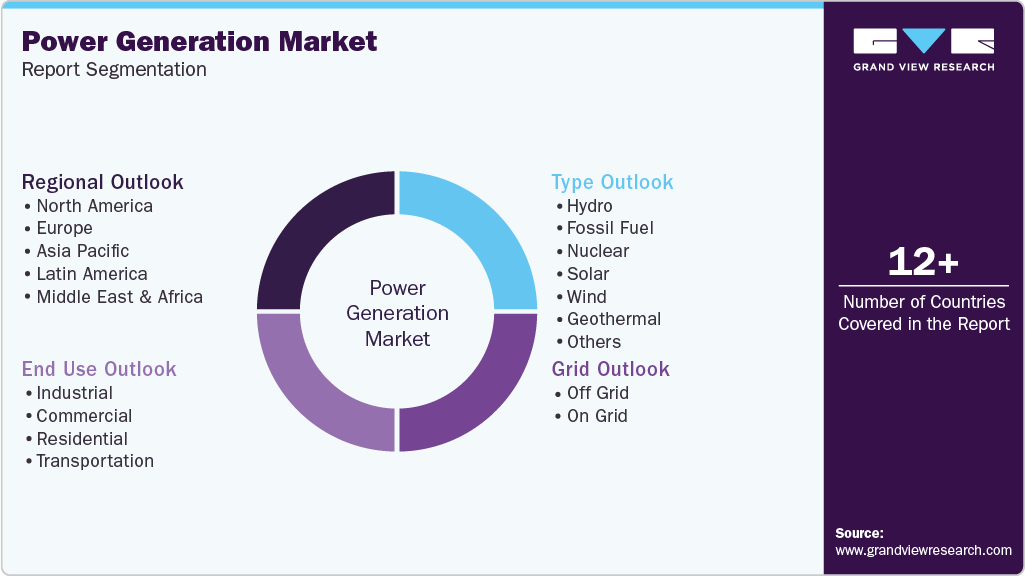
This report forecasts revenue growth at global, regional, and country levels and provides an analysis of the latest industry trends in each of the sub-segments from 2021 to 2033. For this study, Grand View Research has segmented the global power generation market report based on type, grid, end use, and region.
 To learn more about this report, Download Free Sample Report
 -
Type Outlook (Revenue, USD Billion, 2021 - 2033)
-
Hydro
-
Fossil Fuel
-
Nuclear
-
Solar
-
Wind
-
Geothermal
-
Biomass
-
Others
-
-
Grid Outlook (Revenue, USD Billion, 2021 - 2033)
-
Off Grid
-
On Grid
-
-
End Use Outlook (Revenue, USD Billion, 2021 - 2033)
-
Industrial
-
Commercial
-
Residential
-
Transportation
-
-
Regional Outlook (Revenue, USD Billion, 2021 - 2033)
-
North America
-
U.S.
-
Canada
-
Mexico
-
-
Europe
-
Germany
-
UK
-
France
-
Italy
-
Spain
-
-
Asia Pacific
-
China
-
India
-
Australia
-
Japan
-
South Korea
-
-
Latin America
-
Brazil
-
Argentina
-
-
Middle East & Africa
-
Saudi Arabia
-
UAE
-
South Africa
-
-
Frequently Asked Questions About This Report
The on-grid segment held the largest revenue share of 92.6% in 2025, while the off-grid segment is expected to witness the fastest growth over the forecast period.
The industrial segment accounted for the largest revenue share of 42.6% in 2025, while the residential segment is projected to grow at the fastest rate during the forecast period.
Asia Pacific dominated the global power generation market with a revenue share of 49.9% in 2025.
The global power generation market size was valued at USD 2,386.6 billion in 2025 and is estimated at USD 2,574.5 billion in 2026.
The global power generation market is expected to grow at a CAGR of 8.1% from 2026 to 2033, reaching USD 4,451.3 billion by 2033.
Asia Pacific is the fastest-growing regional market, registering a CAGR of 9.2% during the forecast period.
Some of the key players operating in the power generation market include Abu Dhabi National Energy Company (TAQA), China Yangtze Power Co., Ltd., Duke Energy Corporation, Électricité de France (EDF), Enel S.p.A., Iberdrola S.A., NextEra Energy, Inc., NTPC Limited, State Grid Corporation of China, and The Southern Company.
Key factors driving the power generation market include rising global electricity demand, rapid urbanization and industrialization, increasing investments in renewable energy projects, modernization of aging power infrastructure, growing adoption of smart grids and energy storage systems, and supportive government policies focused on decarbonization and energy security.
About the Author(s)
Power Generation & Storage Research Team
Energy & Power · Power Generation & StorageThis report was authored by the power generation & storage research team at Grand View Research - comprising two research analysts, one senior research analyst, and one industry expert - with specialized expertise in the power generation & storage segment of the energy & power industry. All findings are based on proprietary energy & power databases, executive interviews, and regulatory analysis, subject to internal peer review prior to publication.
Last Updated:
Speak to Analyst

Customize this report to your needs - add regions, segments, or data points, with 20% free customization.
Or view our licence options:


ISO 9001:2015 & 27001:2022 Certified
We are GDPR and CCPA compliant! Your transaction & personal information is safe and secure. For more details, please read our privacy policy.


