
- Home
- »
- Conventional Energy
- »
-
Compressed Natural Gas Market Size Report, 2026-2033GVR Report cover

Compressed Natural Gas Market (2026 - 2033)
Size, Share & Trends Analysis Report By Source (Refinery, Associated Gas, Non Associated Gas), By Application (Chemical, Industrial, Auto Gas), By End Use, By Region, And Segment Forecasts
Market Size, 2025
$197.1BMarket Estimate, 2026
$219.9BMarket Forecast, 2033
$491.7BCAGR, 2026–2033
12.2%Compressed Natural Gas Market Summary
The global compressed natural gas market size was valued at USD 197.1 billion in 2025 and is projected to grow from USD 219.9 billion in 2026 to USD 491.7 billion by 2033, at a CAGR of 12.2% from 2026 to 2033. Asia Pacific dominated the market, accounting for the revenue share of 48.6% in 2025. Market growth is driven by the rising need for cleaner energy options, government programs promoting sustainable methods, and the expanding use of CNG as a transportation fuel.
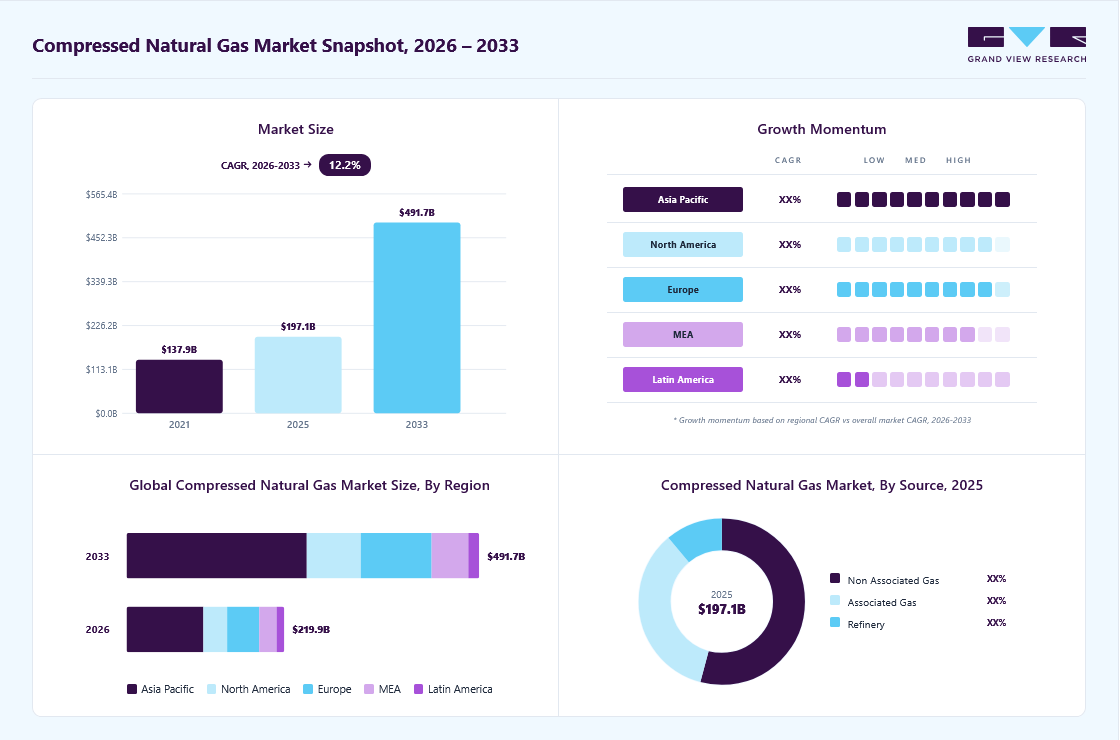 Source: Grand View Research, IR Documents, Primary Interviews, Paid DatabasesTo learn more about this report,
 Download Free Sample Report
Key Market Trends & Insights
- By application: Autogas segment dominated the market with the largest revenue share of 27.8% in 2025.
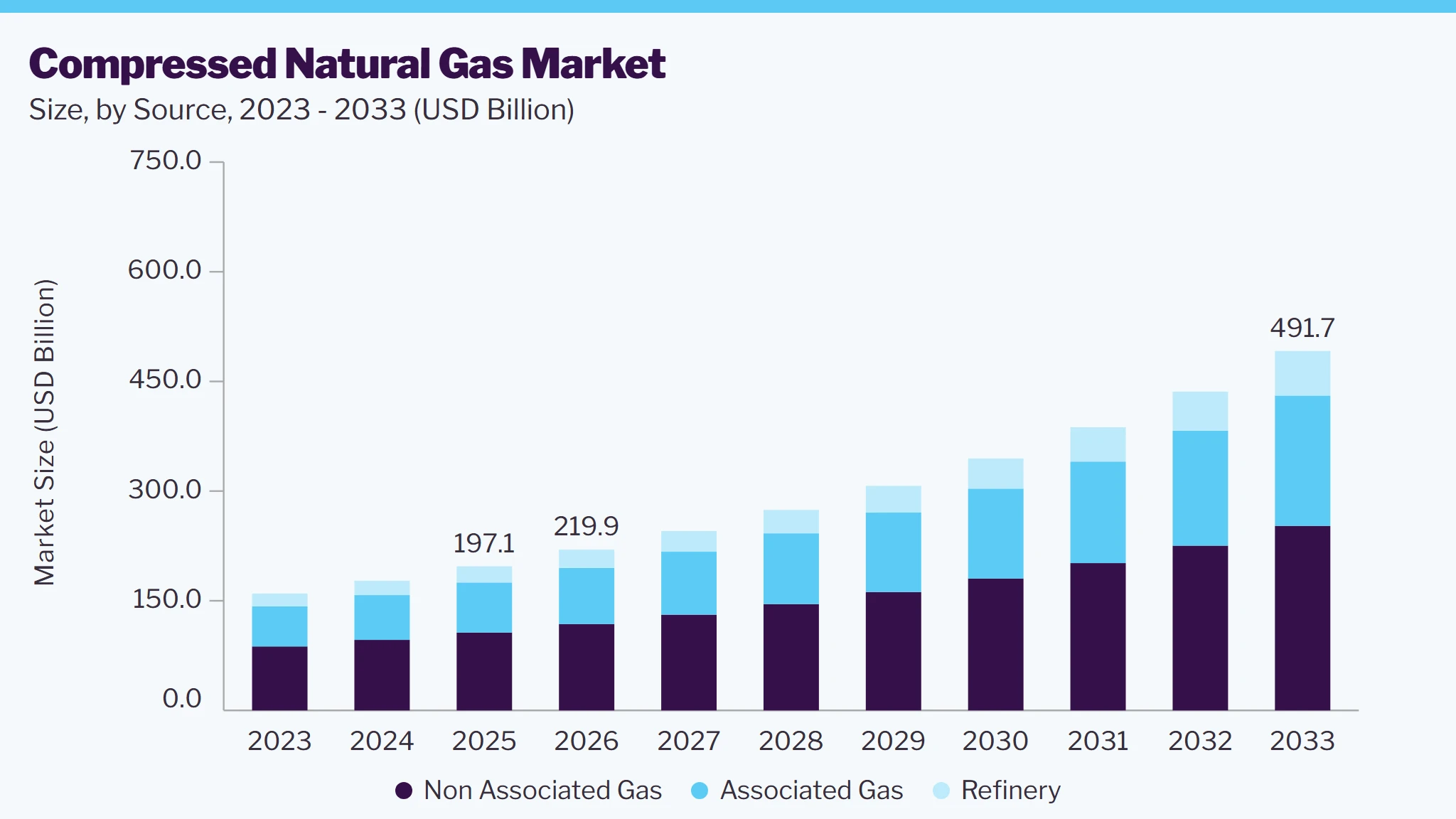
- By source: Non-associated gas segment held the largest revenue share of 54.1% in 2025.
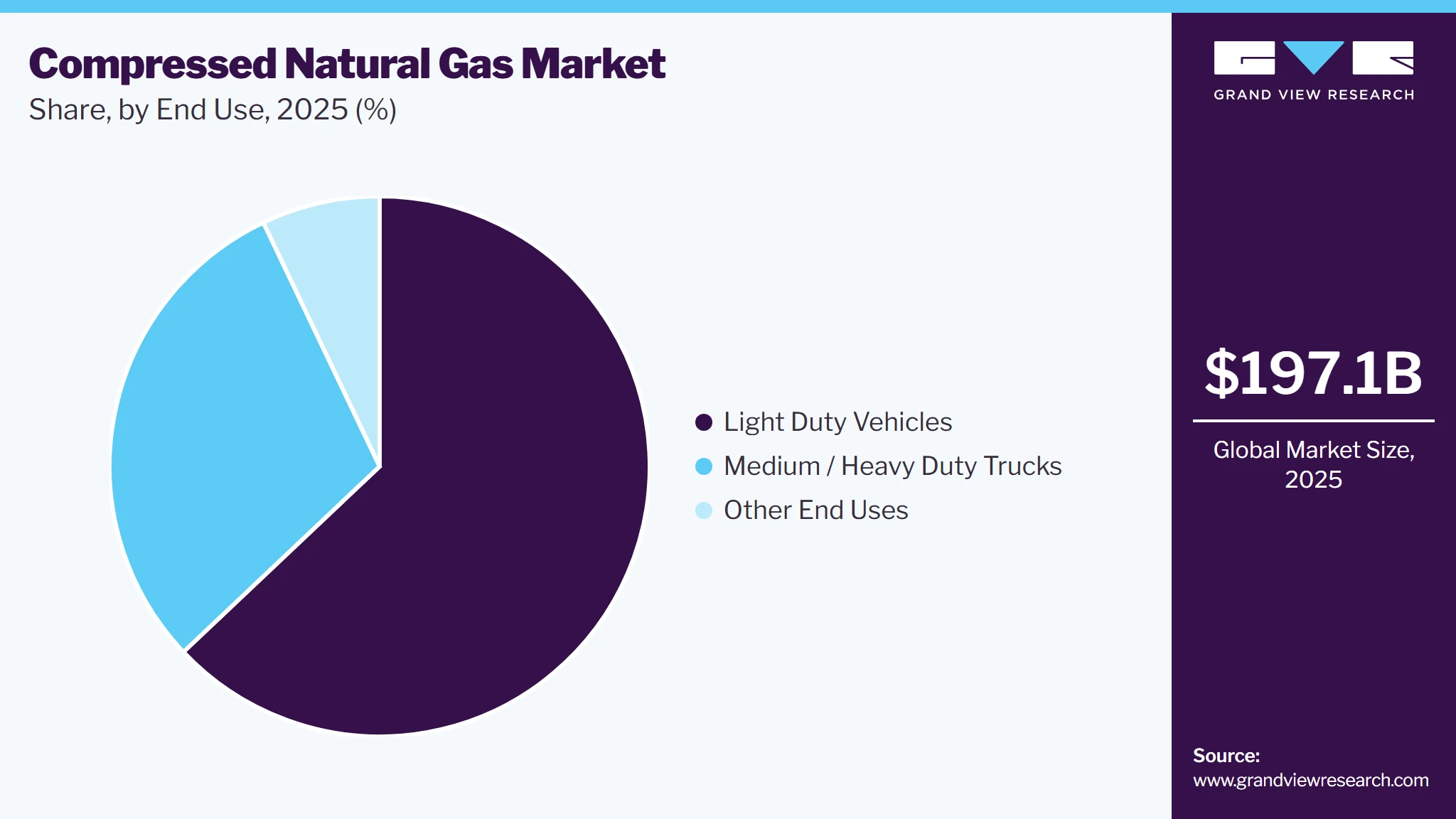
- By end use: Light duty vehicles segment led the market with the largest revenue share of 62.9% in 2025.
Regional Highlights
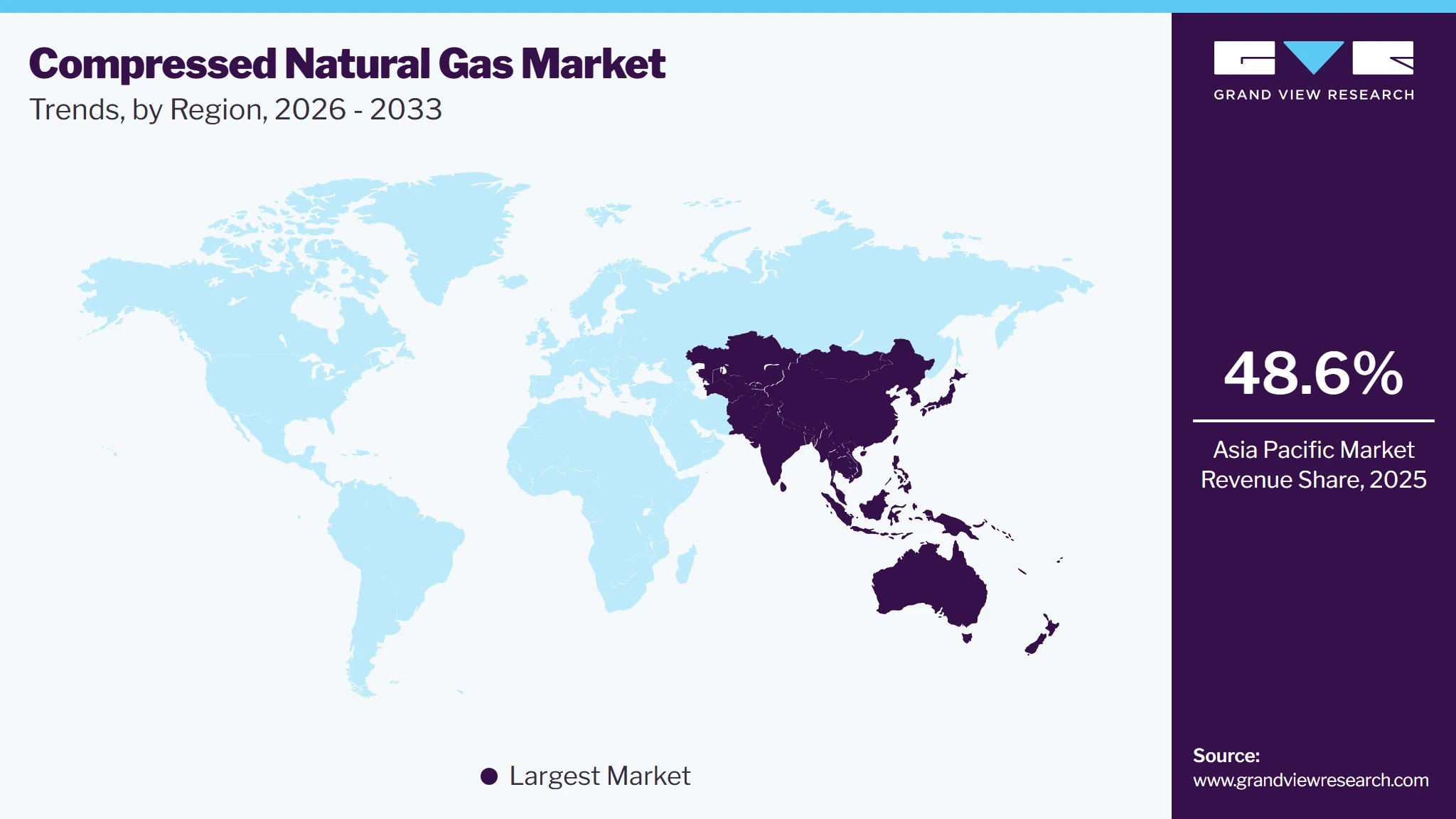
- Largest regional market: Asia Pacific (48.6% revenue share, 2025)
- By country: China dominated Asia Pacific with the largest revenue share in 2025
Market Size & Forecast
- Market size in 2025: USD 197.1 Billion
- Estimated market size in 2026: USD 219.9 Billion
- Projected market size by 2033: USD 491.7 Billion
- CAGR (2026-2033): 12.2%
Three ways to get this report
Buy it, customize it, or ask a question.Ask an Analyst
Analyst response in 1 business day
- AccessReport author, directly
- Reply timeWithin 1 working day
- No sales callDirect answer only
- FormatEmail reply
- CostFree, no cost
Get the Full Report
What the study covers
- FormatsPDF · Excel · Dashboard
- Timeline2026–2033 annual, 2025 base
- Coverage20+ countries, 5 regions
- Companies10+ key players profiled
Customize the Report
20% free customization
- IncludeCountries, segments, points
- TailorTo your product definition
- ExtendDeeper competitor detail
- OrA fully bespoke study
- Turnaround5–10 working days
 To learn more about this report, Download Free Sample Report
Market Dynamics
The compressed natural gas industry is driven by rising demand for cleaner transportation fuels, efforts to reduce vehicular emissions, and the expansion of natural gas distribution infrastructure. Increasing adoption of CNG-powered passenger vehicles, buses, and commercial fleets is supporting market growth. Government incentives, favorable fuel price differentials, and investments in CNG refueling stations are further encouraging adoption. However, fluctuations in natural gas prices, high infrastructure development costs, and limited refueling availability in certain regions constrain market expansion. Competition from electric vehicles and other alternative fuels also influences CNG adoption. Continued investment in pipeline networks, refueling facilities, and natural gas supply infrastructure will shape the market's growth.
Governments are implementing stricter vehicle emission standards and air quality regulations to reduce pollution from road transportation. These policies encourage public transport authorities, logistics operators, and commercial fleet owners to adopt CNG vehicles as an alternative to conventional petrol and diesel vehicles. CNG's lower particulate matter emissions and reduced emissions of certain air pollutants make it a suitable option for improving urban air quality. Regulatory restrictions on older, high-emitting vehicles and investments in cleaner public transport are further supporting CNG adoption across passenger and commercial transportation.
In June 2025, India's Commission for Air Quality Management (CAQM) directed that buses operating under specified service categories and entering Delhi must use cleaner modes, including BS-VI diesel, CNG, or electric vehicles, from November 1, 2026. The commission also introduced restrictions on the entry of non-compliant commercial goods vehicles into Delhi from November 2025. These measures aim to reduce vehicular pollution across the National Capital Region and encourage the use of cleaner transportation technologies, supporting demand for CNG-powered buses and commercial vehicles.
The market faces constraints from the substantial capital investment required to develop and maintain refueling infrastructure. Establishing CNG stations involves expenditure on compressors, high-pressure storage systems, gas pipelines, safety equipment, and distribution networks. These costs can limit infrastructure expansion, particularly in regions with low vehicle density or inadequate natural gas pipeline connectivity. High initial investments and long payback periods may discourage private investors and smaller fuel retailers from entering the market. Limited refueling station availability can also reduce consumer adoption of CNG vehicles, restricting market penetration across passenger transportation, commercial fleets, and heavy-duty applications.
Investment in CBG production plants presents an emerging business opportunity in the CNG market, as CBG produced from agricultural waste, municipal solid waste, and animal residue can be purified and supplied through compatible gas infrastructure. India's SATAT initiative and phased CBG blending obligations in CNG used for transportation and PNG supplied to households are creating opportunities for plant developers, gas distributors, waste-management companies, and technology providers. These initiatives can diversify domestic gas supplies, improve the utilization of organic waste, and reduce dependence on imported fossil fuels. Companies investing in feedstock collection, anaerobic digestion, gas purification, and distribution infrastructure can benefit from the growing integration of renewable gas into existing CNG networks.
Analyst Perspective
The compressed natural gas market is evolving through the integration of renewable gas, digital monitoring systems, and more efficient refueling technologies. The growing use of CBG offers producers an opportunity to convert agricultural and organic waste into a commercial energy resource, while blending initiatives may diversify gas supply sources. Fleet operators are also evaluating CNG based on vehicle utilization rates, fuel costs, and operating economics across urban and intercity routes. However, the long-term outlook will depend on the availability of competitively priced gas and the ability of infrastructure operators to maintain station utilization. Competition from battery electric vehicles is likely to influence investment decisions, particularly in passenger mobility and urban delivery fleets.
Source Insights
The non-associated gas segment accounted for the largest market revenue share of 54.1% in 2025. CNG and natural gas are derived from the same source. The decline in global crude oil production and depletion of oil wells have led to a shift towards non-associated gas as a primary source of compressed natural gas. Unconventional and non-associated gas are expected to dominate CNG production in the future. Notably, significant amounts of CNG are already being produced from non-associated gas reserves in the Middle East and Russia.
The refinery segment is expected to register at the fastest CAGR of 13.6% over the forecast period. The growth is driven by increasing demand for CNG in refinery operations for process heating and other fuel requirements, alongside efforts to improve energy efficiency and reduce emissions from conventional fuels. Expanding refinery capacity, modernizing existing facilities, and investing in cleaner fuel alternatives are supporting adoption. In addition, the availability of natural gas and integration of gas-based systems into refinery operations are creating opportunities for market growth.
Application Insights
The autogas segment held the largest revenue share of 27.8% in 2025. The growth of this segment is supported by the increasing adoption of CNG-powered passenger vehicles, taxis, and commercial fleets due to lower fuel costs compared with petrol and diesel. Expanding refueling station networks, government initiatives promoting cleaner transportation fuels, and rising consumer demand for economical mobility solutions are further driving segment growth. In addition, the growing use of CNG in urban transport and fleet operations supports consistent fuel demand across major markets.
The chemical segment is expected to grow at the fastest CAGR of 15.8% from 2026 to 2033. This is driven by increasing natural gas consumption as a feedstock and fuel in chemical manufacturing, particularly in the production of ammonia, methanol, and other chemical intermediates. Expanding chemical production capacity, rising demand for industrial chemicals, and investments in gas-based manufacturing facilities are supporting growth. In addition, the availability of natural gas in key producing regions and efforts to improve production efficiency are encouraging greater utilization of gas across chemical processing operations.
End Use Insights
The light-duty vehicles segment led the market with the largest revenue share of 62.9% in 2025. The increasing demand for light-duty cars is driven by rising disposable income, urbanization, and growth in the auto industry. This demand also fuels the adoption of CNG as a fuel for light-duty vehicles. Global players like Royal Dutch Shell and TotalEnergies are developing CNG products to gain a competitive edge. CNG’s cost-effectiveness, environmental benefits, and government incentives are driving its popularity in urban areas, making it an attractive option for consumers and fleet operators.
 To learn more about this report, Download Free Sample Report
The medium/heavy-duty trucks segment is expected to grow at the fastest CAGR of 13.1% over the forecast period. Heavy-duty trucks converted to run on CNG produce fewer pollutants, such as carbon monoxide, nitrogen oxides, and particulate matter, than diesel trucks. Segment growth is primarily driven by the significant reduction in greenhouse gas emissions and air pollution. CNG-powered trucks offer lower operating costs, reduced emissions, and improved fuel efficiency, making them an attractive option for fleet operators. Government incentives and regulations have boosted adoption in the medium and heavy-duty segments, driving growth as companies seek to reduce their environmental impact.
Regional Insights
The compressed natural gas market in North America is supported by abundant natural gas, established production infrastructure, and demand from high-utilization commercial fleets. The U.S. provides a substantial supply base, while Canada offers opportunities in municipal transport, waste collection, transit buses, and regional freight operations. Fleet operators consider CNG where fuel savings, predictable routes, and centralized refueling can offset vehicle and station investment costs. Market development is increasingly shaped by competition from battery-electric and other low-emission vehicle technologies, as well as fluctuations in natural gas prices.
U.S. Compressed Natural Gas Market Trends
The compressed natural gas market in the U.S. is primarily supported by fleets that benefit from centralized refueling and high annual vehicle utilization, including refuse collection, municipal services, transit, and regional logistics. Domestic natural gas availability provides a supply advantage, although the economics of CNG adoption depend on fuel prices, station utilization, maintenance requirements, and vehicle acquisition costs. The U.S. Department of Energy's Alternative Fuels Data Center tracks CNG refueling stations and alternative-fuel vehicle trends, with its station data highlighting closures associated with high repair and operating costs and fleet transitions away from CNG. This indicates that future investment is likely to favor locations with stable fleet demand and sufficient throughput rather than broad, consumer-oriented station expansion.
Asia-Pacific Compressed Natural Gas Market
The Asia Pacific compressed natural gas market held the largest revenue share of 48.6% in 2025 and is anticipated to grow at the fastest CAGR during the forecast period. The region is supported by vehicle demand, the expansion of city gas distribution networks, and government efforts to improve urban air quality. India is an important growth market, where city gas distributors are expanding station coverage and integrating CBG into the broader gas supply ecosystem. China also contributes through the adoption of natural gas vehicles and investments in gas distribution infrastructure. Growing demand for cost-effective transportation fuels and the expansion of commercial vehicle fleets are expected to support regional market growth.
 To learn more about this report, Download Free Sample Report
The compressed natural gas market in China accounted for the largest revenue share in the Asia-Pacific region in 2025, driven by government initiatives to improve urban air quality and expand natural gas use in transportation. Rising adoption of CNG-powered taxis, buses, and commercial vehicles supports demand, particularly in regions with established refueling infrastructure. Investments in domestic gas production and distribution networks further strengthen market development. However, competition from electric vehicles and LNG-powered heavy-duty trucks may limit adoption across certain transport segments.
Europe Compressed Natural Gas Market Trends
The compressed natural gas market in Europe is influenced by emission-reduction targets, alternative-fuel infrastructure, and demand from commercial transport operators. Adoption varies considerably across countries, depending on the existing gas refueling network, vehicle availability, and the relative cost of CNG compared with diesel and electricity. Italy and other established natural gas vehicle markets provide a base for continued use in passenger vehicles and commercial fleets. However, the expansion of electric mobility and tighter decarbonization requirements are limiting the long-term role of fossil-based CNG in some transport segments. Growing interest in biomethane offers an opportunity to leverage existing gas-vehicle infrastructure while reducing lifecycle emissions.
Latin America Compressed Natural Gas Market Trends
The compressed natural gas market in Latin America is supported by established natural gas vehicle ecosystems, particularly in Argentina and Brazil, where CNG is used in passenger vehicles, taxis, and commercial transportation. Argentina has a well-developed conversion and servicing network, along with domestic natural gas production, which supports local fuel supply. In December 2025, Argentina's energy regulator approved updated requirements for CNG transport modules, reflecting continued attention to the technical standards governing gas transportation and handling. Further development of domestic gas resources and pipeline capacity may support supply security and regional market expansion. However, currency volatility, infrastructure investment requirements, and changes in gasoline and diesel prices can affect the economics of vehicle conversions and consumer demand.
Middle East & Africa Compressed Natural Gas Market Trends
The compressed natural gas market in the Middle East and Africa presents opportunities in countries with domestic natural gas resources, established gas distribution networks, and policies promoting cleaner transport fuels. Egypt is an important example of infrastructure-led development: in April 2026, state-owned gas vehicle company GASTEC reported that it had expanded its active project portfolio, with 302 natural gas vehicle refueling stations across 26 governorates and approximately 27,000 vehicles converted to natural gas during 2025. Such investments support CNG adoption among private motorists and commercial fleets while creating demand for compressors, refueling equipment, vehicle conversion systems, and station services. Elsewhere in the region, growth depends on local gas availability, the affordability of vehicle conversions, and the pace of deployment of refueling infrastructure.
Key Compressed Natural Gas Company Insights
Some of the key players operating in the global market include Atlas Copco AB and Kirloskar, among others.
-
Atlas Copco AB is a key equipment supplier in the compressed natural gas industry, providing gas compression solutions used in CNG production, processing, transportation, and refueling applications. The company offers gas and process compressors, high-pressure compression systems, and associated equipment that support efficient gas handling and dispensing operations. Atlas Copco focuses on energy-efficient compression technologies, equipment reliability, and service capabilities to improve operational performance across natural gas infrastructure. Its global service network, engineering expertise, and portfolio of industrial gas compression solutions position the company as an important equipment provider in the global CNG market.
-
Kirloskar is a participant in the compressed natural gas industry through its industrial engineering and gas compression capabilities. Kirloskar Pneumatic Company Limited offers gas compression solutions for applications involving natural gas processing, transmission, distribution, and CNG infrastructure. Its product portfolio includes reciprocating and screw compressors, refrigeration systems, and process gas compression equipment used across industrial and energy applications. The company focuses on developing reliable compression technologies, expanding application-specific engineering capabilities, and supporting customers through installation and after-sales services. Its established industrial presence in India and experience in compression equipment position it to serve the country's expanding CNG infrastructure and related natural gas applications.
Key Compressed Natural Gas Companies
The following key companies have been profiled for this study on the compressed natural gas market.
-
Ariel Corporation
-
Atlas Copco AB
-
BAUER COMP Holding GmbH
-
Chicago Pneumatic
-
Fornovo Gas S.p.A.
-
Galileo Technologies
-
Gasorex India Pvt Ltd.
-
Ingersoll Rand
-
JSC Grasys
-
Kirloskar
Competitive Benchmarking
Category
Operating Strategies
Competitive Edge
Weakness
Established Players (Ariel Corporation, Atlas Copco AB, BAUER COMP Holding GmbH, Ingersoll Rand, Kirloskar)
- Maintain broad portfolios of reciprocating, screw, and high-pressure gas compressors for CNG stations and related gas infrastructure.
- Use global distribution networks, local service centers, and spare-parts availability to support long-term customer relationships.
- Target large city gas distribution companies, fleet operators, gas utilities, and infrastructure developers.
- Invest in compressor efficiency, equipment reliability, customized system design, and lifecycle maintenance services.
- Extensive operating experience and established customer relationships across industrial gas and energy applications.
- Strong engineering capabilities for high-pressure compression, continuous operation, and demanding operating conditions.
- Wider geographic reach and established after-sales service networks.
- Ability to compete for large projects requiring proven equipment, technical documentation, and long-term support.
- Higher manufacturing, engineering, and service costs can make some offerings less competitive on upfront price.
- Large organizational structures and established product platforms may limit flexibility for smaller, highly customized projects.
- Exposure to investment cycles in natural gas infrastructure and competition from alternative-fuel technologies.
- Some companies have diversified compressor portfolios, so CNG may represent only one part of their overall business.
Emerging Players (Chicago Pneumatic, Fornovo Gas S.p.A., Galileo Technologies, Gasorex India Pvt. Ltd., JSC Grasys)
- Focus on specialized CNG equipment, modular refueling packages, gas processing systems, or application-specific compression solutions.
- Compete through customization, shorter project response times, and solutions tailored to regional infrastructure requirements.
- Build relationships with local gas distributors, station developers, equipment integrators, and fleet operators.
- Pursue opportunities in emerging CNG markets, decentralized gas supply, virtual pipelines, and biomethane applications.
- Greater specialization in selected CNG applications and customer requirements.
- Potential to offer flexible configurations and competitive pricing for regional projects.
- Opportunities to develop modular solutions that reduce installation complexity and accommodate varying station capacities.
- Regional manufacturing and service capabilities can improve responsiveness and customer support.
- Smaller geographic footprints and service networks may restrict participation in large international projects.
- Lower scale can limit purchasing power, manufacturing capacity, and the ability to absorb development costs.
- Less extensive installed bases may make it harder to compete for projects requiring long operating histories and extensive performance references.
- Dependence on a narrower product range or regional customer base can increase exposure to changes in local CNG infrastructure investment.
Recent Developments
-
In September 2026, SinoCleansky launched its CNG Mobile Refueling Unit (MRU) series, designed to expand refueling access in areas without natural gas pipeline connectivity. The modular system integrates compressors, gas storage, dispensers, and intelligent controls, enabling deployment within days when paired with the company's CNG tube trailers. Featuring variable-frequency drive technology that reduces energy consumption by approximately 20%, the system targets industrial parks, mining sites, and logistics hubs. The launch highlights the growing adoption of modular refueling solutions to reduce infrastructure costs and improve CNG accessibility.
Compressed Natural Gas Market Report Scope
Report Attribute
Details
Market Definition
The compressed natural gas market represents the annual revenue generated from the sale of CNG sourced from refinery processing, associated gas, and non-associated gas for residential, commercial, chemical, industrial, automotive, refinery, and other applications.
Market size in 2025
USD 197.1 billion
Estimated market size in 2026
USD 219.9 billion
Projected market size by 2033
USD 491.7 billion
Growth rate
CAGR of 12.2% from 2025 to 2033
Base year for estimation
2025
Historical data
2021 - 2024
Forecast period
2026 - 2033
Quantitative units
Revenue in USD billion, Volume in Million Tons, and CAGR from 2025 to 2033
Report coverage
Revenue forecast, competitive landscape, growth factors, and trends
Segments covered
Source, application, end use, region
Regional scope
North America; Europe; Asia Pacific; Latin America; Middle East & Africa
Country scope
U.S.; Canada; Mexico; Germany; UK; France; Italy; Spain; Russia; China; India; Japan; South Korea; Australia; Brazil; Argentina; UAE; Saudi Arabia; South Africa
Key companies profiled
Ariel Corporation; Atlas Copco AB; BAUER COMP Holding GmbH; Chicago Pneumatic; Fornovo Gas S.p.A.; Galileo Technologies; Gasorex India Pvt Ltd; Ingersoll Rand; JSC Grasys; Kirloskar
Customization scope
Free report customization (equivalent up to 8 analysts working days) with purchase. Addition or alteration to country, regional & segment scope.
Pricing and purchase options
Avail customized purchase options to meet your exact research needs. Explore purchase options
Global Compressed Natural Gas Market Report Segmentation
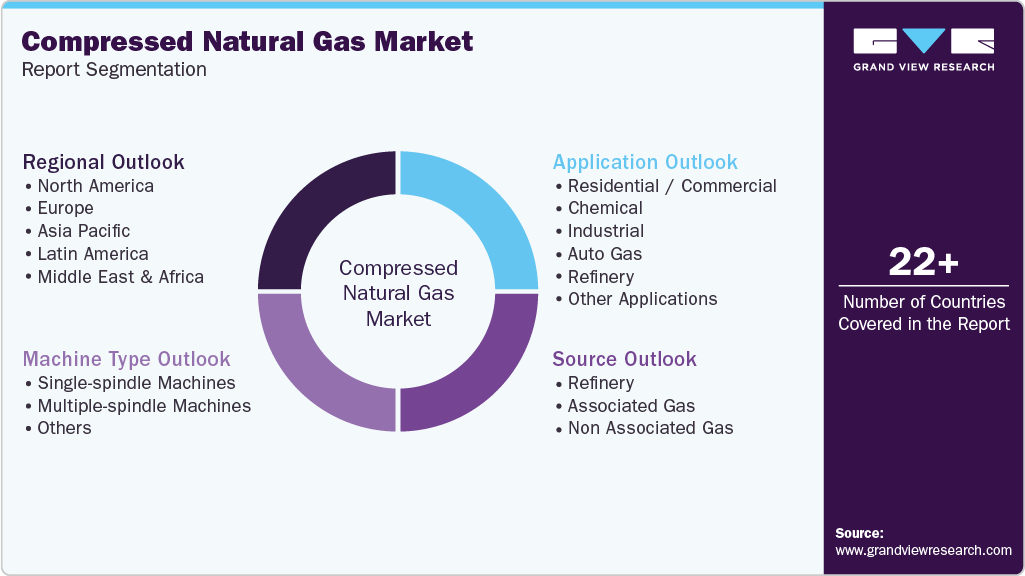
This report forecasts revenue growth at global, regional, and country levels and provides an analysis of the latest industry trends in each of the sub-segments from 2021 to 2033. For this study, Grand View Research has segmented the global compressed natural gas market report based on the source, application, end use, and region:
 To learn more about this report, Download Free Sample Report
-
Source Outlook (Volume, Million Tons; Revenue, USD Billion, 2021 - 2033)
-
Refinery
-
Associated Gas
-
Non Associated Gas
-
-
Application Outlook (Volume, Million Tons; Revenue, USD Billion, 2021 - 2033)
-
Residential / Commercial
-
Chemical
-
Industrial
-
Auto Gas
-
Refinery
-
Other Applications
-
-
End Use Outlook (Volume, Million Tons; Revenue, USD Billion, 2021 - 2033)
-
Light Duty Vehicles
-
Medium / Heavy Duty Trucks
-
Other End Uses
-
-
Regional Outlook (Volume, Million Tons; Revenue, USD Billion, 2021 - 2033)
-
North America
-
U.S.
-
Canada
-
Mexico
-
-
Europe
-
Germany
-
UK
-
France
-
Italy
-
Spain
-
Russia
-
-
Asia Pacific
-
China
-
India
-
Japan
-
South Korea
-
Australia
-
-
Latin America
-
Brazil
-
Argentina
-
-
Middle East & Africa
-
Saudi Arabia
-
UAE
-
South Africa
-
-
Research Methodology
The compressed natural gas market figures in this report are based on a proven research process that combines executive interviews with secondary research from proprietary databases, company filings, and recognized regulatory and institutional sources. Market size is built through value-chain sizing - reconciling supply-side and demand-side estimates - and triangulated with bottom-up and top-down approaches. Every estimate passes multiple levels of expert validation before publication, with each compressed natural gas segment quantified using the revenue-capture definitions in the table below.
Segment Definition
Segment - Source
Revenue capture definition
Refinery
Revenue generated from CNG produced using natural gas processed or recovered through refinery operations.
Associated Gas
Sales of CNG derived from natural gas extracted alongside crude oil.
Non-Associated Gas
Revenue generated from compressing and selling natural gas extracted from reservoirs without crude oil.
Segment - Application
Revenue capture definition
Residential / Commercial
Sales of CNG for energy requirements in residential buildings and commercial establishments.
Chemical
Revenue from CNG used as a fuel or feedstock in chemical manufacturing processes.
Industrial
Covers CNG consumed for industrial heating, manufacturing, and process operations.
Auto Gas
Sales of CNG as a transportation fuel for passenger vehicles and commercial fleets.
Refinery
Revenue generated from CNG used for process heating and other fuel requirements within petroleum refineries.
Other Applications
Includes CNG used in power generation and other applications outside the specified categories.
Segment - End Use
Revenue capture definition
Light Duty Vehicles
Sales of CNG for passenger cars, taxis, and light commercial vehicles.
Medium / Heavy Duty Trucks
Revenue from CNG consumed by freight trucks and other medium- or heavy-duty goods vehicles.
Covers CNG used to fuel public transit, school, intercity, and other medium- or heavy-duty buses.
Other End Uses
Includes CNG sales for vehicle types and end-use categories beyond the specified segments.
Estimation Model
Layer No.
Layer Name
Key Question
Description
01
Source Layer
Which sources contribute to CNG supply?
Assess CNG supply derived from refinery processing, associated gas, and non-associated gas. Analyze natural gas production, refinery operations, gas processing capacity, feedstock availability, purification requirements, and compression infrastructure influencing market supply.
02
Application Layer
Which applications drive CNG consumption?
Evaluate CNG demand across residential/commercial, chemical, industrial, auto gas, refinery, and other applications. Analyze fuel requirements, industrial activity, vehicle adoption, gas price competitiveness, environmental regulations, and the availability of distribution and refueling infrastructure.
03
End Use Layer
Which vehicle categories account for CNG demand?
Assess CNG consumption across light-duty vehicles, medium/heavy-duty trucks, medium/heavy-duty buses, and other end uses. Examine vehicle population, annual distance traveled, fuel consumption per vehicle, fleet utilization, vehicle conversion rates, and refueling accessibility to estimate demand across end-use categories.
04
Revenue Layer
How is market revenue generated?
Market revenue is quantified through the sales of CNG across source, application, and end-use categories. Revenue estimation considers CNG sales volume, average selling prices, gas procurement costs, compression and distribution expenses, transportation fuel demand, industrial consumption, and regional pricing variations. Market sizing excludes revenue from standalone compression equipment, refueling station construction, and vehicle sales.
Delivered Customizations
This report has been delivered with the following In-depth customizations
Client Request
Customization Delivered
Value Adds
Regional Opportunity Assessment
Country-level analysis was conducted to assess CNG adoption across key regions, considering natural gas availability, vehicle fleet penetration, refueling infrastructure, fuel pricing, emissions regulations, and government initiatives.
Identified high-potential countries for CNG market expansion based on favorable fuel economics, growing vehicle demand, domestic gas availability, and infrastructure development.
Cross-Segmentation Analysis
A detailed assessment was conducted across CNG sources (refinery, associated gas, and non-associated gas), applications (residential/commercial, chemical, industrial, auto gas, refinery, and other applications), and end uses (light-duty vehicles, medium/heavy-duty trucks, medium/heavy-duty buses, and other end uses).
Identified key demand-source relationships and high-potential application and vehicle segments, supporting targeted market entry, supply planning, and resource allocation.
Fuel Cost Competitiveness Assessment
CNG economics were compared with petrol and diesel across selected vehicle categories and countries, considering fuel prices, vehicle efficiency, annual mileage, conversion costs, and operating expenses.
Determined the vehicle categories and markets where CNG offers stronger operating-cost advantages, supporting fleet conversion decisions and customer targeting.
Frequently Asked Questions About This Report
.The global compressed natural gas market size was valued at USD 159.9 billion in 2023 and is estimated at USD 219.9 billion for 2026.
.The global compressed natural gas market is expected to grow at a CAGR of 11.7% from 2024 to 2030, reaching USD 344.6 billion by 2030.
.Asia Pacific dominated with a 48.3% revenue share in 2023.
Key players include National Iranian Gas Company; Chevron Corporation; Indraprastha Gas Limited; Total Energies; Phillips 66 Company; Gazprom; Exxon Mobil Corporation; Royal Dutch Shell Plc .com; Occidental Petroleum Corporation; JW Power Company
.Market growth is driven by the rising need for cleaner energy options, government programs advocating for sustainable methods, and the expanding use of CNG as a fuel for transportation.
About the Author(s)
Conventional Energy Research Team
Energy & Power · Conventional EnergyThis report was authored by the conventional energy research team at Grand View Research - comprising two research analysts, one senior research analyst, and one industry expert - with specialized expertise in the conventional energy segment of the energy & power industry. All findings are based on proprietary energy & power databases, executive interviews, and regulatory analysis, subject to internal peer review prior to publication.
Last Updated:
Speak to Analyst

Customize this report to your needs - add regions, segments, or data points, with 20% free customization.
Or view our licence options:


ISO 9001:2015 & 27001:2022 Certified
We are GDPR and CCPA compliant! Your transaction & personal information is safe and secure. For more details, please read our privacy policy.


