
- Home
- »
- Renewable Energy
- »
-
Solar Tracker Market Size, Share, Trends Report, 2026-2033GVR Report cover

Solar Tracker Market (2026 - 2033)
Size, Share & Trends Analysis Report By Technology (PV, CSP, CPV), By Type (Single Axis, Dual Axis), By Application (Utility, Non-utility), By Region (North America, Asia Pacific, Europe, Latin America), And Segment Forecasts
Market Size, 2025
$7.9BMarket Estimate, 2026
$10.3BMarket Forecast, 2033
$42.2BCAGR, 2026–2033
22.4%Solar Tracker Market Summary
The global solar tracker market size was valued at USD 7.9 billion in 2025 and is projected to grow from USD 10.3 billion in 2026 to USD 42.2 billion by 2033, at a CAGR of 22.4% from 2026 to 2033. The market in North America dominated with a revenue share of 27.5% in 2025. The market is expanding as solar trackers improve the efficiency and energy output of solar power systems by enabling panels to follow the sun’s movement throughout the day.
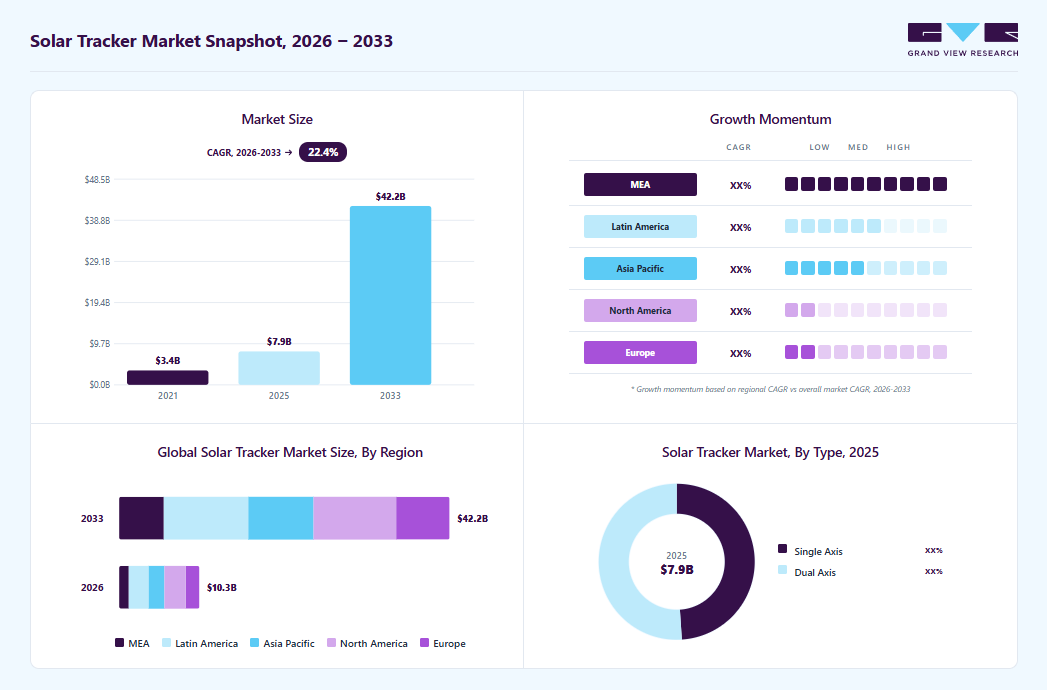 Source: Grand View Research, IR Documents, Primary Interviews, Paid DatabasesTo learn more about this report,
 Download Free Sample Report
 Key Market Trends & Insights
- By type: Dual-axis segment held the largest market share of 51.0% in 2025.
- By technology: Solar photovoltaic segment held the largest market share of 92.6% in 2025.
- By application: Utility segment held the largest market share of 86.5% in 2025.
Regional Highlights
- Largest regional market: North America (27.5% revenue share, 2025)
- Fastest-growing regional market: Middle East & Africa (highest CAGR, 2026-2033)
- By country: U.S. held the largest market share in 2025
Market Size & Forecast
- Market size in 2025: USD 7.9 Billion
- Estimated market size in 2026: USD 10.3 Billion
- Projected market size by 2033: USD 42.2 Billion
- CAGR (2026-2033): 22.4%
Three ways to get this report
Buy it, customize it, or ask a question.Ask an Analyst
Analyst response in 1 business day
- AccessReport author, directly
- Reply timeWithin 1 working day
- No sales callDirect answer only
- FormatEmail reply
- CostFree, no cost
Get the Full Report
What the study covers
- FormatsPDF · Excel · Dashboard
- Timeline2026–2033 annual, 2025 base
- Coverage20+ countries, 5 regions
- Companies10+ key players profiled
Customize the Report
20% free customization
- IncludeCountries, segments, points
- TailorTo your product definition
- ExtendDeeper competitor detail
- OrA fully bespoke study
- Turnaround5–10 working days
Compared to fixed-tilt systems, solar trackers increase electricity generation and support cost-effective renewable energy production, making them increasingly attractive for utility-scale, commercial, and industrial solar projects. The market is growing due to the strong long-term economic advantages of solar energy generation. Solar trackers improve the efficiency and energy yield of solar power systems by enabling panels to follow the sun’s movement throughout the day, resulting in higher electricity output and improved project returns compared to fixed-tilt systems. Declining solar module prices and lower operating costs are making solar tracker systems increasingly cost-effective for utility-scale and commercial solar projects.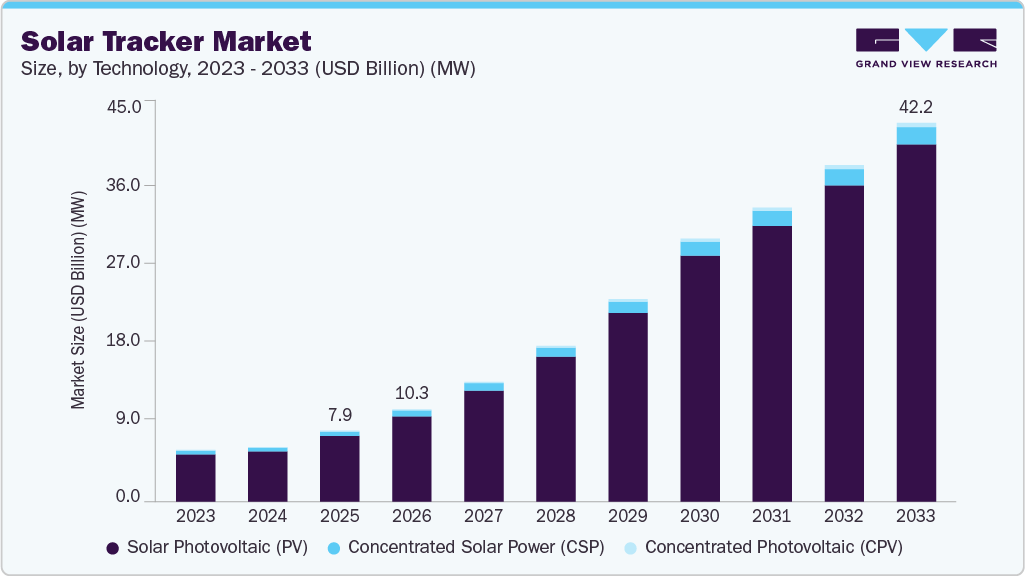 To learn more about this report, Download Free Sample Report
 Economic considerations are further supporting investments in the solar tracker market as countries focus on expanding renewable energy capacity and reducing carbon emissions. Although solar tracker installations involve higher initial costs than fixed-tilt systems, their ability to increase power generation and optimize land utilization enhances long-term project profitability. Growing investments in clean energy infrastructure, supportive government incentives, and rising demand for low-cost renewable electricity are positioning solar trackers as an efficient and economically attractive solution for large-scale solar power generation.
Market Dynamics
The solar tracker market is experiencing significant growth due to the increasing integration of bifacial solar modules with single-axis tracking systems. Bifacial panels are capable of capturing sunlight from both the front and rear sides, allowing them to generate higher electricity output compared to conventional monofacial modules. When combined with single-axis trackers that continuously adjust panel orientation throughout the day, these systems significantly improve overall solar energy capture and project efficiency. This combination has become highly attractive for utility-scale solar developers seeking to maximize power generation while lowering the LCOE.
The growing deployment of bifacial module-integrated tracker systems is further supported by advancements in tracker design, improved module durability, and increasing demand for high-performance solar infrastructure. Solar project developers are increasingly adopting these systems in regions with high solar irradiation to optimize land utilization and improve long-term project economics. For instance, in 2025, Array Technologies, Inc. expanded deployment of its OmniTrack and DuraTrack systems, designed for compatibility with utility-scale bifacial solar modules, to support higher energy yield optimization across large solar projects in North America and international markets.
The solar tracker market faces restraints due to geographical and weather-related limitations that can reduce the economic viability of tracker installations in certain regions. In high-latitude areas with shorter daylight hours and lower solar irradiance, the incremental energy gains from solar trackers may not offset the higher installation, operation, and maintenance costs compared to fixed-tilt systems. Uneven terrain, extreme temperature fluctuations, and remote project locations can increase engineering complexity and overall project expenditure, limiting adoption in some markets.
Severe weather conditions, such as hurricanes, hailstorms, and high-wind events, also pose operational challenges for solar tracker systems, requiring advanced stow mechanisms, reinforced structures, and sophisticated monitoring systems to minimize damage risks. These additional protective measures increase system complexity and capital costs. For instance, in 2025, FTC Solar introduced its Pioneer High Wind tracker engineered to withstand wind speeds of up to 150 mph for hurricane-prone and high-altitude regions, highlighting the growing need for weather-resilient tracker technologies amid rising climate-related risks.
Type Insights
The dual-axis segment accounted for the largest revenue share of 51.0% in 2025, primarily due to its superior precision in maintaining optimal panel orientation throughout changing sunlight angles and seasonal variations. These systems are widely used in large-scale solar farms in regions with high direct normal irradiance, where maximizing output is essential to improving project economics. Their ability to enhance energy production per installed panel also supports better land-use efficiency. Increasing deployment of advanced solar infrastructure and performance-focused renewable energy projects continues to drive demand for dual-axis trackers.
The single-axis segment is expected to register the second-fastest CAGR of 21.0% from 2026 to 2033, driven by its cost-effectiveness, simpler design, and widespread adoption in utility-scale solar projects. Single-axis trackers offer a favorable balance between installation costs and energy yield improvements, making them suitable for large solar farms seeking operational efficiency and a faster return on investment. Their lower maintenance requirements and compatibility with diverse terrains further support deployment across emerging and established solar markets. Increasing investments in large-scale renewable energy infrastructure are also contributing to segment growth.
Technology Insights
The Solar Photovoltaic (PV) segment accounted for the largest revenue share of 92.6%, driven by the rapid expansion of utility-scale and commercial solar power installations worldwide. Increasing adoption of photovoltaic technology for clean electricity generation, supported by declining solar module costs and favorable government policies, has significantly accelerated demand for solar tracking systems in PV projects. Solar trackers are widely integrated with PV systems to improve panel efficiency and maximize energy output, particularly in high-capacity solar farms.
The Concentrated Photovoltaic (CPV) segment is expected to register the fastest CAGR of 23.3% during the forecast period, driven by increasing demand for high-efficiency solar power generation technologies in regions with strong direct sunlight exposure. CPV systems rely heavily on advanced solar tracking technologies to maintain precise alignment with the sun, which significantly improves energy concentration and electricity output.
Application Insights
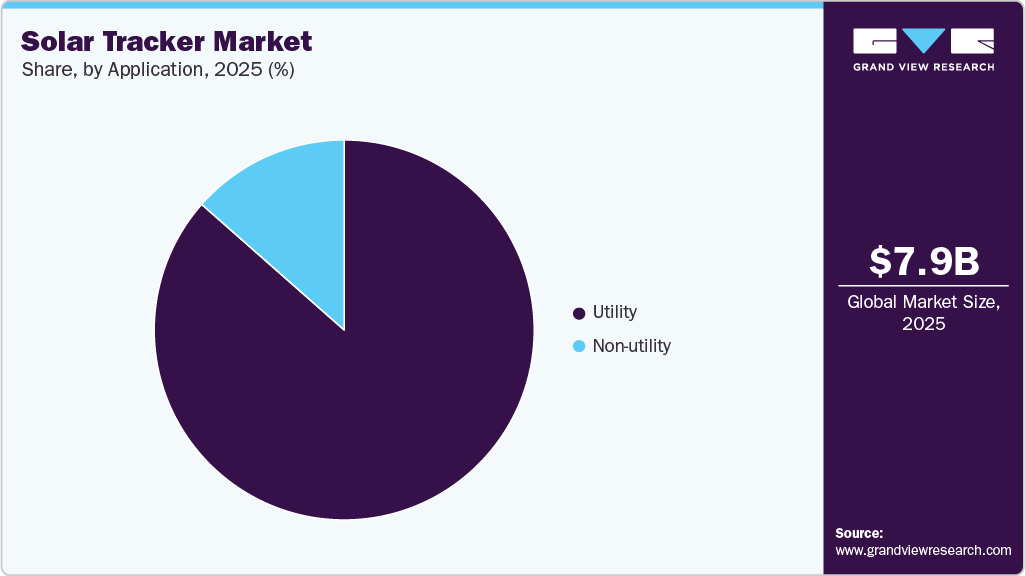
The utility segment captured the largest revenue share of 86.5% in 2025. This segment is driven by the rapid development of large-scale solar power plants and increasing investments in grid-connected renewable energy infrastructure worldwide. Utility-scale projects widely adopt solar tracking systems to improve energy generation efficiency, optimize land utilization, and enhance overall project economics. Supportive government policies, renewable energy targets, and rising demand for low-cost, clean electricity are further accelerating deployment of utility-scale solar installations.
 To learn more about this report, Download Free Sample Report
 The non-utility segment is projected to register the second-fastest CAGR of 19.4 % over the forecast period due to the rising adoption of solar energy systems across commercial, industrial, and institutional facilities. Businesses are increasingly deploying solar trackers to improve energy efficiency, reduce electricity costs, and enhance the performance of rooftop and ground-mounted solar installations. Growing emphasis on corporate sustainability initiatives, distributed energy generation, and energy independence is further supporting segment expansion.
Regional Insights
In 2025, the Asia Pacific solar tracker market was largely driven by the rapid expansion of utility-scale solar power projects across countries such as China, India, Australia, and Japan. Increasing electricity demand, supportive renewable energy policies, and large government investments in clean energy infrastructure significantly accelerated solar tracker deployment in the region. Rising focus on improving solar power generation efficiency and optimizing land utilization also encouraged the adoption of advanced tracking systems in large solar farms. Declining solar installation costs and ambitious carbon reduction targets continued to strengthen market growth across the Asia Pacific.
China Solar Tracker Market Trends
China's solar tracker market is being shaped by large-scale investments in utility-scale solar farms, strong government support for renewable energy expansion, and the country’s aggressive carbon neutrality targets. The rapid deployment of high-capacity photovoltaic projects in desert and remote regions has increased demand for advanced solar tracking systems to maximize energy generation efficiency. The presence of major solar equipment manufacturers, declining solar technology costs, and continuous grid infrastructure development are further supporting market growth.
Europe Solar Tracker Market Trends
The Europe region's solar tracker market is being driven by increasing investments in renewable energy infrastructure, ambitious carbon reduction targets, and the rapid expansion of utility-scale solar power projects across countries such as Spain, Germany, Italy, and France. Strong government support through clean energy policies and sustainability initiatives is accelerating the adoption of advanced solar technologies, including tracking systems. Growing emphasis on improving solar power efficiency and optimizing land utilization is further supporting demand for solar trackers. For instance, in 2025, TotalEnergies launched its largest solar project in Europe in Seville, Spain, comprising five solar installations with a combined capacity of 263 MW, highlighting the region’s continued investment in large-scale solar infrastructure.
North America Solar Tracker Market Trends
North America dominated the market with the largest revenue share of 27.5% in 2025. The market's growth is supported by strong investments in utility-scale solar power projects, favorable government incentives, and increasing adoption of advanced renewable energy technologies across the U.S. and Canada. Rising electricity demand, corporate clean energy commitments, and the expansion of grid-connected solar infrastructure are further accelerating the deployment of solar tracking systems in the region. Technological advancements focused on improving energy yield and reducing operational costs are also contributing to market expansion. For instance, in 2025, IDEEMATEC completed the 640 MW Parliament Solar Park project in Texas, one of the largest solar parks in North America.
 To learn more about this report, Download Free Sample Report
 The U.S. solar tracker market is supported by the low levelized cost of electricity, as pairing utility-grade bifacial modules with single-axis trackers significantly improves energy yield while reducing overall power generation costs. Rising corporate renewable energy procurement, expanding solar capacity additions, and technological advancements in smart tracking systems are further accelerating market growth. Strong decarbonization goals and the transition toward cost-efficient clean energy solutions continue to support widespread adoption of solar trackers across the country.
Latin America Solar Tracker Market Trends
The solar tracker market in Latin America is driven by rising investments in utility-scale solar power projects, abundant solar irradiation levels, and increasing government support for renewable energy development across its countries. Growing electricity demand and the need for cost-effective clean energy solutions are accelerating the adoption of solar tracking systems to improve energy generation efficiency. The region’s favorable climatic conditions and availability of large land areas further support the deployment of tracker-based solar farms. Increasing foreign investments and the ongoing expansion of grid-connected solar infrastructure continue to strengthen market growth across Latin America.
Middle East & Africa Solar Tracker Market Trends
The MEA region's solar tracker market is expected to grow at the fastest CAGR of 24.4%, largely supported by rising investments in utility-scale solar energy projects, abundant solar resources, and strong government initiatives aimed at diversifying energy sources beyond oil and gas. Countries are expanding renewable energy capacity to meet increasing electricity demand and sustainability goals. Solar trackers are gaining strong adoption across the region due to their ability to maximize energy output under high solar irradiation conditions and harsh desert environments. For instance, in 2025, TrinaTracker established a new 3 GW solar tracker manufacturing facility in Saudi Arabia to strengthen local renewable energy infrastructure and support growing solar project deployment across the MEA region.
Key Solar Tracker Company Insights
Some of the key players operating in the global solar tracker market include Array Technologies, Inc., and Trinasolar, among others.
-
Array Technologies, Inc. is one of the leading participant in the global solar tracker market, recognized for its large-scale deployment of utility-scale solar tracking systems and strong presence across North America, Latin America, Europe, and emerging renewable energy markets. The company specializes in advanced single-axis solar tracker technologies designed to improve solar plant efficiency, optimize energy yield, and reduce operational costs for utility-scale photovoltaic projects. Array Technologies’ strategy focuses on technological innovation, project scalability, and expanding its global footprint through strategic partnerships and product enhancements tailored for diverse environmental conditions. The company also emphasizes tracker durability, smart monitoring capabilities, and integration with next-generation bifacial solar modules to support low-cost renewable electricity generation.
-
Trinasolar is one of the key players operating in the market, recognized for its integrated solar technology portfolio and rapidly expanding tracker business through TrinaTracker. The company focuses on the development of intelligent solar tracking solutions, high-efficiency photovoltaic modules, and smart energy systems for utility-scale and commercial solar projects worldwide. Trinasolar’s strategy emphasizes integrated renewable energy solutions, continuous product innovation, and expansion of manufacturing and project development capabilities across key global markets. The company also prioritizes digitalization, smart control technologies, and compatibility with high-power bifacial modules to improve solar plant performance and energy generation efficiency. For instance, in 2025, TrinaTracker established a new 3 GW solar tracker manufacturing facility in Saudi Arabia to support growing solar infrastructure demand across the Middle East and Africa while strengthening its global renewable energy supply chain presence.
Key Solar Tracker Companies:
The following key companies have been profiled for this study on the solar tracker market
-
All Earth Renewables
-
Array Technologies, Inc.
-
DEGERENERGIE GMBH & CO. KG
-
GameChange Solar
-
Nextpower Inc.
-
Powerway Renewable Energy Co., Ltd
-
PVH Solar
-
Soltec
-
SunPower Inc.
-
Trinasolar
Competitive Benchmarking
Operating Strategies
Competitive Edge
Weaknesses
Mature Players: Array Technologies, Inc.; Trinasolar; Soltec; PVH Solar; GameChange Solar; DEGERENERGIE GMBH & CO. KG
- Focus on large-scale utility solar projects, global market expansion, advanced tracker automation, strategic partnerships, and integration with high-efficiency PV modules. Companies also emphasize R&D, digital monitoring systems, and localized manufacturing to strengthen supply chains and reduce project costs.
- Strong global presence, established customer base, proven project execution capabilities, advanced technology portfolios, economies of scale, and strong financial resources. Mature players benefit from long-term contracts and extensive experience in utility-scale deployments.
- High exposure to raw material price fluctuations, intense competition leading to pricing pressure, dependence on utility-scale project pipelines, and challenges related to supply chain disruptions and regulatory changes across regions.
Emerging Players: All Earth Renewables; Nextpower Inc.; Powerway Renewable Energy Co., Ltd; SunPower Inc.
- Focus on niche markets, regional expansion, customized solar tracking solutions, and cost-competitive offerings. Many emerging companies prioritize flexible product designs, partnerships with local EPC firms, and entry into rapidly growing developing markets.
- Greater operational flexibility, faster adaptation to new technologies, competitive pricing strategies, and ability to target underserved regional markets or specialized solar applications.
- Limited global presence, smaller financial capacity, lower brand recognition, restricted manufacturing scale, and challenges in competing with established players on technology, project experience, and after-sales service capabilities.
Recent Developments
-
In August 2025, Array Technologies, Inc. finalized the acquisition of APA Solar to strengthen its product portfolio by adding engineered foundation and fixed-tilt mounting solutions. The acquisition enhances the company’s ability to deliver integrated, domestically manufactured tracker and foundation systems optimized for complex soil environments. This strategic expansion is expected to support EPC firms and solar developers in improving installation efficiency, lowering project costs, and maximizing energy output across a wide range of solar project locations.
Solar Tracker Market Report Scope
Report Attribute
Details
Market Definition
The global solar tracker market refers to the revenue generated from the deployment of solar tracking systems across various tracker technologies and applications.
Market size in 2025
USD 7.9 billion
Estimated market size in 2026
USD 10.3 billion
Projected market size by 2033
USD 42.2 billion
Growth rate
CAGR of 22.4% from 2026 to 2033
Base year for estimation
2025
Historical data
2021 - 2024
Forecast period
2026 - 2033
Quantitative Units
Revenue in USD million/billion, volume in mw, and CAGR from 2026 to 2033
Report coverage
Revenue forecast, competitive landscape, growth factors, and trends
Segments covered
Technology, type, application, region
Regional scope
North America; Europe; Asia Pacific; Latin America; Middle East & Africa
Country scope
U.S.; Canada; Mexico; Germany; France; Italy; Spain; China; India;Japan; Brazil; Chile; Saudi Arabia; UAE
Key companies profiled
All Earth Renewables; Array Technologies, Inc.; DEGERENERGIE GMBH & CO. KG; GameChange Solar; Nextpower Inc.; Powerway Renewable Energy Co., Ltd; PVH Solar; Soltec; SunPower Inc.; Trinasolar
Customization scope
Free report customization (equivalent up to 8 analysts working days) with purchase. Addition or alteration to country, regional & segment scope.
Pricing and purchase options
Avail customized purchase options to meet your exact research needs. Explore purchase options
Global Solar Tracker Market Report Segmentation
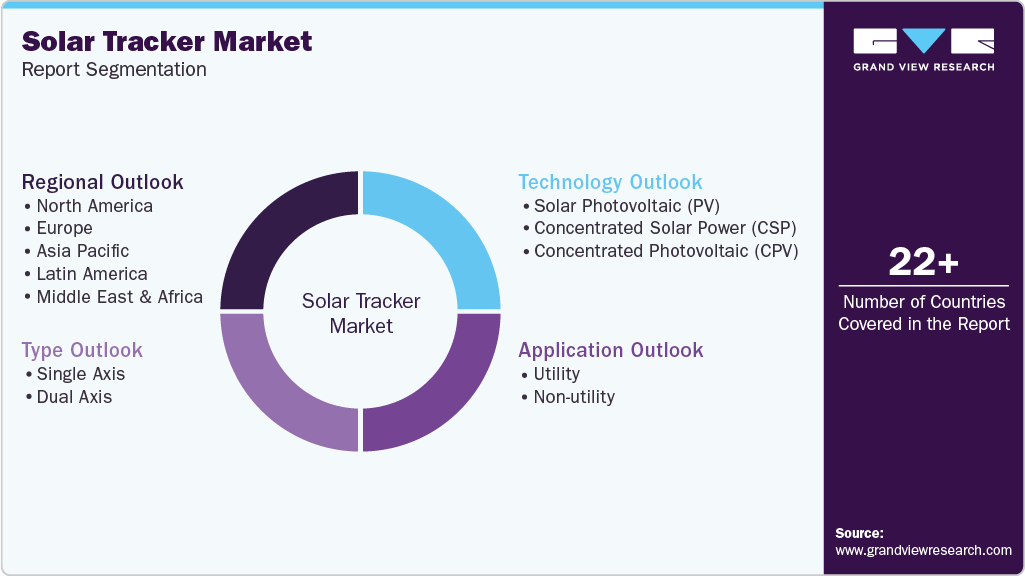
This report forecasts revenue growth at global, regional, and country levels and provides an analysis of the latest industry trends in each of the sub-segments from 2021 to 2033. For the purpose of this study, Grand View Research has segmented the global solar tracker market report on the basis of technology, type, application, and region.
 To learn more about this report, Download Free Sample Report
 -
Technology Outlook (Revenue, USD Billion; Volume, MW; 2021 - 2033)
-
Solar Photovoltaic (PV)
-
Concentrated Solar Power (CSP)
-
Concentrated Photovoltaic (CPV)
-
-
Type Outlook (Revenue, USD Billion; Volume, MW; 2021 - 2033)
-
Single Axis
-
Dual Axis
-
-
Application Outlook (Revenue, USD Billion; Volume, MW; 2021 - 2033)
-
Utility
-
Non-utility
-
-
Regional Outlook (Revenue, USD Billion; Volume, MW; 2021 - 2033)
-
North America
-
U.S.
-
Canada
-
Mexico
-
-
Europe
-
Germany
-
France
-
Italy
-
Spain
-
-
Asia Pacific
-
China
-
India
-
Japan
-
-
Latin America
-
Brazil
-
Chile
-
-
Middle East & Africa
-
Saudi Arabia
-
UAE
-
-
Delivered Customizations
This report has been delivered with the following In-depth customizations
Client Request
Customization Delivered
Value Adds
Regional Opportunity Assessment
Country-level analysis was conducted to evaluate solar tracker adoption trends based on utility-scale solar capacity additions, renewable energy targets, solar irradiation levels, land availability, and upcoming solar infrastructure developments across major regions.
Identified high-growth countries and regions with strong demand potential for solar trackers, supported by increasing investments in renewable energy projects and rising focus on maximizing solar power generation efficiency.
Type-Based Market Analysis
A comprehensive assessment was provided across Single Axis and Dual Axis tracker systems to analyze installation trends, operational efficiency, project suitability, and adoption across utility-scale and commercial solar projects.
Enabled identification of the most commercially attractive tracker configurations based on cost efficiency, energy yield optimization, and regional deployment potential, supporting strategic product positioning and competitive benchmarking.
Company Profiling
Apart from the companies profiled in the standard report, additional companies were analyzed. Each profile covered company overview, solar tracker technology portfolio, product innovations, regional presence, strategic partnerships, manufacturing expansion, and competitive positioning in the solar tracker market.
Helped benchmark key market participants and evaluate strategies related to smart solar tracking systems, automation integration, utility-scale project expansion, localized manufacturing, and advanced solar energy optimization technologies.
Frequently Asked Questions About This Report
The global solar tracker market size was valued at USD 7.9 billion in 2025 and is estimated at USD 10.3 billion for 2026.
The global solar tracker market is expected to grow at a CAGR of 22.4% from 2026 to 2033, reaching USD 42.2 billion by 2033.
North America dominated with a 27.5% revenue share in 2025.
Middle East & Africa is the fastest-growing region over the forecast period.
Key players include All Earth Renewables; Array Technologies, Inc.; DEGERENERGIE GMBH & CO. KG; GameChange Solar; Nextpower Inc.; Powerway Renewable Energy Co., Ltd; PVH Solar; Soltec; SunPower Inc.; Trinasolar
The key factors driving the growth of the global solar tracker market include rising utility-scale solar installations, increasing demand for higher energy yield and efficiency, declining solar power costs, supportive government renewable energy policies, and growing investments in clean energy infrastructure.
The dual-axis segment led with a 51.0% revenue share in 2025.
The solar photovoltaic (pv) segment led with a 92.6% revenue share in 2025, while the concentrated photovoltaic (cpv) segment is the fastest-growing.
The utility segment led with a 86.5% revenue share in 2025, while the non-utility segment is the fastest-growing.
About the Author(s)
Renewable Energy Research Team
Energy & Power · Renewable EnergyThis report was authored by the renewable energy research team at Grand View Research - comprising two research analysts, one senior research analyst, and one industry expert - with specialized expertise in the renewable energy segment of the energy & power industry. All findings are based on proprietary energy & power databases, executive interviews, and regulatory analysis, subject to internal peer review prior to publication.
Last Updated:
Speak to Analyst

Customize this report to your needs - add regions, segments, or data points, with 20% free customization.
Or view our licence options:


ISO 9001:2015 & 27001:2022 Certified
We are GDPR and CCPA compliant! Your transaction & personal information is safe and secure. For more details, please read our privacy policy.


