Laboratory Testing And Services Industry Trends: Shaping The Business Of Medical And Scientific Testing
Explore all 6 industry trends
Use the contents below to jump directly to the trend relevant to your research.
Key Laboratory Testing And Services Industry Trends
- Large laboratory companies are expanding through hospital partnerships, acquisitions, and higher testing volumes, while advanced diagnostics and specialty testing are creating new revenue opportunities.
- Medicare reimbursement uncertainty and insurance changes are putting pressure on routine testing revenues, increasing the importance of diversified service portfolios.
- Global testing services are delivering improved margins through cost optimization, network consolidation, and stronger performance in selected specialty markets.
- Automation, artificial intelligence, and digital platforms are reshaping laboratory operations, improving efficiency, and expanding access to diagnostic insights and research data.
Laboratory testing and services involve the analysis of blood, tissue, and other samples to support medical decisions, drug development, and product safety. The industry includes clinical laboratories that test patient samples for doctors and hospitals, specialty laboratories that conduct advanced tests such as genetic and Alzheimer’s tests, central laboratories that support clinical trials for pharmaceutical companies, and commercial testing laboratories that assess food, environmental, and consumer products. Since many medical decisions depend on accurate test results, the industry plays an important role in healthcare.
In the second quarter of 2026, Quest Diagnostics reported revenue of USD 3.04 billion, representing an increase of 10.2%, while Labcorp reported revenue of USD 3.73 billion, up 5.8%. Both companies also raised their revenue forecasts for the year. However, growth rates vary across the industry, and a decision in Washington regarding Medicare laboratory payments remains pending.

Section I: Market Growth and Evolving Testing Demand
01The Largest US Laboratories Are Growing and Raising Their Forecasts
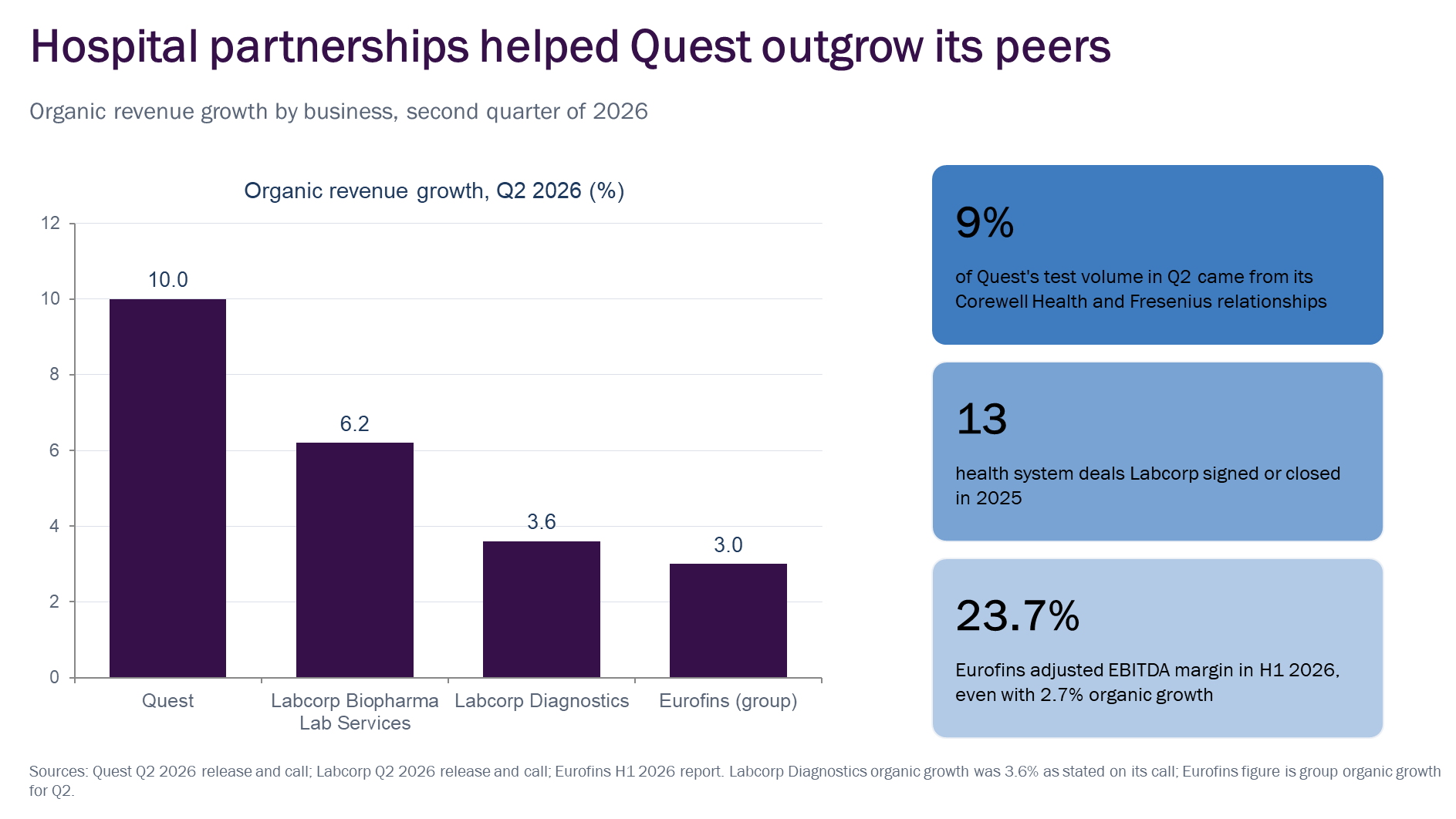
In July 2026, Quest Diagnostics reported that its second-quarter revenue increased by 10.2% to USD 3.04 billion, with organic growth contributing 10.0%. Organic growth is an increase in business generated through existing operations rather than acquisitions. The company’s adjusted earnings per share also increased by 19.1% to USD 3.12. Based on its performance, Quest raised its 2026 revenue forecast to between USD 11.95 billion and USD 12.05 billion, representing expected growth of 8.3% to 9.2%.
In July 2026, Labcorp reported that its second-quarter revenue increased by 5.8% to USD 3.73 billion. Its diagnostics business grew by 5.5% to USD 2.90 billion, including organic growth of 3.6%, while its Biopharma Laboratory business increased by 6.5% to USD 836 million. Adjusted earnings per share rose by 15% to USD 4.99. Labcorp also raised its full-year revenue growth forecast to between 5.4% and 6.3%.
“With strong growth and sustained demand for our diagnostic insights, we are again raising our full-year guidance.”
Why This Matters
Both companies are growing faster than they did a few years ago, which suggests that laboratory testing and services industry growth is being driven by rising patient volumes and greater use of advanced tests. Quest is growing faster, but a large part of its gain comes from specific hospital partnerships.
02Hospitals Are Outsourcing More Laboratory Work to National Laboratories
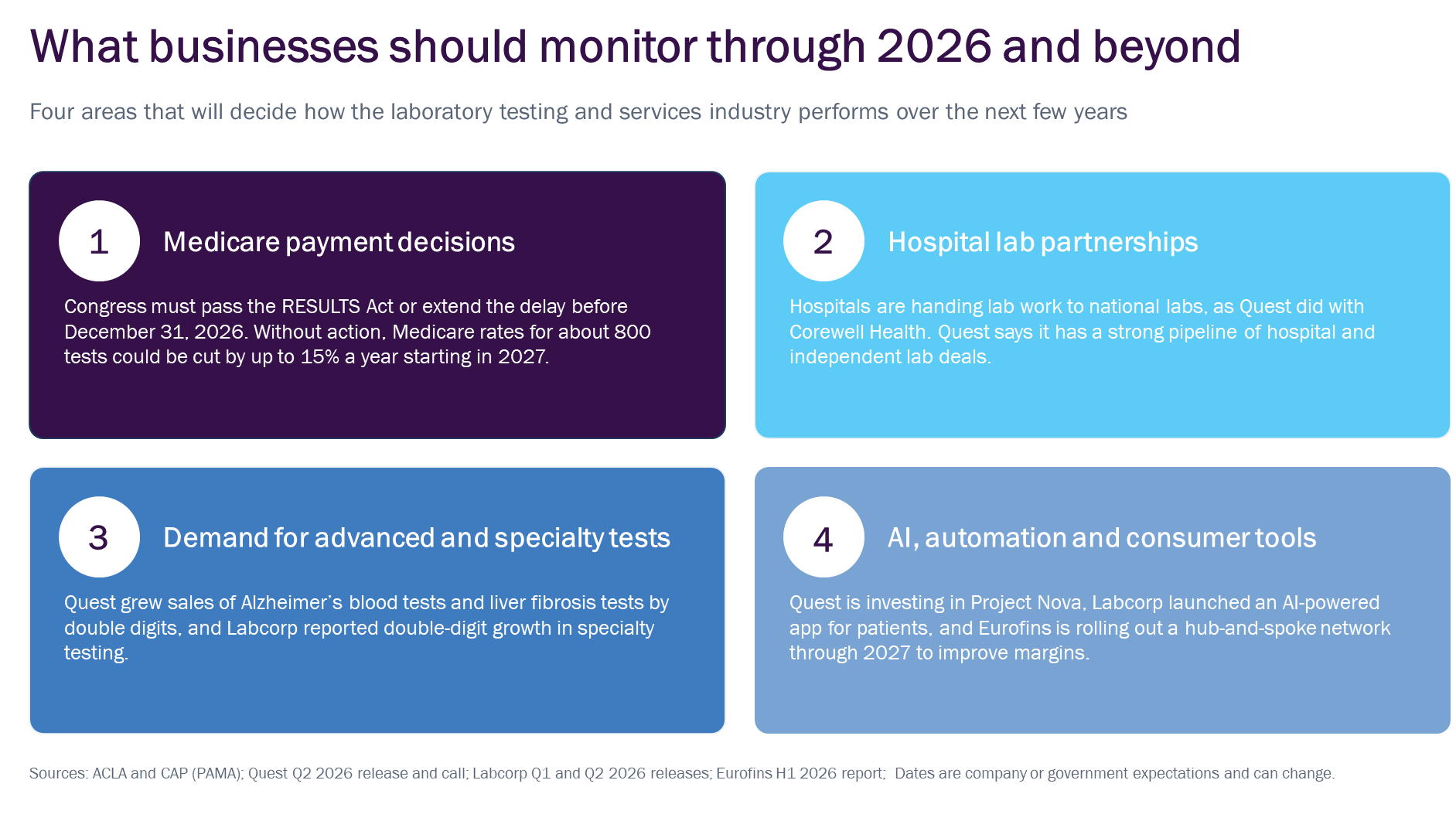
Operating an in-house laboratory can be expensive for hospitals, thus encouraging many healthcare providers to outsource some or all of their testing activities to large national laboratory companies. Quest Diagnostics reported that its partnerships with Corewell Health and Fresenius Medical Care contributed approximately 9% to its test volume in the second quarter. The company also reported double-digit growth in its hospital channel. However, these partnerships generally involve lower average prices, and Quest’s revenue per test order declined by 2.8% due to the changing mix of business.
Labcorp is following a similar strategy to expand its hospital business. According to its 2026 proxy statement, the company signed or completed 13 transactions with hospitals, health systems, and regional laboratories in 2025. During its second-quarter earnings call, Quest’s chief executive also highlighted a strong pipeline of potential collaborations and acquisitions involving hospitals and independent laboratories.
“Key accomplishments include broadening our specialty test portfolio, expanding partnerships with leading health systems, biopharmaceutical clients, and regional and local laboratories, continuing to grow our consumer business, and increasing the use of advanced technologies across the company”
Why This Matters
Hospital partnerships allow national laboratories to increase testing volumes quickly and spread fixed operating costs across a larger number of tests. However, these agreements often involve lower prices and may initially reduce profit margins while new operations are being integrated. Smaller independent laboratories may find it increasingly difficult to compete with large national companies for these contracts.
03Advanced and Specialty Tests Are the Main Growth Engine
The most profitable laboratory testing and services industry growth is in tests that are harder to run and that help doctors make treatment decisions. Quest reported that its revenue grew by double digits in several advanced areas, including its blood tests for Alzheimer’s disease and advanced heart, metabolic, and hormone tests, including a test for liver scarring. Labcorp also reported double-digit growth in specialty testing and highlighted its efforts to strengthen its position in specialty and companion diagnostics. Companion diagnostics are tests that help identify patients who are likely to benefit from specific drugs.
The Medicare Part B spending on lab tests was USD 8.4 billion in 2024, up 5% from USD 8.0 billion in 2023 and equal to the 2022 level. The growth came from genetic tests, which rose from USD 2.4 billion in 2022 to USD 3.0 billion in 2023 and USD 3.6 billion in 2024, lifting their share of spending to 43%. Spending on traditional tests, such as panels and blood counts, was flat at about USD 4.8 billion over 2023 and 2024. These figures cover only Medicare Part B, so they do not include Medicare Advantage or private insurance.
| Medicare Part B lab spending | 2022 | 2023 | 2024 |
|---|---|---|---|
| Total | 8.4B | 8.0B | 8.4B (+5%) |
| Genetic tests | 2.4B | 3.0B | 3.6B |
| Genetic share of spending | 33% | 39% | 43% |
| Traditional tests (panels, blood counts) | 4.9B | 4.8B | 4.8B |
Consumers are also becoming more direct customers of laboratory companies. Labcorp planned to launch an artificial intelligence-powered mobile application in May 2026 to bring individual test results together with clinical guidance, while Quest reported growth in its consumer channel during the second quarter.
Why This Matters
Doctors and patients are asking for more complex tests, and labs that can offer them have more control over prices and are harder for competitors to copy. Labs that focus only on routine tests are more exposed to price pressure.
Section II: Business Challenges and Operational Transformation
04Medicare Payment Rules and Insurance Changes Remain the Biggest Risk
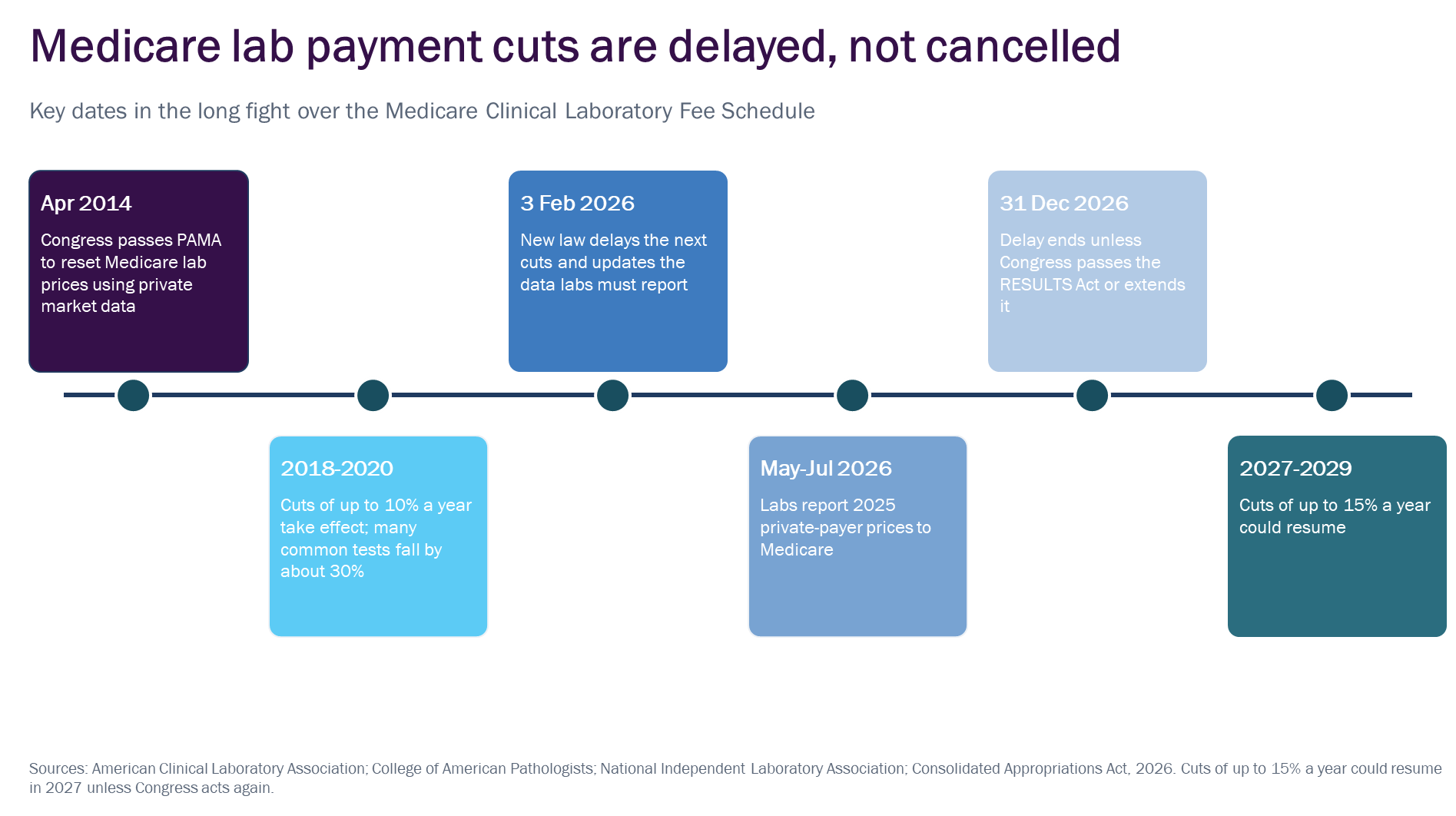
Medicare pays for laboratory tests according to a national fee schedule established under the Protecting Access to Medicare Act (PAMA) of 2014. According to the National Independent Laboratory Association, since 2018, payment reductions of up to 10% per year have lowered prices for many common laboratory tests by approximately 30%.
In January 2026, Congress passed the Consolidated Appropriations Act, 2026, which delayed the next round of payment cuts until 1 January 2027. The legislation also updated the private-payer data that laboratories must report, changing the reporting period from 2019 to the first half of 2025. The data submission window was set for 1 May to 31 July 2026.
According to industry groups, after the delay, payment cuts of up to 15% per year could resume through 2029 for approximately 800 commonly billed tests, unless Congress passes the RESULTS Act. The proposed legislation has support from both parties but has not been passed in the sources reviewed. Changes in insurance coverage also affect the industry. Quest Diagnostics reported that the expiration of subsidies on the Affordable Care Act exchanges was expected to reduce its 2026 revenue by approximately 0.3%.
“While the delay in cuts and updated data represents important improvements, significant structural problems with PAMA remain and temporary delays are not a solution. A fair, accurate, and stable payment system is needed to sustain the workforce, innovation, and capacity required to deliver clinical laboratory services.”
Why This Matters
The industry continues to face uncertainty over Medicare pricing, as companies await a long-term solution to the payment rules. Laboratories with diversified services, including drug-development testing and advanced diagnostics, are better positioned to absorb potential price reductions than those that depend primarily on routine Medicare tests.
05Global Testing Services Are Growing More Slowly but Earning Better Margins
Eurofins Scientific is a global testing company that operates laboratories in dozens of countries and serves customers across the food, environmental, pharmaceutical, and clinical testing markets. In the first half of 2026, it reported that the company generated revenue of 3.70 billion euros (approximately USD 4.32 billion), with organic growth of 2.7% for the period and 3.0% in the second quarter. Its adjusted earnings before interest, taxes, depreciation, and amortization (EBITDA) margin improved to 23.7%, while earnings per share increased by 29%. The company stated that its growth remained below its mid-single-digit target; it also indicated that performance was improving.
Eurofins’ consumer and technology products testing business achieved organic growth of 7.4%, supported by the demand from semiconductor and defense customers. Its business in markets outside Europe and North America grew by 9.1%. Labcorp’s drug-development laboratory business also performed well, recording growth of 6.5% and a book-to-bill ratio of 1.14. This ratio indicates that the value of new orders exceeded the revenue recognized during the period, suggesting potential for future growth.
“Organic revenue growth has not yet returned to a normal level, although there was improvement as H1 progressed. Environment Testing activity rebounded well from the severe weather impacts of the first quarter, and while growth in BioPharma remained slow, particularly in the ancillary activities, we expect some acceleration in the second half of the year.”
Why This Matters
Laboratory companies can improve their profit margins even when revenue growth is modest by reducing costs, closing underperforming facilities, and distributing the workloads more efficiently across their networks. These improvements are relevant for investors who want steady earnings from a business that is partly tied to economic conditions.
06Automation and Artificial Intelligence Are Becoming Part of Daily Lab Operations
Among the most practical laboratory testing and services industry trends, large laboratory companies are investing in technology to process more tests with fewer errors and lower operating costs. Quest Diagnostics reported that its financial results were affected by investments in Project Nova, a program designed to modernize its operations, and stated that spending on the initiative was expected to increase in the second half of 2026. In earlier results, the company also highlighted its growing use of automation and artificial intelligence to improve the testing quality and operational efficiency. Eurofins Scientific expects to complete its hub-and-spoke laboratory network, which directs testing activities to central laboratories, along with its new information technology systems by the end of 2027.
Labcorp has also introduced an artificial intelligence-powered real-world data platform in collaboration with Datavant and Amazon Web Services to accelerate Alzheimer’s research. In addition, the company is also expanding its patient application. These digital tools can help laboratories attract business from doctors, hospitals, and pharmaceutical companies that want faster results and easier access to data.
Why This Matters
Technology spending lowers profit in the short term but can create long-term advantages in cost and service. Laboratories that do not modernize their operations may find it more difficult to secure large contracts from hospitals and pharmaceutical companies, which are important sources of growth.
Laboratory Testing and Services Industry Outlook: Where the Next Opportunities Could Emerge
Future opportunities may arise from partnerships between hospitals and large laboratories to reduce testing costs and handle higher testing volumes efficiently. Demand for advanced blood tests for Alzheimer’s disease and other conditions may also increase as new treatments and diagnostic guidelines develop. Pharmaceutical companies may expand their use of laboratory services to support clinical trials. Digital tools that help patients understand their test results could strengthen customer relationships, while lab automation and facility improvements may help laboratories control operating costs and improve profit margins.
The Bottom Line:
The laboratory testing and services industry outlook remains positive, supported by an aging population, complex medical needs, and rising demand for drug development services. Large laboratories are expanding through hospital partnerships and advanced testing capabilities. Demand for Alzheimer’s blood tests and specialty diagnostics may create further opportunities. Automation and digital tools can improve efficiency, reduce costs, and strengthen customer relationships.
Last updated:


