Forces Reshaping Orthopedic Devices in 2026 and Beyond
Explore all 7 industry trends
Use the contents below to jump directly to the trend relevant to your research.
Forces shaping orthopedic devices industry
- Orthopedic procedures are shifting to ASCs, enhancing demand for compact, cost-effective surgical solutions.
- Orthopedic robotics is expanding across specialties, with competition shifting toward wider adoption.
- Companies are streamlining portfolios to sharpen focus and improve growth and profitability.
- Specialized sales teams are improving productivity and targeting high-growth segments.
- Frequent product launches are becoming critical to gaining market share.
- Pricing pressure, regulatory delays, and weaker M&A activity are challenging industry growth and profitability.
Section I: What The Market Actually Looks Like (Size, growth, and segment reality)
Orthopedic devices industry whose growth has cooled since 2023
The orthopedic devices industry is one of the largest and most mature ecosystems in MedTech industry. However, it has witnessed subdued growth for the past 4-5 years. Since 2023, the industry has grown by 4.3%. Companies registering high single-digit or double-digit growth are essentially catering to a few high-growth sub-industries and inventing high-growth next-gen technologies.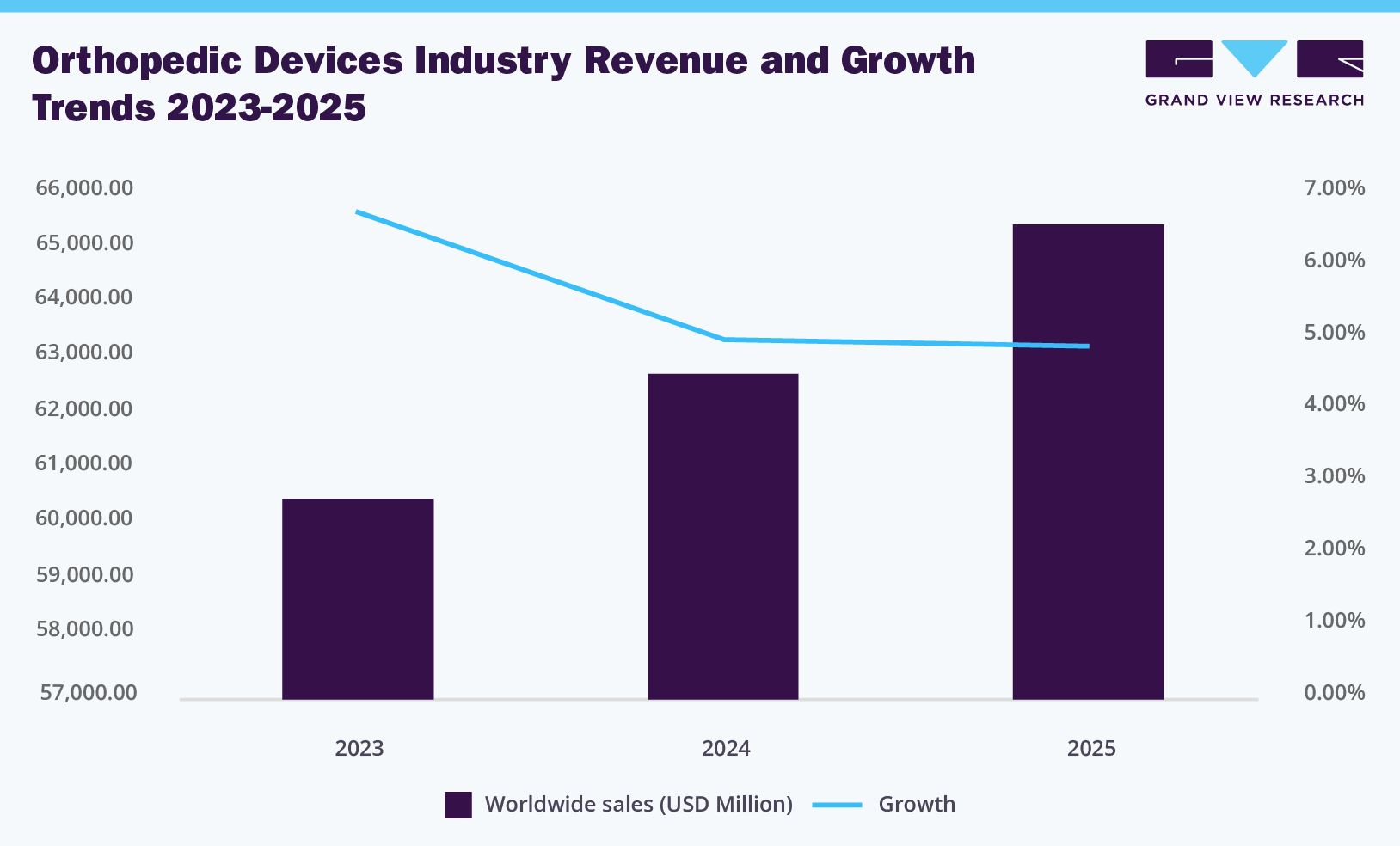
Source: GVR Orthopedic Devices Database, Industry publications and White Papers
01The ASC shift gets its regulatory unlock, and orthopedic device companies respond with ASC specific portfolios
The migration of orthopedic procedures from hospital settings to ASCs reached a tipping point post Center for Medicare and Medicaid Services (CMS) policy shifts in November 2025. In its updated rules, the CMS began phasing out its Inpatient-Only list by removing 285 procedures. Most of these were complex musculoskeletal surgeries. The agency added 270+ of these codes to the ASC Covered Procedures List. Regulators justified the move by saying that rapid advancements in surgical technology and safety protocols have led to the old restrictive lists obsolete. Rather than relying on rigid regulatory mandates, the agency is transferring the decision-making power directly to the surgeon while pushing for site-neutral payments. This is not just a reimbursement footnote, it’s a market-access event that dictates where surgeries happen, and who controls the checkbook, and the commercial terms of every sale.
Zimmer Biomet is attacking this migration by treating the outpatient clinic not just as another healthcare setting, but as a critical piece of healthcare infrastructure. Through its dedicated ZBX ASC Solutions program, the company bundles project management, operating room capital equipment, strict infection control, and highly flexible financing options right alongside its traditional implant portfolios. To rapidly scale this model, the company built a distribution partnership with Getinge in July 2025. Chief Strategy and Development Officer Jehanzeb Noor described this alliance as a "comprehensive, turnkey solution for our ASC customers." This major operational push follows an earlier, deliberate partnership with real estate giant CBRE. That deal was executed explicitly "to grow the orthopedic ambulatory surgery center footprint in the U.S." and anchor the company's presence in the outpatient market.
Other market participants are modifying their product engineering to fit the physical constraints of these smaller, high-turnover outpatient facilities. Stryker response was the launch of its Mako RPS handheld system in July 2026. This device combines robotic execution with the workflow of a standard power tool to cut the capital costs and floor space that usually keep large robotic consoles out of outpatient centers. Meanwhile, Smith & Nephew has built its digital surgery strategy around this minimal footprint. They put the inpatient-to-outpatient transition on center stage at their December 2025 Capital Markets Days. Deepak Nath, PhD, CEO, Smith & Nephew: "RISE is our bold new strategy to elevate Smith & Nephew." As part of this broader operational elevation, the company is heavily leveraging its compact CORI Surgical System. It is uniquely tailored for the dynamic environment of ASCs because it avoids the million dollar price tags and dedicated rooms required by bulky rival consoles.
Even with this momentum, financial models tracking the outpatient shift should account for two structural hurdles. First, since ASCs operate on tighter margins, they generally choose to lease or finance capital equipment rather than purchasing it outright. This trend lowers upfront revenue for manufacturers even with the total number of unit placements increase. Second, the pace of this transition varies by clinical segment. While joint replacements are moving at a fast pace, spine surgeries remain primarily bound to traditional inpatient hospitals. Until future regulatory updates close the payment gap between care settings, spine surgeons have very minimal financial incentive to move their complex cases out of the hospital operating room.
02Orthopedic Robotics has become a multi-specialty, multi-form-factor race
Orthopedic robots are expanding well beyond knee applications as the industry transitions from a single architecture to multiple competing system designs. Stryker documented this in its financial filings, reporting more than two million robotic procedures were completed across its Mako Total Knee, Mako Total Hip, and Mako Partial Knee platforms. The company also secured FDA 510(k) clearance for its Mako Total Hip with Advanced Primary and Revision application. As per Stryker, Form 10-K 2025: "Stryker's first-to-market, robotically enabled revision hip arthroplasty procedure." The market for different hardware formats expanded in July 2026 when Stryker completed the U.S. commercial launch of the Mako RPS (Robotic Power System) for total knee replacement procedures, officially introducing the Mako Handheld Robotics platform.
Smith & Nephew committed to handheld robotics early with its CORI system and views this new competitor launch as validation of its original technology choice. The company reported that CORI system placements continued to grow at a double-digit rate as rival product introductions confirmed the validity of the handheld format. Meanwhile, Zimmer Biomet is targeting underpenetrated surgical specialties rather than focusing exclusively on head-on knee competition. According to CEO Ivan Tornos, ROSA Shoulder is the only robotic shoulder system in the world that can perform both anatomic and reverse procedures. The commercial adoption of this platform resulted in a 53% surge in U.S. Technology and Data sales.
Since the early adopters have largely captured the early enabling technology placements, the competition has moved toward driving utilization across large hospital accounts. This market movement aligns with Zimmer Biomet's corporate positioning around surgeon optionality. This strategy relies on acquiring and partnering across various technologies and form factors rather than forcing accounts to adopt a single corporate platform.
Section II: How Companies Are Competing (Portfolio, channel and product cycle)
03Portfolio recalibration at industry scale
The orthopedic devices are experiencing an industrywide portfolio recalibration. The pivotal event of this cycle is Johnson and Johnson's planned exit from orthopedics, which follows a pattern of corporate portfolio pruning. This same pattern is visible in Zimmer Biomet's divestiture of its spine and dental businesses, and Stryker's exit from spine.
Tim Schmid, EVP, MedTech, Johnson & Johnson said: "Wall Street is not rewarding size, but rather best-in-class performance." Schmid added that the company expects the separation to lift both top-line growth and margins once it is complete. The standalone business will remain large, as DePuy Synthes will continue to cater to a global market opportunity of more than USD 50 billion and serve approximately 7 million patients annually, with Namal Nawana appointed as worldwide president.
The signs of this recalibration are visible in hips segment, where the three industry leaders sit within roughly five share points of each other. DePuy Synthes will enter as the number three hip player, growing at nearly a quarter of Stryker's rate. Whether pointed corporate focus can close that growth gap remains the open question for 2027 and 2028.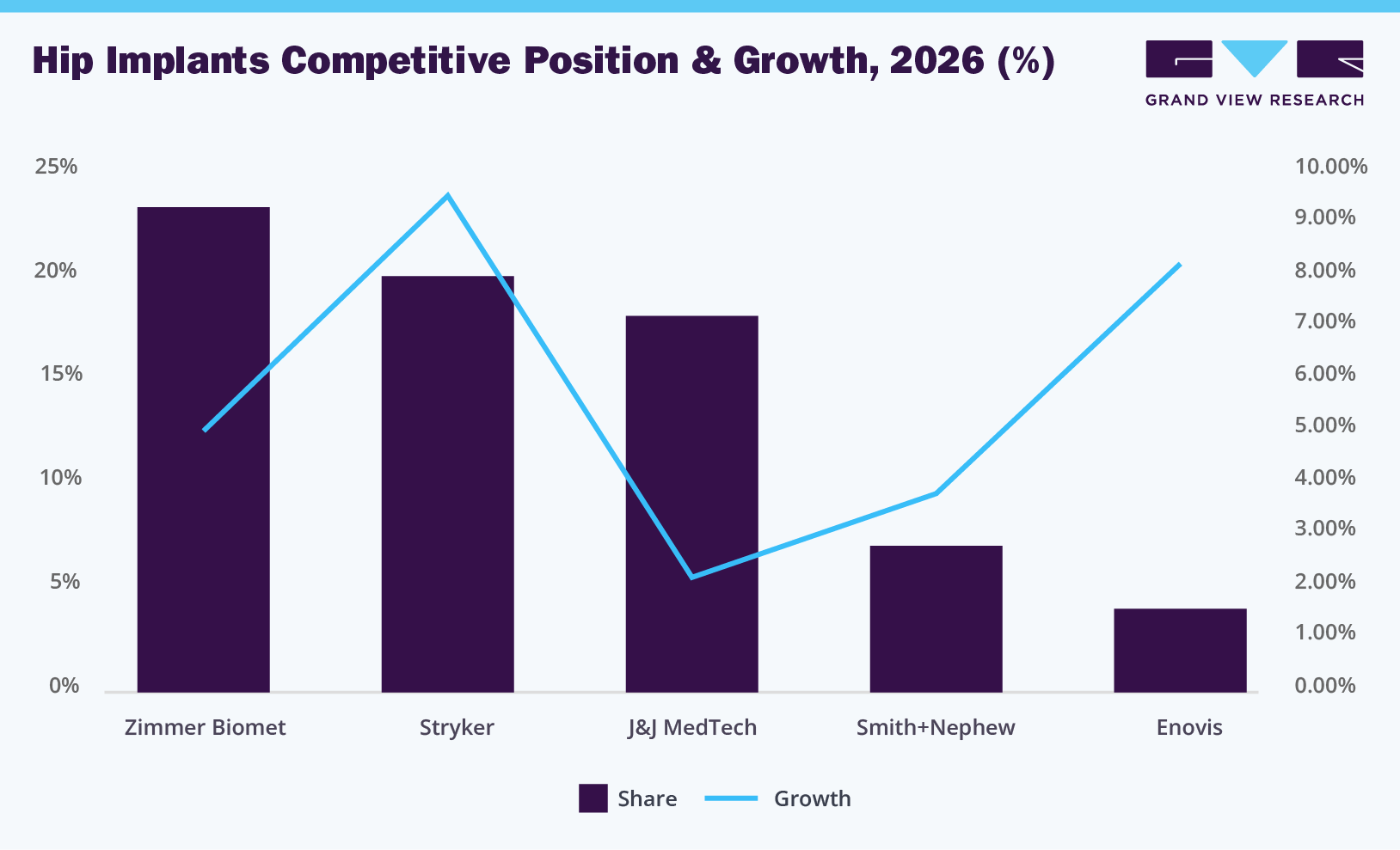
Source: GVR Orthopedic devices database, Investor presentations & analyst reports
04Companies are rebuilding the sales channel alongside the product line
This trend represents a shift in how the orthopedic device industry operates. Leading players like Zimmer Biomet, Smith & Nephew, and Stryker are moving away from broad sales structures to build specialized sales teams. The key driver is a mature market that is growing at a mid-single digit each year. Additionally, hospitals keep pushing for lower prices across the board. Companies can no longer just wait for the next big product innovation cycle to increase their revenue. Rather, they are focusing on fixing their own sales productivity. Companies’ internal data shows that traditional, non-dedicated sales territories bring in about half the revenue of specialized models.
Zimmer Biomet is leading this shift and wants to complete the transition by the end of 2027. The company is transforming its sales approach from a mixed network of independent contractors into a fully dedicated workforce. Since the U.S. generates 58% of its total revenue, the leadership views this as a pure growth strategy rather than a mechanism to cut costs. They are deploying highly focused teams to grab the high-margin sectors like surgical robots and ASCs. At the same time, Smith & Nephew is running its own Ortho 360 program to fix sales incentives and streamline product deployment. Stryker is also following a similar playbook by making sales specialization a core pillar of its growth strategy.
Even though the long-term goal is faster growth, making this transition brings real-world friction. Changing established sales territories and hiring specialized clinical experts requires large upfront costs. Zimmer Biomet is already feeling this pressure on its margins as it absorbs these corporate investments. The success of this industry-wide move depends on keeping sales reps focused and happy. Companies must pull off this restructuring without damaging the relationships their reps have built with orthopedic surgeons over the years.
05Product cycle density is the primary share lever
In a mature medical device industry where annual growth is tightly capped at 4% to 5%, winning market share comes down to a single factor. Companies gain ground almost entirely by launching new products faster and more consistently than their rivals. This reality turns a company's product pipeline into its most valuable strategic asset. Zimmer Biomet entered 2026 with high confidence because of this dynamic. The company is leaning into product density to outpace the competition.
Zimmer Biomet showcased this operational focus in its latest annual report to investors. In the official message to shareholders, the leadership team set a confident tone. As per Zimmer Biomet, 2025 Annual Report: "Discipline is a competitive advantage, and our teams proved it again in 2025." Company filings explain that they entered 2026 with their strongest product cycle in this decade. This commercial push relies on seven core platforms, including the Persona OsseoTi Keel Tibia for cementless total knee arthroplasty and the Oxford Cementless Partial Knee. It also includes the Z1 Femoral Hip System and their ROSA Robotic Solutions. Furthermore, the management expects to introduce more than 50 new products over the next 36 months to keep this momentum going.
Smith & Nephew is building its corporate roadmap around these exact fundamentals. The company's leadership has mapped out a new long-term vision to accelerate its own commercial engine. Deepak Nath, PhD, CEO, Smith & Nephew: "RISE is our bold new strategy to elevate Smith & Nephew." Under this three-year RISE strategy, the company expects to reach ambitious 2028 financial targets. The company is projecting a 6% to 7% revenue CAGR and over USD 1 billion in free cash flow. They plan to achieve this by using fresh innovation to drive above-market growth in sports medicine, advanced wound management, and ear, nose, and throat devices, while their core orthopedic devices segment delivers steady market-level growth.
Section III: What Constrains The Economics (Pricing, innovation throughput and capital)
06Price erosion is a permanent line item, not a cycle
The financial reality of the medical device industry has forced major companies to guide implant pricing, proving how embedded price erosion has truly become. Zimmer Biomet reports that pricing pressure remains one of the key corporate headwinds, absorbing 80 basis points of erosion in the quarter while expecting up to 100 basis points of erosion for the full year. Despite the financial strain, executive leadership has confirmed that this guidance holds steady even in the face of the proposed Medicare physician fee cuts for 2027. This proactive forecasting shows that manufacturers are completely re-engineering their financial expectations to survive institutional budget tightening.
Meanwhile, Stryker shows the segment split clearly, highlighting how different divisions weather these pricing shifts. The company reported that pricing remained "modestly positive" overall, sustained by its MedSurg business, while its core Orthopedics division skewed negatively. By breaking down performance this way, it becomes obvious that heavy hardware like joint implants feels the brunt of hospital cost-cutting, whereas specialized surgical equipment manages to maintain a premium.
The battle over margins is not just a domestic problem, as international rivals open a second front. China's volume-based procurement (VBP) policy acts as a catalyst for global price decay, pushine companies to lower prices to secure large hospital contracts. Smith & Nephew expects the visible impacts in the second half of the year, while anticipating a related 2026 profit risk of around USD 15-20 million. Navigating this double-edged sword of domestic erosion and aggressive international policy will define the next decade of medtech profitability.
07Innovation throughput and M&A capacity are both tightening
The orthopedic industry is facing a unique squeeze as two major supply-side constraints hit the market at the same time. First, regulatory bottlenecks are slowing down the introduction of new products. The FDA issued 482 orthopedic 510(k) clearances in 2025, which is 6.6% lower as compared to the 516 clearances granted in 2024. On segment/product level, spine implants and instruments took the largest share at 30%, followed by trauma indications at 23%, and joint replacements at 20%. This slower regulatory throughput means companies are facing a stickier, more delayed path to getting their new technologies into the hands of surgeons.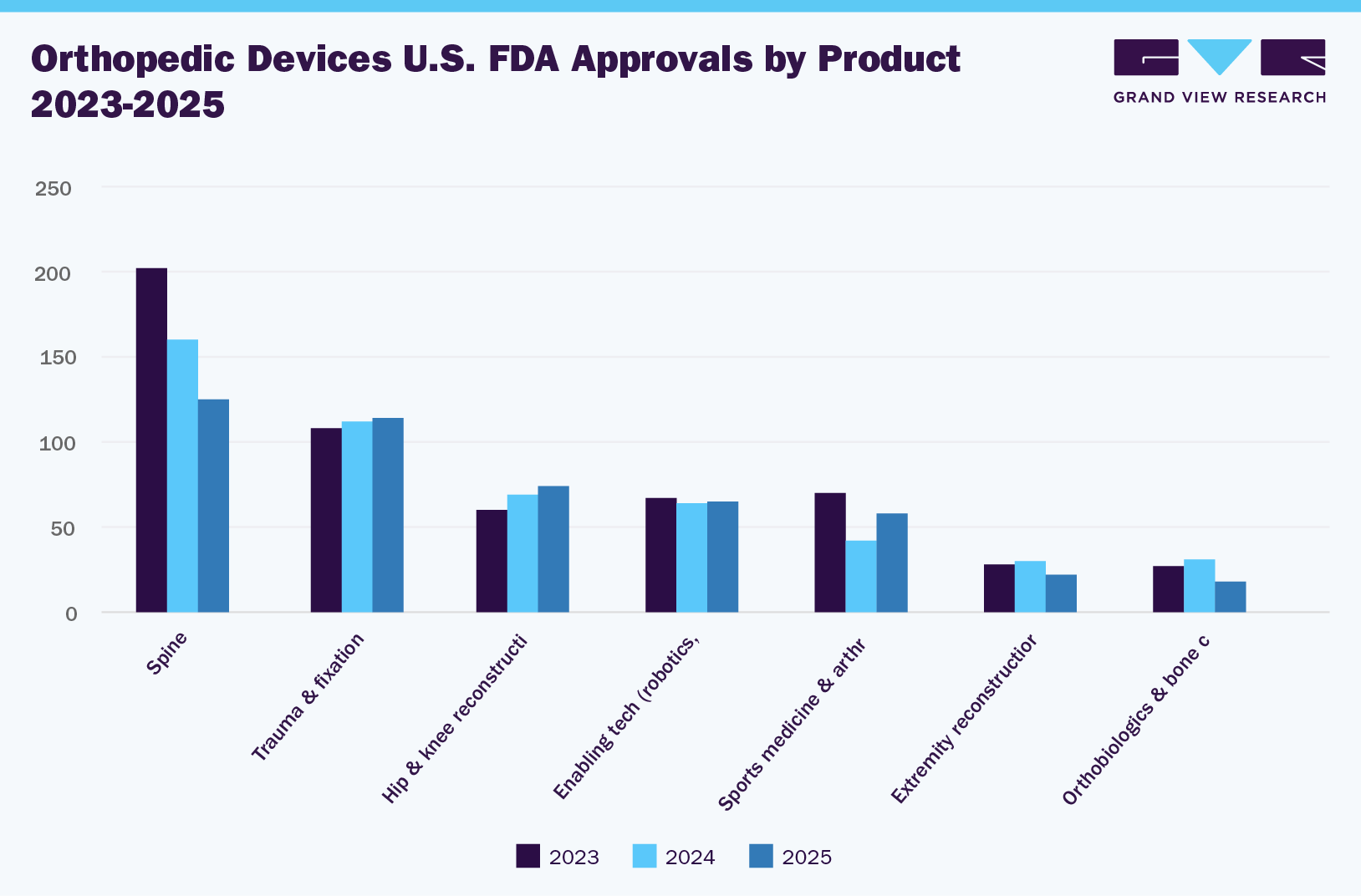
Source: U.S. FDA 510K filings, GRV Orthopedic Device Database
At the exact same time, deal-making capacity among top buyers has hit a roadblock. Zimmer Biomet, DePuy Synthes, Globus Medical, and Enovis represent four of the six most active corporate buyers in orthopedics, yet none of them can make the major moves. Zimmer Biomet is stuck with integrating past acquisitions and overhauling its sales channel, while DePuy Synthes is navigating its corporate separation. The funding pipeline for smaller players is also lean, with only 25 orthopedic companies publicly announcing funding agreements in the last year, mostly in joint replacement and enabling healthcare technologies. The capital market isn't completely dry, though, as the IPO window did open slightly with Carlsmed and Shoulder Innovations both going public, with Carlsmed raising USD 100.5 million in its offering to back its aprevo Technology platform an end-to-end, artificial intelligence (AI)-driven system built for personalized spine surgery.
Because of these internal corporate distractions, the market is bracing for a distinct M&A air pocket, followed by a 2027 catch-up period. With Zimmer Biomet and DePuy Synthes completely occupied with internal restructurings, Stryker and Smith & Nephew are left as the most likely acquirers. This small buyer pool turns it into a highly challenging year to run a sales process if you are a smaller company looking to get acquired. For sellers, navigating this dry spell requires patience, as the true rebound in major corporate buyouts will likely hold off until the industry's heaviest hitters clear their operational plates.
Last updated:


