Rewiring the Flow of Money: The Future of Payments and Money Transfer Industry
Explore all 12 industry trends
Use the contents below to jump directly to the trend relevant to your research.
Key trends defining the payments & money transfer industry beyond 2026
Instant payments as baseline
Availability of real-time payment services across markets, merchants, and countries is baseline of future trends in payments and money transfer industry.
Transparency associated with cross-border transactions
Regulatory scenarios and customer expectations are likely to increase pressure to disclose total fees associated with cross-border transactions and foreign-exchange margins.
AI agents become customers
Agents are projected to handle 15–25% of US e-commerce purchases by 2030, turning machine-to-machine payments into a mainstream channel.
Checkout disappears
Tokenization and biometrics will put one-click checkout within reach by 2030, and payments will be embedded wherever buying intent appears.
Identity becomes infrastructure
Digital identity wallets will underpin trust as instant, irreversible payments become the default.
The payments and money transfer industry has improved transaction speed across regions. Now, it is moving toward modern concepts such as autonomous transactions, interoperability across multiple ecosystems, and seamless cross-border connectivity. The focus of the industry is shifting from just enabling high-speed performance to improved data security, adoption of AI, and fundamentally changing how payments are initiated and settled. Online distribution of products and services contributes significantly to this transition, and customer expectations shape novel features associated with portfolios.
Payment Ecosystem Workflow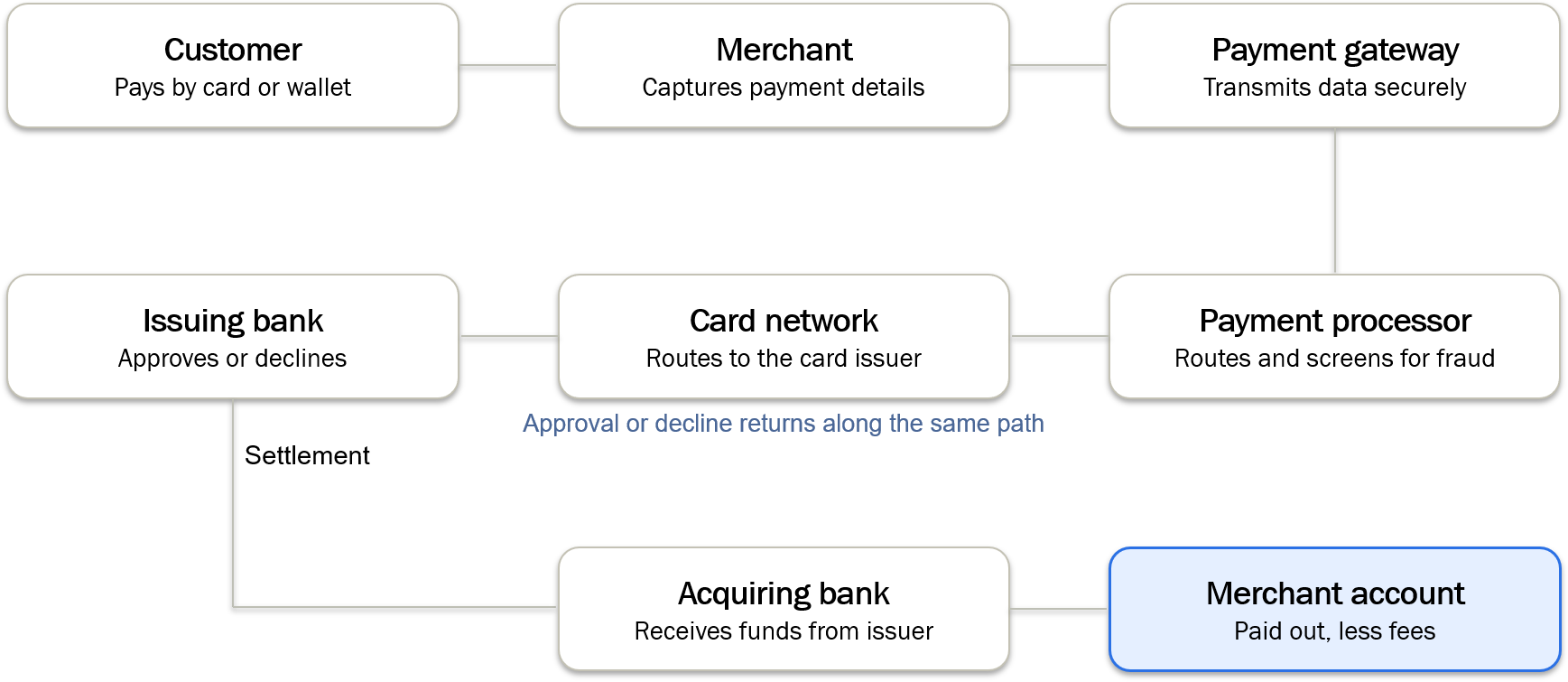
| Participant | Core role | Examples |
|---|---|---|
| Customer | Initiates the payment by card, wallet or bank transfer | Consumers, businesses |
| Merchant | Accepts payment for goods or services | Retailers, SaaS firms, marketplaces |
| Payment gateway | Securely transmits payment data from checkout to processor | Online and POS gateways |
| Payment processor | Handles authorization, clearing and settlement messaging; screens for fraud | Stripe, Adyen, Fiserv |
| Card network | Sets rules and routes transactions between acquirer and issuer | Visa, Mastercard, American Express |
| Issuing bank | Issues the card, approvals or declines, and funds the transaction | Consumer and commercial banks |
| Acquiring bank | Holds the merchant account and deposits funds, less fees | Merchant banks |
| Payment facilitator (PSP) | Onboards many merchants under one master account | Stripe, PayPal, Mollie |
| Regulators | Set rules for security, AML and consumer protection | FATF, CFPB, ECB, FCA, RBI |
Instead of replacing, the following decade is likely to witness a fundamental restructuring of this chain. Account-to-account payments go straight past the card networks, stablecoins move past correspondent banks, and the trend will see the move from distinct institutional chains to network-based ledger systems. Each one of these will cut out a fee layer but also a fraud and compliance burden for the other participants.
Section I: Trends shaping payments beyond 2026
01AI is changing the economics of creation
By the year 2030, agentic commerce is expected to be one of the major channels for online commerce, with AI agents predicted to handle roughly between 15.0% and 25.0% of all e-commerce orders in the U.S. The merchants are likely to use AI agents to optimize pricing strategies, control inventories, engage customers personally, and communicate with other AI agents serving customers. It is also anticipated that the standardized methods for verifying and authenticating the activities of AI agents and recording intent of agents will emerge.
02Programmable Money and Tokenized Assets
Stablecoins, tokenized bank deposits, and central bank digital currencies are increasingly expected to complement traditional forms of money. The financial services industry is expected to accelerate the tokenization of financial instruments, including bonds, securities, and repurchase agreements (repos), enabling these assets to be issued, transferred, and settled via digital infrastructure. The emergence of integrated digital wallets capable of supporting identity verification and holding multiple asset classes is also expected to facilitate seamless transactions, with smart contracts automating transfers based on predefined conditions and institutional requirements. Growing institutional interest in digital assets, with approximately 60% of institutional investors planning to increase their exposure, is likely to support further adoption.
03One-Click and Invisible Commerce by 2030
By 2030, concepts such as payment tokenization, biometric authentication, and others are expected to transform the digital transactions from task-based processes to seamless one-click activities. Tokenization is likely to support faster, one-click online payments, while biometric technologies are expected to simplify in-store payment authentication. Payment options are expected to become increasingly integrated into product pages, emails, QR codes, and other customer touchpoints, enabling consumers to complete purchases without navigating to a separate checkout page.
Furthermore, increasing adoption of technologies such as wearable payment devices, connected devices, and others is expected to generate a greater number of transactions initiated and completed with minimal user involvement. The growing inclusion of modern technologies such as AI, machine learning, and cloud-based applications is expected to facilitate this process further.
04Financial Services Become Part of Everyday Apps
Unprecedented growth in the use of online shopping portals, e-commerce websites, smartphone applications, and other digital platforms has significantly accelerated the integration of financial services, including payments, directly into these platforms. These integrations primarily focus on reducing checkout friction and improving user experiences. For example, in February 2026, PayPal announced it was joining forces with Rainforest, one of the prominent embedded payment providers purpose-built for software platforms to introduce embedded payment integration.
05Personalized Payment Models
Increasing use of connected devices and smartphones for payments has resulted in the availability of data that can be used to assess spending habits, financial preferences, and individual needs of users. Access to such key information and customer data has enabled payment service providers to develop models that deliver improved personalized experiences.
Data-driven models are also expected to assist companies in identifying unusual transactions and improving fraud detection, while supporting more informed assessments of customer risk. However, increasing use of this data for enhanced service delivery and focused efforts to increase security measures, also develops requirements such as customer consent, transparency in data usage policies, and strong data protection capabilities.
Section II: The future of cross-border payments and money transfer
International money transfers are expected to be more efficient with improved speed of settlement, reduced costs, enhanced transparency, and interconnected digital payment platforms in the future. Conventional correspondent banking is anticipated to remain relevant for a while, although the connections between instant payment systems, standardized finance messaging services, tokenized deposits, and digital payment systems are likely to result in emergence of new international money transfer mechanisms.
01Global Instant Payments
Several nations have adopted domestic instant payment schemes and thus opened up the possibilities of enhancing cross-border connectivity through regional and bilateral payment corridors. This will eventually make it possible for cross-border payments to attain a level of speed and convenience similar to domestic instant payments. With the development of real-time payment systems becoming highly interlinked, the corporate treasury department will greatly be favored by the constant settlement system, real-time cash visibility, and FX position tracking.
02Wallets as the Primary Endpoint
Mobile wallets are beginning to become the main access point for financial transactions in many developing countries where mobile wallets are being used for conducting digital transactions, transferring money, and availing other financial services. Online wallets are expected to become one of the fast-growing mediums for making remittances. This growth will be driven by increasing smartphone penetration, development in digital payment systems, and use of wallet services for transferring money.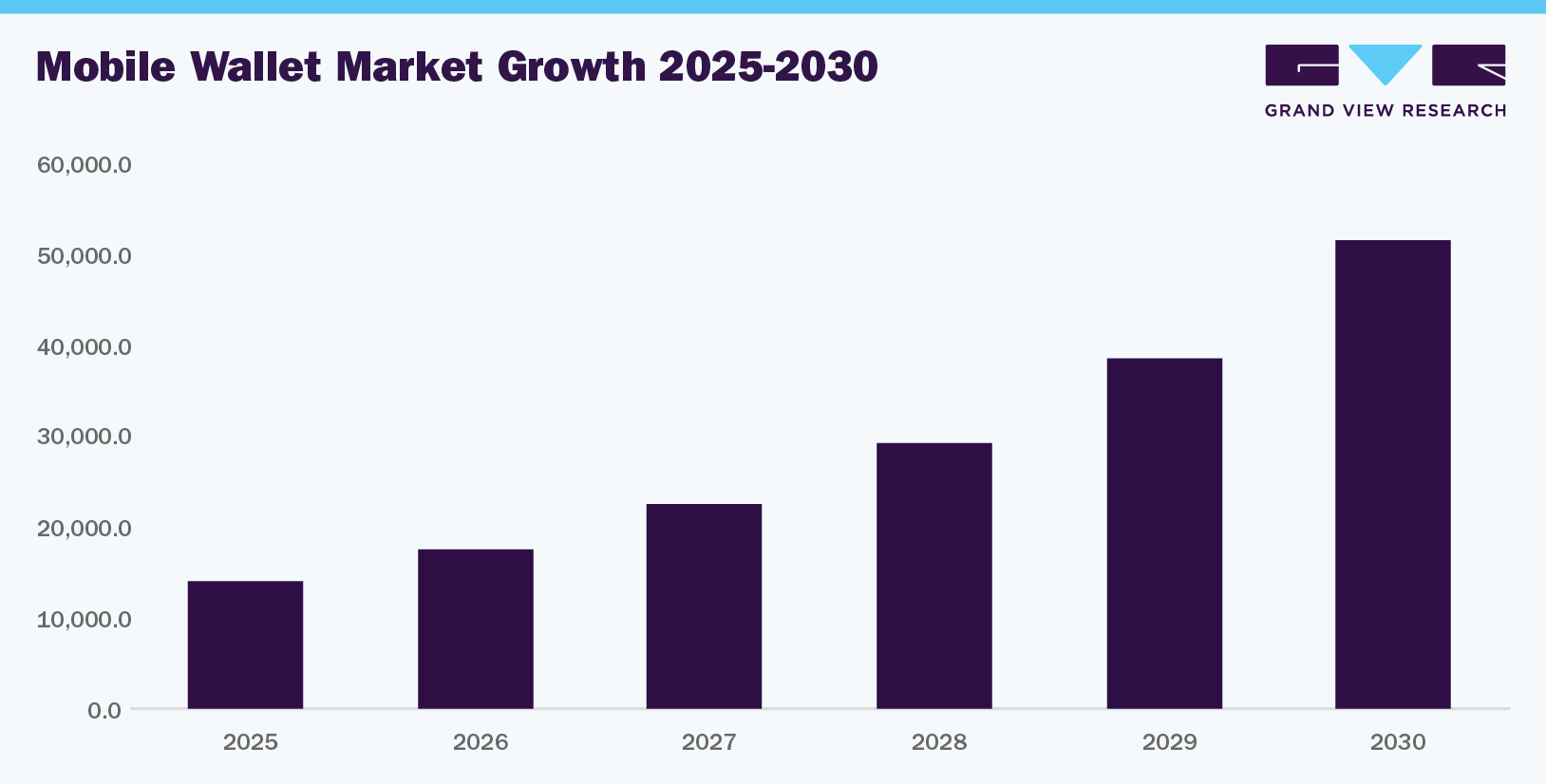
Source: GVR Mobile Wallet Market Database
03Real-Time Compliance by Design
Compliance systems such as sanctions screening, anti-money laundering (AML), and transaction risk assessment are supposed to occur simultaneously with the payment process. By incorporating explainable artificial intelligence (AI) and full audit trail mechanisms, it would be easier for the financial institutions to detect fraud and ensure regulatory compliance.
04Alias-Based Transfers
Alias-based payment solutions are expected to simplify cross-border remittances by enabling users to send money using identifiers such as mobile phone numbers or other registered aliases, rather than entering complete bank account details. This approach is likely to improve transaction convenience, reduce input errors, and strengthen payment security, making it easier for individuals to transfer funds to family members and other recipients across borders.
Section III: Challenges and Risks
Although the prospects for growth are positive, the growth of the payments and money transfer industry after 2026 will be reliant on whether the industry is able to overcome the various issues of security, interoperability, regulation, operations, and customer engagement that still remain. One such issue will be fraud, as new systems that use faster payments and AI will have less time for prevention.
01Fraud and Scams
Financial fraud remains a significant risk to the payment’s ecosystem. Authorized push payment (APP) scam losses are projected to reach USD 3.03 billion by 2027, while business email compromise (BEC) losses totaled approximately USD 2.8 billion in 2024. Increasing transaction speeds and the growing use of automated payment systems are expected to intensify fraud prevention challenges.
02Regulatory Complexity
Regulatory differences between regions create obstacles for payment service providers working globally. Regulations related to stablecoins, buy now, pay later (BNPL) services, data protection, and anti-money laundering (AML) vary from country to country.
03Customer Recognition and Personalization
The increasing use of guest checkout options and privacy-focused digital wallets can limit merchants' ability to identify the same customer across online and in-store channels. This fragmentation of customer information may limit the effectiveness of loyalty programs, personalized offers, and cross-channel engagement strategies.
Conclusion
By 2026, the payments industry had made significant progress in improving transaction speed and efficiency. The next phase of industry evolution is expected to be shaped by the growing role of AI-driven purchasing, the adoption of programmable money, and the development of interoperable payment networks connecting card schemes, banks, digital wallets, and digital assets across borders.
Last updated:


