Industrial Safety Products and Solutions Industry Trends: Connected Technologies, Predictive Analytics, and Worker-Centered Protection
Explore all 7 industry trends
Use the contents below to jump directly to the trend relevant to your research.
Forces Shaping the Industrial Safety Products and Solutions Industry
- From PPE to an Integrated Safety Ecosystem
- Regulation and Standards Continue to Anchor the Industry
- Smart PPE and Connected Worker Technologies Gain Ground
- Heat Stress Is Becoming a Larger Safety Design Consideration
- AI and Predictive Analytics Push Safety Upstream
- Safety Software and Services Expand the Value Proposition
Section I: How Safety Requirements Are Evolving Across the Industrial Safety Products and Solutions Industry (Integrated protection and regulatory standards)
One of the defining industrial safety products and solutions industry trends is the transition from standalone personal protective equipment (PPE) toward integrated workplace safety solutions that combine protective products, connected technologies, and digital safety management systems. Though conventional equipment such as safety helmets, safety eyewear, face protection, masks & respirators, safety gloves, fall protection systems, safety clothing, and footwear remains fundamental, employers are increasingly seeking more than protection. The integration of sensors, connected devices, software, and data analysis is supporting companies in detecting hazards early, improving compliance monitoring, and making informed decisions on safety issues.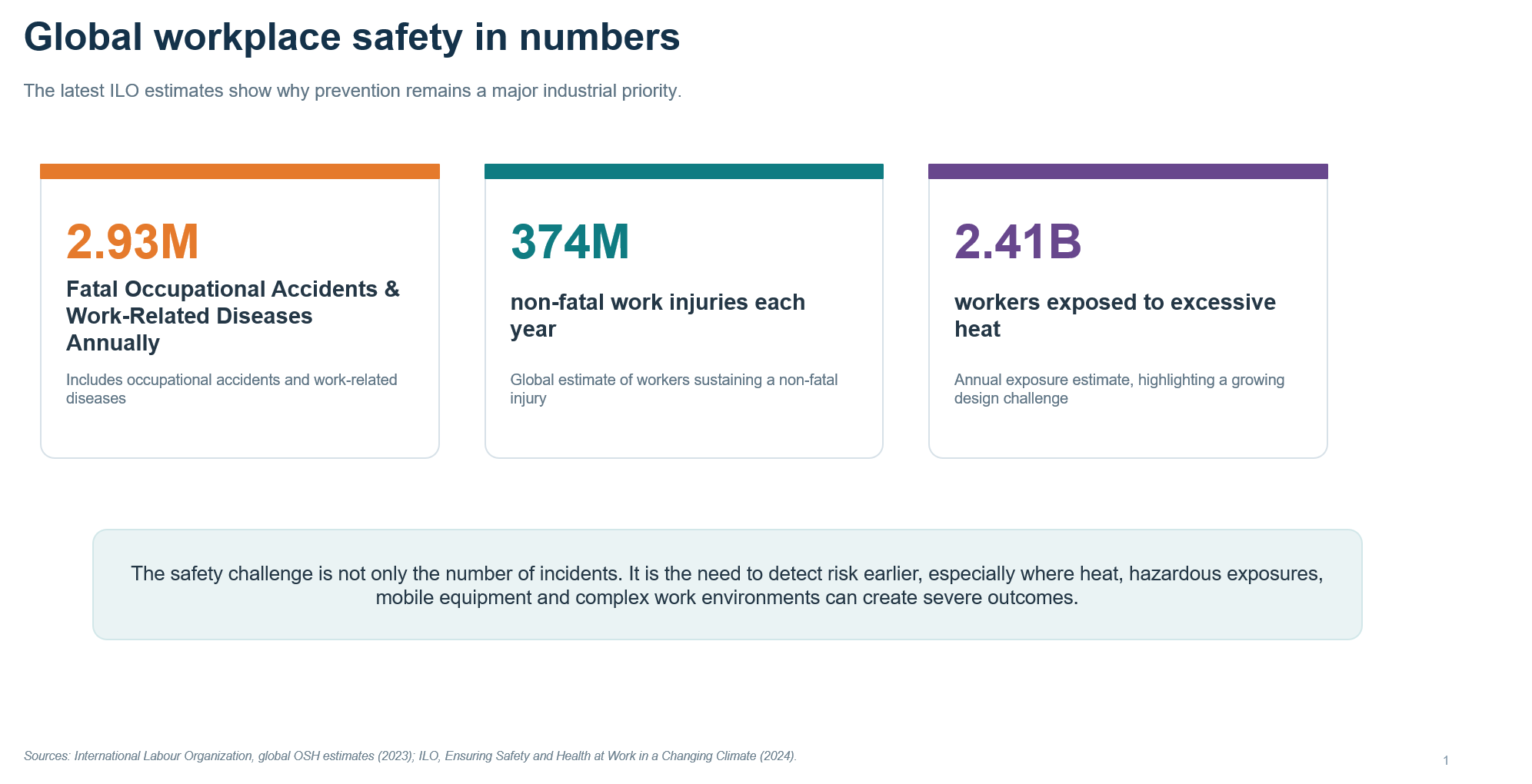
Workplace injuries and diseases caused at the workplace continue to be a major concern in workplace safety around the globe. According to statistics provided by the International Labour Organization (ILO), about 2.93 million workers lose their lives every year due to accidents and diseases in the workplace, whereas almost 395 million workers suffer non-fatal injuries at the workplace. Increased warming and climatic threats add more concern for workplace safety, as it is reported that 2.41 billion people around the world are exposed to excessive heat conditions at the workplace every year. These risks continue to underpin industrial safety products and solutions industry growth.
01From PPE to an Integrated Safety Ecosystem
Traditionally, procurement within the industry has been product-focused, with businesses sourcing equipment such as helmets, gas detectors, and fall protection systems from different vendors while relying on manual inspection and compliance procedures. Nevertheless, this paradigm is changing as companies incorporate integrated safety solutions that link workers, equipment, and safety management systems.
Modern industrial safety solutions combine traditional PPE with the use of wearable devices, connected gas detectors, worker location tracking, mobile inspection, digital permit-to-work systems, and EHS platforms. They allow for real-time monitoring and the prompt detection of risks. In case of issues such as gas exposure, heat stress, falls, late equipment inspections, and entering into restricted areas, warnings will be instantly sent to safety managers.
This trend is also reshaping the competitive landscape of the industrial safety products and solutions industry, encouraging manufacturers and suppliers to expand their offerings beyond conventional protective equipment. In addition to the traditional elements of quality, certification, and distribution, the integration of software, compatibility with other systems, data precision, technical assistance, and cybersecurity are now becoming more significant in making purchasing decisions.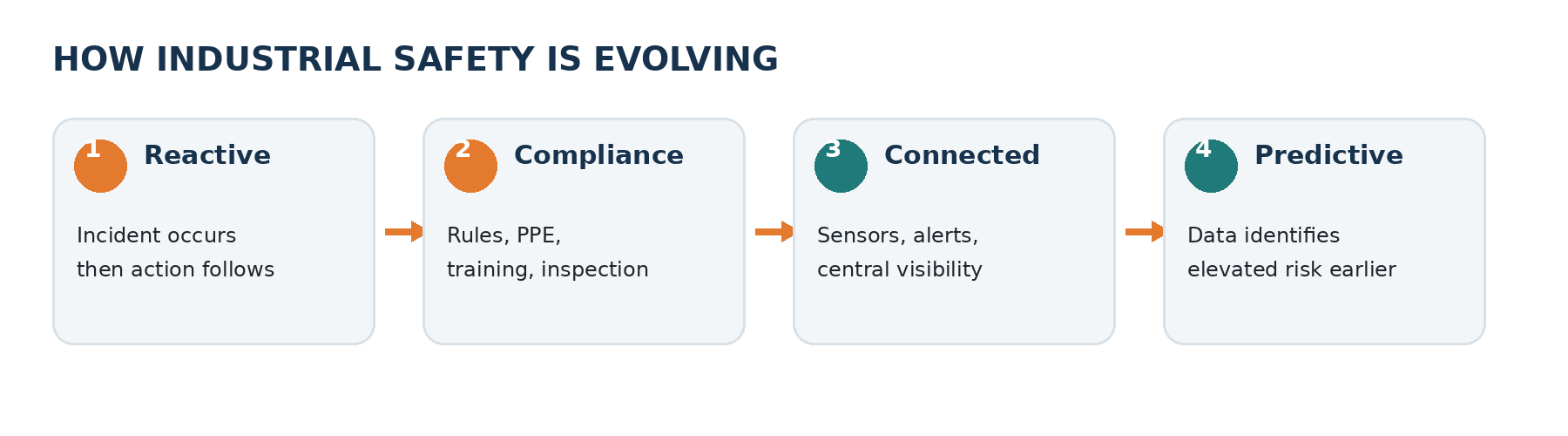
02Regulation and Standards Continue to Anchor the Industry
Despite the increasing adoption of advanced technologies, the Industrial Safety Products and Solutions Industry continues to be governed by regulations and technical standards that influence product design, certification, and compliance requirements. Industrial safety products such as respirators, safety helmets, safety clothing, safety shoes, hearing protectors, and fall protectors should be designed to comply with the relevant safety standards.
However, in line with the changing safety requirements and technological innovation of safety products, regulations and technical standards have been revised to keep up. For example, in Europe, the European Commission issued the Commission Implementing Decision (EU) 2026/1279 in June 2026 regarding the harmonized standards for the Personal Protective Equipment (PPE) Regulation. Because products designed to these standards benefit from a presumption of conformity, revisions can change the testing and documentation required for certification. As a result, manufacturers increasingly need to consider testing, certification, and technical documentation from the early stages of product design, rather than after it.
Section II: How Worker Protection Technology Is Advancing (Connected PPE and human-centered protection)
03Smart PPE and Connected Worker Technologies Gain Ground
Smart PPE is gaining importance within the industrial safety products and solutions industry as manufacturers increasingly integrate connectivity technologies into conventional protective equipment to enhance worker safety and monitoring capabilities. Smart helmets, smart gas detectors, wearables, and smart glasses have become more common in the development of products to deliver safety information alongside physical protection. According to the National Institute for Occupational Safety and Health (NIOSH), some of the applications could include proximity monitoring, physiological monitoring, heat stress warning, environmental monitoring, and hazardous substance monitoring.
Smart PPE is adopted because of its capability to solve workplace dangers. Proximity sensors may sense the presence of machines or vehicles near workers, while the connected gas detectors can send signals and alarms about hazardous gases to the safety team. Wearables can aid in ensuring that the lone workers are safe, as well as monitoring heat exposure and any possible danger. The digital information for inspections and maintenance will enable firms to track the equipment's status.
In high-risk industries like oil and gas, chemical plants, utilities, and those that conduct activities in confined spaces, connected gas detection has become an area of increased importance. On June 15, 2026, Honeywell added features to the Safety Suite 2.0 software platform for gas detection devices including real-time gas detection, exposure, compliance tracking, historical alarm analysis, and device management. These advances are characteristic of a larger trend from safety equipment to integrated software systems for workplace safety management.
04Heat Stress Is Becoming a Larger Safety Design Consideration
Occupational heat stress has become one of the significant health hazards in industries, especially in construction, power, mining, oil and gas, logistics, foundry, and manufacturing industries where the employees work under high thermal stress. According to the National Institute for Occupational Safety and Health (NIOSH), occupational heat stress is determined by environment, activity levels, and PPE used by workers. Some types of PPE might cause higher thermal stress because of their impact on air circulation and heat release.
These challenges are motivating PPE manufacturers to give importance not only to protection but also to comfort in the development of new products. The lightness of materials, ventilation, moisture control, ease of breathing, ergonomic design, and cooling are among the aspects which are gaining more relevance. This is especially true for workers who have to use various kinds of protective equipment at work for a long period of time. In view of increasing awareness of the hazards related to heat in the workplace, PPE manufacturers are likely to pay more attention to the development of comfortable protective equipment.
Section III: How Digital Safety Management Is Transforming Operations (Predictive analytics, EHS platforms and lifecycle services)
05AI and Predictive Analytics Push Safety Upstream
Safety management in industrial settings has generally been done through the use of indicators such as injuries in the workplace, lost time accidents, and accident investigations. But companies are shifting towards a more practical approach where they look for hazards, near-misses, and unsafe situations before an actual accident arises. The change in direction is leading to more organizations adopting the use of artificial intelligence (AI), predictive analytics, and data-driven safety management.
Artificial intelligence and other predictive analytics can be used by organizations to make sense of the information gathered from safety inspections, equipment alerts, permits for works, incident reports, and employee exposures. They will assist safety managers in identifying trends in hazards and risks in order to implement appropriate measures to improve workplace safety. Predictive safety does not replace human judgment but gives more information to work with.
The model presented above is very pertinent in relation to the increasing importance being attached to prevention of Serious Injury and Fatalities (SIFs). In September 2026, the Occupational Safety and Health Administration (OSHA) launched a National Serious Injury and Fatality Prevention Alliance with the participation of the American Society of Safety Professionals, American Industrial Hygiene Association, National Safety Council, and the Construction Safety Research Alliance at the University of Colorado Boulder.
To industrial employers, this is a move from reacting to accidents to preventing them. Roles that involve handling loads that are suspended, operating equipment while powered on, or handling equipment when there is no guard around may not seem to cause injuries at the time, but they are a sign of danger. Through this, preventive safety measures can be strengthened.
06Safety Software and Services Expand the Value Proposition
Digital transformation is becoming one of the key contributors to industrial safety products and solutions industry growth, with software platforms gaining prominence in workplace safety management, regulatory compliance, and operational risk monitoring. EHS platforms and integrated safety solutions are assisting organizations in making it easier to carry out functions like equipment inspection, training of employees, accident reporting, gas detector management, permit to work management, corrective actions, PPE management, contractor safety, and regulatory compliance. This helps in making the operations more efficient by integrating different safety-related functions on a single platform.
Moreover, the shift presents business opportunities for industrial safety equipment suppliers as well. In addition to sales of safety equipment, suppliers have been adding services like calibration, inspection, maintenance of equipment, asset management, subscriptions to software, remote monitoring, data analysis, and training to their service portfolio. All of these added value services will not only add recurring revenue streams but also help suppliers build long-lasting relationships with industrial clients.
Integrated safety platforms are of great benefit for both industrial clients and suppliers. As opposed to maintaining different data sets and dealing with single safety products, all necessary information becomes easily available through connectivity. This makes it much easier for industrial clients to make decisions and manage safety. Supplier’s opportunities become wider since they are able to sell safety solutions rather than safety equipment.
The increasing use of such technologies has also been linked to concerns about cybersecurity and privacy, both for employees and their personal information. The collection, access, and storage of data gathered from wearables, workforce location tracking tools, and exposure monitoring technologies have to be done in a secure way. Companies should develop policies in order to ensure safe handling of this technology.
07Industrial Safety Products And Solutions Industry Outlook: Where the Industry Is Heading
The industrial safety products and solutions industry is expected to evolve through six key trends, including connected PPE, real-time hazard sensing, AI-based risk assessment, worker-centered product design, EHS platforms, and equipment lifecycle services. Despite the differences in technology uptake due to work hazards and industry requirements, companies are seeking to deploy more sophisticated safety technologies than simple protective gear for employees. More consideration is being given to technologies that will help with hazard sensing, real-time monitoring, compliance management, among others.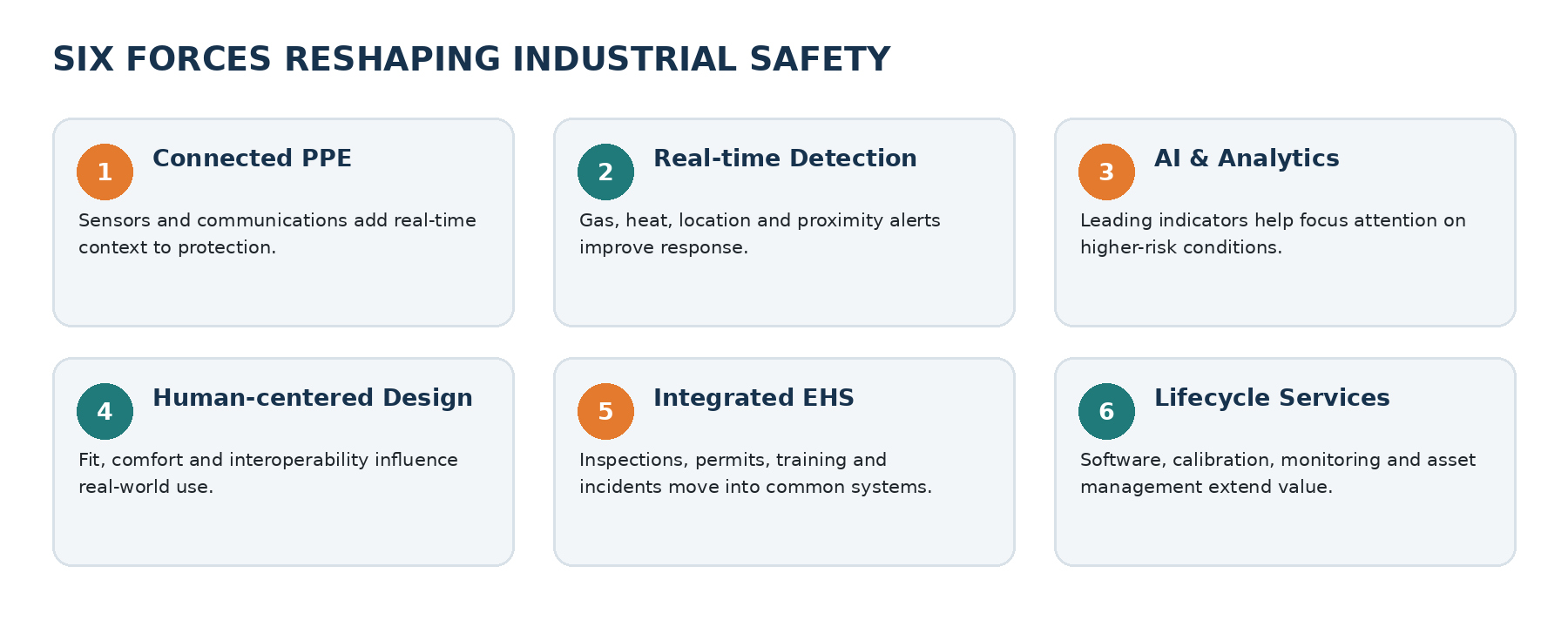
At the sector level, the industrial safety products and solutions industry outlook will be shaped by the specific safety needs of individual end-use industries. Construction will be one of the most important markets for fall protection products, safety helmets, high visibility wear, and connected worker solutions. Manufacturing will see increased use of traditional PPE along with machine safety, ergonomics, proximity sensing, and compliance management software. The oil & gas, chemicals, and utility sectors will continue to be strong markets for connected gas detection, flame resistant clothing, respiratory protection, and centralized safety management platforms. In addition, mining, transportation, and logistics will present new areas for the deployment of wearable safety technology and proximity sensing products.
Last updated:


