
- Home
- »
- Organic Chemicals
- »
-
Leather Chemicals Market Size, Share, Industry Report, 2033GVR Report cover
![Leather Chemicals Market Size, Share & Trends Report]()
Leather Chemicals Market (2026 - 2033) Size, Share & Trends Analysis Report By Product (Biocides, Surfactants, Polyurethane Resins), By Process (Tanning & Dyeing, Beamhouse Chemicals), By Application (Footwear, Upholstery, Garments, Leather Goods), By Region, And Segment Forecasts
- Report ID: GVR-2-68038-816-9
- Number of Report Pages: 84
- Format: PDF
- Historical Range: 2018 - 2024
- Forecast Period: 2026 - 2033
- Industry: Bulk Chemicals
- Report Summary
- Table of Contents
- Interactive Charts
- Methodology
- Download FREE Sample
-
 Download Sample Report
Leather Chemicals Market Summary
The global leather chemicals market size was estimated at USD 9,217.7 million in 2025 and is projected to reach USD 15,941.7 million by 2033, growing at a CAGR of 7.1% from 2026 to 2033. The growth is primarily driven by the increasing demand for high-quality leather products across footwear, upholstery, garments, and leather goods, along with the expanding automotive and furniture industries.
Key Market Trends & Insights
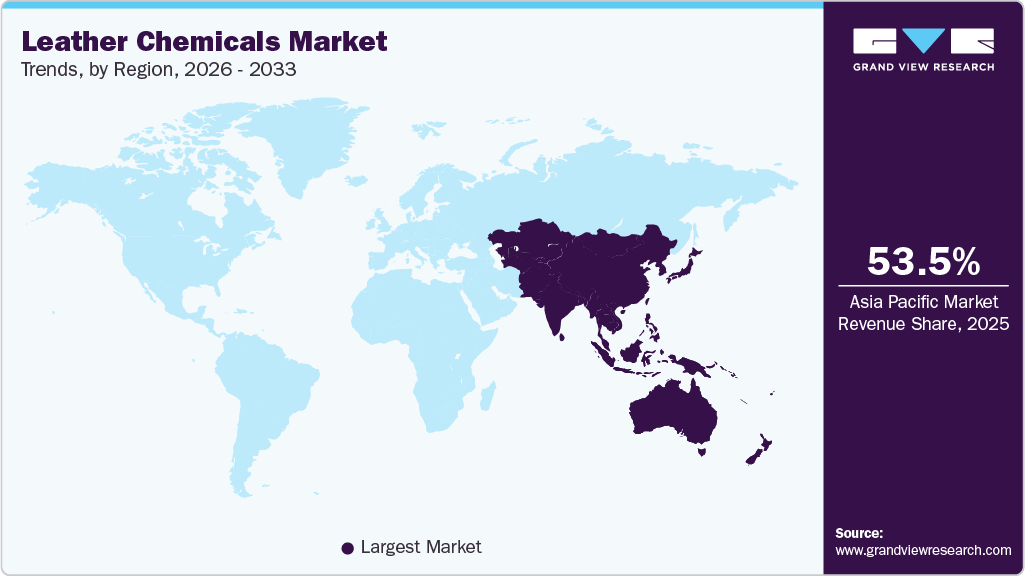
- Asia Pacific dominated the leather chemicals market with the largest revenue share of 53.5% in 2025.
- The China leather chemicals industry dominated Asia Pacific in 2025, in terms of revenue.
- By product, the polyurethane resins segment dominated the market with a significant revenue share of 23.3% in 2025.
- By process, the tanning & dyeing segment is expected to grow at the fastest CAGR of 7.2% from 2026 to 2033, in terms of revenue.
- By application, the footwear segment led the market with a revenue share of 50.5% in 2025.
Market Size & Forecast
- 2025 Market Size: USD 9,217.7 Million
- 2033 Projected Market Size: USD 15,941.7 Million
- CAGR (2026-2033): 7.1%
- Asia Pacific: Largest market in 2025
The rising emphasis on sustainable, environmentally compliant processing chemicals, coupled with technological advancements in tanning, dyeing, and finishing solutions, is further supporting the expansion of the leather chemicals industry.A key process driving the market growth is its extensive use across tanning and dyeing operations in leather manufacturing. These processes form the foundation of leather treatment, requiring significant volumes of chemicals, including chromium sulphate, surfactants, biocides, sodium bicarbonate, and specialty auxiliaries, to enhance durability, texture, color consistency, and resistance properties. With rising demand for high-quality leather products across footwear, upholstery, garments, and leather goods, manufacturers are increasingly adopting advanced chemical formulations to improve product performance and operational efficiency.
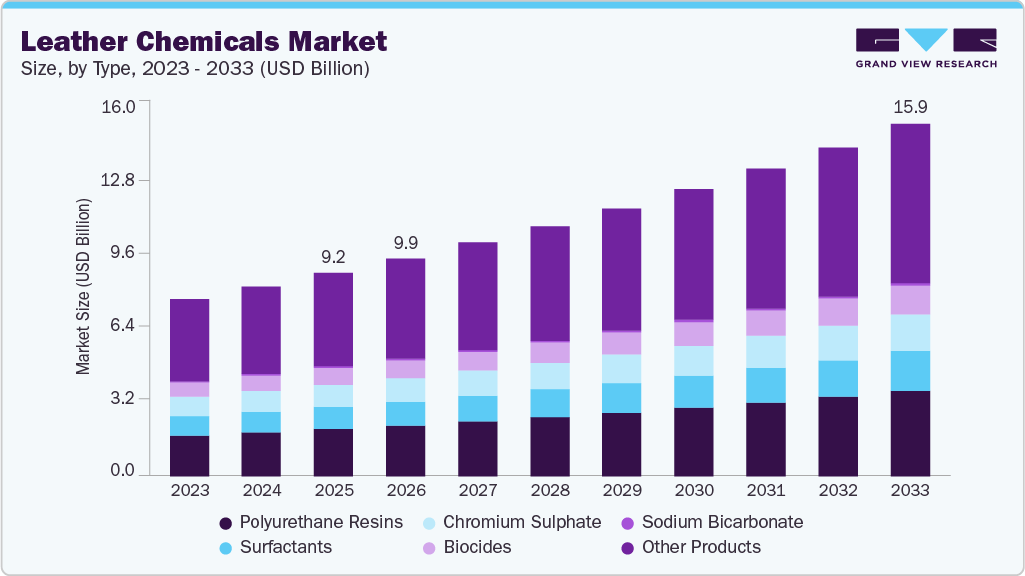
Growing regulatory pressure on effluent treatment, waste management, and sustainable sourcing is driving the development of eco-friendly, low-impact chemical solutions. However, raw material price volatility, environmental compliance costs, and competition from synthetic alternatives continue to influence market dynamics.
Market Concentration & Characteristics
The global leather chemicals market is moderately fragmented, with market leadership concentrated among several established producers such as BASF SE; TFL Ledertechnik GmbH; Clariant AG; Stahl International B.V.; Lanxess AG; Bayer AG; Elementis plc; Texapel; Chemtan Company Inc.; and Lawrence Industries Limited, along with other regional leather chemical formulators and specialty processing solution providers. These key players benefit from strong in-house production capabilities, established manufacturing infrastructure, technical expertise in leather processing, and extensive regional and global distribution networks to maintain a competitive advantage.
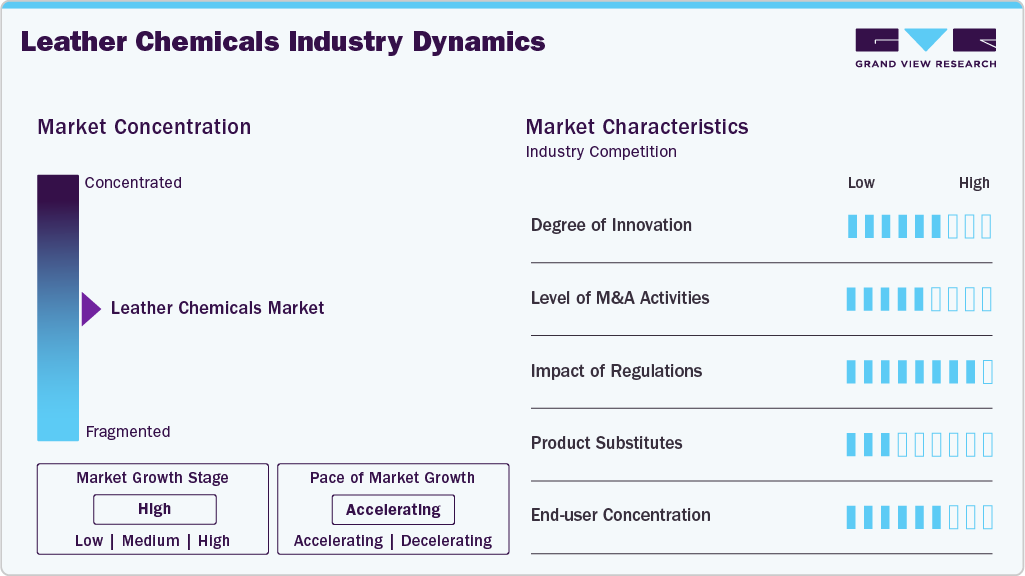
At the same time, emerging players in Asia Pacific, Latin America, and the Middle East & Africa are steadily expanding their presence in the global leather chemicals market by leveraging cost-efficient manufacturing capabilities, improving access to raw materials, and rising domestic demand for leather products and specialty processing chemicals. These regional manufacturers are supported by targeted investments in modern production facilities, advanced formulation technologies, and localized distribution networks strategically positioned near key leather manufacturing and export hubs. Their focus is on delivering scalable and performance-driven solutions across high-growth application areas such as footwear, upholstery, garments, and leather goods, while aligning with evolving environmental standards and sustainable processing requirements.
Product Insights
Polyurethane resins accounted for a significant revenue share of the leather chemicals industry, with 23.3% in 2025. This can be attributed to their extensive use in finishing formulations to enhance surface durability, flexibility, gloss, and resistance to abrasion and environmental exposure. These resins are widely adopted across premium footwear, upholstery, and leather goods applications where performance and aesthetic appeal are critical. Chromium sulphate remains a core tanning agent in leather manufacturing due to its ability to improve tensile strength, hydrothermal stability, and structural integrity of hides.
The surfactants segment is projected to register the second-highest CAGR of 7.4% over the forecast period, driven by their expanding role as surface-active agents in leather processing operations. These chemicals are widely utilized not only as emulsifiers and key formulation components, but also as anti-static agents, water-repellent enhancers, and abrasion-reducing additives that improve overall leather performance. Additionally, surfactants facilitate the effective dispersion of oils in water, ensuring uniform treatment and process efficiency. The growing reliance on multifunctional surfactants in modern leather manufacturing is expected to contribute significantly to the overall market growth.
Process Insights
The tanning & dyeing segment led the leather chemicals market, accounting for the largest share of 48.2% in 2025, reflecting its central role in transforming raw hides into durable, value-added leather materials. This stage directly determines leather strength, color fastness, softness, and resistance properties, making it the most chemically intensive phase in leather manufacturing.
The beamhouse segment is projected to register the second-largest CAGR of 7.1% over the forecast period, supported by its essential role in the initial preparation and preservation of hides and skins prior to tanning. This stage encompasses key operations such as wetting and soaking, liming and unhairing, and deliming and bating, all of which are critical to ensuring proper fiber opening and impurity removal. The selection and dosage of chemicals vary depending on the type and origin of hides and skins being processed. Commonly used inputs during this stage include enzymes, degreasers, sodium sulfide, lime, sulfuric acid, and formic acid, each contributing to process efficiency and quality consistency in subsequent leather treatment stages.
Application Insights
The footwear application segment dominated the leather chemicals industry, accounting for a revenue share of 50.5% in 2025. The growth is primarily attributed to rising demand for leather in the manufacturing of formal, casual, and athletic footwear, which in turn drives the consumption of processing chemicals across the value chain. Leather remains a key raw material in footwear production, alongside rubber, plastics, textiles, and metals, and requires extensive chemical treatment during tanning, dyeing, finishing, and strengthening. Leather chemicals are widely used to enhance durability, flexibility, surface finish, and structural integrity, including crust strengthening and filling applications to meet performance and aesthetic standards.
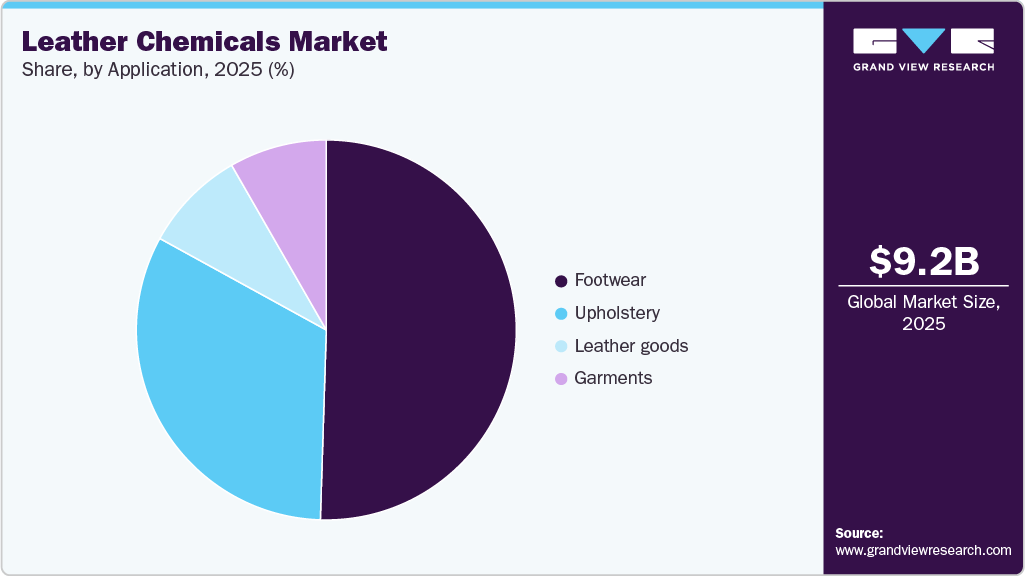
The upholstery segment is projected to register the second-fastest CAGR of 6.9% from 2026 to 2033. The growth is supported by the increasing application of coated and soft leather materials across automotive interiors and residential and commercial furniture. Upholstery applications include leather used in automotive seating and furniture, where aniline, semi-aniline, and pigmented or protected leathers are widely used. As a result, demand for chemicals used in tanning, beamhouse processing, re-tanning, waterproofing, and fat-liquoring remains substantial to ensure softness, color consistency, durability, and long-term performance in these end-use applications.
Regional Insights
Asia Pacific dominated the global leather chemicals market, accounting for the largest revenue share of 53.5% in 2025, driven by its strong leather manufacturing base and cost-competitive production structure across major countries such as China and India. The region benefits from high processing volumes in footwear, upholstery, garments, and leather goods, which support substantial consumption of tanning, beamhouse, and finishing chemicals. China remains a key contributor to the region, supported by large-scale domestic production capacity and export-oriented leather manufacturing.
China Leather Chemicals Market Trends
The China leather chemicals is the largest country-level market within Asia Pacific, accounting for 56.3% share in 2025, supported by extensive leather manufacturing infrastructure, strong availability of raw hides and skins, and cost-competitive large-scale processing capabilities. The country’s well-established export network, long-standing expertise in leather production, and dominant presence in global footwear and upholstery supply chains continue to reinforce its leadership position.
Europe Leather Chemicals Market Trends
Europe accounted for the second-largest region by revenue with a revenue share of 29.0% of the global leather chemicals industry in 2025, driven by its well-established premium leather manufacturing base, advanced processing technologies, and strong presence of specialty chemical producers. The region maintains steady consumption levels supported by downstream industries including footwear, automotive upholstery, furniture, and luxury leather goods. Increasing regulatory focus on sustainability, reduced chromium discharge, and environmentally compliant processing encourage the adoption of high-performance and eco-friendly leather chemical formulations.
The Germany leather chemicals market is expected to grow over the forecast period. Germany is a major industrial hub in Europe, supported by a strong specialty chemical manufacturing base and advanced leather processing capabilities. The demand for leather chemicals in the country is driven by applications across premium footwear, automotive upholstery, and high-performance leather goods used in engineering and mobility sectors. The country’s emphasis on high-quality processing standards, technological innovation, and sustainable production practices supports steady adoption of advanced and environmentally compliant leather chemical formulations.
North America Leather Chemicals Market Trends
North America emerged as the third-largest region, with a 10.0% revenue share in 2025, supported by steady demand in automotive upholstery, footwear, and specialty leather goods applications, as well as the presence of an organized manufacturing infrastructure. The increasing focus on sustainable processing technologies, regulatory compliance, and adoption of performance-enhancing formulations is further supporting market expansion. These factors are contributing to gradual demand growth while reinforcing long-term development of the North America market.
U.S. Leather Chemicals Market Trends
The U.S. is a key market in North America, supported by demand from the automotive upholstery, footwear, and specialty leather goods manufacturing sectors. The country relies on a combination of domestic production and imports to meet its leather chemical requirements, particularly for specialized and performance-oriented formulations. Strong downstream consumption across automotive interiors, furniture upholstery, and premium footwear continues to sustain steady market demand.
Latin America Leather Chemicals Market Trends
Latin America is experiencing increased demand for leather chemicals, driven by expanding leather processing activities and improving industrial infrastructure across key countries. The nations with strong livestock availability and developing tanning industries offer opportunities to increase leather chemical consumption in footwear, upholstery, and leather goods manufacturing. Applications in tanning, beamhouse processing, and finishing operations primarily support industrial demand.
Middle East And Africa Leather Chemicals Market Trends
The Middle East & Africa region is experiencing moderate growth in the global leather chemicals industry, with demand largely tied to expanding leather processing, industrial manufacturing, and footwear production. Developing tanning infrastructure continues to generate steady requirements for tanning, beamhouse, and finishing chemicals across the region. Local production capacity remains limited, resulting in continued dependence on imported specialty leather chemicals to meet domestic and export-oriented manufacturing needs.
Key Leather Chemicals Company Insights
The global leather chemicals market is characterized by the presence of several leading players, including BASF SE, TFL Ledertechnik GmbH, Clariant AG, Stahl International B.V., and Lanxess AG. These companies actively focus on research and development, product innovation, capacity expansion, and strategic partnerships while prioritizing sustainability and regulatory compliance. They continuously adapt to evolving industry requirements across the footwear, automotive upholstery, garments, and leather goods sectors, while optimizing supply chains and enhancing operational efficiency to meet growing global demand in a cost-effective, environmentally responsible manner.
BASF SE is a significant market participant in the global leather chemicals industry, with substantial manufacturing and innovation capabilities across Europe, Asia Pacific, and North America. The company specializes in specialty chemical solutions for leather processing, including products for beamhouse operations, tanning, retanning, dyeing, and finishing applications. Its diversified portfolio, integrated production infrastructure, and strong technical expertise support a broad presence across footwear, automotive upholstery, and leather goods manufacturing sectors.
Key Leather Chemicals Companies:
The following key companies have been profiled for this study on the leather chemicals market.
- BASF SE
- TFL Ledertechnik GmbH
- Clariant AG
- Stahl International B.V
- Lanxess AG
- Bayer AG
- Elementis plc
- Texapel
- Chemtan Company Inc.
- Lawrence Industries Limited
Recent Developments
-
In December 2025, Nouryon, a manufacturer of leather chemicals, entered a strategic distribution partnership with IMCD to expand its textile and leather processing solutions across the EMEA region. The agreement strengthens regional supply capabilities and enhances customer access to specialty processing ingredients. Such strategic collaborations improve distribution efficiency and accelerate the adoption of advanced chemical solutions, thereby supporting overall growth in the leather chemicals market.
Leather Chemicals Market Report Scope
Report Attribute
Details
Market size value in 2026
USD 9,863.0 million
Revenue forecast in 2033
USD 15,941.7 million
Growth rate
CAGR of 7.1% from 2026 to 2033
Base year for estimation
2025
Historical data
2018 - 2024
Forecast period
2026 - 2033
Quantitative units
Revenue in USD million and CAGR from 2026 to 2033
Report coverage
Revenue forecast, company ranking, competitive landscape, growth factors, and trends
Segments covered
Product, process, application, region
Regional scope
North America; Europe; Asia Pacific; Middle East & Africa; Latin America
Country scope
U.S.; Canada; Mexico; Spain; Italy; France; Turkey; China; India; Japan; Brazil; Saudi Arabia;
Key companies profiled
BASF SE; TFL Ledertechnik GmbH; Clariant AG; Stahl International B.V.; Lanxess AG; Bayer AG; Elementis plc; Texapel; Chemtan Company Inc.; Lawrence Industries Limited
Customization scope
Free report customization (equivalent up to 8 analysts’ working days) with purchase. Addition or alteration to country, regional & segment scope.
Pricing and purchase options
Avail customized purchase options to meet your exact research needs. Explore purchase options
Global Leather Chemicals Market Report Segmentation
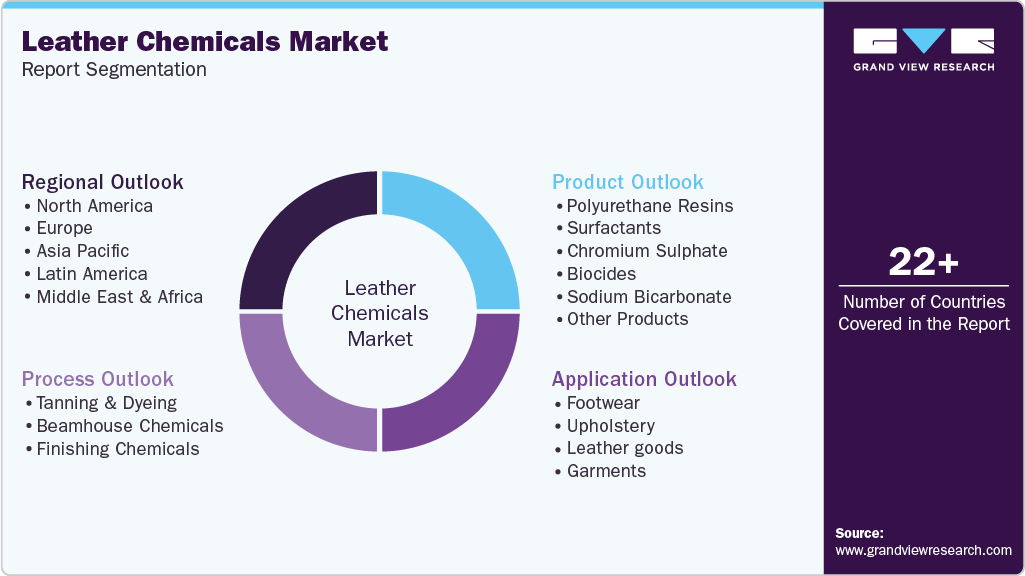
This report forecasts revenue growth at the global, regional, and country levels and provides an analysis of the latest industry trends in each of the sub-segments from 2018 to 2033. For this study, Grand View Research has segmented the global leather chemicals market report based on product, process, application, and region:
-
Product Outlook (Revenue, USD Million, 2018 - 2033)
-
Polyurethane Resins
-
Surfactants
-
Chromium Sulphate
-
Biocides
-
Sodium Bicarbonate
-
Other Products
-
-
Process Outlook (Revenue, USD Million, 2018 - 2033)
-
Tanning & Dyeing
-
Beamhouse Chemicals
-
Biocides
-
Surfactants
-
Sodium sulfide
-
Formic acid
-
Other Beamhouse Chemicals
-
-
Finishing Chemicals
-
-
Application Outlook (Revenue, USD Million, 2018 - 2033)
-
Footwear
-
Upholstery
-
Leather goods
-
Garments
-
-
Regional Outlook (Revenue, USD Million, 2018 - 2033)
-
North America
-
U.S.
-
Canada
-
Mexico
-
-
Europe
-
France
-
Spain
-
Italy
-
Turkey
-
-
Asia Pacific
-
China
-
India
-
Japan
-
-
Latin America
-
Brazil
-
-
Middle East & Africa
-
Saudi Arabia
-
-
Frequently Asked Questions About This Report
b. Key factors driving the growth of the leather chemicals market include increasing demand for high-quality and performance-oriented leather products, rising adoption of sustainable and environmentally compliant processing chemicals, and expanding applications across footwear, upholstery, garments, and leather goods globally. Growing emphasis on regulatory compliance, wastewater management, and reduction of hazardous chemical usage is encouraging manufacturers to develop eco-friendly formulations and integrate low-impact chemistries into leather processing operations.
b. The global leather chemicals market size was estimated at USD 9,217.7 million in 2025 and is expected to reach USD 9,863.0 million in 2026.
b. The polyurethane resins segment held the largest share of 23.3% in 2025 within the global leather chemicals market. This leading position is primarily attributed to its extensive application in leather finishing processes, supported by strong demand from footwear, upholstery, and leather goods manufacturing industries. The product is widely utilized due to its ability to enhance surface durability, flexibility, gloss, and resistance properties, making it a preferred choice for high-performance and premium leather applications.
b. Some of the key players operating in the global leather chemicals market include BASF SE, TFL Ledertechnik GmbH, Clariant AG, Stahl International B.V., Lanxess AG, Bayer AG, Elementis plc, Texapel, Chemtan Company Inc., Lawrence Industries Limited.
b. The global leather chemicals market is expected to grow at a compound annual growth rate of 7.1% from 2026 to 2033 to reach USD 15,941.7 million by 2033.


Share this report with your colleague or friend.
Need a Tailored Report?
Customize this report to your needs — add regions, segments, or data points, with 20% free customization.


ISO 9001:2015 & 27001:2022 Certified
We are GDPR and CCPA compliant! Your transaction & personal information is safe and secure. For more details, please read our privacy policy.
Trusted market insights - try a free sample
See how our reports are structured and why industry leaders rely on Grand View Research. Get a free sample or ask us to tailor this report to your needs.













