
- Home
- »
- Personal Care & Cosmetics
- »
-
Surfactants Market Size And Share, Industry Report, 2033GVR Report cover

Surfactants Market (2026 - 2033) Size, Share & Trends Analysis Report By Source (Petroleum, Biobased), By Product (Non-Ionic, Amphoteric), By Application (Homecare, Personal Care, Food Processing, Agriculture Chemicals, Textiles, Emulsion Polymers), By Region, And Segment Forecasts
Market Size, 2025
$47.4BMarket Estimate, 2026
$49.7BMarket Forecast, 2033
$71.7BCAGR, 2026–2033
5.4%Surfactants Market Summary
The global Surfactants market size was valued at USD 47.4 billion in 2025 and is projected to grow from USD 49.7 billion in 2026 to USD 71.7 billion by 2033, at a CAGR of 5.4% from 2026 to 2033. The market in Asia Pacific dominated with a revenue share of 35.6% in 2025. The market growth is driven by the expanding use of surfactants across a wide range of end-use industries, along with increasing consumer awareness regarding sustainable and environmentally responsible practices.
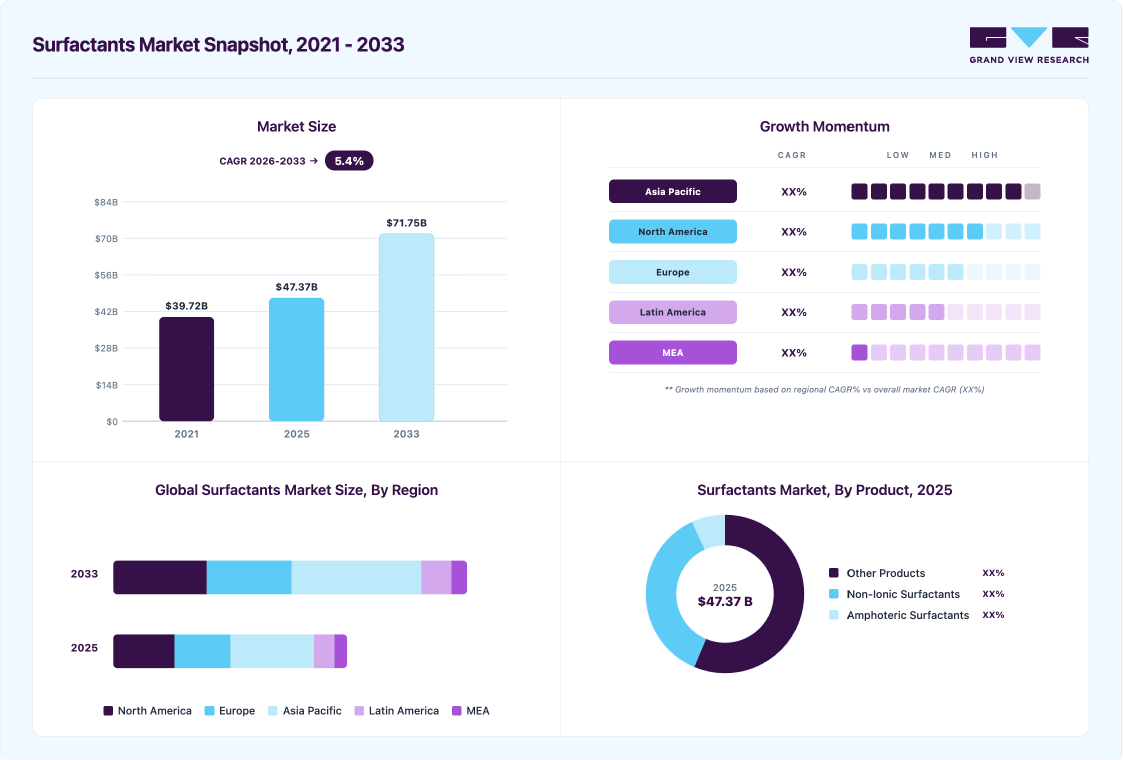 Source: Grand View Research, IR Documents, Primary Interviews, Paid DatabasesTo learn more about this report,
 Download Free Sample Report
 Key Market Trends & Insights
- By source: The petroleum-based surfactants segment led the surfactants industry, accounting for a dominant share of 87.4% in 2025.
- By product: The non-ionic surfactants dominated the market with a revenue share of 36.8% in 2025.
- By application: The homecare dominated the market with a revenue share of 38.3% in 2025.
Regional Highlights
- Largest regional market: Asia Pacific (35.6% revenue share, 2025)
- The surfactants industry in the China held the largest revenue share in 2025.
Market Size & Forecast
- Market size in 2025: USD 47.4 Billion
- Estimated market size in 2026: USD 49.7 Billion
- Projected market size by 2033: USD 71.7 Billion
- CAGR (2026-2033): 5.4%
Three ways to get this report
Buy it, customize it, or ask a question.Ask an Analyst
Analyst response in 1 business day
- AccessReport author, directly
- Reply timeWithin 1 working day
- No sales callDirect answer only
- FormatEmail reply
- CostFree, no cost
Get the Full Report
What the study covers
- FormatsPDF · Excel · Dashboard
- Timeline2026–2033 annual, 2025 base
- Coverage20+ countries, 5 regions
- Companies10+ key players profiled
Customize the Report
20% free customization
- IncludeCountries, segments, points
- TailorTo your product definition
- ExtendDeeper competitor detail
- OrA fully bespoke study
- Turnaround5–10 working days
The surfactants industry is further supported by the rising adoption of eco-friendly product formulations and the growing emphasis on sustainability across industrial value chains. As both consumers and regulatory bodies increasingly prioritize environmental protection, demand for bio-based surfactants derived from renewable resources has grown significantly. These sustainable alternatives offer reduced environmental impact while complying with stringent global regulations on manufacturing processes and product safety, thereby encouraging industries to transition to greener surfactant solutions.Another key factor driving demand for surfactants is their indispensable role across industries such as personal care, pharmaceuticals, and chemicals. In these sectors, surfactants function as essential agents for emulsification, foaming, wetting, and dispersion, thereby improving product performance, stability, and shelf life. The personal care segment continues to witness robust demand for surfactant-based formulations, including shampoos, facial cleansers, and lotions, supported by growing consumer emphasis on hygiene, grooming, and premium personal care products.
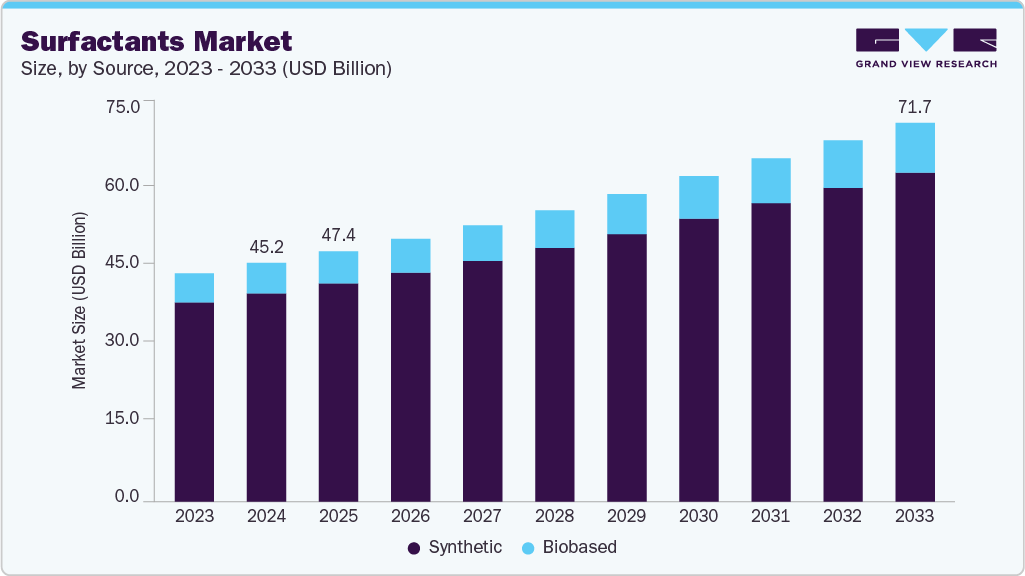 To learn more about this report, Download Free Sample Report
 In parallel, the expansion of industrial and institutional cleaning applications has significantly contributed to market growth, as organizations increasingly seek high-efficiency and regulatory-compliant cleaning formulations. Industries including healthcare, hospitality, retail, and education have accelerated surfactant consumption due to heightened standards for cleanliness and sanitation. In environments with frequent human interaction, effective cleaning is critical, making surfactants indispensable components in formulations designed to remove oils, dirt, and microbial contaminants.
The broad applicability of surfactants across diverse end-use sectors, coupled with rising demand for biodegradable, high-performance formulations, has created a competitive yet opportunity-rich market landscape. As leading manufacturers continue to invest in product innovation and sustainable chemistry, the global surfactants industry is expected to sustain steady growth, supported by both industrial demand and increasing environmental accountability.
Market Dynamics
Personal care & cosmetics is a prominent application segment of the surfactants market, as surfactants are broadly used in the formulation of hair care, skincare, creams, gels, ointments, and other products. The rapidly growing personal care industry and an increase in consumer spending on quality products are expected to boost the surfactants market growth. In addition, the retail sector in developing countries such as Brazil, India, and China is becoming increasingly well-organized, which is anticipated to further drive the growth of the personal care & cosmetics industry, in turn promoting the consumption of surfactants.
The above graph depicts the growth of the global beauty market. The growth can be attributed to the continuous evolvement in the personal care products and innovations to comply with the shifting consumer preferences. In the past, shampoos and soaps were the key applications of surfactants in the personal care & cosmetics market. However, the inclusion of surfactants in several products, including lotions and cold creams, is gaining momentum, thus driving the market. Increasing focus on “green chemistry” by key end-use manufacturers to meet the growing consumer demand for eco-friendly products is anticipated to positively influence the biosurfactants market.
Increasing numbers of regulatory norms are being mandated by various governments on manufacturers to narrow the list of chemicals that can be used in the manufacture of surfactants. This prompts manufacturers to invest more in the development of better, user-friendly, renewable, and sustainable chemicals, which adds to their cost of capital. With increasing environmental concerns, the regulations are expected to be more stringent and thus, are expected to restrain the growth of the global surfactants market. A few stringent regulations for surfactants in Europe are listed below:
• As chemical substances, surfactants are subject to the EU chemical legislation, namely REACH (Registration, Evaluation, Authorization and Restriction of Chemicals - Regulation (EC) No 1907/2006). REACH impacts companies at various levels of the supply chain, from manufacturers to importers and downstream users. Companies are obliged to assess the hazards and potential risks presented by the substance (i.e., the surfactant), based on the data collected, and classify the substance accordingly. In most cases, suppliers will decide on the classification of the substance.
Market Concentration & Characteristics
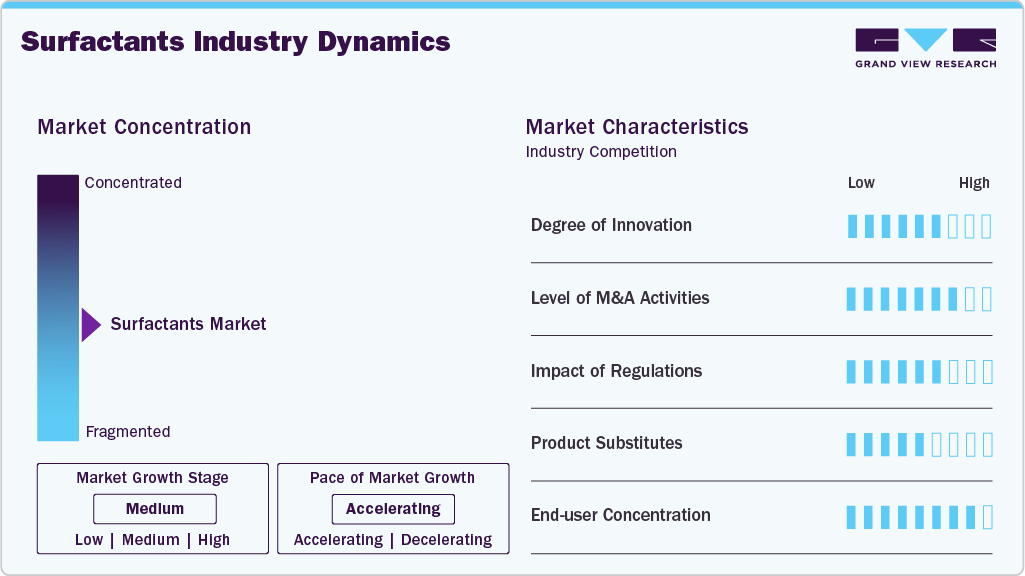
The global surfactants market is characterized by a highly fragmented competitive landscape, with the presence of numerous global and regional manufacturers competing across product categories and end-use applications. At the same time, the market does not exhibit dominance by any single player, leading companies such as BASF, Dow, Solvay, and Evonik command notable market shares through their diversified product portfolios, advanced technical capabilities, and extensive global distribution networks.
These key players are increasingly focused on capacity expansions, particularly in high-growth regions such as Asia Pacific, to address rising demand from consumer goods and industrial sectors. Strategic initiatives, including mergers and acquisitions, partnerships, and investments in sustainable and green chemistry, are widely adopted to enhance market positioning and long-term competitiveness. Furthermore, continuous investment in research and development remains a core focus area, enabling manufacturers to introduce high-performance, environmentally friendly surfactant formulations that align with evolving regulatory requirements and shifting consumer preferences.
 To learn more about this report, Download Free Sample Report
 In emerging markets such as India, Southeast Asia, Central & South America, and parts of Africa, a new wave of local and mid-sized manufacturers is entering the surfactants space. The rising demand is driving these players toward personal care, home care, and industrial cleaning products, as urbanization, population growth, and increased hygiene awareness fuel demand. The relatively low entry barriers, availability of raw materials, and supportive government policies toward local manufacturing make this sector attractive to startups and smaller companies. Many of these new entrants are focusing on bio-based or niche surfactant segments, catering to the rising preference for sustainable, localized solutions while also benefiting from lower production and labor costs.
Despite strong growth prospects, the surfactants market faces several challenges and restraints. Volatility in raw material prices, especially for petrochemical-based surfactants, can impact profit margins. Additionally, stringent environmental regulations, especially in developed economies, pressure manufacturers to invest heavily in sustainable practices. Competition is intense, and building brand loyalty can be difficult in commodity segments. Furthermore, the rising cost of innovation, coupled with increasing scrutiny on chemical safety, may limit the ability of smaller players to scale effectively. These factors pose significant hurdles for companies aiming to sustain long-term growth in a rapidly evolving market.
Source Insights
The petroleum-based surfactants segment led the surfactants industry, accounting for a dominant share of 87.4% in 2025, supported by its cost-effectiveness, established production infrastructure, and wide availability. Within this segment, anionic surfactants continue to hold a significant position due to their affordability and extensive usage in household detergents, shampoos, and industrial and institutional cleaning products. However, increasing environmental concerns about metal toxicity and the limited biodegradability of synthetic surfactants pose notable challenges. Ongoing research and development initiatives aimed at enhancing performance characteristics and improving environmental profiles are expected to partially address these concerns and support sustained demand.
In contrast, the bio-based surfactants segment is anticipated to register the fastest revenue growth at a CAGR of 5.8% during the forecast period, driven by the rising adoption of sustainable technologies and environmentally responsible formulations. Bio-based surfactants, derived from renewable feedstocks such as sugars and vegetable oils, are gaining traction due to their biodegradability and lower environmental impact. Shifting consumer preferences toward natural and organic products, supported by increasing per-capita spending, have accelerated demand across personal care and household cleaning applications. Additionally, the versatility of bio-based surfactants as emulsifying agents, biocides, and anticorrosive agents, along with their compatibility across detergents, cosmetics, and industrial formulations, continues to create new growth opportunities for the market.
Product Insights
The non-ionic surfactants segment accounted for the leading share of the market with 36.8% in 2025, supported by their excellent emulsifying, wetting, and dispersing properties. These surfactants exhibit high chemical stability, perform effectively in hard water conditions, and demonstrate broad compatibility across diverse formulations. Their mild nature and low potential for skin irritation make them well-suited for personal care and household cleaning applications. Additionally, the relatively low toxicity and favorable biodegradability profile of non-ionic surfactants align with tightening environmental regulations and growing consumer preference for sustainable products. This combination of performance efficiency and regulatory compliance continues to support their strong market position.
The amphoteric surfactants segment is expected to register the fastest CAGR of 5.7% during the forecast period, driven by its versatile chemical behavior and increasing adoption in mild and high-performance formulations. Amphoteric surfactants can exhibit both anionic and cationic properties depending on pH levels, offering enhanced formulation flexibility. Their mild cleansing action, excellent foaming characteristics, and conditioning benefits make them particularly suitable for sensitive-skin applications, including baby care products and facial cleansers. Rising demand for eco-friendly, biodegradable, and skin-safe surfactants is further accelerating adoption within the personal care and cosmetics industries. As awareness of product safety and sustainability continues to grow, amphoteric surfactants are well-positioned for sustained market expansion.
Application Insights
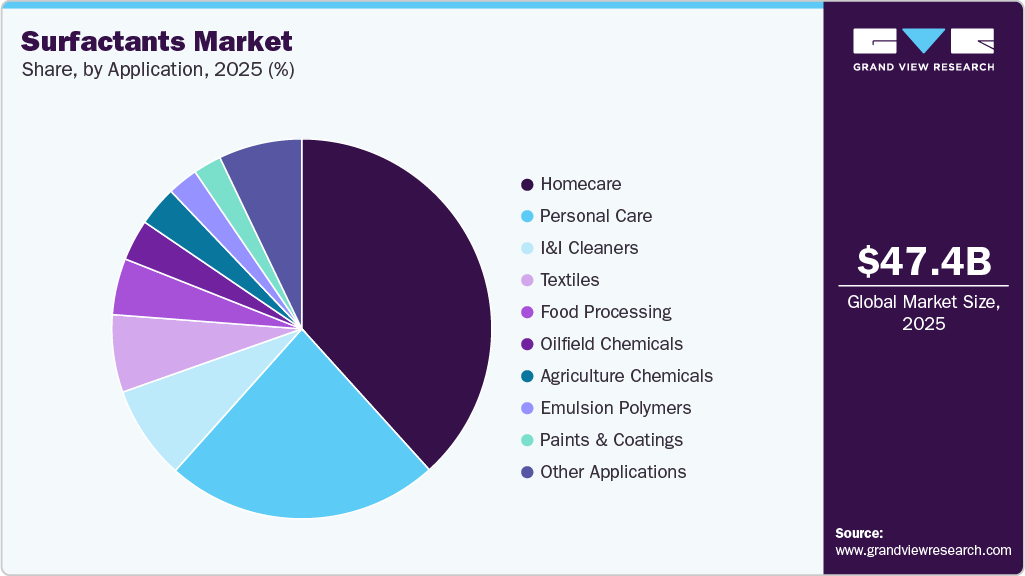
The homecare segment dominated the surfactants industry, accounting for a revenue share of 38.3% in 2025. The increasing demand for household cleaning products such as laundry detergents, dishwashing liquids, surface cleaners, and disinfectants primarily drove this. Rising hygiene awareness, especially following the COVID-19 pandemic, has boosted the consumption of surfactant-based products in residential and commercial spaces. Urbanization and the growing middle class in emerging economies have driven product use. Manufacturers are also introducing innovative, eco-friendly, and multifunctional cleaning solutions to meet consumer preferences, further strengthening the segment’s position. The essential role of surfactants in cleaning efficacy contributed significantly to this dominant market share.
 To learn more about this report, Download Free Sample Report
 Personal care is expected to emerge as the fastest-growing segment with a CAGR of 6.1% over the forecast period. This growth is driven by increasing consumer awareness of personal hygiene, grooming, and skincare. Surfactants play a crucial role in products such as shampoos, facial cleansers, body washes, and toothpaste, offering foaming, cleansing, and emulsifying benefits. The rising demand for mild, skin-friendly, sulfate-free formulations is driving manufacturers toward innovative, natural surfactant solutions. Growing disposable incomes, especially in Asia-Pacific and Central & South America, combined with the influence of beauty trends and self-care routines, are driving strong demand for high-performance, safe personal care products.
Regional Insights
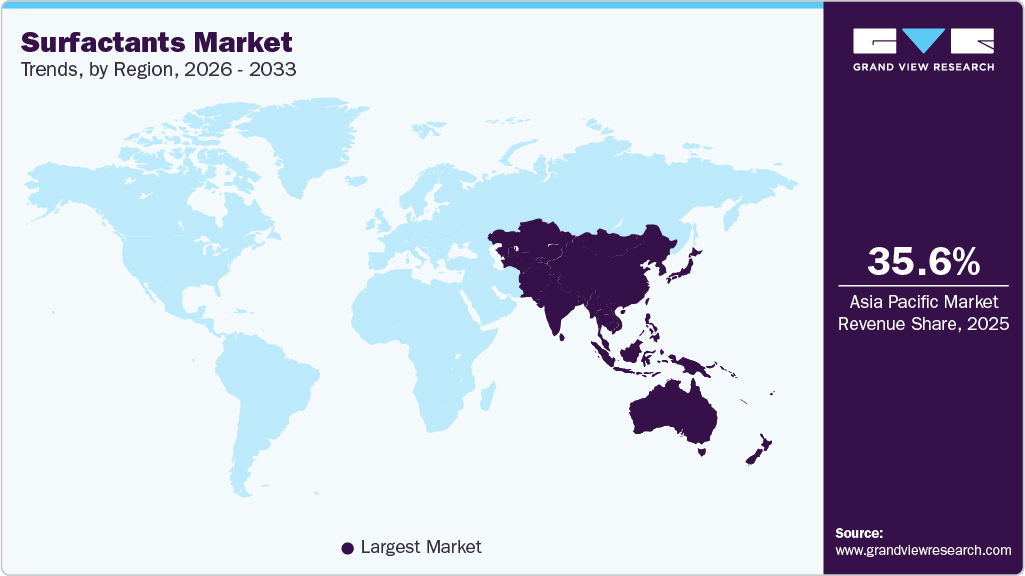
The Asia Pacific surfactants marketheld the largest share of 35.6% in 2025, driven by rising urbanization, higher disposable incomes, and heightened awareness of hygiene and personal care. Countries like China and India are experiencing strong demand for products such as detergents, shampoos, and surface cleaners, which heavily rely on surfactants. For example, companies like Unilever and P&G are expanding operations in India to meet rising consumer demand. Industrial development across sectors like textiles, agriculture, and food processing further boosts demand for surfactants. The shift toward bio-based and eco-friendly formulations, driven by environmental regulations, is also encouraging innovation and investment in the regional market.
 To learn more about this report, Download Free Sample Report
 China Surfactants Market Trends
The China surfactants market is expanding rapidly due to surging demand from household detergents and personal care products fueled by rising incomes, urbanization, and a growing middle class. Companies like Unilever, P&G, and local giants such as Sinopec and Galaxy Surfactants China have expanded production to meet this demand and export volume. Moreover, expanding industrial usage in textiles, agriculture, and oilfield chemicals is boosting surfactant consumption for applications such as emulsification and enhanced oil recovery. Tightening environmental regulations and government-led initiatives promoting green chemistry are accelerating the shift toward biodegradable and bio-based surfactants, driving innovation and investment.
North America Surfactants Market Trends
The North America surfactants industry secured 26.2% of the revenue share in 2025, driven by high demand across personal care, home care, and industrial applications. The region's well-established consumer goods industry, led by companies such as Procter & Gamble and Colgate-Palmolive, drives consistent use of surfactants in detergents, shampoos, and skincare products. Additionally, increased focus on hygiene post-COVID and rising demand for eco-friendly, sulfate-free formulations are driving innovation in bio-based surfactants. The presence of advanced R&D infrastructure and supportive regulatory frameworks further accelerates product development. Industrial sectors such as agriculture, textiles, and oil & gas also contribute significantly to market growth.
The U.S. surfactants market held a dominant revenue share of 78.6% in 2025, fueled by strong consumer demand for high-performance personal care and home cleaning products. American brands like Procter & Gamble, Unilever USA, and SC Johnson are driving surfactant usage in products such as Tide detergents, Head & Shoulders shampoo, and Dawn dish soap. Additionally, the U.S. oil and gas industry utilizes surfactants in enhanced oil recovery processes, especially in Texas and North Dakota. The market is also influenced by rising demand for sulfate-free and plant-based formulations, with regulations such as the Toxic Substances Control Act (TSCA) and California’s Proposition 65 pushing companies toward greener, safer ingredients.
Europe Surfactants Market Trends
The surfactants industry in Europe held 24.0% of the global revenue share in 2025, driven by strong demand from the personal care, home care, and industrial cleaning sectors. Growing consumer preference for eco-friendly and biodegradable products has led companies like BASF, Clariant, and Evonik to invest in green surfactant technologies. Stringent EU regulations on chemical safety and sustainability are driving the adoption of bio-based, low-toxicity surfactants across applications. Additionally, Europe's mature cosmetics and pharmaceutical industries rely heavily on high-quality surfactants for product formulation. The region’s focus on sustainability, innovation, and circular economy practices continues to fuel steady market growth.
The Germany surfactants market is growing steadily, driven by strong demand for high-performance personal care and household cleaning products. Leading German companies such as BASF, Henkel, and Evonik are key contributors to surfactant consumption in products including Persil laundry detergents, Fa personal care products, and Pril dishwashing liquids. In addition, Germany’s robust automotive and industrial manufacturing sectors utilize surfactants in metal treatment, surface cleaning, and industrial maintenance applications. Market dynamics are also shaped by rising demand for sulfate-free and bio-based formulations, with regulatory frameworks such as EU REACH and the EU Detergents Regulation encouraging the adoption of safer, biodegradable, and environmentally compliant surfactant ingredients.
Central & South America Surfactants Market Trends
The demand for surfactants in Central & South America is rising swiftly, driven by expanding hygiene awareness, urbanization, and growing consumption of household and personal care products. Countries like Brazil and Mexico lead due to booming markets for detergents, soaps, shampoos, and skincare. Brazil’s strong agrochemical and food processing sectors also fuel demand, using surfactants to enhance pesticide efficiency and beverage solubilization. Companies such as Oxiteno, BASF, and regional innovators offer bio-based and sustainable surfactants to meet evolving consumer and regulatory demands. Additionally, rising investment in local production facilities, enhanced oil recovery applications, and a move toward green chemistry all bolster regional market expansion.
Middle East & Africa Surfactants Market Trends
The Middle East and Africa surfactants industry is gaining momentum due to growing industrialization, urban expansion, and rising hygiene awareness. In the Gulf countries, particularly Saudi Arabia and the UAE, surfactants are heavily used in enhanced oil recovery (EOR) processes, driving industrial demand. Meanwhile, in African nations such as South Africa, Nigeria, and Kenya, population growth and improved access to personal care products are driving demand for soaps, detergents, and shampoos. Multinational and regional manufacturers are increasingly investing in localized production to meet rising consumption. Environmental regulations and consumer preferences are gradually shifting the market toward greener, bio-based alternatives.
Key Surfactants Company Insights
Some key players operating in the surfactants market include BASF SE and Stepan Company.
-
BASF SE is a global leader in surfactants, offering a broad portfolio for personal care, home care, industrial cleaning, and technical applications. Its products include eco-friendly surfactants such as Plantapon, Texapon, and Dehyton, known for their biodegradability and renewable sourcing. BASF emphasizes sustainability by using RSPO-certified palm oil and soy-based ingredients, while also investing in digital tools and innovation to support safe, efficient, and sustainable product formulation.
-
Stepan Company is a global specialty chemicals leader and one of the world’s largest merchant producers of surfactants, offering anionic, cationic, nonionic, amphoteric surfactants, blends, and custom solutions. Its products serve personal care, industrial cleaning, agriculture, and enhanced oil recovery markets. Stepan’s global network includes 20 production sites and 14 R&D centers.
Evonik Industries AG Controls is an emerging participant in the surfactants market.
- Evonik Industries AG is a global leader in specialty chemicals and has positioned itself at the forefront of sustainable surfactant innovation. The company focuses on developing high-performance, bio-based surfactants using renewable raw materials and advanced fermentation technologies. These surfactants are fully biodegradable, non-toxic, and skin-friendly, making them ideal for eco-conscious personal care and household cleaning applications. Evonik operates one of the few industrial-scale biosurfactant production facilities in Europe, enabling efficient large-scale supply. Strategic partnerships with major consumer goods companies and a strong commitment to green chemistry have helped Evonik gain recognition as a pioneer in environmentally responsible surfactant solutions.
Key Surfactants Companies:
The following key companies have been profiled for this study on the surfactants marke.
- Akzonobel N.V
- BASF SE
- Evonik Industries AG
- Solvay S.A
- Clariant AG
- Huntsman International LLC
- Dow
- Kao Corporation
- Henkel Adhesives Technologies India Private Limited
- Bayer AG
- Godrej Industries Limited
- Stepan Company
Competitive Benchmarking
Operating Strategies
Competitive Edge
Weaknesses
Mature Players: BASF SE, Dow, Clariant, Solvay, Evonik Industries AG, and Kao Corporation
- Focus on integrated surfactant manufacturing supported by petrochemical and oleochemical feedstock access.
- Invest heavily in sustainable and bio-based surfactant technologies.
- Expand alkoxylation and specialty surfactant production capacities globally.
- Broad product portfolios across anionic, nonionic, cationic, amphoteric, and specialty surfactants.
- Strong backward integration and economies of scale.
- Established global manufacturing and supply chain infrastructure.
- Large operational structures may reduce agility in niche customization.
- High exposure to feedstock price volatility and energy costs.
- Significant compliance and sustainability transition costs.
- Mature market exposure may limit high-growth opportunities in developed regions.
Emerging Players: Stepan Company, Croda International Plc, Nouryon, Arkema Group, and Indorama Ventures
- Focus on specialty and high-performance surfactant formulations.
- Target niche applications including personal care, institutional cleaning, coatings, and specialty industrial applications.
- Expand through strategic partnerships, regional expansion, and customized solutions.
- Increase focus on green surfactants and formulation innovation.
- Faster response to customer-specific formulation requirements.
- Strong application development and technical support capabilities.
- Better flexibility in serving regional and niche customers.
- Competitive positioning in specialty and value-added surfactants.
- Limited global manufacturing footprint compared to integrated leaders.
- Lower economies of scale.
- Higher dependence on third-party raw material suppliers.
- Narrower product portfolios and limited penetration across diversified applications.
Recent Developments
-
In May 2025, Pilot Chemical Company announced an exclusive partnership with Novvi LLC to introduce CalCare AOS, a new biobased alpha olefin sulfonate surfactant technology, to the North American market. This sustainable innovation targets the household, industrial and institutional (I&I), and personal care (PC) sectors, offering high performance while supporting sustainability goals. The partnership combines Novvi’s bio-based alpha olefin feedstock expertise with Pilot’s sulfonation capabilities and market presence. As the exclusive sulfonator and distributor, Pilot will produce CalCare AOS at its Middletown, Ohio facility, making it the first to commercialize this sustainable surfactant technology at scale in North America.
Surfactants Market Report Scope
Report Attribute
Details
Market size in 2025
USD 47.4 billion
Estimated market size in 2026
USD 49.7 billion
Projected market size by 2033
USD 71.7 billion
Growth rate
CAGR of 5.4% from 2026 to 2033
Base year for estimation
2025
Historical data
2018 - 2024
Forecast period
2026 - 2033
Quantitative units
Revenue in USD million, volume in kilotons and CAGR from 2026 to 2033
Report coverage
Revenue forecast, volume forecast, company ranking, competitive landscape, growth factors, and trends
Segments covered
Source, product, application, region
Regional scope
North America; Europe; Asia Pacific; Central & South America; Middle East & Africa
Country scope
U.S.; Canada; Mexico; UK; Germany; France; Italy; Spain; China; India; Japan; South Korea; Brazil; Argentina; Saudi Arabia; South Africa
Key companies profiled
Akzonobel N.V.; BASF SE; Evonik Industries AG; Solvay S.A.; Clariant AG; Huntsman International LLC; Dow; Kao Corporation; Henkel Adhesives Technologies India Private Limited; Bayer AG; Godrej Industries Limited; Stepan Company
Customization scope
Free report customization (equivalent to up to 8 analyst’s working days) with purchase. Addition or alteration to country, regional & segment scope.
Pricing and purchase options
Avail customized purchase options to meet your exact research needs. Explore purchase options
Global Surfactants Market Report Segmentation
This report forecasts volume & revenue growth at the global, regional, and country levels and provides an analysis of the latest industry trends in each of the sub-segments from 2018 to 2033. For this study, Grand View Research has segmented the global surfactants market report based on source, product, application, and region:
 To learn more about this report, Download Free Sample Report
 -
Source Outlook (Volume, Kilotons; Revenue, USD Million, 2018 - 2033)
-
Petroleum
-
Biobased
-
-
Product Outlook (Volume, Kilotons; Revenue, USD Million, 2018 - 2033)
-
Non-Ionic Surfactants
-
Alcohol Ethoxylates
-
Fatty Alcohol Ethoxylates
-
Lauryl Alcohol Ethoxylates
-
Ceto Stearyl Alcohol Ethoxylates
-
Behenyl Alcohol Ethoxylate
-
Other Alcohol Ethoxylates
-
-
Alkyl Phenol Ethoxylates
-
Fatty Acid Esters
-
Fatty Amine Ethoxylates
-
(EO-PO) co-ethoxylates
-
Other Non-Ionic Surfactants
-
-
Amphoteric Surfactants
-
Other Products
-
-
Application Outlook (Volume, Kilotons; Revenue, USD Million, 2018 - 2033)
-
Homecare
-
Personal Care
-
I&I Cleaners
-
Food Processing
-
Oilfield Chemicals
-
Agriculture Chemicals
-
Textiles
-
Emulsion Polymers
-
Paints & Coatings
-
Construction
-
Other Application
-
-
Regional Outlook (Volume, Kilotons; Revenue, USD Million, 2018 - 2033)
-
North America
-
U.S.
-
Canada
-
Mexico
-
-
Europe
-
Germany
-
UK
-
France
-
Italy
-
Spain
-
-
Asia Pacific
-
China
-
India
-
Japan
-
South Korea
-
-
Central & South America
-
Brazil
-
Argentina
-
-
Middle East & Africa
-
Saudi Arabia
-
South Africa
-
-
Delivered Customizations
This report has been delivered with the following In-depth customizations
Client Request
Customization Delivered
Value Adds
Trade Analysis
Assessment of global and regional trade dynamics for surfactants, including import-export analysis, major trade corridors, tariff structures, raw material dependency, supply-demand shifts, and country-level trade positioning for key surfactant chemistries and applications.
Identify supply concentration risks and sourcing opportunities across regions. Support procurement, localization, and expansion strategies through better visibility into trade flows, regulatory dependencies, and regional competitiveness.
Cross-Segmentation
Detailed segmentation of the surfactants market across product type, chemistry, application, end-use industry, and region to identify high-growth demand pockets and emerging opportunity areas. Analysis includes demand trends, penetration levels, and growth attractiveness across niche applications and geographies.
Enable prioritization of the most attractive application areas and regional markets. Reveal whitespace opportunities and demand concentration zones to support product positioning, market entry, and the development of growth strategies.
Competitive benchmarking
Comparative assessment of key surfactant manufacturers based on product portfolio, manufacturing footprint, feedstock integration, sustainability initiatives, application focus, strategic developments, and regional presence. Includes evaluation of competitive positioning across commodity and specialty surfactant segments.
Support benchmarking against leading market participants and identify competitive gaps. Enable strategic decision-making related to partnerships, product differentiation, sustainability positioning, and long-term competitive strategy.
Frequently Asked Questions About This Report
Asia Pacific dominated with a 35.6% revenue share in 2025.
Non-ionic surfactants held the largest revenue share in 2025, while amphoteric surfactants is the fastest-growing segment.
Homecare held the largest share (over 38.3%) in 2025 and personal care is the fastest-growing segment.
The global surfactants market size was estimated at USD 47.4 billion in 2025 and is expected to reach USD 49.8 billion in 2026.
The global surfactants market is expected to grow at a compound annual growth rate of 5.4% from 2026 to 2033, reaching USD 71.8 billion by 2033.
The petroleum segment led the market and accounted for the largest revenue share of 87.4% in 2025, driven by its widespread availability, cost-effectiveness, and high performance across industrial and consumer applications.
Some of the key players operating in the Surfactants Market include Akzonobel N.V, BASF SE, Evonik Industries AG, Solvay S.A, Clariant AG, Huntsman International LLC, Dow, Kao Corporation, Henkel Adhesives Technologies India Private Limited, Bayer AG, Godrej Industries Limited, and Stepan Company.
Key factors driving the surfactants market include rising demand from the personal care, homecare, and industrial cleaning sectors and increased emphasis on hygiene and sanitation.
About the Author(s)
Personal Care & Cosmetics Research Team
Bulk Chemicals · Personal Care & CosmeticsThis report was authored by the personal care & cosmetics research team at Grand View Research - comprising two research analysts, one senior research analyst, and one industry expert - with specialized expertise in the personal care & cosmetics segment of the bulk chemicals industry. All findings are based on proprietary bulk chemicals databases, executive interviews, and regulatory analysis, subject to internal peer review prior to publication.
Last Updated:
Speak to Analyst

Customize this report to your needs - add regions, segments, or data points, with 20% free customization.
Or view our licence options:


ISO 9001:2015 & 27001:2022 Certified
We are GDPR and CCPA compliant! Your transaction & personal information is safe and secure. For more details, please read our privacy policy.


