API And Excipients Industry Trends Shaping the Future Course
Explore all 6 industry trends
Use the contents below to jump directly to the trend relevant to your research.
Key Active Pharmaceutical Ingredients And Excipients Industry Trends
- Modern therapeutics have a strong influence on the API and excipients industry, and advanced medicines, including gene therapies, RNA therapeutics, and biologics, are expected to generate further growth in demand for specialized excipients.
- Emerging therapeutics associated with rare diseases and increasing investments to develop those are likely to create novel opportunities for the excipients industry.
- Investments in localization of supply chain capabilities and expansion of existing facilities to address changing industry trends are anticipated to strongly reinforce API and excipients industry growth.
- Regulatory scenario requirements, guidance, and standards published by key authorities, including requirements associated with factors such as packaging and labeling, have been forcing improved monitoring efforts and impurity control.
- Novel concepts such as co-processed or combined excipient ingredients and functional excipients have been gaining attention from manufacturers, primarily for factors such as formulation performance improvements and efficiency enhancements.
- An increasing number of investments directed at coordinated and individual research activities are anticipated to facilitate the development of advanced excipients for complex and novel drug formulations.
In recent years, the pharmaceutical industry and sectors related to it, including raw materials such as active pharmaceutical ingredients (APIs) and excipients, have been experiencing fundamental changes. In addition, medical science has also been in a phase of transition over the years, as novel opportunities emerge from scientific discoveries and changing approaches in the healthcare industry. Now, in the era of technological advancements, where care delivery is more patient-centric, the pharmaceutical industry is also focusing on patient-driven product development, rather than traditional mass production.
The ongoing R&D activities, supported by a continuous flow of investments from government agencies and private partners, shape the future course of this industry, while numerous prominent industry participants focus on the development of novel solutions for complex conditions with unmet medical needs that require more than simple mechanical fillers.
Furthermore, a significant increase in the number of new cases associated with chronic diseases and a rising burden of rare diseases across regions has resulted in more focused investments toward the development of therapies and drugs that address newer areas. In addition, noteworthy advancements in diagnostic technologies related to conditions such as cancer and cardiovascular diseases have also been acting as a strong force in early detection of diseases, leading to a growing requirement for modern therapeutics.
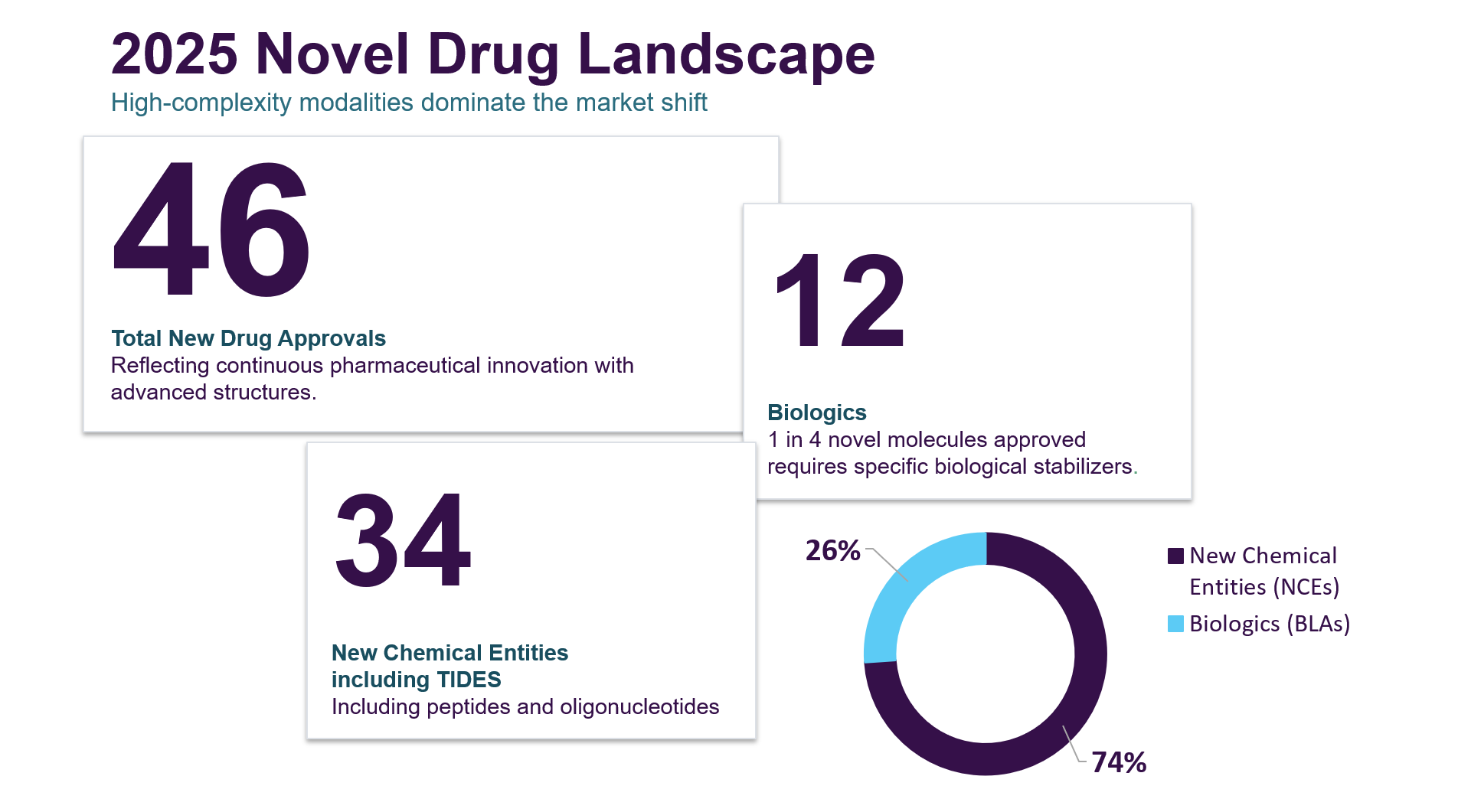
Section I: Which factors act as key drivers for industry growth
01Modern therapeutics act as a catalyst for growth
Multiple chronic diseases have been presenting significant challenges in front of the healthcare sector worldwide. However, changing dynamics of the therapeutics industry, technology advancements that have opened new horizons for medical science, and the increasing focus of the pharmaceutical industry on the development of complex therapies to address rare diseases, manageable conditions, and terminal illness are expected to shape API and excipients industry trends in the near future.
Strategies embraced by prominent manufacturers and pharmaceutical companies in developed economies equipped with necessary R&D strength and financial backing also highlight the remarkable growth in significance of advanced excipients. In September 2025, Evonik, a global specialty chemicals company, and next-generation therapeutics and vaccines developer Ethris announced joining forces for development of a novel lipid nanoparticle (LNP) platform, designed for improved nucleic acid delivery.
“Our partnership with Ethris strengthens our portfolio and tackles key challenges in nucleic acid delivery. Ethris’ SNaP LNP technology improves thermostability — enabling storage at higher temperatures — and enhances local retention, facilitating targeted delivery to the site of action and prolonged presence where therapeutic effect is needed.”
- JP Milde, Global Product Line Head, Parenteral Drug Delivery Solutions at Evonik
02Growing focus on treatments for rare diseases
In recent years, multiple researchers, regulators, and developers have united across domains to address healthcare requirements associated with rare diseases. According to Resolution WHA78.11 adopted by the WHO during the 78th World Health Assembly in May 2025, titled "Rare diseases: a global health priority for equity and inclusion," more than 7,000 rare diseases have an impact on nearly 300 million individuals, with a large number of cases manifesting during early childhood.
Such scenarios clearly highlight the intentions behind increasing investments in the development of new solutions and treatments for rare diseases. Increasing development of such therapeutics is likely to result in growing demand for advanced excipients that can aid in improving the drug stability, solubility, delivery, and shelf life of the product.
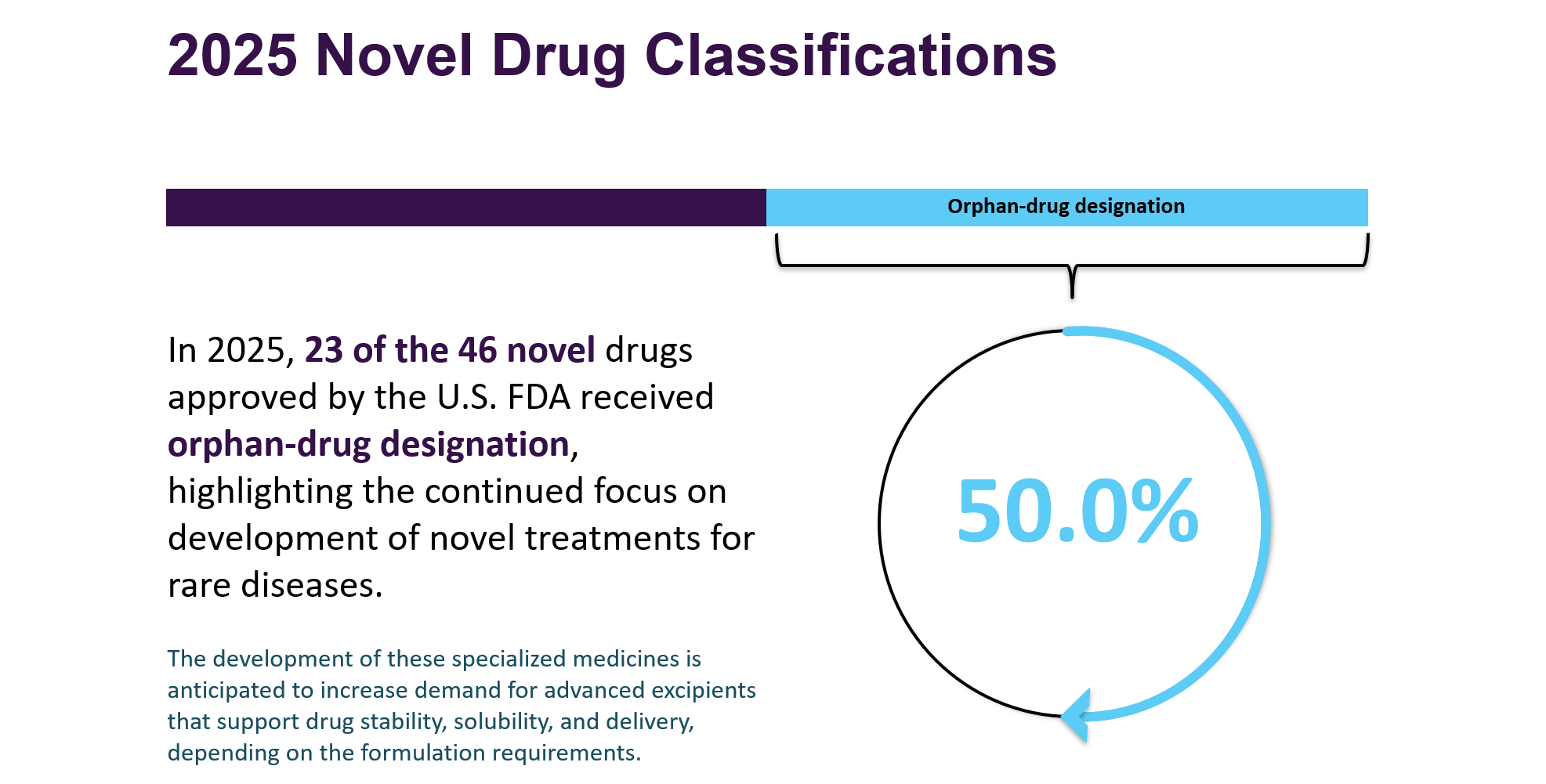
Section II: How regulatory scenarios influence the industry
03Changing regulatory scenarios increase quality expectations
Multiple regulatory authorities from various regions have been focusing on improving the quality of products offered by pharmaceutical companies and ensuring strict rules are followed in terms of labeling, packaging, and information sharing. These steps are part of major efforts directed at improving safety, purity, consistency, and documentation associated with the pharmaceutical offerings.
As authorities across various regional markets focus on improved patient safety and increased purity, the excipients industry has been facing greater pressure related to impurity controls. In September 2024, the US Food and Drug Administration (FDA) announced its guidance, which recommended that manufacturers of APIs and finished drug products conduct necessary risk assessments and testing and initiate required control measures to identify and prevent undesirable levels of nitrosamine impurities. Such regulatory changes are key in determining further trends in this industry.
As excipients have a significant influence on various features, including product stability, desired performance, and patient safety, authorities that oversee the pharmaceutical industry have been launching stringent regulations and guidelines for manufacturers. For instance, in December 2025, the European Medicines Agency (EMA) announced newly developed, stricter rules related to labeling safety and stated that it is adopting Revision 5 of the annex to the European Commission guideline on excipients, which mandates pharmaceutical companies to clearly disclose these inactive ingredients (determined action or effect) on outer packaging across the EU.
03Strengthening localized supply chain capabilities
The changing trade relations between countries and strong effects of phenomena such as reverse globalization have prompted companies engaged in the pharmaceutical industry to develop domestic strengths in terms of supply chain capabilities. This moves beyond relying on homegrown vendors and involves investments in the development of newer areas of expertise and facility expansions as well. In March 2026, CLARIANT expanded its Clear Lake facility with its latest investment, specifically to include excipient GMP-compliant manufacturing of pharmaceutical-grade polyethylene glycol (PEG) excipients.
"This expansion strengthens our ability to provide reliable local supply and positions us as a true partner to the North American pharmaceutical industry. In addition to greater manufacturing capacity, we're fundamentally transforming how we serve our customers by bringing production closer to their operations and accelerating more responsive, collaborative relationships."
- Vaios Barlas, Head of Health Care at Clariant
Section III: API And Excipients Industry Outlook: What is coming next?
04Rising demand for functional and co-processed excipients
The functional and co-processed excipients are expected to play a critical role in further trends related to the pharmaceutical industry, as manufacturers have been focusing on enhancing formulation performance and product quality to develop a competitive advantage. As medical science evolves and technological advancements eliminate the entry barriers in the pharmaceutical industry, multiple companies have been engaging in the development of drugs associated with specialized purposes.
The use of functional excipients that can offer specific performance characteristics or co-processed excipients that provide combined properties which cannot be accomplished through use of individual ingredients is likely to mark continuous growth. Such developments have also been gaining regulatory attention, as the EMA published its Q & A Regarding Co-Processed Excipients Used in Solid Oral Dosage Forms in January 2026, with the guidance becoming effective in August 2026.
05Conclusion
As medical science evolves and newer possibilities are discovered, complex therapies that require precise formulations and advanced API excipients which support desired patient outcomes are becoming mainstream, rather than exceptions. This fundamentally changes the dynamics of the API and excipients industry, as these ingredients are not treated just as regular fillers or inactive binders anymore.
The success of complex therapies and novel drugs entirely relies on factors such as targeted drug delivery, controlled release, and enhancement of bioavailability. The advanced API excipients play a critical role in facilitating these processes while supporting optimal therapeutic outcomes.
The growing burden of diseases such as cancer, diabetes, and cardiovascular diseases is expected to act as a key factor in increasing demand for modern therapeutics and novel drugs in the coming years. This is likely to drive continuous active pharmaceutical ingredients and excipients industry growth across various regions, as companies focus more on patient-centric product development over mass production of medicines in batches.
Seamless operations of the supply chain play an important role in the pharmaceutical industry. Any trade restrictions, geopolitical tensions, tariffs, and other events that cause disruptions in international transport may result in severe shortages and halted production lines, leading to substantial losses. In response, multiple manufacturers and groups of companies engaged in the production of raw materials related to the pharmaceutical industry have been expanding regional production capabilities to ensure uninterrupted supplies.
These trends will primarily shape the active pharmaceutical ingredients and excipients industry outlook, as key competitors seek ways to develop advantages over others.. Regional industry forces, regulatory decisions, access to adequate transport infrastructure, and the availability of multiple ingredients required to develop key products of this industry also influence major developments in the industry.
Last updated:


