Genomics And Genetic Engineering Industry Trends Reshaping The Future
Explore all 6 industry trends
Use the contents below to jump directly to the trend relevant to your research.
Key Genomics And Genetic Engineering Industry Trends
- Tools such as Google DeepMind’s AlphaGenome are helping researchers predict how DNA variations affect gene regulation and biological processes. Their long-term value will depend on accuracy, experimental validation, and their ability to support disease research and drug discovery.
- Data ownership, informed consent, and safeguards for genetic information will be critical to restoring consumer confidence.
- Large programs such as the NIH’s “All of Us” are building extensive genomic datasets linked to health records, supporting research into disease risk and precision medicine.
- Gene editing is used to create crops with better traits and to engineer microorganisms for producing chemicals and food ingredients. Its commercial success will depend on technical performance, production costs, and regulatory requirements in various markets.
At the start of 2024, genomics focused mainly on two areas, including large-scale sequencing to explore genetic variation and gene-editing tools like CRISPR that depend on this data. By 2026, both fields had made quick progress, and the industry had changed a lot. AI companies have started using advanced models to analyze genetic data. Gene-editing tools were also used in agriculture, not just medicine.
Between 2024 and 2026, many important changes happened. Genomic AI became more common, population-scale sequencing increased, and whole-genome newborn screening was used more widely. Genomics and genetic engineering industry growth remains strong. According to Grand View Research’s published study, the global genomics market is expected to grow at a CAGR of 18.2% from 2026 to 2033. There were also advances in base editing and a rise in gene-edited crops. These genomics and genetic engineering industry trends show that most genomic data is now held by large research and public platforms, and new technologies based on this data are spreading into healthcare, agriculture, and other areas.
Section I: Consumer Genomics Reset
01Direct-to-Consumer Genomics Failed and Was Restarted as a Nonprofit
In March 2025, 23andMe, a big consumer DNA testing company, filed for bankruptcy after years of falling sales, a major data breach in 2023, and board-level changes. The case raised concerns about who would control the genetic data of more than 15 million customers if the company was sold.
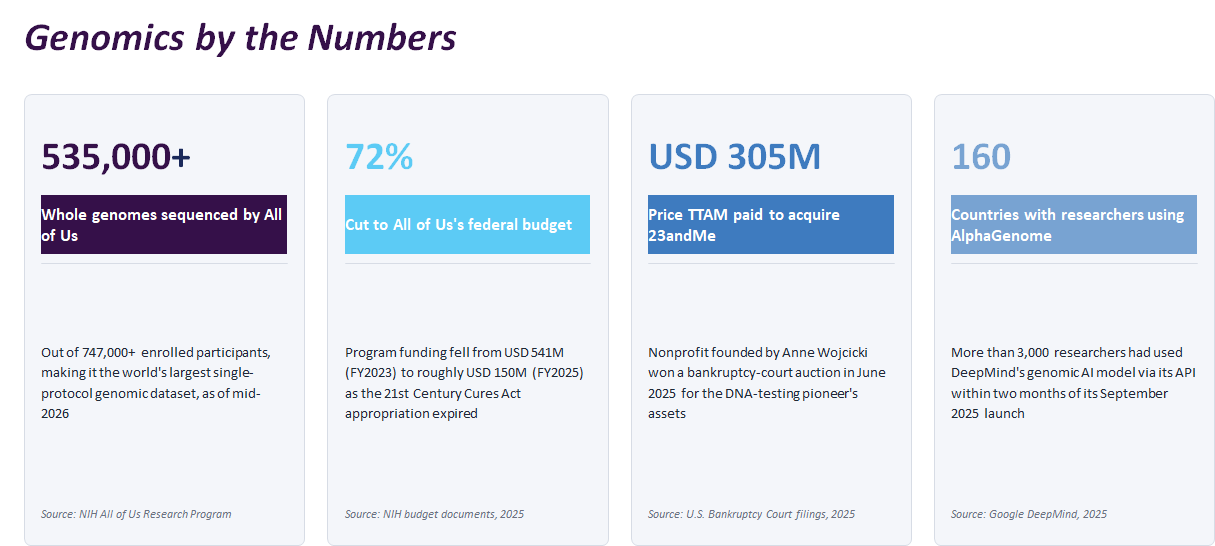
23andMe’s assets were put up for auction after the company filed for bankruptcy in March 2025. Regeneron initially won the auction with a USD 256 million bid. Still, the bidding process was reopened after TTAM Research Institute, a nonprofit founded by co-founder Anne Wojcicki, submitted a higher USD 305 million offer. TTAM was selected as the winning bidder in June, and the acquisition was completed on July 14, 2025.
Under the agreement, TTAM committed to maintaining 23andMe’s existing privacy policies and customer choices, including the right to delete genetic data and opt out of research, while introducing additional privacy safeguards. However, the transaction also raised legal and regulatory concerns about transferring sensitive genetic information during bankruptcy. The case highlights the growing importance of data ownership, customer consent, and privacy protections in the genomics market.
“I am thrilled that TTAM Research Institute will be able to continue the mission of 23andMe to help people access, understand, and benefit from the human genome.”
— Anne Wojcicki, Co-Founder and Chief Executive Officer, TTAM Research Institute
The 23andMe bankruptcy highlighted the legal challenges involved in transferring genetic data when a company is sold. In 2025, attorneys general from multiple U.S. states challenged the proposed sale, arguing that transferring customers’ genetic information could require additional consent under state privacy laws.
States such as Washington, Minnesota, and Arizona have laws that provide specific protections for genetic or sensitive health data. The case has brought renewed attention to whether existing consent is sufficient when ownership changes and how privacy rights should be protected during bankruptcy, mergers, and acquisitions.
Why This Matters
Companies that handle genetic data will face increased scrutiny from regulators and consumers. Privacy protections during mergers, acquisitions, and bankruptcies will become vital for how these businesses manage and safeguard genetic data.
Section II: AI Reads the Genome
02Artificial Intelligence Is Learning to Predict What DNA Variants Actually Do
In June 2025, Google DeepMind introduced its AlphaGenome, which is an AI model designed to predict how changes in DNA may affect gene activity and other genetic processes. The model can study DNA sequences of about one million base pairs at a time. Unlike AlphaFold, which focuses on protein structure, AlphaGenome examines how changes in genes affect gene regulation, gene expression, and other functions.
“AlphaGenome will be a powerful tool for the field. Determining the relevance of different non-coding variants can be extremely challenging, particularly when done at scale. This tool will provide a crucial piece of the puzzle, allowing us to make better connections to understand diseases like cancer.”
— Professor Marc Mansour, University College London
AlphaGenome quickly attracted attention from researchers after its launch. Within two months, over 3,000 researchers from 160 countries used the model via its public API. This technology helps researchers identify which genetic changes are likely to cause diseases, especially in non-coding parts of the genome that are hard to understand. It can also aid in finding new drug targets and enhance understanding of genetic diseases.
Why This Matters
AI tools for gene research and clinical testing may become common. Their effectiveness will depend on how well they perform in laboratory studies and with real patient data. For these tools to be widely used, they must also be accurate, validated, and approved by regulators.

Section III: Population Genomics at Scale
03Population genomics is expanding rapidly, even though public funding is shrinking
In May 2018, the NIH “All of Us Research Program” was launched to build a large and diverse health and genomic database. By mid-2026, the program had more than 747,000 participants and over 535,000 whole genomes sequenced. This makes it one of the largest health and genomic datasets that are built under a single research program. More than 75% of participants come from groups that have been underrepresented in medical research. This focus is important because many existing genomic datasets have mostly included people of European ancestry.
The program has reached this scale despite major cuts in federal funding. “All of Us” received USD 541 million in funding in fiscal 2023. After that, its budget fell to about USD 158 million in fiscal 2025, which was about 72% below the 2023 level. Researchers have warned that lower funding may slow down new enrollment and data collection. Moreover, interest in the existing dataset is growing among researchers and companies. The program offers access to genomic and health record data through its secure Researcher Workbench. It also supports studies on diseases such as heart disease and depression.
Why This Matters
“All of Us” shows both the value and the challenge of building large public genomic databases. The value of these datasets increases as they become larger, more diverse, and more useful for research. However, maintaining and expanding them depends heavily on stable public funding. Changes in government budgets can affect the future growth and research value of large genomic data programs.
04Whole-Genome Newborn Screening Is Shifting from Pilot Projects to A National Program
The UK Generation Study, which was run by Genomics England and the NHS, began recruiting newborns in 2024. The program aimed to sequence the whole genomes of 100,000 babies and screen for about 200 rare genetic conditions that can be treated or managed when found early. This is different from conventional newborn screening, which usually tests for a much smaller number of conditions.
Genomics England has reported that its study helped find health conditions early. This early detection allowed for treatments that standard screening was unable to provide. The program also stores genetic information of the babies for future research if parents provide their consent.
This helps newborn genome testing find diseases early and supports long-term studies. While similar projects occur in the U.S., the UK program is one of the largest national efforts of its kind.
Why This Matters
Whole-genome newborn screening can help improve early diagnosis of rare diseases and help doctors start treatment sooner. It could also create larger genomic datasets for research and support future gene therapy development. However, wider use will depend on clinical benefits, cost, consent, data privacy, and how long children’s genetic information should be stored.
Section IV: Precision Editing Advances Beyond Human Health
05Base and prime editing are moving closer to clinical use as more precise alternatives to CRISPR
Base editing and prime editing are the new gene-editing methods that can make precise changes to DNA without cutting both strands of DNA. This can reduce the risk of undesired changes compared with traditional CRISPR-Cas9 editing.
Beam Therapeutics is developing BEAM-101 for sickle cell disease. The treatment edits a patient’s blood stem cells to increase fetal hemoglobin, which can help reduce the effects of the sickle cell mutation. BEAM-101 has received several FDA designations, and early results from the BEACON trial have also shown positive changes in patients.
These designations not only recognize the promise of BEAM-101 but also enable enhanced collaboration with the FDA as we advance toward a BLA filing. With 30 patients now dosed in the BEACON Phase 1/2 trial and additional data expected later this year.”
— Giuseppe Ciaramella, PhD, President, Beam Therapeutics
Other companies, such as Prime Medicine, are developing prime-editing therapies for different genetic diseases. These technologies are in the early stages of clinical development, and their long-term safety needs to be studied in larger patient groups. Their main advantage could be more precise DNA changes with fewer unwanted effects, but this has not yet been fully proven.
Why This Matters
Base and prime editing can offer good alternatives to first-generation CRISPR therapies. These methods could be helpful for blood disorders, where gene editing is already showing promise. As more clinical data become available, factors such as safety, treatment durability, and patient results will decide how these new technologies compare to the current CRISPR therapies.
06Genetic engineering is being used for much more than just human medicine
Gene-editing technologies are now also being used in agriculture and industrial biotechnology. In May 2020, the U.S. USDA introduced the SECURE Rule, which allows certain gene-edited plants to avoid the full regulatory review used for some genetically engineered crops when the changes could also be made through conventional breeding. By 2024, around 6 gene-edited crop traits had been cleared for commercialization in the U.S. under this framework, covering soybean, canola, rice, corn, mushroom, and camelina.
Gene editing is also used in industrial biotechnology to modify the microorganisms that can produce chemicals, materials, and food ingredients. These applications can help replace the products that are made from petroleum or agricultural sources. Regulatory requirements can be different based on the product and country. For instance, in the U.S., there is the USDA, EPA, or FDA, depending on how the technology is used.
Why This Matters
Gene editing may open new avenues for genomics and genetic engineering industry growth outside the healthcare sector. In the field of agriculture, it can be used to produce crops that have greater resistance to disease, can tolerate drought, and have improved nutritional value. In industrial biotechnology, it can help companies in finding new methods for producing chemicals, materials, and ingredients. Moreover, faster and more flexible regulatory pathways will also help promote wider commercial use.
Genomics and Genetic Engineering Industry Outlook: The Bottom Line
Genomics and genetic engineering are moving in two directions at the same time. Large genomic databases, AI tools, and newborn screening programs are becoming more concentrated in a smaller number of major platforms. In addition, gene-editing technologies are expanding into healthcare, agriculture, and industrial biotechnology.
Developments such as 23andMe’s bankruptcy and nonprofit acquisition, the growth of the “All of Us” program despite funding cuts, AlphaGenome’s rising use, the UK newborn sequencing program, and advances in base editing show this shift.
Genomic data is becoming an important asset, while the technologies that use this data are advancing faster than regulations and business systems can keep up. A key issue for the genomics and genetic engineering industry outlook will be how this infrastructure is owned, funded, and managed.
The growth of genomics is likely to continue, but future progress will also depend on data privacy, long-term funding, regulation, and access. The market is moving from a research-focused field toward a more important and widely used technology platform.
Last updated:


