
- Home
- »
- Renewable Chemicals
- »
-
Bio-polyamide Market Size, Share & Growth Report, 2033GVR Report cover
![Bio-polyamide Market (2026 - 2033)Report]()
Bio-polyamide Market (2026 - 2033)
Size, Share & Trends Analysis Report By Product (PA-6, PA-66, Specialty Polyamides), By Application (Fiber, Engineering Plastics), By End Use (Textile, Automotive, Film & Coating), By Region, And Segment Forecasts
Market Size, 2025
$304.1MMarket Estimate, 2026
$361.1MMarket Forecast, 2033
$1,099.6MCAGR, 2026–2033
17.2%Bio-polyamide Market Summary
The global bio-polyamide market size was valued at USD 304.1 million in 2025 and is projected to grow from USD 361.1 million in 2026 to USD 1,099.6 million by 2033, at a CAGR of 17.2% from 2026 to 2033. The market in Europe dominated with a revenue share of 37.2% in 2025. Growing environmental awareness and increasingly stringent regulations aimed at reducing carbon emissions and plastic waste are positively influencing the bio-polyamide market growth.

Key Market Trends & Insights
- By application: Engineering plastics segment held the largest market share of 67.3% in 2025.
- By product: PA-66 segment held the largest market share of 50.8% in 2025.
- By end use: Automotive segment held the largest market share of 34.6% in 2025.
Regional Highlights
- Largest regional market: Europe (37.2% revenue share, 2025)
- By country: Germany held the largest market share in 2025.
Market Size & Forecast
- Market size in 2025: USD 304.1 Million
- Estimated market size in 2026: USD 361.1 Million
- Projected market size by 2033: USD 1,099.6 Million
- CAGR (2026-2033): 17.2%
Moreover, factors such as strong consumer demand for sustainable materials, rising restrictions on conventional plastics, limited availability of fossil-based resources, and increasing adoption of bio-based polymers with lower carbon footprints are driving market demand. The emphasis on efficient natural resource utilization and the transition toward a more sustainable economy is further supporting market expansion globally. The significant consumer demand, along with increasing regulations such as global warming initiatives and plastic bag bans, are driving market opportunities for bio-based plastics. Limited availability and increasing cost of fossil resources have forced manufacturers to shift their focus toward bio-based products. Bio-based polymers generally have a lower CO2 footprint and are associated with efforts to create more sustainable and environmentally friendly products. One of the main reasons for the increasing level of interest in bio-based products is the fact that these products may contribute to more efficient use of natural resources, which is a necessary condition for creating a more sustainable economy.
The bio-polyamide market is experiencing a significant shift toward sustainable production practices, with companies increasingly investing in bio-based materials. This trend is driven by the need for renewable alternatives to traditional petroleum-derived polyamides, reflecting broader market preferences for eco-friendly solutions. Advanced bio-polyamide grades are being developed for applications in industries such as automotive, textiles, and electronics, where high-performance and lightweight materials are in demand. Innovations in feedstock, including the use of castor oil and other plant-based raw materials, are gaining traction as they reduce greenhouse gas emissions compared to fossil-based polyamides. This trend is further reinforced by stricter environmental regulations, especially in Europe, which are encouraging companies to adopt sustainable solutions across their product lines.
Maket Dynamics
The bio-polyamide market is evolving from a niche sustainable materials segment into a strategically important component of the broader bio-based polymers industry. Growing demand for renewable alternatives to conventional petroleum-based polyamides is encouraging manufacturers to invest in sustainable production technologies and advanced bio-based material development. At the same time, innovations in plant-derived feedstocks, including castor oil and other renewable raw materials, are improving product performance while reducing environmental impact. Stricter environmental regulations and sustainability targets, particularly in Europe, are further accelerating adoption. Strong demand from the automotive, textile, and electronics industries continues to drive market growth, innovation, and competitive differentiation.
The bio-polyamide market is witnessing strong growth due to increasing adoption in automotive and electric vehicle (EV) applications. The automotive industry's growing focus on fuel efficiency, emission reduction, and vehicle light weighting is driving demand for high-performance bio-based materials that can replace conventional engineering plastics without compromising strength, durability, or safety. Bio-polyamides are increasingly utilized in under-the-hood components, structural parts, fuel systems, and interior applications, enabling manufacturers to reduce vehicle weight and improve overall operational efficiency while supporting sustainability objectives.
Demand is further supported by the rapid expansion of the electric vehicle sector, where bio-polyamides are gaining traction in battery systems, electrical connectors, wiring components, and thermal management applications due to their excellent mechanical properties and environmental advantages. At the same time, increasing collaboration between material suppliers and automotive manufacturers is accelerating product innovation and commercialization. As automakers seek cost-effective solutions that align with regulatory requirements and corporate sustainability commitments, bio-polyamides are emerging as a strategic material choice, reinforcing their role in next-generation vehicle manufacturing and long-term market growth.
High production costs and fluctuating raw material prices are key challenges for the bio-polyamide market. Bio-polyamides are produced using renewable feedstocks such as castor oil and other bio-based materials, which are typically more expensive than conventional petroleum-based alternatives. In addition, the need for specialized manufacturing processes, supply chain adjustments, and investments in production facilities increases overall costs. The market is also affected by changes in feedstock prices due to agricultural factors and limited supplier availability. These cost pressures can restrict adoption, particularly in price-sensitive industries, making improvements in production efficiency, supply chain management, and economies of scale essential for market growth.
The growing demand for sustainable textiles is creating strong opportunities for the bio-polyamide market. Consumers are increasingly choosing eco-friendly clothing, sportswear, and fashion products, encouraging manufacturers and brands to use more bio-based materials. Bio-polyamides provide key performance benefits such as durability, flexibility, and heat resistance, making them suitable for a wide range of textile applications while supporting sustainability goals. In addition, advancements in textile technologies and the development of innovative fabrics are expanding their use. Growing sustainability commitments from apparel companies and stricter environmental regulations are further driving the adoption of bio-polyamides, supporting long-term market growth.
Analyst Perspective
The bio-polyamide market is expected to evolve from a sustainability-driven niche into a value- and innovation-focused materials market, supported by rising demand across textiles, automotive, consumer goods, electronics, and industrial applications. Advances in bio-based feedstocks, polymer performance, recyclability, and circular materials will expand applications and improve cost competitiveness. Regulatory support, corporate decarbonization goals, and consumer demand for sustainable products will further drive growth. However, feedstock volatility, limited raw material availability, conventional polyamide pricing pressure, and supply chain challenges may affect profitability. Companies balancing performance, cost efficiency, and sustainability are expected to gain the strongest long-term opportunities.
Product Insights
Based on product, the PA-66 segment led the market with the largest revenue share of 50.8% in 2025. Increasing applications in the electrical & electronics, automotive, aerospace and marine segment is expected to foster market demand. The strength and wear resistance of PA-66 makes it a suitable product for manufacturing high quality cable ties. Its property of absorbing slightly less moisture than PA-6 gives it a competitive edge over other substitutes.
Growing end-use industries such as manufacturing, automobile, marine, electrical & electronics, and others are driving the product demand over the forecast period. Moreover, the presence of well-established film & coating companies, which is a major consumer of bio-based polyamide, is anticipated to drive the demand for the product across the globe.
Furthermore, the PA-6 product segment is anticipated to experience significant growth owing to properties such as better ductility, long-term thermal resistance, surface quality, creep resistance, and UV resistance over other PA-66. PA-6 ability to provide resistance from impact in low temperatures and its low cost over other substitutes. It is widely used in various applications such as automotive, manufacturing, textiles, film & coating, and the electrical & electronics industry. In the automotive sector, it is used as a cover for crash-active engines, oil pans, transmission cross beams, and air intake manifolds.
Application Insights
Based on the application, the engineering plastics segment led the market with the largest revenue share of 67.3% in 2025, owing to its wide scope of application. Development in energy saving and demand for environment-friendly solutions is anticipated to augment market growth. These plastics are widely used in the electronic and automobile sectors on account of their light weight and strength to weight ratio.
Development in automobile technology and changing consumer buying behavior are positively impacting this segment. The requirement for fuel-efficient products & solutions coupled with stringent emission norms is pushing the end use industry to use such products. The growing economy, rise in consumer spending power, and technological innovation are creating a strong growth potential for this segment.
Fibers application segment is growing with a substantial CAGR owing to its superior benefits such as light weight, less expensive than other substitutes, high electrical & mechanical resistivity and capability to withstand high temperatures on account of its high tensile strength. It is used in many applications by various end use industries such as automobiles, electrical & electronics, manufacturing, aerospace, and others
End Use Insights
Based on end use, the automotive segment led the market with the largest revenue share of 34.6% in 2025. Bio-polyamide is used in the automobile industry for various applications such as transmission cross beams, air intake manifolds, crashworthy engine covers, oil pans, etc. From dashboards to complicated ABS and engines, these polyamides have diversified applications that provide improved specifications and features with a reduction in weight and size. Technological advancements in the automobile field with improvements in infrastructure are creating more demand for automobile products.

Textile is one of the major end-use industries of the bio-polyamide market. Growing consumer awareness of the product regarding its aesthetics, recyclability and impact on the environment is a major driver for environment-friendly products. Energy conservation practices coupled with changed social orientation toward products & services are pushing the bio-polyamide market toward growth.
Regional Insights
North America bio-polyamide market is driven by a strong focus on sustainable practices within the automotive and packaging industries. Companies across these sectors are actively adopting bio-based polymers to meet corporate sustainability targets and to respond to consumer demand for eco-friendly products. In the automotive industry, lightweight and durable bio-polyamides are gaining attention as carmakers strive to improve fuel efficiency and reduce emissions.
U.S. Bio-polyamide Market Trends
The bio-polyamide market in the U.S. is driven by the country’s robust regulatory framework focused on reducing plastic waste and promoting sustainable materials. Federal and state initiatives, including incentives and grants for sustainable manufacturing practices, are encouraging companies to use bio-based alternatives in a wide range of applications. In particular, the construction and textile sectors are adopting bio-polyamides due to their durability and eco-friendliness, helping firms align with "green building" standards and sustainable fashion trends. The growing demand for sustainable clothing and construction materials, combined with government support, is expected to boost the bio-polyamide market in the U.S.
Europe Bio-polyamide Market Trends
Europe dominated the bio-polyamide market with the largest revenue share of 37.2% in 2025, which is attributable to strict environmental regulations and a strong consumer preference for sustainable products. The European Union’s Green Deal and its stringent carbon reduction goals have created a high demand for bio-based materials, with bio-polyamides positioned as a favorable alternative to traditional plastics. This shift is particularly evident in sectors like consumer goods, automotive, and personal care, where European consumers show strong demand for eco-friendly and biodegradable materials. Additionally, funding programs by the European Union to support innovation in sustainable materials are accelerating research and development, making bio-polyamides increasingly accessible to various industries across Europe.

The bio-polyamide market in Germany accounted for the largest market revenue share in Europe in 2025. The bio-polyamide market in Germany is primarily driven by the country’s leadership in automotive engineering and its commitment to sustainability. German automotive manufacturers are at the forefront of integrating bio-based materials into vehicle production to meet national emissions targets and EU regulations. As part of Germany's "Industry 4.0" movement, which promotes advanced and sustainable manufacturing, companies are investing in bio-polyamides for automotive components like engine covers, fuel lines, and interior parts. Moreover, Germany’s focus on circular economy principles is encouraging companies across sectors to adopt bio-polyamides, fostering a strong domestic demand for bio-based and recyclable materials.
Asia Pacific Bio-polyamide Market Trends
The bio-polyamide market in Asia Pacific is growing due to the rapid expansion of the automotive and electronics sectors. Countries like China, Japan, and South Korea are leaders in electronics manufacturing, and the increasing adoption of bio-based materials in electronic casings and connectors is boosting demand for bio-polyamides.
Key Bio-polyamide Company Insights
The market is highly competitive, with several key players dominating the landscape. The market is also characterized by a competitive landscape with several key players driving innovation and market growth. Major companies in this sector are investing heavily in research and development to enhance the performance, cost-effectiveness, and sustainability of their products.
Key Bio-polyamide Companies:
The following key companies have been profiled for this study on the bio-polyamide market.
-
Evonik Industries AG
-
Huntsman International LLC
-
LANXESS
-
BASF SE
-
UBE Corporation
-
INVISTA
-
DOMO Chemicals GmbH
-
Arkema
-
Asahi Kasei Corporation
-
Honeywell International Inc.
-
DSM
-
TORAY INDUSTRIES, INC.
-
Radici Partecipazioni SpA
-
DuPont
-
Solvay
-
ZIG SHENG INDUSTRIAL CO., LTD
-
Quadrant Group Limited
-
LEALEA ENTERPRISE CO., LTD.
-
EMS-CHEMIE HOLDING AG
Competitive Benchmarking
Category
Operating Strategies
Competitive Edge
Weakness
Established Players (Arkema; Evonik Industries AG; BASF SE; LANXESS; UBE Corporation; INVISTA; DOMO Chemicals GmbH; Asahi Kasei Corporation; Honeywell International Inc.; DSM; TORAY INDUSTRIES, INC.; Radici Partecipazioni SpA; DuPont; Solvay; EMS-CHEMIE HOLDING AG; Huntsman International LLC)
- Broad portfolios of bio-polyamide and advanced polyamide solutions spanning PA-6, PA-66, long-chain polyamides, and specialty engineering grades used across automotive, textiles, electrical & electronics, industrial machinery, consumer goods, films & coatings, and high-performance engineering applications.
- Strong focus on sustainable material innovation, renewable feedstock integration, lightweight engineering solutions, and development of high-performance bio-based polymers aligned with decarbonization goals, circular economy initiatives, and evolving environmental regulations.
- Extensive investments in R&D, production capacity expansion, strategic partnerships with automotive OEMs and industrial manufacturers, and vertically integrated value chains to strengthen market presence across global engineering plastics and specialty materials markets.
- Strong expertise in polymer chemistry, advanced materials engineering, and large-scale manufacturing capabilities that support the commercialization of high-performance bio-polyamide solutions with superior mechanical, thermal, and chemical properties.
- Established global distribution networks, long-standing relationships with automotive, electronics, textile, and industrial customers, and proven ability to meet stringent quality, regulatory, and performance requirements across multiple end-use sectors.
- Advanced research and innovation capabilities enabling continuous development of specialty bio-polyamide grades, lightweight material solutions, and application-specific products that support differentiation in highly competitive engineering materials markets.
- Higher production costs associated with renewable feedstocks, advanced processing technologies, and specialty bio-based formulations compared to conventional petroleum-derived polyamides, creating pricing challenges in cost-sensitive applications.
- Dependence on feedstock availability, evolving sustainability regulations, and customer willingness to adopt premium bio-based materials, which can influence commercialization rates and market penetration across different regions and end-use industries.
Emerging Players (ZIG SHENG INDUSTRIAL CO., LTD; Quadrant Group Limited; LEALEA ENTERPRISE CO., LTD.; Huntsman International LLC)
- Focus on expanding bio-polyamide offerings across textile fibers, engineering plastics, automotive components, electrical & electronics, and specialty industrial applications through investments in bio-based material development and product diversification.
- Emphasis on enhancing material performance, sustainability credentials, and customized compound solutions tailored to specific end-use requirements.
- Strategic collaborations with automotive OEMs, textile manufacturers, electronics producers, and industrial processors support market expansion and customer acquisition. Increasing focus on advanced polymer engineering, renewable feedstock integration, and regional manufacturing capabilities to strengthen competitiveness in high-growth bio-based materials markets.
- Strong technical expertise in polyamide manufacturing, polymer compounding, and specialty material development supports participation in performance-driven applications.
- Competitive advantage is reinforced through established customer relationships in textiles, automotive, electronics, and industrial sectors, along with the ability to provide application-specific material solutions.
- Flexible production capabilities, growing sustainability-focused product portfolios, and expertise in engineering-grade polymers enable these companies to address evolving customer requirements while benefiting from increasing demand for renewable and lightweight materials.
- Higher production costs associated with bio-based feedstocks, specialized processing requirements, and sustainability certifications can impact profitability and pricing competitiveness.
- Dependence on agricultural raw material availability and fluctuations in feedstock pricing may create supply chain and cost management challenges.
- Compared with larger global bio-polyamide producers, relatively limited market presence and scale may restrict penetration into certain high-volume applications. In addition, evolving regulatory standards, increasing competition from established manufacturers, and ongoing investment requirements for research and development may place pressure on growth and margin expansion.
Recent Developments
-
In June 2024, Fulgar, an innovative Italian company, launched Q-Geo, a new bio-based polyamide yarn aimed at transforming the textile market. This yarn is made from 46% non-edible corn, which is grown on land unsuitable for food production, significantly reducing its environmental impact compared to traditional materials.
-
In February 2024, LG Chem and CJ CheilJedang announced a partnership to build a bio-polyamide plant in South Korea, aiming to create a domestic supply chain for bio-nylon. This collaboration formalized through a non-binding agreement, will involve CJ CheilJedang using advanced fermentation technology to produce pentamethylenediamine (PMDA), a key ingredient for bio-nylon. LG Chem will then polymerize PMDA into bio-nylon and manage its sales.
Bio-polyamide Market Report Scope
Report Attribute
Details
Market size in 2025
USD 304.1 million
Estimated market size in 2026
USD 361.1 million
Projected market size by 2033
USD 1,099.6 million
Growth rate
CAGR of 17.2% from 2026 to 2033
Base year for estimation
2025
Historical data
2021 - 2024
Forecast period
2026 - 2033
Quantitative units
Revenue in USD million/billion, volume in kilotons, and CAGR from 2026 to 2033
Report coverage
Revenue forecast, company ranking, competitive landscape, growth factors, and trends
Segments covered
Product, end use, application, region
Regional scope
North America; Europe; Asia Pacific; Latin America; Middle East & Africa
Country scope
U.S.; Canada; Mexico; Germany; UK; France; Italy; Spain, The Netherlands; Turkey, China; India; Japan; South Korea, Australia, Malaysia, Singapore, Thailand, Vietnam, Brazil, Argentina, Saudi Arabia, UAE, South Africa
Key companies profiled
Evonik Industries AG, Huntsman International LLC, LANXESS, BASF SE, UBE Corporation, INVISTA, DOMO Chemicals GmbH, Arkema, Asahi Kasei Corporation, Honeywell International Inc., DSM, TORAY INDUSTRIES, INC., Radici Partecipazioni SpA, DuPont, Solvay, ZIG SHENG INDUSTRIAL CO., LTD, Quadrant Group Limited, LEALEA ENTERPRISE CO., LTD., EMS-CHEMIE HOLDING AG
Customization scope
Free report customization (equivalent up to 8 analysts' working days) with purchase. Addition or alteration to country, regional & segment scope.
Pricing and purchase options
Avail customized purchase options to meet your exact research needs. Explore purchase options
Global Bio-polyamide Market Report Segmentation
This report forecasts volume & revenue growth at global, regional, and country levels and provides an analysis of the latest industry trends in each of the sub-segments from 2021 to 2033. For this study, Grand View Research has segmented the global bio-polyamide market report on the basis of product, application, end use, and region:
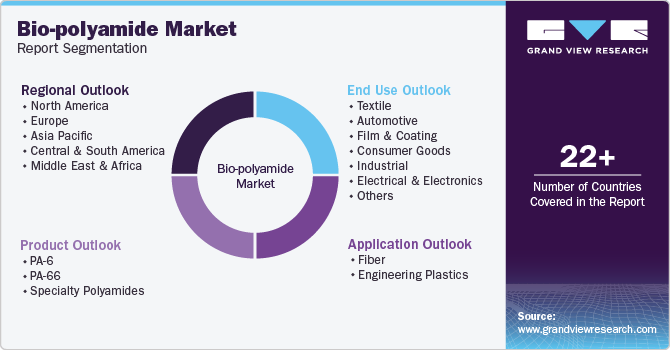
-
Product Outlook (Volume, Kilotons; Revenue, USD Million, 2021 - 2033)
-
PA-6
-
PA-66
-
Specialty Polyamides
-
-
Application Outlook (Volume, Kilotons; Revenue, USD Million, 2021 - 2033)
-
Fiber
-
Engineering Plastics
-
-
End-use Outlook (Volume, Kilotons; Revenue, USD Million, 2021 - 2033)
-
Textile
-
Automotive
-
Film & Coating
-
Consumer Goods
-
Industrial
-
Electrical & Electronics
-
Others
-
-
Regional Outlook (Volume, Kilotons; Revenue, USD Million, 2021 - 2033)
-
North America
-
U.S.
-
Canada
-
Mexico
-
-
Europe
-
Germany
-
U.K.
-
France
-
Italy
-
Spain
-
The Netherlands
-
Turkey
-
-
Asia Pacific
-
China
-
India
-
Japan
-
South Korea
-
Australia
-
Malaysia
-
Singapore
-
Thailand
-
Vietnam
-
-
Central & South America
-
Brazil
-
Argentina
-
-
Middle East and Africa
-
Saudi Arabia
-
UAE
-
South Africa
-
-
Research Methodology
The bio-polyamide market figures in this report are based on a proven research process that combines executive interviews with secondary research from proprietary databases, company filings, and recognized regulatory and institutional sources. Market size is built through value-chain sizing - reconciling supply-side and demand-side estimates - and triangulated with bottom-up and top-down approaches. Every estimate passes multiple levels of expert validation before publication, with each bio-polyamide segment quantified using the revenue-capture definitions in the table below.
Segment Definition
Segment - Product
Revenue capture definition
PA-6
Revenue is captured through the production and sale of bio-based PA-6 grades utilized across automotive, electrical & electronics, industrial components, textiles, and consumer goods applications. Demand is driven by its favorable balance of mechanical strength, wear resistance, processability, and lightweight characteristics, enabling manufacturers to replace conventional fossil-based engineering plastics while supporting sustainability and carbon reduction objectives.
PA-66
Revenue is captured through the supply of bio-based PA-66 materials used in high-performance applications requiring superior strength, heat resistance, dimensional stability, and durability. Growth is supported by increasing adoption in automotive under-the-hood components, electrical connectors, industrial machinery, and engineering applications where stringent performance requirements and growing emphasis on sustainable materials are driving demand.
Specialty Polyamides
Revenue is captured through the commercialization of specialty bio-polyamides, including long-chain and high-performance polyamide grades designed for advanced engineering applications. Demand is driven by their enhanced chemical resistance, flexibility, thermal performance, lightweight properties, and sustainability advantages, supporting growing utilization in automotive, electronics, medical devices, consumer products, and specialty industrial applications requiring customized material solutions.
Segment - Application
Revenue capture definition
Fiber
Revenue is captured through the utilization of bio-polyamide fibers in textiles, apparel, sportswear, carpets, industrial fabrics, and technical textile applications. Demand is driven by increasing preference for sustainable and high-performance materials offering excellent abrasion resistance, elasticity, durability, and moisture management properties, supporting the growing adoption of eco-friendly fibers across consumer and industrial sectors.
Engineering Plastics
Revenue is captured through the application of bio-polyamide in engineering plastic components used across automotive, electrical & electronics, industrial machinery, consumer goods, and specialty manufacturing sectors. Growth is supported by its superior mechanical strength, thermal stability, chemical resistance, and lightweight characteristics, enabling manufacturers to meet performance requirements while advancing sustainability goals and reducing dependence on petroleum-based engineering materials.
Segment - End Use
Revenue capture definition
Textile
Revenue is captured through the use of bio-polyamide fibers in apparel, sportswear, technical textiles, carpets, and industrial fabrics. Demand is driven by increasing consumer preference for sustainable textile materials, growing adoption of bio-based fibers by fashion brands, and the need for high-performance materials offering durability, elasticity, and abrasion resistance.
Automotive
Revenue is captured through the application of bio-polyamide in lightweight automotive components, under-the-hood parts, fuel systems, interior components, and electric vehicle applications. Growth is supported by increasing focus on vehicle lightweighting, fuel efficiency improvements, emission reduction targets, and the growing adoption of sustainable materials across automotive manufacturing.
Film & Coating
Revenue is captured through the utilization of bio-polyamide in specialty films, barrier packaging films, protective coatings, and industrial surface applications. Demand is driven by the need for enhanced mechanical performance, chemical resistance, durability, and sustainable material solutions across packaging, industrial, and specialty applications.
Consumer Goods
Revenue is captured through the incorporation of bio-polyamide in household products, sporting goods, personal accessories, luggage, and various consumer products. Growth is supported by rising consumer awareness of sustainability, increasing demand for bio-based materials, and manufacturers’ efforts to reduce environmental impact while maintaining product performance and durability.
Industrial
Revenue is captured through the use of bio-polyamide in machinery components, industrial equipment, tools, conveyor systems, and engineered parts. Demand is driven by the material’s high mechanical strength, wear resistance, thermal stability, and ability to provide sustainable alternatives to conventional engineering plastics in demanding industrial environments.
Electrical & Electronics
Revenue is captured through the application of bio-polyamide in connectors, cable insulation, circuit components, electronic housings, and electrical assemblies. Growth is supported by increasing demand for lightweight, heat-resistant, and high-performance materials, along with sustainability initiatives within the electronics industry aimed at reducing environmental impact.
Others
Revenue is captured through bio-polyamide applications across healthcare, packaging, construction, consumer packaging, and specialty engineering sectors. Growth is supported by expanding awareness of bio-based materials, evolving sustainability regulations, continuous product innovation, and the development of new end-use applications requiring environmentally responsible performance materials.
Estimation Model
Layer Name
Key Question
Description
Top-Down Bio-Polyamide Demand Scan Layer
What defines market boundaries?
This layer begins with global bio-polyamide demand across textiles, automotive, electrical & electronics, industrial manufacturing, consumer goods, films & coatings, and specialty engineering applications, then filters consumption intensity based on production output, lightweight material requirements, sustainability targets, bio-based material adoption rates, and regulatory initiatives promoting carbon footprint reduction and renewable raw material utilization.
End-Use Industry Validation Layer
Where is demand generated?
This layer evaluates demand distribution across textile fibers, automotive components, electrical connectors, consumer products, industrial machinery parts, films & coatings, and other specialty applications, aligning market revenue with performance requirements such as mechanical strength, thermal stability, chemical resistance, durability, lightweight properties, and environmental compliance across key end-use sectors.
Product & Material Conversion Layer
Who captures market revenue?
This layer converts end-use consumption volumes into bio-polyamide revenue by applying product mix ratios across PA-6, PA-66, specialty polyamides, and other bio-based polyamide grades, while accounting for bio-based content levels, processing technologies, material specifications, performance requirements, certification standards, and manufacturer pricing strategies throughout the value chain.
Regional Commercial Cross-Check Layer
How are assumptions validated?
This layer validates demand concentration by comparing Europe’s strong sustainability regulations and established bio-based materials ecosystem, Asia Pacific’s expanding automotive, textile, and electronics manufacturing sectors, and North America’s growing adoption of renewable engineering materials and sustainable consumer products, while also considering emerging opportunities in Latin America and the Middle East driven by industrial development, environmental initiatives, and increasing investments in bio-based manufacturing technologies.
Delivered Customizations
This report has been delivered with the following In-depth customizations
Client Request
Customization Delivered
Value Adds
Regional Segmentation
Detailed market sizing and forecasts across North America, Europe, Asia-Pacific, Central & South America, and Middle East & Africa, with country-level analysis for key markets including the U.S., Germany, France, Italy, China, Japan, South Korea, India, and Brazil.
Enabled identification of high-growth regions, demand hotspots, regulatory trends, and investment opportunities across mature and emerging bio-polyamide markets.
Cross-Segmentation
Comprehensive analysis by product type, application, end-use industry, and region. Evaluated demand patterns across textiles, automotive, electrical & electronics, industrial components, consumer goods, and packaging sectors.
Provided deeper visibility into revenue pockets, niche application opportunities, and segment-specific growth strategies for market participants.
Opportunity Assessment
Identification of emerging growth opportunities across sustainable textiles, lightweight automotive components, electrical & electronics, 3D printing materials, circular economy solutions, and high-performance engineering applications.
Assisted clients in prioritizing high-potential markets, developing expansion strategies, evaluating investment opportunities, and capturing long-term growth potential.
Frequently Asked Questions About This Report
The global bio-polyamide market size was valued at USD 304.1 million in 2025 and is estimated at USD 361.1 million for 2026.
The global bio-polyamide market is expected to grow at a CAGR of 17.2% from 2026 to 2033, reaching USD 1,099.6 million by 2033.
The engineering plastics led the bio-polyamide market in 2025 with a 67.3% share. Growing demand for lightweight, high-performance, and environmentally sustainable engineering materials across automotive, electrical & electronics, industrial machinery, consumer goods, and electric vehicle applications is driving the adoption of bio-polyamide-based engineering plastics.
Key factors that are driving the market growth include increasing preference for eco-friendly and sustainable solutions among end-use industries and increasing awareness about the environmental degradation caused by the extraction of petroleum derivatives.
The textile segment based on end use is expected to grow at a CAGR of 17.4% for the forecast period.
Some key players operating in the bio-polyamide market include Evonik Industries AG, Huntsman International LLC, LANXESS, BASF SE, UBE Corporation, INVISTA, DOMO Chemicals GmbH, Arkema, Asahi Kasei Corporation, Honeywell International Inc., DSM, TORAY INDUSTRIES, INC., Radici Partecipazioni SpA, DuPont, Solvay, ZIG SHENG INDUSTRIAL CO., LTD, Quadrant Group Limited, LEALEA ENTERPRISE CO., LTD., EMS-CHEMIE HOLDING AG.
The Europe bio-polyamide market accounted for the largest share of 37.2% of the market size in 2025.
The UK was the leading Bio-polyamide market and is expected to grow at a compound annual growth rate of 18.5%.
Based on end use, the automotive segment accounted for the largest share of 34.6% of the market size in 2025. Bio-polyamide is used in the automobile industry for various applications such as transmission cross beams, air intake manifolds, crashworthy engine covers, oil pans, and others.
About the Author(s)
Renewable Chemicals Research Team
Specialty & Chemicals · Renewable ChemicalsThis report was authored by the renewable chemicals research team at Grand View Research - comprising two research analysts, one senior research analyst, and one industry expert - with specialized expertise in the renewable chemicals segment of the specialty & chemicals industry. All findings are based on proprietary specialty & chemicals databases, executive interviews, and regulatory analysis, subject to internal peer review prior to publication.
Last Updated:
Speak to Analyst


Customize this report to your needs — add regions, segments, or data points, with 20% free customization.
Or view our licence options:


ISO 9001:2015 & 27001:2022 Certified
We are GDPR and CCPA compliant! Your transaction & personal information is safe and secure. For more details, please read our privacy policy.


