
- Home
- »
- Next Generation Technologies
- »
-
Marine Electronics Market Size & Share Report, 2026-2033GVR Report cover
![Marine Electronics Market (2026 - 2033)Report]()
Marine Electronics Market (2026 - 2033)
Size, Share & Trends Analysis Report By Component (Hardware, Software, Services), By Vessel Type (Merchant Vessels, Fishing Vessels, Recreational Boats), By Application, By Region, And Segment Forecasts
Market Size, 2025
$7.0BMarket Estimate, 2026
$7.4BMarket Forecast, 2033
$12.5BCAGR, 2026–2033
7.7%Marine Electronics Market Summary
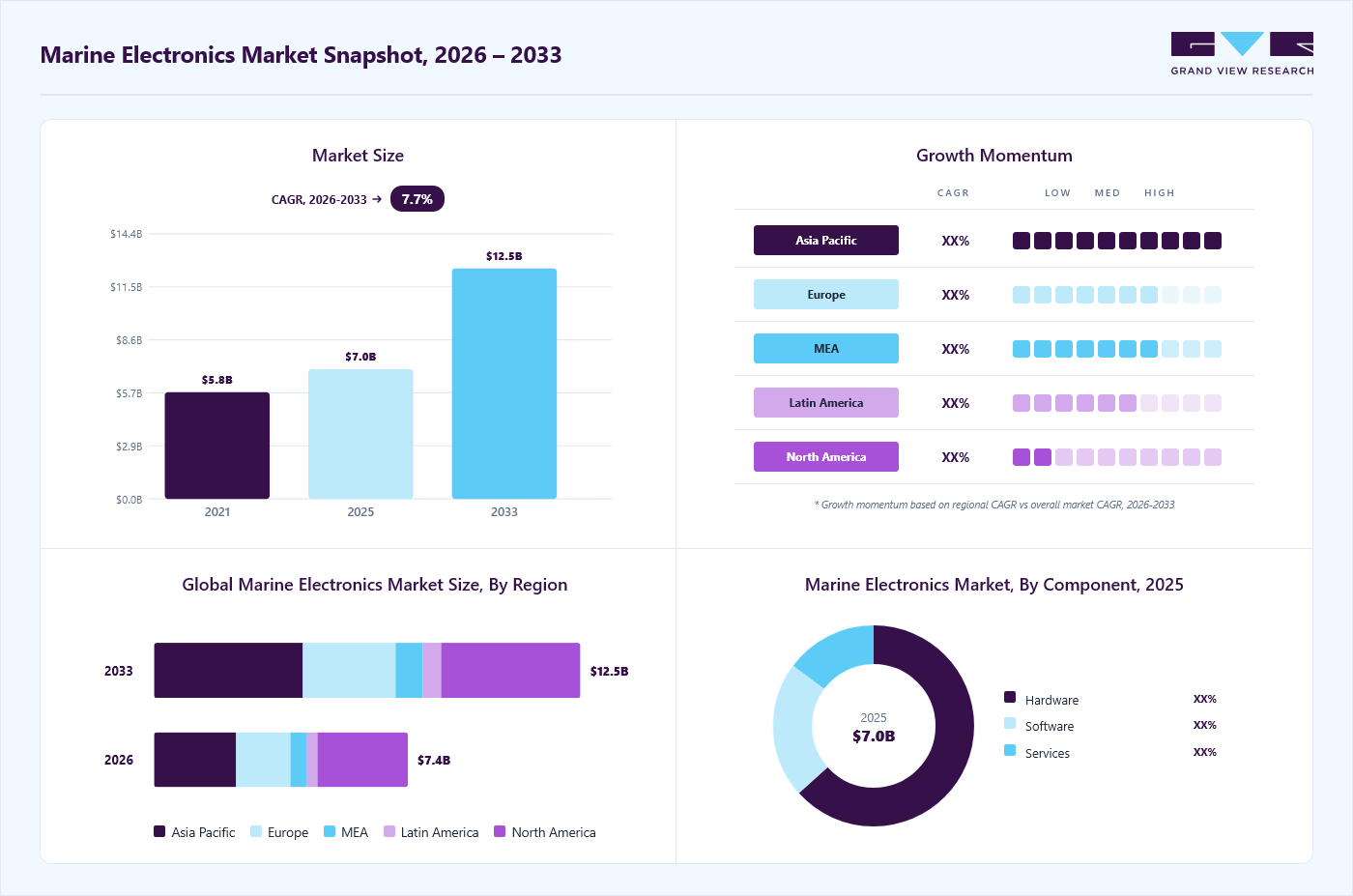
The global marine electronics market size was valued at USD 7.0 billion in 2025 and is projected to grow from USD 7.4 billion in 2026 to USD 12.5 billion by 2033, at a CAGR of 7.7% from 2026 to 2033. The market in North America dominated with a revenue share of 36.0% in 2025. This market expansion is driven by the significant increase in the integration of AI-enabled navigation, autonomous vessel technologies, and connected maritime communication systems.
Key Market Trends & Insights
- By component: Hardware segment dominated the market, with a revenue share of 63.6% in 2025.
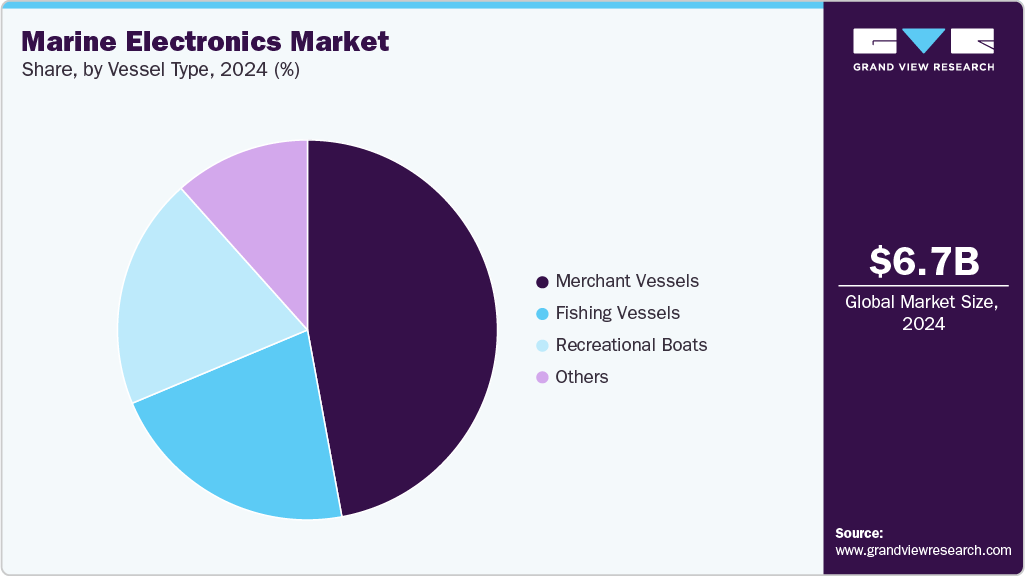
- By vessel type: Merchant vessels segment held the largest market share of 47.0% in 2025.
- By application: Navigation system segment holds the largest revenue share in 2025.
Regional Highlights
- Largest regional market: North America (36.0% revenue share, 2025)
- Fastest-growing regional market: Asia Pacific (highest CAGR, 2026-2033)
- By country: The U.S. held the largest market share in 2025.
Market Size & Forecast
- Market size in 2025: USD 7.0 Billion
- Estimated market size in 2026: USD 7.4 Billion
- Projected market size by 2033: USD 12.5 Billion
- CAGR (2026-2033): 7.7%
Three ways to get this report
Buy it, customize it, or ask a question.Ask an Analyst
A direct answer, usually in 1 working day
- AccessReport author, directly
- Reply timeWithin 1 working day
- No sales callDirect answer only
- FormatEmail reply
- CostFree, no cost
Get the Full Report
What the study covers
- FormatsPDF · Excel · Dashboard
- Timeline2026–2033 annual, 2025 base
- Coverage20+ countries, 5 regions
- Companies10+ key players profiled
Customize the Report
20% free customization
- IncludeCountries, segments, points
- TailorTo your product definition
- ExtendDeeper competitor detail
- OrA fully bespoke study
- Turnaround5–10 working days
The global marine electronics market is driven by increasing demand for advanced navigation, communication, and safety systems across commercial and recreational vessels. Growing concerns about maritime safety, regulatory requirements, and the need for efficient route planning contribute to heightened adoption of electronic systems. Enhanced awareness of fuel efficiency and operational cost reduction encourages integration of innovative electronic solutions. Moreover, rising maritime activities, including fishing, shipping, and leisure boating, stimulate consistent use of marine electronics.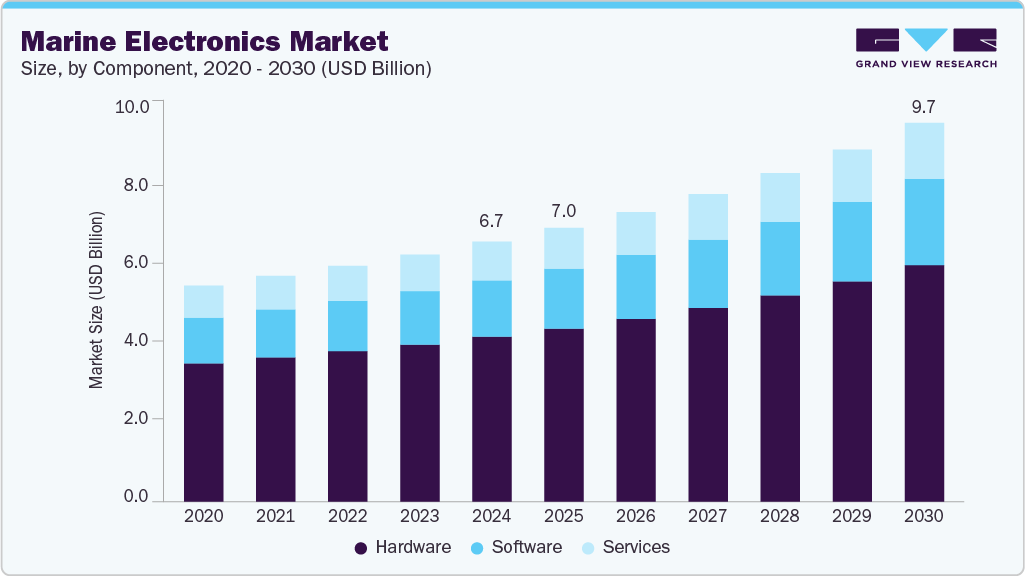
Moreover, the growth is driven by ongoing technological advancements that improve marine equipment's accuracy, connectivity, and automation. Innovations such as integrated bridge systems, digital chart displays, and real-time data transmission enhance vessel management and operational decision-making. Expanding deployment of Internet of Things (IoT) and AI in marine electronics enables predictive maintenance and environmental monitoring, driving further demand. Increasing investments in upgrading fleets and modernizing maritime infrastructure contribute to expanding marine electronics applications worldwide.
Furthermore, rising environmental regulations and emphasis on sustainable maritime operations encourage the adoption of electronics that support energy efficiency and emission reduction. The development of smart ports and digital maritime ecosystems creates additional requirements for communication and tracking technologies. Increased consumer interest in recreational boating and water sports also broadens the market's scope, encouraging manufacturers to offer user-friendly, connected devices. Collectively, these factors shape ongoing growth and diversification in the marine electronics market.
Market Dynamics
The marine electronics market is driven by the growing adoption of advanced navigation, communication, surveillance, and automation systems across commercial, naval, and recreational vessels. Increasing maritime trade volumes, stricter international maritime safety regulations, and rising investments in fleet modernization are accelerating demand for integrated electronic solutions. Ship operators are prioritizing real-time vessel monitoring, route optimization, and fuel-efficiency technologies to improve operational performance and reduce costs.
Commercial shipping companies, naval fleets, and recreational vessel operators are investing in advanced electronic solutions to improve situational awareness, route planning, and onboard safety. Technologies such as electronic chart display systems, automatic identification systems (AIS), radar, and satellite communication equipment enable vessels to operate more efficiently in complex maritime environments. These systems help reduce navigation errors, improve coordination between vessels and shore-based operations, and support compliance with maritime regulations. As global maritime traffic continues to expand, the need for reliable, integrated marine electronic systems is increasing across vessel types.
Vessel operators are focusing on real-time monitoring capabilities to optimize fuel consumption, reduce maintenance costs, and enhance overall fleet performance. Connected monitoring systems provide continuous data on vessel location, engine performance, weather conditions, and operational status, enabling data-driven decision-making. The growing focus on digitalization and smart shipping practices is accelerating the deployment of integrated marine electronics platforms that combine navigation, communication, and monitoring functions. Advancements in satellite connectivity and onboard analytics are further improving operational visibility and efficiency.
The high installation and maintenance costs of advanced marine electronic systems remain a significant restraint for the marine electronics market. Modern vessels increasingly require integrated navigation, communication, radar, sonar, and monitoring solutions, which involve substantial upfront investments in hardware, software, and system integration. For small fleet operators and vessel owners, the capital expenditure associated with deploying these technologies can limit adoption, particularly in cost-sensitive markets.
In addition, marine electronic systems operate in harsh maritime environments that demand regular maintenance, calibration, software updates, and periodic equipment replacement to ensure reliability and compliance with safety standards. The need for skilled technical personnel and specialized servicing further increases operational expenses over the lifecycle of the equipment. As a result, the overall cost burden can delay modernization initiatives and reduce the pace of adoption of advanced marine electronics across certain vessel segments.
The expansion of autonomous and smart vessel technologies is creating significant opportunities for the marine electronics market as ship operators increasingly invest in advanced navigation, sensor, communication, and control systems. Autonomous vessels rely on a complex network of radar, sonar, GPS, cameras, and AI-powered decision-support platforms, driving demand for sophisticated marine electronic equipment. Growing efforts to improve operational efficiency, reduce human error, and enhance maritime safety are encouraging the adoption of intelligent vessel solutions across commercial shipping, defense, and offshore sectors.
In addition, governments and maritime organizations are supporting the development of autonomous shipping corridors and digital maritime infrastructure, accelerating technology deployment. The integration of real-time data analytics, remote monitoring, and vessel-to-shore connectivity is further increasing the need for advanced electronic systems capable of supporting autonomous operations. As maritime stakeholders continue to modernize fleets and embrace smart shipping initiatives, marine electronics providers are positioned to benefit from expanding technology requirements across the global shipping ecosystem.
Market Concentration & Characteristics
Merger and acquisition activity in the marine electronics market remains moderate, as companies pursue strategic acquisitions to expand technological capabilities, strengthen product offerings, and enter new regional markets. Large maritime technology providers are increasingly targeting niche software developers, navigation specialists, and automation companies to enhance their digital maritime solutions. Acquisitions also enable firms to broaden customer bases and accelerate access to emerging technologies. For instance, in May 2025, Firmhelm Ltd acquired Rowlands Marine Electronics Ltd, to strengthen its service offerings by integrating complementary marine electronics expertise and increasing its ownership stake in Pwllheli Marine Centre Limited.
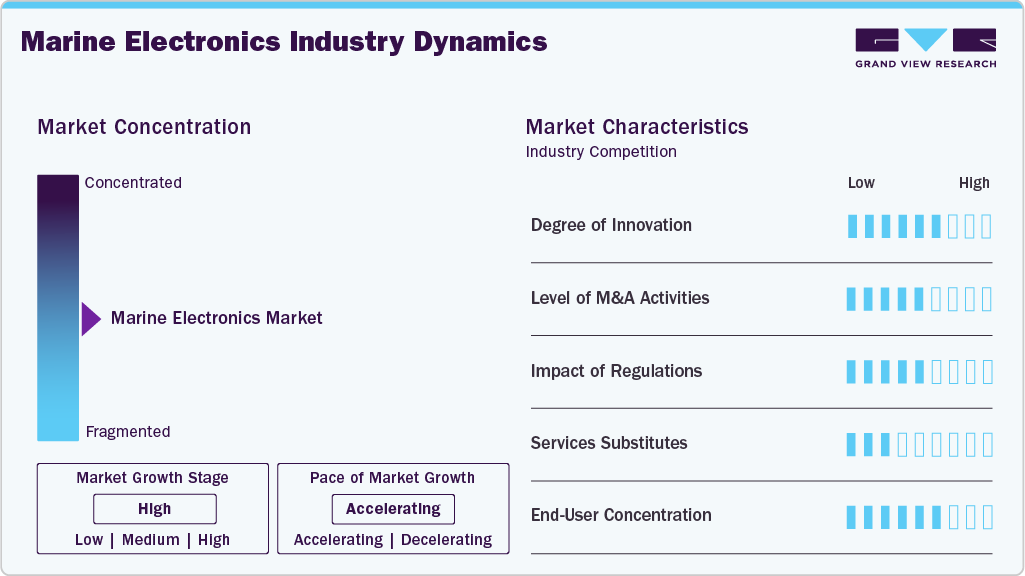
The marine electronics market serves a diversified customer base that includes commercial shipping operators, naval and defense organizations, offshore energy companies, fishing fleets, and recreational boat owners. This broad distribution of end users reduces dependency on any single customer segment and supports stable demand across varying economic cycles. Commercial maritime operators account for a substantial share of industry revenues, while defense and offshore sectors contribute significant high-value opportunities. The expanding adoption of advanced electronic systems across multiple vessel categories further enhances market resilience and growth potential.
Component Insights
Based on component, the hardware segment led the market with the largest revenue share of 63.6% in 2025 and is expected to grow at the significant CAGR over the forecast period. Physical components such as advanced sensors, radar, sonar, communication devices, and navigation instruments are essential for autonomous maritime operations. These highly reliable hardware elements enable vessels to accurately perceive their environment, including detecting obstacles, measuring weather conditions, and maintaining position even in challenging situations. Integrating durable, maritime-grade hardware with AI-driven control systems is essential for supporting long-duration journeys and ensuring safety at sea. This dependency on resilient, cutting-edge hardware across commercial shipping, naval fleets, and recreational boats drives sustained investment in this segment.
The software segment is predicted to experience the fastest growth during the forecast period due to continuous innovation in AI algorithms and maritime operational platforms that enable real-time decision-making, predictive diagnostics, and autonomous vessel control. Sophisticated software modules manage complex data fusion from multiple sensors, applying machine learning models to optimize navigation, detect threats like piracy or collision risks, and conduct equipment health monitoring. Autonomous software enhances fuel efficiency by dynamically adjusting routes based on weather and sea currents, reduces crew workload through AI-assisted guidance, and supports seamless integration with global maritime traffic systems. As digitalization in the marine sector deepens, software becomes indispensable for harnessing the full potential of hardware capabilities.
Vessel Type Insights
The merchant vessel segment accounted for the largest market revenue share in 2025 as commercial shipping operations demand extensive use of agentic marine electronics for safe navigation, regulatory compliance, and operational efficiency. Large fleets rely on autonomous systems to conduct precise route planning, monitor cargo conditions, and perform real-time anomaly detection to prevent accidents and operational disruptions. Automated systems mitigate human errors by continuously analyzing sensor data and environmental conditions. Furthermore, integration with global shipping databases and port authorities facilitates smoother, faster logistics and customs processing, which is vital to the worldwide supply chain’s efficiency and resilience.
The recreational boats segment is expected to grow at the fastest CAGR during the forecast period, driven by a growing consumer base seeking more intelligent, user-friendly, and connected marine electronics. AI-powered navigation aids, collision avoidance systems, and simplified autopilot functions offer enhanced convenience and safety to leisure boaters with varying experience levels. Including entertainment and IoT connectivity features on recreational vessels transforms boating into an integrated digital experience, appealing to tech-savvy consumers. Advances in cost-efficient components and plug-and-play AI modules enable manufacturers to offer accessible autonomous solutions, encouraging wider adoption in personal and small commercial watercraft.
Application Insights
Based on application, the navigation system segment led the market with the largest revenue share of 43.0% in 2025 as autonomous navigation is the cornerstone of agentic marine electronics. These systems leverage GPS, radar, sonar, and inertial navigation integrated with AI algorithms to continuously chart optimal routes, avoid hazards, and maintain vessel stability in various maritime environments. Enhanced situational awareness is achieved by incorporating satellite data, weather forecasts, and maritime traffic information, facilitating dynamic path adjustments and efficient fuel usage. Strict international safety regulations mandating reliable navigation systems across the shipping and boating sectors maintain a strong, consistent demand for advanced autonomous navigation technologies.
The entertainment segment is expected to grow significantly during the forecast period as AI-enabled multimedia systems are increasingly integrated into marine vessels to elevate passenger experience during leisure travel. Modern marine entertainment features encompass smart audio-visual streaming, voice-controlled interfaces, and immersive connectivity options that cater to diverse passenger preferences on yachts, cruise ships, and recreational boats. Developing secure, autonomous management systems ensures entertainment platforms operate without compromising vessel safety or cybersecurity. The convergence of entertainment and operational AI systems creates multifunctional onboard environments, attracting investments from luxury marine segments and expanding the market’s technological scope.
Regional Insights
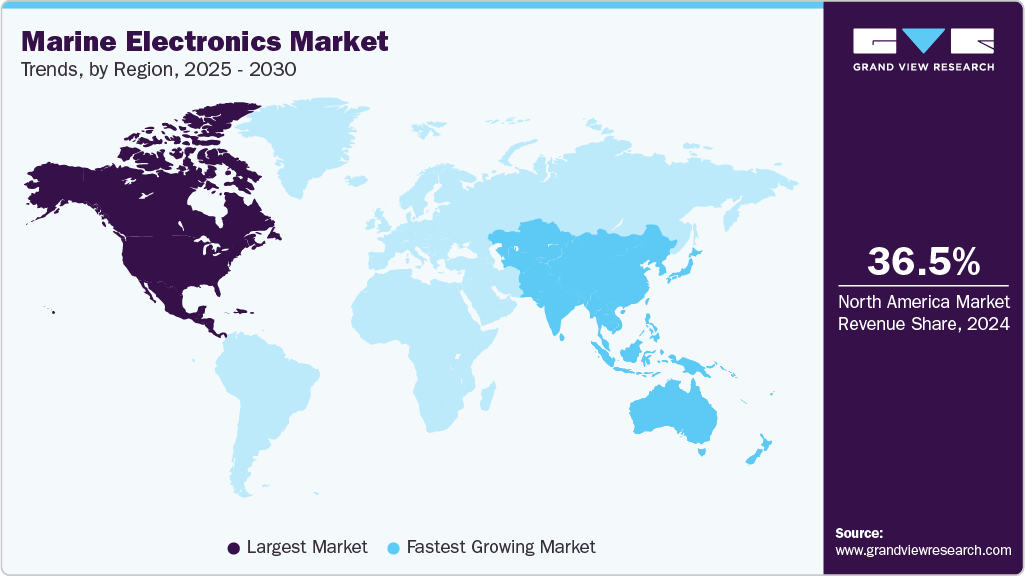
North America dominated the marine electronics market with the largest revenue share of 36.0% in 2025 due to extensive maritime infrastructure, active commercial ports, and rapidly modernizing fleets. The region benefits from high investments in research and development focused on autonomous navigation and AI-driven marine safety solutions. Regulations encouraging maritime emission reductions and safety improvements motivate fleet operators to adopt agentic electronics that enhance compliance and operational efficiency.
U.S. Marine Electronics Market Trends
The marine electronics market in the U.S. held the largest share in the North America region in 2025 due to its comprehensive maritime ecosystem encompassing commercial shipping, offshore energy exploration, naval operations, and recreational boating sectors. The country’s focus on national security and coastal protection accelerates the adoption of advanced autonomous marine technologies for surveillance and threat detection. Federal initiatives promote the modernization of fleets with AI-enabled systems that operate reliably in diverse maritime conditions.
Europe Marine Electronics Market Trends
The marine electronics market in Europe is expected to grow significantly over the forecast period, driven by stringent maritime safety standards, increasing environmental regulations, and digital transformation initiatives aimed at sustainable shipping. European fleets increasingly implement agentic marine electronics to monitor emissions, optimize routes for fuel efficiency, and comply with regulations such as the EU’s Maritime Safety Framework. Investments in smart port infrastructure and integrated logistics platforms allow seamless interaction between vessels and shore-side systems.
Asia Pacific Marine Electronics Market Trends
The marine electronics industry in the Asia Pacific region is anticipated to grow at the fastest CAGR over the forecast period, driven by booming commercial shipping activities, expanding shipbuilding industries, and rising disposable incomes, which are driving recreational boating popularity. Key maritime hubs in the region invest heavily in modernizing their fleets with autonomous navigation and safety technologies to handle congested shipping lanes efficiently. Governments back initiatives to improve maritime security, environmental monitoring, and port automation, fueling demand for AI-powered marine electronics.
Key Marine Electronics Company Insights
Some key companies in the marine electronics industry are Garmin Ltd., Furuno Electric Co., Ltd., Kongsberg Maritime AS, and Navico.
-
Garmin Ltd. is a provider of advanced marine electronics, offering integrated navigation, communication, and fish-finding systems designed to enhance safety and efficiency on the water. The company develops user-friendly multifunction displays, radar systems, autopilots, and sonar technology, catering to recreational boaters and commercial vessels. Garmin Ltd.'s marine solutions emphasize seamless connectivity, enabling real-time data sharing and situational awareness. Its commitment to innovation positions it as a key player in delivering reliable, cutting-edge electronics for maritime navigation and vessel management.
-
Furuno Electric Co., Ltd. is a prominent marine electronics manufacturer specializing in radar, sonar, GPS, and communication systems for commercial shipping and fishing industries. It provides high-performance navigation and safety equipment designed to operate under challenging maritime conditions with precision and durability. Its product portfolio includes advanced fish-finding radars, electronic chart systems, and integrated bridge systems that improve operational efficiency and vessel safety. The company's legacy of technological expertise supports its reputation for delivering reliable marine electronics solutions worldwide.
Key Marine Electronics Companies:
The following key companies have been profiled for this study on the marine electronics market.
-
Garmin Ltd.
-
Furuno Electric Co., Ltd.
-
Kongsberg Maritime AS
-
Navico
-
Wärtsilä Corporation
-
Northrop Grumman Corporation
-
Thales Group
-
Tokyo Keiki Inc.
-
L3Harris Technologies, Inc.
-
Japan Radio Co., Ltd.
-
FLIR Systems, Inc.
-
ATLAS ELEKTRONIK GmbH
Competitive Benchmarking
Category
Operating Strategies
Competitive Edge
Weakness
Established Players (Garmin Ltd.; Furuno Electric Co., Ltd.; Kongsberg Maritime AS; Tokyo Keiki Inc.)
- Focus on long-term contracts with commercial shipping companies, naval agencies, and offshore operators.
- Expand integrated product portfolios through R&D investments, technology partnerships, and selective acquisitions.
- Strong global distribution networks and established relationships with maritime stakeholders.
- Broad offerings spanning navigation, communication, surveillance, automation, and defense-grade systems.
- Longer product development and certification cycles can slow response to evolving customer requirements.
- High dependence on large-scale maritime and government procurement programs may create revenue fluctuations.
Emerging Players (Navico; FLIR Systems, Inc.)
- Concentrate on specialized technologies such as marine imaging, recreational marine electronics, and connected vessel solutions.
- Focus on product innovation and targeted expansion within high-growth application segments.
- Greater agility in introducing advanced digital features and user-centric technologies.
- A strong focus on niche applications enables differentiation within specific vessel categories and end-user groups.
- Limited penetration in large commercial and defense marine programs compared with established competitors.
- Smaller geographic presence and narrower product portfolios may restrict large-scale market participation.
Recent Developments
-
In July 2025, Vinici, a prominent provider of energy solutions, reached a definitive agreement to acquire the Marine Electric Systems business unit from Wärtsilä. This acquisition is a strategic move aimed at enhancing Vinici's capabilities and strengthening its presence in the defense sector as well as various industrial markets. The transaction aligns with Wärtsilä’s ongoing strategy to divest non-core businesses to unlock shareholder value and focus on its core operations.
-
In July 2025, Garmin Ltd introduced the Force Current, a groundbreaking kayak trolling motor featuring a steering control system and a cutting-edge hands-free wireless throttle. This innovative all-in-one propulsion solution empowers anglers to navigate, troll, and engage fish without needing to set their rod down. Engineered specifically for kayak anglers, the Force Current delivers exceptional performance with a dual-voltage brushless motor providing up to 50 pounds of thrust at 24V, or 30 pounds at 12V, enabling effortless maneuverability in any direction, tight circles, and precise movements through challenging environments like timber, shorelines, and weed beds.
-
In May 2025, Firmhelm Ltd acquired Rowlands Marine Electronics Ltd, a neighboring marine electronics specialist. Rowlands Marine Electronics Ltd specializes in the sale, installation, and servicing of marine navigation systems and electrical equipment from various brands. This strategic acquisition strengthens Firmhelm Ltd’s service offerings by integrating complementary marine electronics expertise and increasing its ownership stake in Pwllheli Marine Centre Limited.
Marine Electronics Market Report Scope
Report Attribute
Details
Market size in 2025
USD 7.0 billion
Estimated market size in 2026
USD 7.4 billion
Projected market size by 2033
USD 7.9 billion
Growth rate
CAGR of 7.7% from 2026 to 2033
Base year for estimation
2025
Historical data
2021 - 2024
Forecast period
2026 - 2033
Quantitative units
Revenue in USD million/billion and CAGR from 2026 to 2033
Report coverage
Revenue forecast, company ranking, competitive landscape, growth factors, and trends
Segments covered
Component, vessel type, application, region
Regional scope
North America; Europe; Asia Pacific; Latin America; MEA
Country scope
U.S.; Canada; Mexico; Germany; UK; France; China; Japan; India; South Korea; Australia; Brazil; Saudi Arabia; South Africa; UAE
Key companies profiled
Garmin Ltd.; Furuno Electric Co., Ltd.; Kongsberg Maritime AS; Navico; Wartsila Corporation; Northrop Grumman Corporation; Thales Group; Tokyo Keiki Inc.; L3Harris Technologies, Inc.; Japan Radio Co., Ltd.; FLIR Systems, Inc.; ATLAS ELEKTRONIK GmbH
Customization scope
Free report customization (equivalent up to 8 analysts' working days) with purchase. Addition or alteration to country, regional & segment scope.
Pricing and purchase options
Avail customized purchase options to meet your exact research needs. Explore purchase options
Global Marine Electronics Market Report Segmentation
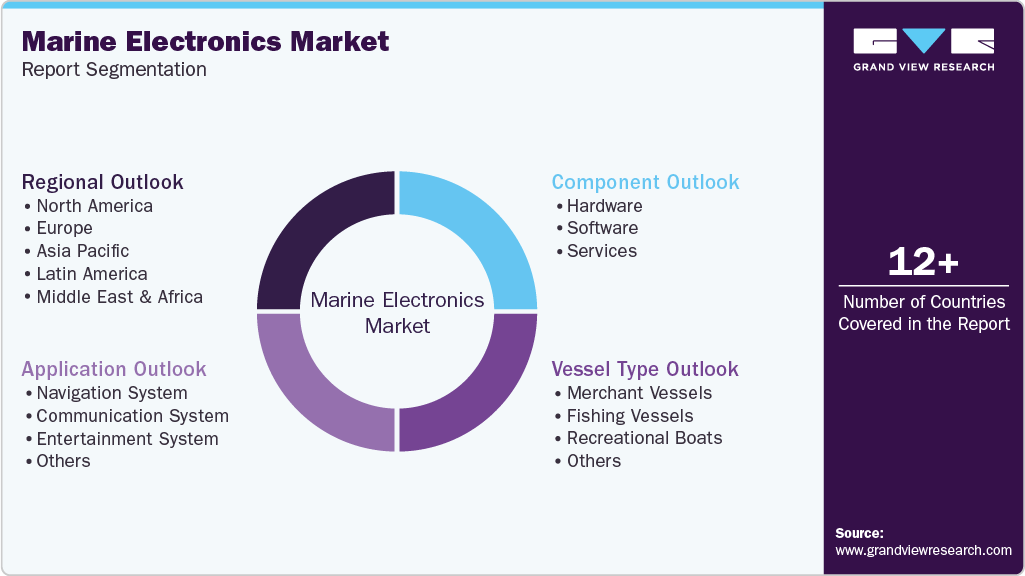
This report forecasts revenue growth at global, regional, and country levels and provides an analysis of the latest industry trends in each of the sub-segments from 2021 to 2033. For this study, Grand View Research has segmented the global marine electronics market report based on component, vessel type, application, and region:
-
Component Outlook (Revenue, USD Billion, 2021 - 2033)
-
Hardware
-
Software
-
Services
-
-
Vessel Type Outlook (Revenue, USD Billion, 2021 - 2033)
-
Merchant Vessels
-
Fishing Vessels
-
Recreational Boats
-
Others
-
-
Application Outlook (Revenue, USD Billion, 2021 - 2033)
-
Navigation System
-
Communication System
-
Entertainment System
-
Others
-
-
Regional Outlook (Revenue, USD Billion, 2021 - 2033)
-
North America
-
U.S.
-
Canada
-
Mexico
-
-
Europe
-
Germany
-
UK
-
France
-
-
Asia Pacific
-
China
-
Japan
-
India
-
South Korea
-
Australia
-
-
Latin America
-
Brazil
-
-
Middle East and Africa (MEA)
-
UAE
-
KSA
-
South Africa
-
-
Research Methodology
The marine electronics market figures in this report are based on a proven research process that combines executive interviews with secondary research from proprietary databases, company filings, and recognized regulatory and institutional sources. Market size is built through value-chain sizing - reconciling supply-side and demand-side estimates - and triangulated with bottom-up and top-down approaches. Every estimate passes multiple levels of expert validation before publication, with each marine electronics segment quantified using the revenue-capture definitions in the table below.
Segment Definition
Segment - Component
Revenue capture definition
Hardware
Revenue for the hardware segment is generated from the sale of physical marine electronic equipment, including radar systems, sonar devices, navigation displays, communication systems, sensors, and integrated bridge solutions installed on vessels.
Software
The software segment captures revenue from navigation platforms, fleet management applications, vessel monitoring systems, route optimization tools, cybersecurity solutions, and analytics platforms that support maritime operations and decision-making.
Services
Revenue in the services segment is derived from installation, system integration, maintenance, repair, technical support, calibration, and training services that ensure the effective operation and lifecycle management of marine electronic systems.
Segment - Vessel Type
Revenue capture definition
Merchant Vessels
Revenue from merchant vessels is generated through the adoption of navigation, communication, radar, and vessel monitoring systems used across cargo ships, tankers, and container fleets. Demand is supported by fleet modernization programs and the increasing focus on operational efficiency and maritime safety.
Fishing Vessels
Fishing vessels contribute revenue through the deployment of sonar, fish-finding equipment, GPS systems, and marine communication technologies. Growth is influenced by the need for improved catch optimization, navigation accuracy, and regulatory compliance in commercial fishing operations.
Recreational Boats
Revenue in this segment comes from the integration of chart plotters, marine entertainment systems, navigation aids, and safety electronics in leisure and sport boating activities. Rising participation in recreational marine tourism and boating supports equipment upgrades and new installations.
Others
This segment includes offshore support vessels, research vessels, patrol boats, and specialized marine craft utilizing advanced electronic systems for mission-specific operations. Revenue is driven by investments in offshore activities, maritime security, and scientific exploration programs.
Segment - Application
Revenue capture definition
Navigation System
Revenue for the navigation system segment includes sales of radar systems, GPS devices, electronic chart display systems, autopilot solutions, sonar equipment, and integrated bridge navigation technologies used across commercial, naval, fishing, and recreational vessels.
Communication System
Revenue for this segment comprises marine satellite communication equipment, VHF radios, AIS transceivers, onboard networking solutions, and ship-to-shore communication platforms that support operational connectivity and safety.
Entertainment System
Revenue is generated from onboard audio systems, multimedia displays, satellite television equipment, internet connectivity solutions, and passenger infotainment technologies installed on leisure boats, yachts, and cruise vessels.
Others
Revenue for the other segment includes marine monitoring systems, vessel security solutions, engine control electronics, environmental monitoring equipment, power management systems, and various auxiliary electronic components supporting vessel operations.
Estimation Model
Layer Name
Key Questions
Description
Fleet Base Layer
Who uses marine electronics?
Identify the global installed base of commercial vessels, naval fleets, offshore support vessels, fishing boats, recreational boats, and yachts that require navigation, communication, monitoring, and control systems. Establish the total addressable vessel population across key maritime industries and regions.
Adoption Layer
Who deploys marine electronics solutions?
Apply adoption rates for radar systems, GPS navigation, sonar, satellite communication, integrated bridge systems, vessel monitoring platforms, and automation technologies across target vessel categories. Evaluate deployment levels based on fleet modernization programs, regulatory compliance requirements, and operational needs.
Utilization Layer
How extensively are marine electronics systems used?
Measure the breadth and intensity of electronics integration through the number of systems installed per vessel, upgrade cycles, replacement demand, and utilization of connected maritime technologies. Assess penetration across navigation, communication, surveillance, automation, and safety applications.
Monetization Layer
How much revenue is generated?
Apply average spending per vessel on equipment procurement, software platforms, installation services, upgrades, maintenance, and aftermarket support. Aggregate revenues across commercial shipping, defense, offshore energy, fishing, and recreational marine sectors to estimate total market value.
Delivered Customizations
This report has been delivered with the following In-depth customizations
Client Request
Customization Delivered
Value Adds
Market Entry & Expansion Assessment
Regional demand sizing and forecasting
Customer segmentation and buying behavior analysis
Competitive landscape benchmarking
Regulatory and distribution channel assessment
Identified high-growth market opportunities
Supported go-to-market strategy development
Highlighted investment priorities and risks
Enabled data-driven expansion planning
Technology & Innovation Assessment
Emerging technology trend analysis
Innovation pipeline
Technology adoption readiness assessment
Ecosystem and partnership mapping
Identified future growth areas
Supported innovation roadmap planning
Evaluated commercialization potential
Strengthened strategic partnership decisions
Customer & End-User Insights Study
Consumer awareness and adoption analysis
Purchase decision journey mapping
Satisfaction and loyalty assessment
Usage pattern and pain-point evaluation
Revealed key adoption drivers and barriers
Supported customer-centric product development
Improved targeting and engagement strategy
Identified opportunities for retention and upselling
Frequently Asked Questions About This Report
Asia Pacific is the fastest-growing region over the forecast period.
The Hardware segment led with a 63.6% revenue share in 2025, while Software is the fastest growing segment.
Merchant Vessels held the largest revenue share in 2025, while Recreational Boats is the fastest growing segment.
The Navigation System segment led with a 43.0% revenue share in 2025, while Entertainment System is the fastest growing segment.
The global marine electronics market size was estimated at USD 7,023.1 million in 2025 and is expected to reach USD 7,430.5 million in 2026
The global marine electronics market is expected to grow at a compound annual growth rate of 7.7% from 2026 to 2033 to reach USD 12,481.7 million by 2033
North America dominated the Marine Electronics market with a share of over 36.0% in 2025, due to extensive maritime infrastructure, active commercial ports, and rapidly modernizing fleets. The region benefits from high investments in research and development focused on autonomous navigation and AI-driven marine safety solutions.
Some key players operating in the Marine Electronics market includeGarmin Ltd.; Furuno Electric Co., Ltd.; Kongsberg Maritime AS; Navico; Wartsila Corporation; Northrop Grumman Corporation; Thales Group; Tokyo Keiki Inc.; L3Harris Technologies, Inc.; Japan Radio Co., Ltd.; FLIR Systems, Inc.; ATLAS ELEKTRONIK GmbH
This market expansion is driven by the significant increase in the integration of AI-enabled navigation, autonomous vessel technologies, and connected maritime communication systems.
About the Author(s)
Next Generation Technologies Research Team
Technology · Next Generation TechnologiesThis report was authored by the next generation technologies research team at Grand View Research - comprising two research analysts, one senior research analyst, and one industry expert - with specialized expertise in the next generation technologies segment of the technology industry. All findings are based on proprietary technology databases, executive interviews, and regulatory analysis, subject to internal peer review prior to publication.
Last Updated:
Speak to Analyst


Customize this report to your needs - add regions, segments, or data points, with 20% free customization.
Or view our licence options:


ISO 9001:2015 & 27001:2022 Certified
We are GDPR and CCPA compliant! Your transaction & personal information is safe and secure. For more details, please read our privacy policy.


