- Home
- »
- Biotechnology
- »
-
Microfluidics Market Size And Share, Industry Report, 2030GVR Report cover
![Microfluidics Market Size, Share & Trends Report]()
Microfluidics Market (2025 - 2030) Size, Share & Trends Analysis Report By Technology, By Product (Microfluidic-based Devices, Microfluidic Components), By Material (Silicon, Glass), By Application (Medical, Non-Medical), By Region, And Segment Forecasts
- Report ID: GVR-1-68038-056-9
- Number of Report Pages: 150
- Format: PDF
- Historical Range: 2018 - 2023
- Forecast Period: 2025 - 2030
- Industry: Healthcare
- Report Summary
- Table of Contents
- Interactive Charts
- Methodology
- Download FREE Sample
-
 Download Sample Report
Microfluidics Market Summary
The global microfluidics market size was estimated at USD 37.49 billion in 2024 and is anticipated to reach USD 73.85 billion by 2030, growing at a CAGR of 11.99% from 2025 to 2030. This growth is primarily driven by the increasing adoption of microfluidic devices across various fields of research and diagnostics.
Key Market Trends & Insights
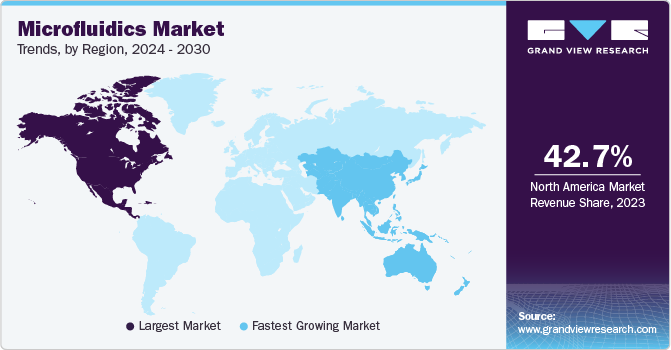
- North America microfluidics market dominated the global market with a revenue share of 42.3% in 2024.
- Advanced healthcare infrastructure, robust research and development investments, and the presence of industry leaders drive the U.S. microfluidics market.
- By material, the polydimethylsiloxane (PDMS) segment held the highest revenue share of 36.60% in 2024.
- By technology, lab-on-a-chip segment held the highest market share of 37.49% in 2024.
- By product, the microfluidic components segment held the largest revenue share in 2024 and is anticipated to grow at the fastest CAGR over the forecast period.
Market Size & Forecast
- 2024 Market Size: USD 37.49 Billion
- 2030 Projected Market Size: USD 73.85 Billion
- CAGR (2025-2030): 11.99%
- North America: Largest market in 2024
For instance, in March 2025, a U.S.-based study introduced a microfluidics-based analytical technique, improving detection and accuracy. It promised to revolutionize chemical analysis, with applications in pharmaceuticals, environmental testing, and food safety. Microfluidic approaches have been effectively used to determine glucose levels, detect infection, diagnose dry eye disease, and assess vascular endothelial growth factor levels. Such applications are expected to positively affect market growth in the coming years.
Advancements and Adoption of Microfluidics in Diagnostic Healthcare
Rising hospital expenditures and frequent patient revisits drive the demand for efficient diagnostic devices. Prehospital diagnostic solutions, such as at-home blood glucose monitoring, are helping reduce hospital visits and inpatient stays. Key industry players' launch of Point-of-Care (POC) products has enabled earlier disease detection and improved patient outcomes. With ongoing technological advancements, companies are differentiating their offerings through features like minimally invasive sampling, enhanced accuracy, and rapid turnaround times, significantly contributing to the growth of the in vitro diagnostics (IVD) market.
Leading companies such as Abbott, Roche, and Danaher actively integrate microfluidics into their diagnostic platforms to enhance performance and usability. Digital microfluidics is also emerging as a promising area, with several players investing in its development. For example, in August 2022, HORIBA partnered with SigTuple to accelerate the rollout of AI100, an AI-driven digital pathology solution in the Indian subcontinent. The platform integrates robotics, artificial intelligence, cloud computing, and microfluidics to deliver affordable, high-quality diagnostic solutions.
Table 1 Some commercialized POCT devices based on Nucleic-Acid Testing (NAT).
Product Name
Manufacturer
Method
Target
Sample Type
ID NOW COVID-19
Abbott Diagnostics Scarborough, Inc.
NEAR
COVID-19 RdRp gene
Nasal, Throat, and Nasopharyngeal swabs
VitaPCR SARS-CoV-2 Gen2 Assay
Credo Diagnostics Biomedical Pte. Ltd.
Real-Time RT-PCR
N1, N2-Nucleocapsid Gene
Nasopharyngeal and Oropharyngeal swabs
The BioFire Respiratory 2.1-EZ (RP2.1- EZ) Panel (EUA)
BioFire Diagnostics, LLC
Nested multiplex PCR
Spike protein gene, Membrane protein gene
Nasopharyngeal swabs
1copy COVID-19 qPCR Kit
1drop, Inc
RT-PCR
E gene for beta coronavirus and the RdRp gene for SARS-CoV-2
Nasopharyngeal and Oropharyngeal swabs
The COVID-19 pandemic further accelerated the adoption of microfluidic technologies. Point-of-Care Testing (PoCT) devices, which are compact and enable rapid testing, became essential for timely and accurate disease detection. Microfluidics-enhanced PoCT solutions have demonstrated superior sensitivity, specificity, and faster diagnostic turnaround times. As a result, several manufacturers launched microfluidics-based diagnostic kits to meet urgent testing needs. For instance, in October 2021, LumiraDx received Emergency Use Authorization (EUA) from India’s CDSCO for its COVID-19 antigen test, highlighting the growing role of microfluidics in pandemic response and public health diagnostics.
Technological Advancements in Microfluidics
The growing demand for microfluidic devices is driven by their ability to analyze small sample volumes, reduce reagent waste, and preserve valuable samples. The rising hospital expenditures and a shift towards prehospital diagnostic solutions like at-home blood glucose monitoring are driving the need for diagnostic devices. Moreover, innovation with Point of Care (POC) products and focusing on early disease diagnosis make hospital visits less necessary. For instance, in February 2024, Toronto's academic hospital network partnered with the Centre for Research in Microfluidic Devices to advance human health, focusing on innovative microfluidic technologies for medical applications and diagnostics. As technology advances, players in the market differentiate their products through features such as minimally invasive procedures, accuracy, and speed, all confirmed and benefiting the in vitro diagnostic market.
With the increasing penetration of microfluidics devices in various fields of research and diagnosis, industry players are introducing advanced technologies to grab potential market share. Many companies have their devices under trial and are anticipated for commercialization. For instance, in March 2025, MicroLight3D and Eden Tech formed a strategic partnership to advance microfluidic technologies. This collaboration aimed to develop innovative solutions for medical devices, enhancing precision in diagnostics and treatments, further driving the demand in the microfluidics industry.
In addition, the increasing advancements in microfluidic sensors for lab-on-a-chip technologies are driving the growth of the microfluidics market. For instance, in January 2025, Electropages published an article highlighting advancements in microfluidic sensors for lab-on-a-chip technologies. These sensors, integrated with microscopically thin channels, valves, mixers, and pumps, enable precise fluid control and measurement. As these technologies continue to advance, they hold the potential to improve efficiency, accuracy, and accessibility in multiple medical and scientific applications.
Market Concentration & Characteristics
The microfluidics industry is experiencing considerable innovation with advancements and new technologies, including AI-enabled systems, digital microfluidics, modular platforms, and wearable sensors, creating novel uses for microfluidic systems in healthcare, biotechnology, and environmental monitoring. For instance, in May 2025, researchers in China introduced a microfluidic system that integrates acoustic, optical, and electrical methods for rare particle enrichment. The integration of these techniques addresses traditional limitations in particle manipulation and analysis, offering a robust solution for applications in biosciences and environmental monitoring.
Mergers and acquisitions (M&As) in the microfluidics industry have increased, fueled by technological progress, R&D expansion, and market consolidation. Larger companies are acquiring smaller, specialized firms to integrate advanced technologies like AI, digital microfluidics, and wearable biosensors, enhancing their product portfolios and staying competitive. For instance, in May 2025, CellFE and MADE Scientific announced a strategic collaboration to advance non-viral gene editing for T-cell therapies. By integrating MADE Scientific's expertise in gene editing with CellFE's microfluidic-based delivery systems, the partnership seeks to streamline the development of next-generation T-cell therapies. This trend is particularly prevalent in diagnostics, gene editing, and personalized medicine. As the market grows, M&A activity is expected to intensify, with strategic partnerships and acquisitions focusing on cutting-edge technologies and expanding market reach.

Regulations significantly impact the microfluidics industry by ensuring the safety and efficacy of products, particularly in healthcare and biotechnology applications. While these regulations, enforced by bodies like the Food and Drug Administration (FDA) and European Medicines Agency (EMA), are crucial for patient safety, they can also increase compliance costs, slow innovation, and complicate global market entry due to varying international standards. Despite these challenges, regulations help mitigate risks associated with faulty products, and there is an ongoing effort to streamline approval processes to balance safety with the need for faster innovation in the rapidly growing market.
Product expansion in the microfluidics industry is a key strategy for companies aiming to capitalize on the growing demand for advanced diagnostics, drug delivery systems, and biotechnology applications. For instance, in May 2025, researchers at Toyohashi University of Technology, Japan, in collaboration with IMTIB (Argentina) and IIT Madras (India), introduced an enhanced PDMS SlipChip microfluidic device. This advancement addresses challenges like channel clogging and potential cell damage, facilitating more efficient and safer biomedical research, including drug development and sophisticated cell studies.
Regional expansion in the microfluidics industry is a strategic approach driven by the need to capitalize on emerging markets and tap into growing demand for advanced technologies. North America remains the largest market, driven by strong infrastructure, significant investment in R&D, and a well-established healthcare sector. However, regions like Asia-Pacific are becoming key growth areas, driven by advancements in biotechnology and an increased investment in healthcare, which is becoming a large area of growth with an increasing key diagnostic tool in point-of-care diagnostics. Companies are expanding regionally with different types of partners in various regions and changing their products and services to meet the regulatory requirements of different regions. Regional expansion will allow companies to diversify their geographic footprint, minimize dependence on a single geography, and exploit growth opportunities in multiple sectors such as biomedicine, diagnostics, and pharmaceuticals.
Product Insights
The microfluidic components segment held the largest revenue share in 2024 and is anticipated to grow at the fastest CAGR over the forecast period. This is attributed to their critical role in enabling precise fluid control and integration across various microfluidic devices. Components such as pumps, valves, chips, and sensors are essential for diagnostics, drug delivery, and analytical instrumentation applications. The rising demand for point-of-care testing, lab-on-a-chip platforms, and personalized medicine has significantly increased the need for reliable and scalable microfluidic components. Moreover, advancements in fabrication technologies, including soft lithography and 3D printing, have reduced production costs and improved performance, further driving adoption. The presence of key manufacturers and increased investment in biomedical R&D have also contributed to segment growth.
The microfluidic-based devices segment is expected to grow significantly throughout the forecast period due to their expanding applications in diagnostics, drug delivery, and life sciences research. These devices offer advantages such as reduced sample volume, faster analysis, and enhanced sensitivity, making them ideal for point-of-care testing and personalized medicine. Increasing demand for rapid diagnostic solutions, especially in infectious diseases and cancer, further fuels adoption. Technological advancements in device miniaturization, integration, and automation have also improved functionality and accessibility. Additionally, growing investments from the public and private sectors in biomedical research support the development and commercialization of innovative microfluidic-based platforms.
Application Insights
The medical segment held the largest revenue share in 2024. Microfluidics is a significant technology in biological analysis, chemical synthesis, and information technology. The miniaturization of conventional laboratory equipment and technologies through microfluidics has led to several advancements, including minimal usage of reagents and maximum information derived from small sample sizes, short and simple assay protocols, improved parallel processing of samples and screening approaches, and accurate spatiotemporal control of cell microenvironments. For instance, in May 2024, researchers introduced a digital microfluidic system for drug screening using primary tumor cells. This system enabled parallel testing of three drugs on a chip, enhancing throughput and reducing device footprint. Validated on breast cancer xenografts and liver cancer patient samples, the system identified effective therapies aligned with genetic profiles, advancing personalized cancer treatment strategies.
The non-medical segment of the microfluidics market is expected to register a significant growth rate throughout the forecast period. Microfluidics technology is emerging as a key driver in this sector, revolutionizing industries such as oil extraction, food production, and material science. For instance, in May 2025, researchers introduced a vertical textile microfluidic system designed for on-garment sweat sampling and real-time biosensing. This system leverages stereolithography 3D printing to integrate fluid-guiding microstructures within textiles, allowing capillary-driven sweat transport through vertically stacked modules. This innovative design reduces the device's footprint and sample volume requirements, enabling continuous sweat collection, storage, and transport.
Material Insights
The polydimethylsiloxane (PDMS) segment held the highest revenue share of 36.60% in 2024. PDMS is a widely used polymer in microfluidics owing to the several advantages offered by the material. Some of the benefits of PDMS are nontoxicity, robustness, optical transparency, permeability to gas and oxygen, biocompatibility, elastomeric features, low cost, and complex designs of microfluidic devices by stacking multiple layers. For instance, in November 2024, a study published in Scientific Reports emphasized the role of polydimethylsiloxane (PDMS) in soft lithography due to its flexibility, transparency, and biocompatibility. PDMS-based microfluidic devices were noted for their advantages in creating intricate channel designs, making them ideal for biological and chemical applications. The study provided insights into selecting the most suitable fabrication method, highlighting the importance of PDMS in advancing microfluidic device performance.
The polymers segment in the microfluidics industry is expected to experience significant growth during the forecast period. This growth is driven by the increasing demand for cost-effective, customizable, and flexible materials in microfluidic device fabrication. Polymers offer advantages like ease of production, versatility in design, and compatibility with various applications, including diagnostics, drug delivery, and environmental monitoring, making them a preferred choice for manufacturers aiming to innovate and meet market demands.
Technology Insights
Lab-on-a-chip segment held the highest market share of 37.49% in 2024. Lab-on-a-chip research has recently shown potential in cell biology. These systems validate the capability to regulate cells at the single-cell level while quickly dealing with a huge volume of cells. For instance, in March 2024, a review published in Lab on a Chip explored the future directions of microfluidic lab-on-a-chip (LOC) technologies in translational medicine. The research highlighted the importance of improved accessibility, usability, and manufacturability to help connect lab work to clinical practice. The authors provided strategies to help facilitate the transition of microfluidic devices to the clinics to realize their full potential in diagnostics and personalized medicine.

The organs-on-chips segment is anticipated to grow considerably over the forecast period. These models play a major role in drug discovery and development. For instance, in January 2025, the European Commission's Joint Research Centre (JRC) unveiled a roadmap for standardizing organ-on-chip (OoC) technologies. OoCs are microfluidic devices replicating human organ functions, offering insights into the mechanics of disease, and can provide personalized medicine. It proposes working with the International Organization for Standardization (ISO) to create international standards that support the incorporation of OoCs into drug development and chemical safety testing, and spare a few animals from testing, which further drives the segment growth in the microfluidic industry.
Regional Insights
North America microfluidics market dominated the global market with a revenue share of 42.3% in 2024. This dominance is primarily driven by strong research funding from both government bodies and private industries. The growing demand for microfluidics devices in research and diagnostics has further fueled collaborations between academia and industry. Such partnerships aim to accelerate the translation of lab-based innovations into commercial applications, supporting rapid development and adoption across the healthcare and life sciences sectors.
U.S Microfluidics Market Trends
Advanced healthcare infrastructure, robust research and development investments, and the presence of industry leaders drive the U.S. microfluidics market. Moreover, strong collaborations between academia, industry, and government fuel continuous innovation in microfluidics technologies. The country's commitment to R&D and its dynamic ecosystem contribute to its dominance in the global microfluidics market, particularly in medical diagnostics and biotechnology applications. For instance, in April 2025, Mepsgen launched a microfluidics-based platform designed to enhance the efficiency of cell-based assays. This technology enables rapid and precise analysis of cellular responses, facilitating applications in drug discovery, toxicology, and personalized medicine.
Europe Microfluidics Market Trends
Europe microfluidics market is experiencing steady growth, fueled by supportive regulatory frameworks, strong research ecosystems, and a focus on personalized medicine. Moreover, the country's commitment to sustainability has led to the development of eco-friendly microfluidic devices. At the same time, integrating microfluidics with genomics and proteomics enables more precise, individualized medical treatments, aligning with the region's broader healthcare goals.
The UK microfluidics market is experiencing strong growth, supported by government initiatives like the Advanced Research and Invention Agency (ARIA) and substantial funding from the Biotechnology and Biological Sciences Research Council (BBSRC) and the Engineering and Physical Sciences Research Council (EPSRC). Moreover, support from academic institutions plays a crucial role in fostering innovation in the sector. For instance, in March 2025, Young Owl Microfluidics (YOM) Ltd., a spin-out from UCL's Department of Biochemical Engineering, was established to advance microfluidic technologies for rapid and high-throughput drug testing. Its flagship product, a modular microreactor system with a cartridge-based design, supports various applications, including biotransformations, drug screening, and organoid culture.
Germany microfluidics market is experiencing significant growth, driven by a combination of robust research infrastructure, industrial expertise, and strategic investments. The country's commitment to advancing microfluidic technologies is evident through its support for academic and research institutions. Notable research centers like the Max Planck Institute and Leibniz Institute contribute to innovations in microfluidic applications. With continued collaboration between industry and academia, the country is well-positioned to lead in the microfluidic industry, especially in healthcare, diagnostics, and environmental sectors.
Asia Pacific Microfluidics Market Trends
Asia Pacific microfluidics market is expected to grow significantly during the forecast period owing to sophisticated research infrastructure, a developing economy, and affordable labor. For instance, researchers at the Institute of Nano Science and Technology (INST), Mohali, developed a droplet microfluidics technology to produce Polyvinylidene fluoride (PVDF) microspheres with high electroactive (EA) phase content. This breakthrough enhances piezoelectric properties for wearable applications, enabling self-powered sensors to monitor physiological signals. International players are keen on investing in the untapped APAC microfluidics industry. Foreign players majorly dominate the market for diagnostic tests based on microfluidics. However, key players in the region are proposing innovative and interesting solutions in terms of performance and price, allowing them to boost their market share in the coming years.
China microfluidics market is set to grow significantly, driven by strategic government initiatives like the Made in China 2025 plan and the National Key Research and Development Program, which provide substantial support for innovation and industry advancement. The country's large and aging population and the rising prevalence of chronic diseases have increased the demand for efficient diagnostic solutions, positioning microfluidics as a key technology. Moreover, the country's research and development investments and strong manufacturing capabilities enable the miniaturization and integration of complex functionalities in microfluidic devices, fueling the market's expansion.
Japan microfluidics market is growing rapidly, driven by an aging population that increases the demand for efficient diagnostics and personalized medicine. In collaboration with industry and government, leading academic institutions fuel innovations in microfluidic technologies. For example, in March 2025, researchers at the Japan Advanced Institute of Science and Technology (JAIST) developed a novel nanoparticle-based platform for targeted cancer therapy. This system uses magnetically guided carbon nanohorns (CNHs) conjugated with magnetic ionic liquids to deliver photothermal agents directly to tumor sites, showcasing Japan's advancements in microfluidic applications for healthcare.
Middle East and Africa Microfluidics Market Trends
The Middle East and Africa microfluidics market is projected to drive the demand for microfluidics and grow considerably due to factors such as increasing healthcare investments, growing demand for personalized medicine, advancements in diagnostics, and the rising adoption of point-of-care testing. Moreover, the expansion of biotechnology research and development and supportive government initiatives are expected to further fuel the growth of microfluidic technologies in the region. Integrating microfluidics in applications like drug delivery, diagnostics, and lab-on-a-chip devices is also anticipated to expand the market.
The Kuwait microfluidics market is projected to grow steadily, driven by new healthcare infrastructure, increasing demand for point-of-care testing, and government programs encouraging innovation in medical technologies. The increasing prevalence of chronic and infectious diseases is driving the need for rapid diagnostic solutions. This demand for efficient diagnostic solutions is also being fueled by the growth of pharmaceutical and biotechnology research in Kuwait. Emerging applications in drug delivery and wound care also provide momentum for the microfluidics market, which is unique and newer than the Middle East microfluidics market.
Key Microfluidics Company Insights
The microfluidics market is characterized by several established players who dominate through strong product portfolios, strategic collaborations, and consistent R&D investments. Leading companies such as Danaher Corporation, Thermo Fisher Scientific, Agilent Technologies, and PerkinElmer have maintained significant market share due to their global presence and integrated solutions spanning diagnostics, drug discovery, and genomics.
Leading companies-including Illumina, Inc., F. Hoffmann-La Roche Ltd, PerkinElmer, Agilent Technologies, Inc., and Thermo Fisher Scientific Inc.-continue to dominate the landscape through comprehensive product portfolios, robust global distribution networks, and sustained investment in R&D. These players leverage their scale, integrated platforms, and strategic acquisitions to maintain a competitive edge across clinical diagnostics, genomics, and life sciences.
Firms like Bio-Rad Laboratories, Inc., DH Life Sciences, LLC, and Abbott are expanding their footprint by focusing on advanced microfluidic applications in molecular diagnostics, infectious disease testing, and personalized medicine. Through innovation, partnerships, and geographic expansion, these players continue to shape the competitive dynamics of the microfluidics market.

Emerging players such as Standard BioTools Inc. and Parallel Fluidics, Inc. are steadily gaining market traction by offering customizable, cost-efficient microfluidic solutions tailored to specialized research and diagnostic needs. These companies, along with other innovative startups, are driving disruption in segments such as organ-on-chip technology, single-cell analysis, and portable diagnostics through differentiated technologies and flexible commercialization strategies. By actively collaborating with academic institutions and pharmaceutical companies, they are accelerating the development and deployment of novel solutions, positioning themselves as credible challengers to established market leaders.
Overall, the market is witnessing a blend of legacy strength and startup agility, with increased M&A activity, partnerships, and product innovations likely to intensify competition further. Companies that balance scientific validation with lifestyle relevance and ethical sourcing will be best positioned to capture long-term value in the evolving women’s health and beauty supplements landscape.
Key Microfluidics Companies:
The following are the leading companies in the microfluidics market. These companies collectively hold the largest market share and dictate industry trends.
- Illumina, Inc.
- F. Hoffmann-La Roche Ltd
- Revitty
- Agilent Technologies, Inc.
- Bio-Rad Laboratories, Inc.
- Danaher
- Thermo Fisher Scientific, Inc.
- Abbott
- Standard Biotools
- thinXXS Microtechnology GmbH
Recent Developments
-
In December 2024, Dapu Biotechnology (DPBIO) and Leveragen announced a strategic partnership to advance antibody discovery. DPBIO's Cytospark platform utilizes droplet microfluidics to rapidly screen millions of single cells, reducing antibody discovery timelines from months to just 1-2 days. This collaboration addresses complex therapeutic targets and accelerates the development of novel antibody-based treatments.
-
In November 2024, Parallel Fluidics secured a $7M seed round to accelerate the development of its microfluidic manufacturing platform for life science applications. The company aims to solve engineering challenges in diagnostics, drug discovery, and precision medicine by delivering production-ready devices, reducing development time and cost. Parallel Fluidics is revolutionizing the field by enabling faster and more scalable product development, particularly for applications like point-of-care diagnostics and fertility treatments.
-
In July 2024, Bio-Rad Laboratories launched Celselect Slides 2.0, a microfluidics-based solution designed to enhance the capture of rare and circulating tumor cells (CTCs) for cancer research. The upgrade leverages the power of microfluidic technology to drive advancements in cancer research by enabling higher throughput and better recovery of valuable CTCs.
Microfluidics Market Report Scope
Report Attribute
Details
Market size value in 2025
USD 41.92 billion
Revenue forecast in 2030
USD 73.85 billion
Growth rate
CAGR of 11.99% from 2025 to 2030
Base year for estimation
2024
Historical data
2018 - 2023
Forecast period
2025 - 2030
Quantitative units
Revenue in USD million/billion and CAGR from 2025 to 2030
Report coverage
Revenue forecast, company ranking, competitive landscape, growth factors, and trends
Segments covered
Product, technology, material, application, region
Regional scope
North America; Europe; Asia Pacific; Latin America; MEA
Country scope
U.S.; Canada; Mexico; UK; Germany; France; Italy; Spain; Denmark; Sweden; Norway; India; China; Japan; Australia; South Korea; Thailand; Brazil; Argentina; Saudi Arabia; UAE; South Africa; Kuwait
Key companies profiled
Illumina, Inc.; F. Hoffmann-La Roche Ltd; Revitty; Agilent Technologies, Inc.; Bio-Rad Laboratories, Inc.; Danaher; Thermo Fisher Scientific, Inc.; Abbott ; Standard Biotools; thinXXS Microtechnology GmbH
Customization scope
Free report customization (equivalent up to 8 analyst’s working days) with purchase. Addition or alteration to country, regional & segment scope.
Global Microfluidics Market Report Segmentation
This report forecasts revenue growth at global, regional, and country levels and provides an analysis on the latest trends in each of the sub-segments from 2018 to 2030. For this report, Grand View Research has segmented the global microfluidics market report based on product, technology, material, application, and region:
-
Product Outlook (Revenue, USD Million, 2018 - 2030)
-
Microfluidic-based Devices
-
Microfluidic Components
-
Chips
-
Micro-pumps
-
Sensors
-
Others
-
-
-
Technology Outlook (Revenue, USD Million, 2018 - 2030)
-
Lab-on-a-chip
-
Organ-on-a-chip
-
Continuous Flow Microfluidics
-
Optofluidics & Microfluidics
-
Acoustofluidics & Microfluidics
-
Electrophoresis & Microfluidics
-
-
Material Outlook (Revenue, USD Million, 2018 - 2030)
-
Silicon
-
Glass
-
Polymer
-
PDMS
-
Others
-
-
Application Outlook (Revenue, USD Million, 2018 - 2030)
-
Medical
-
Pharmaceuticals
-
Medical Devices
-
In-vitro Diagnostics
-
Others
-
-
Non-medical
-
-
Regional Outlook (Revenue, USD Million, 2018 - 2030)
-
North America
-
U.S.
-
Canada
-
Mexico
-
-
Europe
-
UK
-
Germany
-
France
-
Italy
-
Spain
-
Denmark
-
Sweden
-
Norway
-
-
Asia Pacific
-
Japan
-
China
-
India
-
South Korea
-
Australia
-
Thailand
-
-
Latin America
-
Brazil
-
Argentina
-
-
Middle East & Africa
-
South Africa
-
Saudi Arabia
-
UAE
-
Kuwait
-
-
Frequently Asked Questions About This Report
b. The global microfluidics market size was estimated at USD 37.49 billion in 2024 and is expected to reach USD 41.92 billion in 2025.
b. The global microfluidics market is expected to grow at a compound annual growth rate of 11.99% from 2025 to 2030 to reach USD 73.85 billion by 2030.
b. The medical technology segment dominated the microfluidics market and accounted for the largest revenue share of 85% in 2024. Microfluidics is gaining significant traction in Point-of-Care (POC) diagnostics since it is associated with several advantages that facilitate the development of novel POC diagnostics.
b. The Polydimethylsiloxane (PDMS) segment dominated the microfluidics market and accounted for the largest revenue share of 36.1% in 2023. The material offers several advantages, such as biocompatibility, permeability, and low levels of autofluorescence, which broaden its applications in biotechnology & biomedical engineering.
b. North America dominated the microfluidics market and accounted for the largest revenue share of 42.69% in 2023. Research institutes are showing extensive participation in the development of novel microfluidic devices, which is expected to maintain regional dominance in the global market.
b. The lab-on-a-chip segment dominated the microfluidics market with a share of 37.5% in 2023. This is because lab-on-a-chip offers high detection speed while maintaining the same sensitivity during DNA or RNA amplification and detection procedures. Lab-on-a-chip also allows the rapid sequencing of DNA probes.

Share this report with your colleague or friend.
Need a Tailored Report?
Customize this report to your needs — add regions, segments, or data points, with 20% free customization.


ISO 9001:2015 & 27001:2022 Certified
We are GDPR and CCPA compliant! Your transaction & personal information is safe and secure. For more details, please read our privacy policy.
Trusted market insights - try a free sample
See how our reports are structured and why industry leaders rely on Grand View Research. Get a free sample or ask us to tailor this report to your needs.