Cell Culture And Stem Cell Industry Trends: Transforming Research, Drug Discovery And Cell Therapy
Explore all 5 industry trends
Use the contents below to jump directly to the trend relevant to your research.
Key Cell Culture And Stem Cell Industry Trends Shaping The Future
- There are efforts by researchers and producers to standardize non-animal media, recombinant growth factors, and chemically defined reagents in an effort to increase reproducibility and support clinical-scale production of cells.
- More clinically and physiologically relevant models are gaining prominence in drug discovery, disease modeling, cancer biology studies, and personalized medicine; hence the need for more matrices and culture media.
- Automation is becoming useful in reducing operator variability and process standardization in the production of organoids and iPSCs.
- Growth factor and cytokine engineering help to achieve better control over cell behavior, while AI and mechanistic modeling help in cell-line selection and process optimization.
- Collaboration between cell suppliers, media producers, and automation developers indicates that there is a move towards integration of solutions. Increasing regulatory flexibility in cell and gene therapies is also making reproducible processes more important.
The cell culture and stem cell industry is entering a more application-focused stage in 2026, with growing emphasis on developing systems that deliver consistent results, support large-scale production, and meet the needs of applications ranging from drug discovery to clinical manufacturing. For many years, progress was driven mainly by improvements in research tools, stem cell lines, culture media, and laboratory techniques. However, the growing use of induced pluripotent stem cells (iPSCs), organoids, three-dimensional (3D) cell culture, and cell therapies is changing industry priorities.
Developments within regulations have also contributed to the change. In January 2026, the FDA developed a set of policies to enhance flexibility in the development of cell and gene therapies, which included policies pertaining to manufacturing, chemistry, and controls. The May 2026 guidelines by FDA provided conditions under which the CMC policy could be handled in a flexible manner during the process of development of the therapy, while in August 2026 guidelines were issued by the agency to address the common issues pertaining to CMC, clinical development, pharmacology, and toxicology.
The quantitative trends represent the research and clinical interests, as well as advances in regulations, in the global cell culture and stem cell industry. Government investment and clinical trial activity are key indicators of cell culture and stem cell industry growth.
| Quantitative Indicator | Data |
| U.S. stem cell and progenitor cell research funding (FY2025) | USD 2.592 billion |
| U.S. induced pluripotent stem cell (iPSC) research funding (FY2025) | USD 994 million |
| Global cell therapy clinical trials through October 2025 | 10,373 trials |
| Global stem cell therapy clinical trials through October 2025 | 4,796 trials |
| Hematopoietic stem cell (HSC) therapy clinical trials | 1,550 trials |
| Authorized trials involving human pluripotent stem cell-derived products (December 2024) | 116 trials |
| FDA-approved cell and gene therapies reported in January 2026 | Close to 50 over the preceding decade |
Section I: Advances In Culture Materials And Cell Models
01The Shift Towards Defined And Xeno-Free Culture Systems
A significant trend in the cell culture and stem cell market is the move away from poorly defined or animal-derived materials to culture systems that offer better control and consistency. This shift includes serum-free, xeno-free, animal-component-free, and chemically defined media, and recombinant growth factors. Such products reduce batch-to-batch variation and allow researchers to exert greater control over cell growth and development conditions. For instance, the CTS StemScale PSC Suspension Medium from Thermo Fisher Scientific enables scalable suspension culture of pluripotent stem cells for clinical applications; also, Corning's MSCulture Max product range offers xeno-free and GMP-grade media for mesenchymal stem cell expansion.
This trend extends to specialized proteins and integrated culture workflows. In February 2026, Defined Bioscience partnered with Pluristyx and Solesis to develop an induced pluripotent stem cell (iPSC) transfection platform that is based on its animal-free HiDef-B8 medium. Sartorius invested about USD 163 million in quality-critical materials such as growth factors and cytokines, establishing a competence center in Freiburg, Germany, in May 2026. These efforts are driven by the increasing demand for reliable culture inputs that enable reproducible research and scalable manufacturing of cell and gene therapies.
Why This Matters
Switching to defined and xenofree culture systems allows minimizing batch-to-batch variations. With further development of stem cell treatments and their transition to clinical applications and manufacturing, the need for consistent culture supplies is going to become stronger. Suppliers providing standardized products with guaranteed availability and scalability will be able to gain a competitive advantage.
023D Cell Culture And Organoids Move Further Into The Mainstream
Another of the major cell culture and stem cell industry trends is the transition from conventional two-dimensional cell culture toward 3D systems, spheroids, and organoids. While 2D cell cultures provide an inexpensive, simple, and scalable platform for most laboratory applications, 3D cell culture systems provide a much higher level of complexity with regard to cell-cell interactions, diffusion gradients, spatial organization, and tissue-like environments. These features have led to a significant increase in interest in 3D cell culture systems in drug discovery, disease modeling, cancer research, infectious disease research, and personalized medicine.
In addition, Bio-Techne released its Cultrex Synthetic Hydrogel in February 2026, which is a completely defined synthetic extracellular matrix specifically developed for use in organoid research and 3D stem cell applications. Bio-Techne promoted the Cultrex Synthetic Hydrogel as a means of reducing lot-to-lot variability and supporting more reproducible and scalable workflow processes.
Why This Matters
The increasing use of three-dimensional (3D) culture and organoid models will lead to an increased demand for specialized media, matrix materials, and lab equipment. Specialized products that reduce variation in cultures and simplify the culture process will help researchers obtain more consistent results. Suppliers who can offer reproducible and scalable products are likely to be successful, as these models find greater application in drug discovery and disease research.
Section II: Automation, AI, and Process Optimization
03Automation Becomes More Important As Cell Culture Scales
Automation is rapidly evolving as one of the most critical aspects of cell culture and stem cell technology. While manual cell culture continues to be used by researchers worldwide, managing manual cell cultures is becoming increasingly challenging due to the growing volume of samples, types of cell culture vessels, number of processing steps, and quality control checks. In addition, manual cell culture produces variability among operators. Therefore, when developing consistent cell populations, such variability may create issues; to address these problems, the industry is transitioning toward automated systems for routine procedures including feeding, passaging, imaging, counting cells, monitoring, and sampling.
In September 2026, STEMCELL Technologies and Molecular Devices created an automated workflow for growing human intestinal organoids. The automated workflow uses the CellXpress.ai Automated Cell Culture System in conjunction with IntestiCult Plus Organoid Growth Medium from STEMCELL. The two companies stated that they believe the automated workflow will allow users to increase consistency and reproducibility of organoid production while reducing user involvement and variability. Automation is also becoming a critical part of iPSC manufacturing.
Why This Matters
Automation may help reduce the effort required manually while improving consistency in research. With increasing research being done on organoids and increasing demand for stem cells in manufacturing processes, there will be a need for automation to maintain consistency in quality. Companies that are able to provide automated equipment may find themselves at an advantage.

04Growth Factors And Engineered Proteins Become More Specialized
The development of specialized growth factors, cytokines, and other signaling proteins has increased in recent years due to research using complex stem cell systems and organoids. Growth factors, cytokines, and signaling proteins regulate cell proliferation, cell survival, and cell differentiation; therefore, having consistency in these components is critical to obtaining reproducible results. Companies have developed animal-free, recombinant, and engineered versions of growth factors, cytokines, and other signaling proteins that provide greater control of the cell culture environment.
In May 2026, Qkine and Pluristyx entered into a distribution agreement to combine Pluristyx's clinical-grade iPSC lines with Qkine's animal-free growth factors and cytokines to allow for more reproducible differentiation of cells. Bio-Techne released an expansion of its AI-engineered Designer Protein product line in July 2026.
This expansion included several engineered versions of growth factors and cytokines that were created to enhance the stability and functional properties of the growth factors and cytokines when used in advanced cell culture and cell therapy applications. The expanded Designer Protein product line includes FGF and interleukin proteins for stem cell culture, organoid development, and expansion of immune cells.
Why This Matters
Specific growth factors and proteins designed for applications can assist scientists in ensuring uniformity within cell cultures and improving their control over the biological processes involved. Demand for quality culture materials will be an important driver of cell culture and stem cell industry growth as stem cell research moves toward the possibility of clinical production.
05AI Moves From Data Analysis Toward Process Optimization
Artificial Intelligence is starting to make an impact on cell culture in more practical ways. The initial use of artificial intelligence in life science applications was highly concentrated in applications like drug discovery, image analysis, and biological prediction. Information is collected in large quantities during cell culture about cell morphology, growth rates, viability, media conditions, metabolites, differentiation, and process performance.
In January 2026, Sartorius demonstrated the application of artificial intelligence (AI) and mechanistic modeling in cell-line development and process optimization. The company stated that it uses methods that integrate AI-driven clone selection with mechanistic models to accelerate the identification of suitable production clones and improve process conditions. AI is being more and more employed in automated image processing, abnormal cellular state detection, feed schedule optimization, differentiation outcome prediction, and culture condition optimization.
Why This Matters
AI will assist in the analysis of the data generated during cell culture, the determination of appropriate conditions, and the reduction of time wasted on conducting repetitive experiments. In conjunction with automation, AI will contribute to efficient processes and effective development of cell culture. Companies supplying cell culture materials and technology and combining their products with AI might benefit from the industry's development towards scalability.
Cell Culture And Stem Cell Industry Outlook: What to Expect In 2027 And Beyond
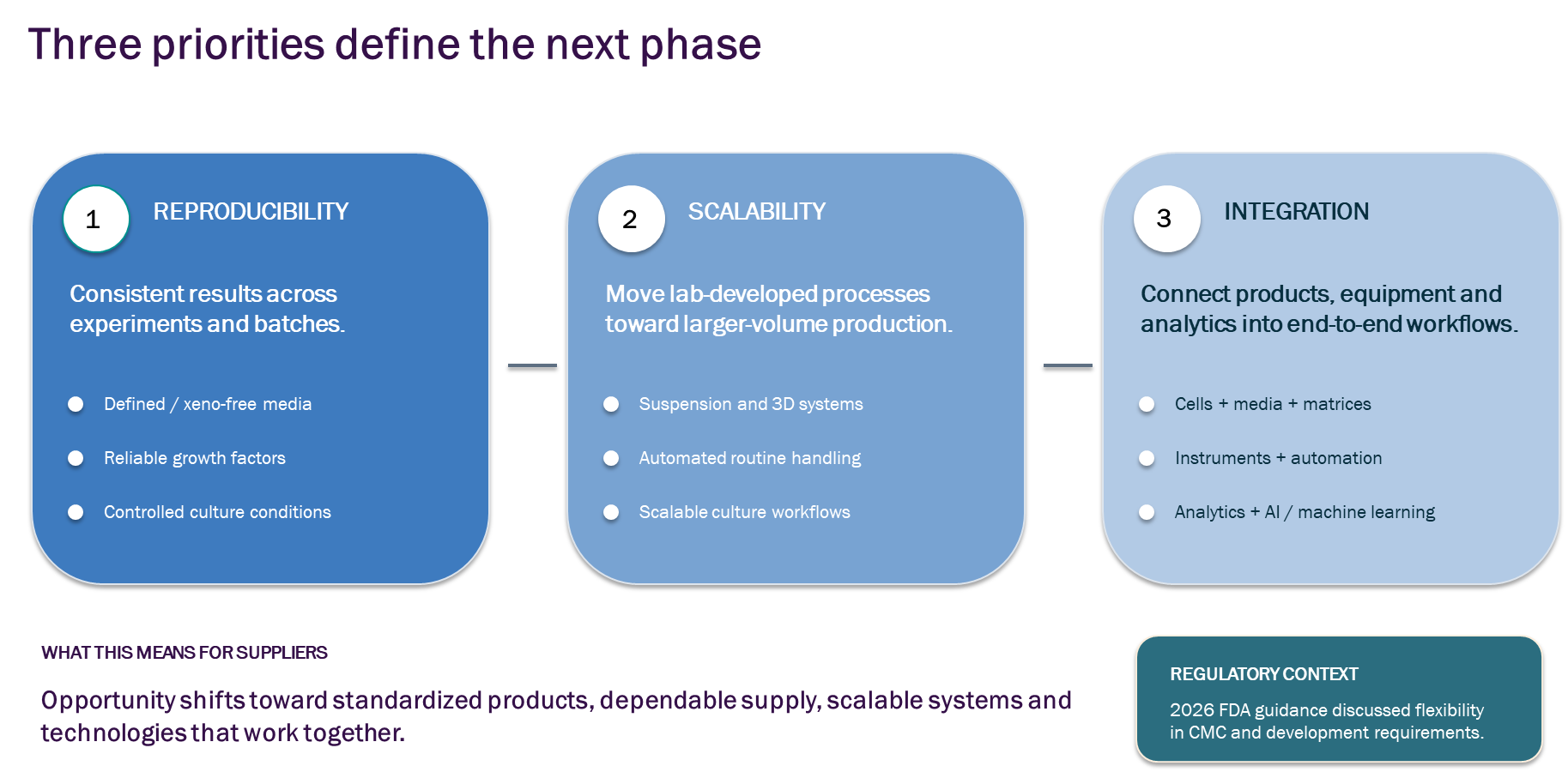
The cell culture and stem cell industry outlook points to a greater focus on reproducibility, scalability, and integration. Researchers and manufacturers will need process control systems that produce consistent results across experiments and batches and also allow the scale-up of laboratory-developed processes to commercial production. Culture media, cell lines, matrices, growth factors, equipment, automation, and analytical instruments are also expected to be more tightly integrated into all-in-one workflows.
Simultaneously, with the rise of automation, the volume of data will also grow, which in turn opens more doors for AI and machine learning to optimize the environment and the productivity of the process. In addition, in pharmacology and pathology, the utilization of organoids, patient-derived cells, and iPSC models is predicted to increase over traditional models, as these models can provide insights that are not obtainable using traditional models.
The Bottom Line:
The cell culture and stem cell industry is moving into a period in which the quality of the overall workflow is becoming as important as the performance of individual products. Recent developments and several partnerships between automation companies, cell suppliers, bioprocess developers, and growth-factor manufacturers are increasingly focused on connecting individual technologies into more complete workflows. Moreover, the market is expected to grow from a collection of individual culture products toward a more integrated ecosystem of cells, media, matrices, proteins, instruments, automation, analytics, and manufacturing technologies.
Last updated:


