Proteomics And Protein Analysis Industry Trends For 2026 And Beyond
Explore all 6 industry trends
Use the contents below to jump directly to the trend relevant to your research.
Key Proteomics And Protein Analysis Industry Trends Shaping The Future
- AI-based protein structure prediction is accelerating molecular research and drug discovery by improving access to computational tools.
- Generative AI is advancing protein engineering, creating opportunities for new therapeutics, vaccines, enzymes, and biomaterials.
- Population-scale proteomics is expanding shared research datasets, enabling large-scale analysis of protein levels and genetic associations.
- Emerging measurement platforms are broadening protein analysis capabilities, but commercial adoption remains constrained by costs and funding pressures.
- Protein biomarker research is advancing early disease detection, although clinical validation remains essential for diagnostic applications.
- Acquisitions and partnerships are integrating proteomics technologies with sequencing and mass spectrometry portfolios to expand product offerings and market reach.
Proteomics is the large-scale study of proteins, the molecules that carry out most of the work inside cells. For many years, it trailed genomics because proteins are harder and more expensive to measure at scale than DNA. That gap is now narrowing, as AI models, population-scale studies, and new instruments reach the market at the same time.
Proteomics is the large-scale study of proteins, which form the majority of the cell's essential functions in the human body. Protein analysis has long been considered more technically challenging and underused compared to genomics for various reasons. Between 2024 and 2026, a combination of advancements in AI and big science, as well as the commercialization of key underlying technologies, will address these limitations.
In October 2024, the Nobel Prize in Chemistry was awarded for advances in protein design and structure prediction through AI-driven tools. The launch of sophisticated protein prediction models, the big pharma investment in large-scale drug discovery research, and the commercialization of key instruments are all contributing factors. Meanwhile, consolidation within the instrumentation space and the growing understanding that protein biomarkers help predict disease risk are also shaping proteomics and protein analysis industry trends. The following indicators highlight progress in data sharing, proteome characterization, and cancer-related proteomic studies.
| Quantitative Indicator | Data |
|---|---|
| Global proteomics dataset submissions | 64,330 datasets submitted to ProteomeXchange resources through June 2025; 44,248 (69%) were publicly available. |
| Annual growth in proteomics datasets | 10,686 datasets were submitted in 2024 and 6,294 in the first six months of 2025. |
| Coverage of the human proteome | Protein-level evidence has been established for 93.6% of the human proteome through large-scale community data reanalysis. |
| Glycoproteomic and proteomic analysis of pancreatic cancer | A study covered 64 pancreatic precursor lesions, 55 cyst-fluid samples from the pancreas, 104 pancreatic cancers, and 76 regular pancreatic duct controls, identifying 10,000 proteins and 22,000 glycopeptides. |
Section I: What Is Expanding the Scientific Foundation (AI, protein design, and shared research data)
01AI Structure Prediction Is Advancing Protein Research and Drug Discovery
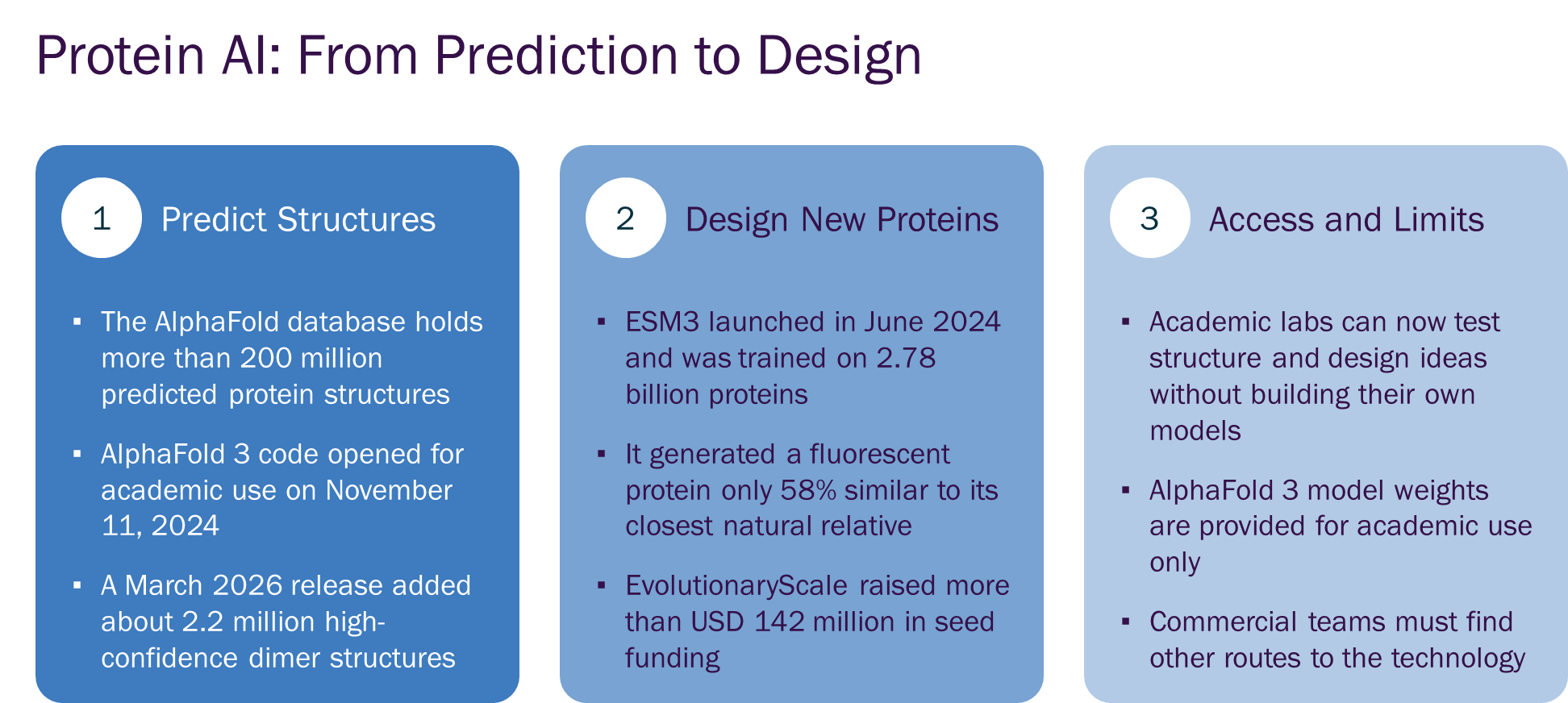
In October 2024, the Nobel Prize in Chemistry was awarded for discoveries in the field of computational design of proteins and prediction of their structure. For his contribution to the development of computer programs for the design of proteins, David Baker, professor at the University of Washington, received half of the prize. The other half was divided between John Jumper and Demis Hassabis of Google DeepMind, who created an algorithm for predicting the structure of proteins called AlphaFold. AlphaFold 3, the improved version of AlphaFold, allows researchers to predict protein structures at a scale that was previously difficult to achieve through laboratory methods alone.
In November 2024, Google DeepMind released AlphaFold 3 for research via open source on an academic basis, also through a web interface. Compared to AlphaFold 2, AlphaFold 3 can also be used to predict relationships between proteins and DNA, RNA, small molecules and drugs, or chemical modifications. The new features have applications in drug discovery, protein interactions, and disease mechanisms. The parameters of the trained model are thus far only available to qualified academic institutions and require permission.
Why This Matters
Using an AI-based approach to predict protein structure enables researchers to determine the function of a certain protein, identify drug targets, and hypothesize about molecular mechanisms and interactions independently of expensive and time-consuming laboratory research. The wider adoption of such technology within the academic science community will allow for faster advancement in the field at an early stage of research and increased use of computational proteomics.
02Generative AI Is Moving from Predicting Proteins to Designing Them
Baker’s share of the Nobel Prize recognizes his different skill, which is designing proteins that do not exist in nature. According to the Nobel Committee, his group has created designed proteins that could be utilized as medicines, vaccines, nanomaterials, and tiny sensors.
Companies are now pursuing the same goal, which employs language models trained on protein data. In June 2024, EvolutionaryScale announced the launch of ESM3, which it positions as the first-ever generative model for biology that can reason over a protein’s sequence, structure, and function simultaneously. The model was trained on 2.78 billion proteins, and to test the model, the company created a new fluorescent protein with a sequence similar to the closest fluorescent protein. It estimates that natural evolution would need more than 500 million years to create that much change.
“ESM3 takes a step toward a future of biology where AI is a tool to engineer from first principles, the way we engineer structures, machines, and microchips, and write computer programs”
— Alexander Rives, Co-Founder and Chief Scientist, EvolutionaryScale
Why This Matters
Protein engineering is set to benefit from increased commercial and cloud-based access to design tools, but the field faces key challenges such as the cost-effectiveness of designed proteins and their ability to outperform conventionally engineered counterparts. Businesses that can offer both cutting-edge protein-design software and established manufacturing pipelines are likely to be the biggest winners.
03Population Proteomics Is Becoming Shared Research Infrastructure
The UK Biobank Pharma Proteomics Project (UKB-PPP) published the results of its pilot study in 2023. The study describes the use of Olink’s Explore 3072 platform to quantify the amounts of nearly 3,000 different proteins in blood samples from around 54,000 participants. The researchers discovered more than 14,000 links between single nucleotide polymorphisms and protein expression levels, of which over 80 percent were uncharacterized prior to the study.
Furthermore, UK Biobank and a consortium of 14 biopharmaceutical organizations have initiated a proteomic study ten times bigger. Its goal is to analyze up to 5,400 proteins across 600,000 biological samples, with 100,000 of them being second samples from the same volunteers as many as 15 years after the baseline visit. The sponsors are covering the cost for the first 300,000 specimens, while UK Biobank is seeking donations to finish the rest. Regeneron Genetics Center is handling the work, which is performed on Thermo Fisher’s Olink Explore HT assay and Ultima Genomics’ UG 100 sequencers. The data will become available to qualified users in phases, starting from 2026, with the entire body of findings projected to appear on the UK Biobank Research Analysis Platform in 2027.
“Analyzing samples from two time points in the same volunteer will allow us to examine how protein levels change across hundreds of health and disease states over time, at an unprecedentedly large scale.”
— Chris Whelan, Director, Neuroscience, Data Science & Digital Health, Johnson & Johnson Innovative Medicine, and Pharma Proteomics Project Lead
Why it matters:
Large shared data sets enable research groups to analyze proteins against a common reference, similarly to the way in which genomic databases of public data facilitated the field’s development. The creation of such a resource requires a significant collaborative effort on a far greater scale than that of any one company. In addition, the platforms that have been chosen for such large-scale initiatives may serve as a reliable reference for other potential customers. UK Biobank reported making the choice in favor of Olink’s assay after comparing it to SomaScan from SomaLogic and Protein Prep from Illumina, an example of how the decision in favor of one platform may drive adoption in the larger field.
Section II: How Technologies Are Moving Toward Commercial Adoption (Measurement platforms and clinical applications)
04New Measurement Platforms Are Entering the Market, but Revenues Remain Small
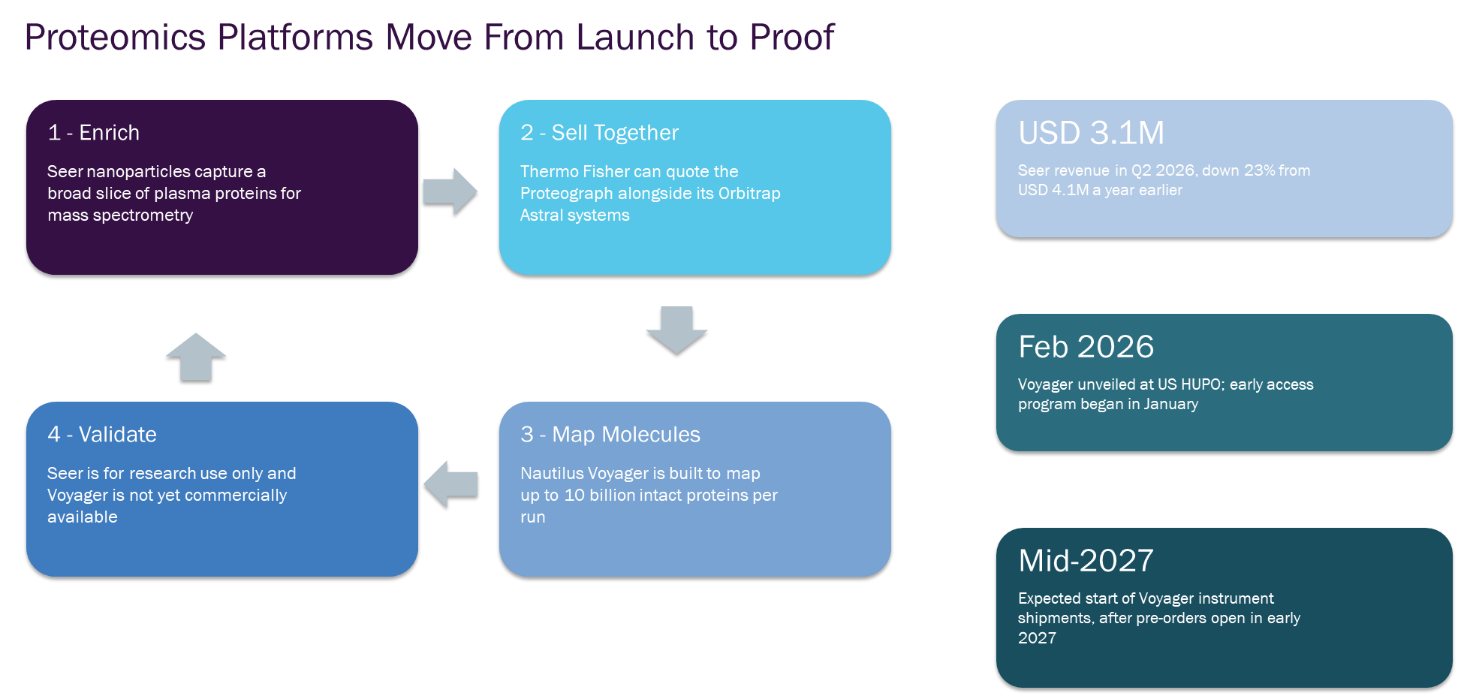
Seer and Nautilus Biotechnology companies take different approaches to expanding the scope of the analysis of proteins, as Seer’s Proteograph platform, which utilizes engineered nanoparticles to enrich proteins for sensitive mass spectrometry analysis, has reported a significant drop in revenue. The company signed a non-exclusive co-marketing and sales agreement with Thermo Fisher Scientific in November 2024, as its global sales force will be able to quote and sell the Proteograph together with the Orbitrap Astral mass spectrometers. However, the firm reported its full-year revenue guidance of USD 16 million to USD 18 million; its revenue in the second quarter of 2026 decreased by 23% year-over-year to USD 3.1 million due to the pressures on academic and government budgets and longer sales cycles of some commercial customers.
Nautilus Biotechnology is developing a different approach, based on single-molecule protein analysis. In January 2026, the company introduced its Iterative Mapping Early Access Program and presented its Voyager discovery platform at the US HUPO conference in March 2026. Voyager is intended to enable mapping up to 10 billion individual proteoforms and proteins in a single run. The platform entered early access in March 2026 with Baylor College of Medicine as the first customer. Nautilus reported first revenue of approximately USD 0.2 million in July 2026, primarily driven by grants. The company now expects pre-orders in early 2027 and shipments of instruments from mid-2027, compared to its initial target of a late-2026 launch of commercial products.
“We are excited to work with our first Iterative Mapping Early Access Program customer, Baylor College of Medicine, by providing Nautilus’ single-molecule analysis platform as the ground truth for precise proteoform quantification.”
—Parag Mallick, Ph.D., Co-Founder and Chief Scientist of Nautilus Biotechnology
Why it matters:
The proteomics market covers a variety of different technologies from mass spectrometry, affinity-based assays, and single-molecule analysis to nanoparticle enrichment. Each provides different trade-offs in terms of reach, speed, and cost, thus offering customers a range of options. However, long sales cycles and decreasing academic funding are constraining proteomics and protein analysis industry growth, particularly for companies selling new instruments. Seer and Nautilus continue to report operating losses, reinforcing the importance of independent validation data, demonstrated research value, and clear cost benefits in securing customer commitments.
05Protein Measurements Are Being Tested as Early Disease Indicators
Genetic variations can predict an individual’s risks for developing a certain disease, whereas proteins can indicate what biological processes have already occurred in the body. UK Biobank announced that academic research utilizing the pilot proteomics dataset has led to the improvement of the forecasting of disease and treatment response for conditions such as breast cancer, cardiovascular disease, Parkinson’s, and other neurological diseases. Olink reported that the pilot dataset has supported the creation of more than 100 peer-reviewed life science publications in 2024 alone.
The applications of the technology are also found in commercial use. At the 2026 American Society for Mass Spectrometry conference, researchers from Korea University presented preliminary results of an AI-driven plasma proteomics strategy for the detection of multiple cancers using Seer’s technology. In addition, the company announced that it had sequenced 10,000 of the 100,000 samples in the PRECISE-SG100K cohort by April 2026. Meanwhile, a study published its results in the journal Nature Genetics, which used the Proteograph platform to investigate genomic and proteomic variants associated with diseases in British South Asians. The results of the study are still at the research level, and the technologies used are meant for research purposes only.
Why it matters:
If they are validated in clinical trials, protein-based measures of risk could be used along with genetic information to help assess a person's cancer risk and other health conditions. However, this will require considerable work by clinicians and geneticists to get such tests approved for general use. Organizations with access to large, well-characterized patient populations are better positioned to validate these approaches and assess their potential clinical applications.
Section III: How Companies Are Competing (Portfolio expansion, partnerships, and market reach)
06Acquisitions and Partnerships Are Expanding Proteomics Portfolios
Acquisitions and partnerships have become a key route to proteomics and protein analysis industry growth, as companies combine complementary technologies, expand the range of protein profiling capabilities, and integrate proteomics with sequencing and multiomics platforms. Thermo Fisher Scientific completed its acquisition of Olink in July 2024. The company reported that the acquired technology, including the Explore HT platform, which is capable of profiling more than 5,400 proteins in plasma, will complement its portfolio of mass spectrometers. The acquisition was announced in October 2023 and faced regulatory reviews before the completion of the deal.
In January 2026, Illumina announced that it had completed the acquisition of SomaLogic from Standard BioTools. Since late 2021, the two companies have been collaborating to run the SomaScan assay on Illumina sequencing platforms. After the acquisition, Illumina reported opportunities to combine SomaScan with its Protein Prep assay, DRAGEN software, and Connected Multiomics technologies.
“By combining SomaLogic's highly differentiated proteomics technology with Illumina's industry-leading innovation and global reach, we are strengthening our ability to deliver scalable insights across genomics and proteomics, helping customers unlock more from every sample in support of better outcomes for patients.”
— Jacob Thaysen, Chief Executive Officer, Illumina
Why it matters:
Acquisitions and commercial alliances are driving proteomics into the sequencing and mass spectrometry ecosystems. By securing established sales channels, smaller firms are able to leverage partners’ resources, avoiding the need to develop their own distribution networks. However, non-exclusive deals enable major vendors to promote competing technologies, and thus, the presence of a product on the market is no longer an indicator of its adoption.
Proteomics and Protein Analysis Industry Outlook: Where the Next Opportunities Could Emerge
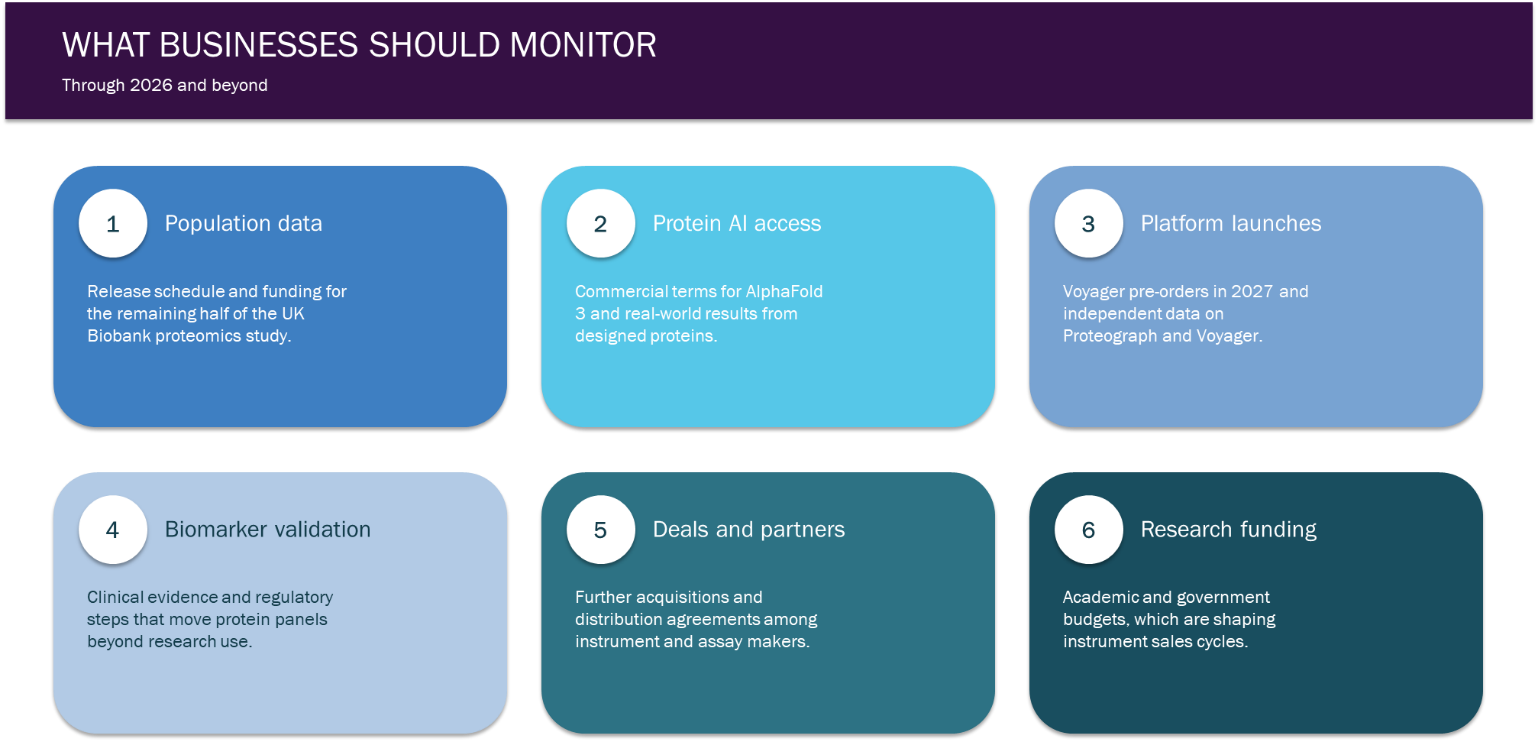
The next phase of proteomics will be defined by the translation of scientific advances into practical applications. Clinically validated protein panels could create new diagnostic categories, while designed proteins that can be produced at scale could lead to new therapeutics, industrial enzymes, and materials. Single-molecule protein analysis may also enable applications that are currently expensive to be practical, if cost and throughput challenges can be overcome.
Integrated platforms that provide genome, transcriptome, and proteome information might be more valuable than their separate use. For drug discovery, the combination of AI-based protein structure prediction with population-scale proteomics could accelerate the process of target identification and validation.
Conclusion:
Proteomics is taking the same route that genomics did in its early days. AI tools are making protein structure prediction much more accessible, large shared datasets are enabling population-scale studies, and new instrumentation is making deeper proteomic analysis more feasible. The 2024 Nobel Prize in Chemistry was awarded for advances in protein design and structure prediction, and the UK Biobank proteomics study is now being expanded to 600,000 samples, thereby increasing the scale of the data available. However, the proteomics and protein analysis industry outlook will depend on turning these innovations into reliable and cost-effective applications. Protein biomarkers must be proven to meet clinical evidence requirements for diagnostic use, and engineered proteins will need to demonstrate efficient manufacturing processes to achieve economies of scale.
Last updated:


